Chase Auto Loan Review: Is It Worth It for Buyers?
Chase Auto Loan fits best if you already bank with Chase and can finance through a participating dealer. If you need posted APRs before you apply or want to buy from a private seller, it is usually a poor match. Wrong lender fit can waste time, push up the APR, or stop the deal at the dealership. This guide explains Chase Auto loan access, rate visibility, dealer limits, and how it compares with other auto lenders.
What Chase Auto offers
Chase Auto covers purchase financing for new and used vehicles, and it also offers refinance loans with separate rules. The purchase side has no disclosed APR table, no origination or processing fee, and terms that can run from 12 to 84 months for used-car loans. Refinance works differently. It has its own loan limits, timing rules, and eligibility checks.
Purchase loans and refinance basics
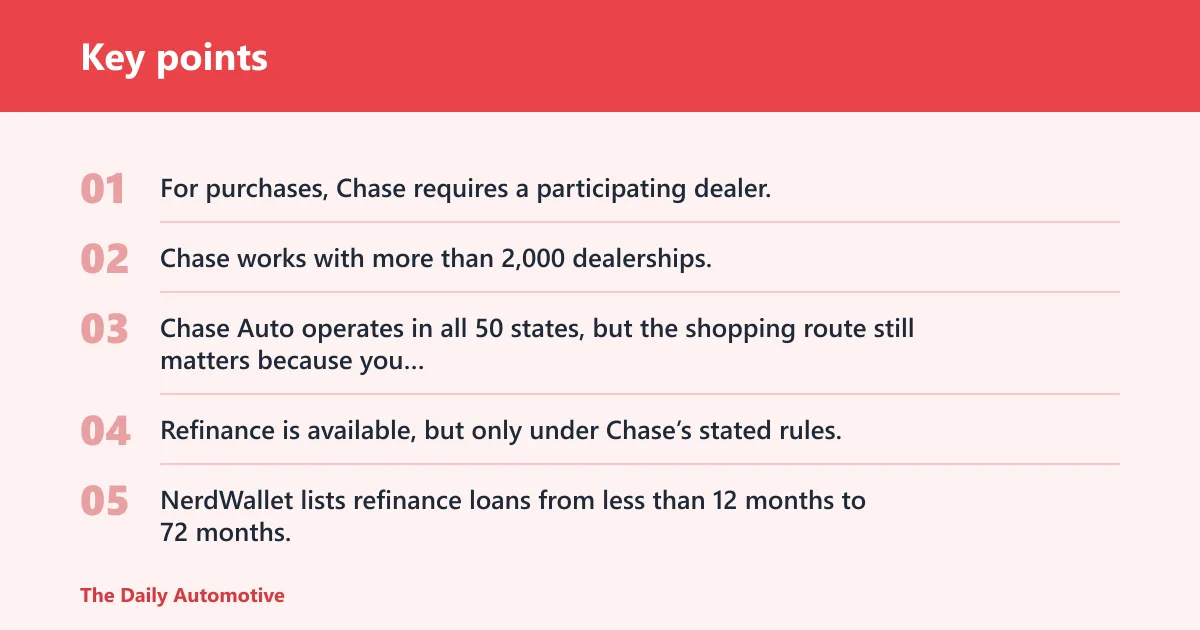
For purchases, Chase requires a participating dealer. Chase works with more than 2,000 dealerships, and NerdWallet says its network includes 12,000-plus dealerships. Chase Auto operates in all 50 states, but the shopping route still matters because you cannot take a Chase purchase loan to just any seller.
Refinance is available, but only under Chase’s stated rules. NerdWallet lists refinance loans from less than 12 months to 72 months, with a 90-day waiting period after the prior loan closing. It also says Chase does not refinance loans already with Chase.
Terms, fees, and rate disclosure limits
Chase does not publish an upfront APR table for auto loans, so rate comparison starts later in the process than with some online lenders. That makes the convenience factor stronger for existing Chase customers, but it also makes rate shopping harder before you apply. The same source says Chase charges no origination or processing fee.
Chase Private Client members may qualify for a 0.25-point rate discount if deposit-account balance requirements are met. That discount can matter, but only after you clear the dealer and vehicle rules. It does not fix a mismatch between your car, your dealer, and Chase’s network.
Chase auto loan decision matrix
This table gives a plain answer on who should consider Chase Auto and who should look elsewhere. The main filters are dealer access, vehicle age, mileage, refinance timing, and whether you already bank with Chase.
| Buyer type | Eligible vehicle | Dealer-network fit | Refinance need | Likely fit | Risk flags |
|---|---|---|---|---|---|
| Chase customer | New or used, if rules fit | Yes, if dealer is in network | No | Yes | Convenience helps, but no disclosed APR means you still need comparison shopping. |
| Non-Chase customer | New or used, if rules fit | Yes, if dealer is in network | No | Maybe | Less account-based value; a credit union or online lender may give you a cleaner rate quote. |
| New-car buyer | New car never titled; under 6,000 miles | Yes, if participating dealer | No | Yes | Private-party purchases and nonnetwork dealers are dead ends. |
| Used-car buyer | Up to 10 years old; fewer than 120,000 miles | Yes, if participating dealer | No | Yes | Older, higher-mileage inventory can fail at underwriting even if the price is attractive. |
| Refinance shopper | Existing auto loan, subject to rules | Not dealer-based | Yes | Maybe | Not available on Chase-originated auto loans, and there is a 90-day waiting period. |
| Bad-credit shopper | Any eligible vehicle | Yes, if dealer is in network | No | No | Chase does not publish a simple score floor, so weaker credit may still face price or approval risk. |
Risk flags that change the answer
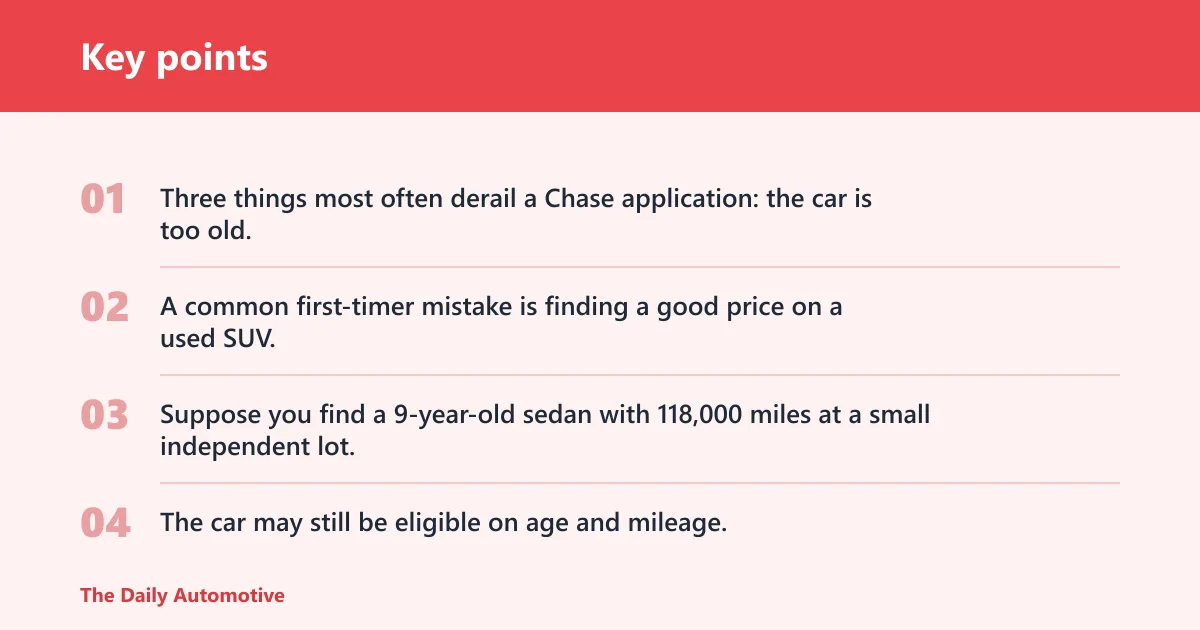
Three things most often derail a Chase application: the car is too old, it has too many miles, or the seller is outside the network. A common first-timer mistake is finding a good price on a used SUV, then learning the dealer cannot submit the loan because it is not part of Chase’s network.
Suppose you find a 9-year-old sedan with 118,000 miles at a small independent lot. The car may still be eligible on age and mileage, but the deal fails if that lot is not a participating dealer. The financing problem is not the car alone. It is the car plus the seller.
Is Chase good for auto loans?
Chase is good for auto loans when convenience matters more than rate visibility, especially for existing Chase customers shopping through a participating dealer. It is less attractive if you want to compare APRs before applying, need private-party financing, or want a lender that is not tied to a dealer network. That is the central tradeoff.
Where Chase beats a one-stop shopping process
Chase can shorten the path from shopping to signing if your dealer is already in its network and you already use Chase banking. The same source says most decisions are available within one hour, and that speed can cut back-and-forth at the dealership. The bank also reduces paperwork for refinance with e-signing.
Where credit unions or online lenders may win
Credit unions and online lenders often post rate ranges up front. Many also let you shop outside a dealer network or finance a private-party purchase. Chase’s dealer-only purchase model narrows the field. If you want to compare several offers before choosing a car, that limit can slow you down instead of helping.
Who gets the most value from the Chase ecosystem
Chase adds the most value for borrowers who already keep deposits, cards, or checking with the bank and who are buying from a network dealer. The 0.25-point Chase Private Client discount matters most when the base offer is already competitive. Without that bank relationship, Chase can feel more restricted than useful.
How Chase purchase loans work
Chase purchase financing is built around dealer access and vehicle eligibility. For new and used car loans, the bank requires a participating dealer, offers no disclosed APR upfront, and does not charge an origination or processing fee. The vehicle must also fit Chase’s age, mileage, and titling rules before pricing even matters.
Dealer-network requirement and shopping limits
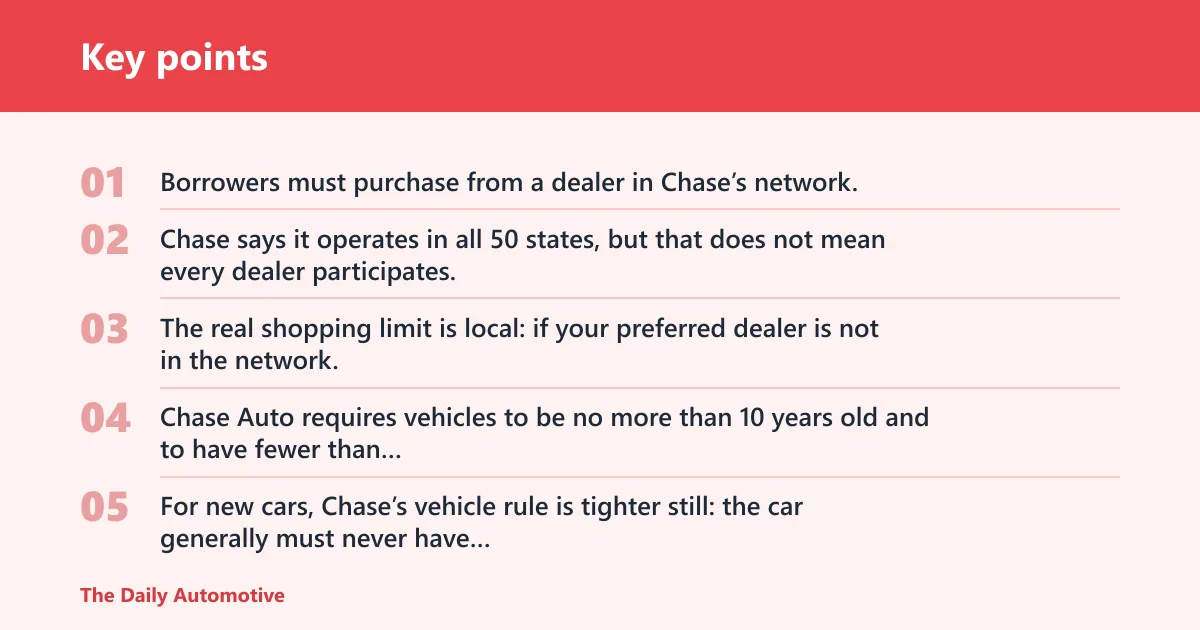
Borrowers must purchase from a dealer in Chase’s network. Chase says it operates in all 50 states, but that does not mean every dealer participates. The real shopping limit is local: if your preferred dealer is not in the network, the loan cannot fund there. That can matter more than the state map.
Vehicle age, mileage, and titling rules
Chase Auto requires vehicles to be no more than 10 years old and to have fewer than 120,000 miles for used and refinance loans. For new cars, Chase’s vehicle rule is tighter still: the car generally must never have been titled, and NerdWallet says new-car mileage may be capped at about 6,000 miles. These rules often create the first denial.
Picture a shopper choosing between two used crossovers. One has 94,000 miles and qualifies; the other has 126,000 miles and does not. The payment difference may look tempting on the sticker, but Chase’s mileage cap cuts off the second vehicle before the loan is considered.
How terms affect monthly payment and total interest
The same source lists used-car loan terms from 12 to 84 months. Longer terms usually reduce the monthly payment, but they raise total interest because the balance stays outstanding longer. Shorter terms push the payment up and reduce interest cost. The right term is the one that fits your budget without stretching the loan past the vehicle’s useful value.
Can you refinance an existing auto loan with Chase?
Yes, Chase offers auto refinancing, but only under tight rules. The same source lists refinance loans from less than 12 months to 72 months, a soft-credit prequalification, and same-day decisions in most cases. Chase also has a 90-day waiting period after the prior loan closing, and it does not refinance loans already with Chase.
Loan amount range and soft prequalification
The same source lists refinance loan amounts in a range from about $4,000 to $100,000. The soft-credit prequalification helps you see whether refinance is worth a full application without adding a hard inquiry at the start. That is useful if you are rate shopping and do not want to pile up inquiries before you know the terms.
90-day waiting rule and same-day decision timing
Same-day decisions are common, but not guaranteed. Chase’s timing depends on the loan file, the vehicle, the dealer or lender paperwork, and whether the refinance request meets the waiting-period rule. If the prior loan closed within 90 days, the application is not ready yet. Timing only helps after eligibility is clear.
Who cannot refinance through Chase
Borrowers already financed through Chase cannot refinance that loan with Chase, according to NerdWallet. A borrower inside the 90-day window also cannot move ahead yet. Those two limits matter because refinance shoppers often assume the fastest lender is automatically the easiest place to refinance. Here, the rules are narrower than that.
Chase’s application flow starts online, then moves through prequalification and dealer paperwork. For refinance, the process can include soft-credit prequalification and e-signing. The goal is to cut repetition at the dealership, but the dealer and vehicle still have to satisfy Chase’s rules before the loan can close.
- Start with the online application or prequalification form.
- Check whether the car and dealer fit Chase’s network and vehicle rules.
- Review any preliminary offer or rate information if it is provided.
- Bring the lender details to the dealership and complete the dealer paperwork.
- For refinance, complete e-signing if the file qualifies.
What happens at the dealership
The dealership submits the loan package if it is in Chase’s network. That is where many approvals either move forward quickly or stop. A dealer mismatch, a title issue, or a car that falls outside the mileage cap can end the process after the shopper has already chosen the vehicle.
Paperwork reduction for refinance
Refinance is the cleaner experience on the paperwork side. Chase’s e-signing and soft prequalification reduce the amount of back-and-forth compared with a fully manual refinance file. That said, the waiting period and lender eligibility still matter more than convenience once the file is blocked by the rules.
Reputation and customer service signals
Reputation data does not predict your exact loan outcome, but it can show where friction tends to appear. For Chase Auto, the most useful signals are J.D. Power dealer-financing results, BBB rating data, and CFPB complaint volume. Read them together, not in isolation.
What J.D. Power dealer-financing results can tell you
J.D. Power’s dealer-financing work is useful because Chase depends on dealer participation. If a lender performs well in dealer-facing financing, that can suggest a smoother handoff between the borrower, the dealer, and the lender. It does not guarantee approval, but it does speak to process quality where the transaction actually happens.
How to read BBB rating data
BBB ratings are a service signal, not a scorecard for loan pricing. A strong rating can suggest the company handles complaints and resolutions reasonably well. A weak one can point to friction in servicing or communication. Either way, the rating should be read as a customer-service clue, not a promise of low rates.
What CFPB complaint volume can and cannot prove
CFPB complaint volume tells you how often borrowers raise issues, but it does not prove every complaint is valid or that every borrower had the same outcome. High volume can still reflect a large customer base. Low volume can still leave you exposed to the same dealer-network and eligibility rules that create denials.
Frequently asked questions
Is chase good for auto loans: chase is good?
Chase is good for auto loans if you want convenience, already bank with Chase, and are buying through a participating dealer. It is less compelling if you need transparent APR quotes before applying or want to buy from a private seller. The fit depends on how much flexibility you need.
Does chase have good auto loans?
Chase has good auto loans for borrowers whose cars and dealers fit its rules. The bank offers no origination or processing fee, refinance options, and fast decisions in many cases. The tradeoff is limited rate visibility and a dealer-network requirement that can narrow your shopping options.
How long does chase auto loan take?
Most Chase Auto decisions are available within one hour, and NerdWallet says same-day decisions are common in most cases. That timing is not automatic, though. Dealer paperwork, vehicle eligibility, and refinance timing can slow the file, so the real clock depends on the deal details.
Is it hard to get a chase auto loan?
It can be, if your vehicle or dealer does not fit Chase’s rules. The loan is not especially hard for a borrower with an eligible car, a participating dealer, and acceptable credit, but Chase does not publish a simple upfront credit-score floor. That makes prequalification useful.
What credit score does chase auto use
Chase does not publish a single credit-score minimum for auto loans. That usually means the lender looks at the full file, including income, vehicle type, loan term, and existing credit. If you want a clearer answer, prequalification is the fastest way to test eligibility without guessing.
What are Chase auto loan rates and fees?
Chase does not disclose auto APRs upfront, so you have to apply or prequalify before seeing a specific rate. The same source says there is no origination or processing fee, and Chase Private Client members may qualify for a 0.25-point discount if deposit requirements are met. The final rate still depends on the file.
Products related to this article
Sponsored / affiliate links. As an Amazon Associate I earn from qualifying purchases. I may earn additional commission from eligible campaigns.