How Much is Ceramic Tint for a Car? Cost Breakdown
Ceramic car tint usually costs about $250 to $800 for a sedan and about $500 to $1,200 for SUVs and trucks, with premium film and difficult glass sometimes pushing the price higher. Pay too little and you may end up with weak heat rejection, poor fit, or a surprise bill at pickup. This guide breaks down film, labor, glass complexity, and add-ons so you can judge a fair quote.
Typical cost range
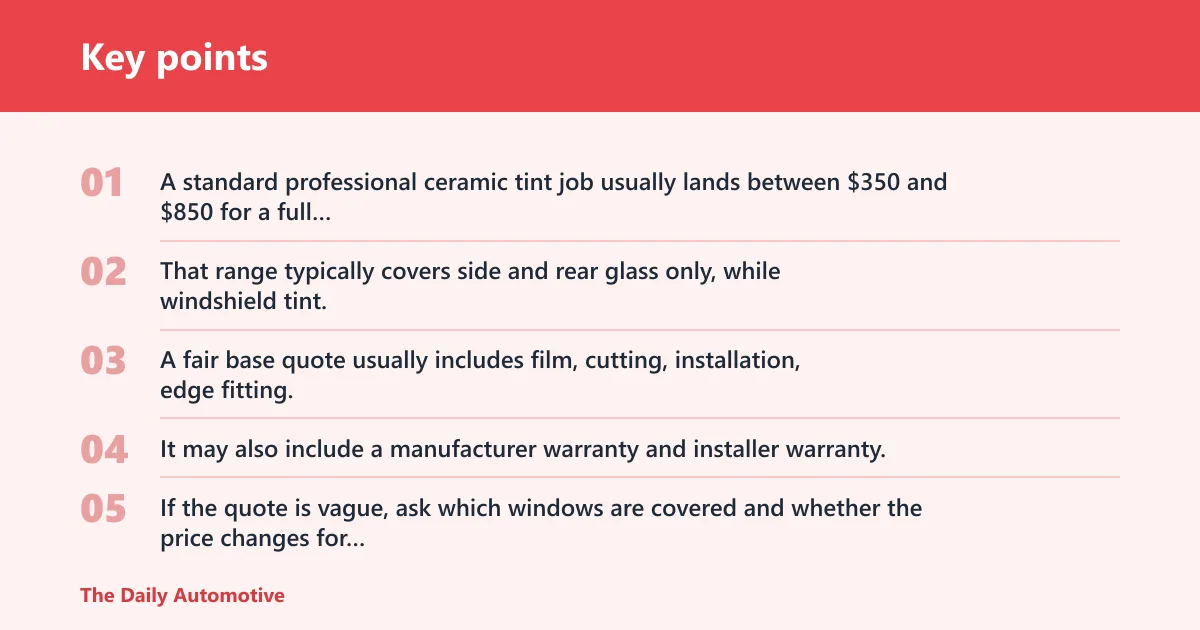


A standard professional ceramic tint job usually lands between $350 and $850 for a full vehicle, with local labor rates and glass shape moving the price up or down. That range typically covers side and rear glass only, while windshield tint, sunroof tint, and panoramic roofs are separate line items.
What a basic quote usually includes
A fair base quote usually includes film, cutting, installation, edge fitting, and cleanup for the listed glass areas. It may also include a manufacturer warranty and installer warranty, but those are not automatic. If the quote is vague, ask which windows are covered and whether the price changes for curved glass or extra-large panels.
Ceramic window film uses non-conductive nano-particles, blocks up to 99% of harmful ultraviolet rays, and rejects more than 80% of infrared heat. It also avoids interference with GPS or cellular signals. That is a different product from dyed film, and usually a step above carbon film in price and performance.
What makes ceramic tint cost more?
Ceramic tint costs more because the film itself uses non-conductive nano-particles, the install usually takes tighter fitting, and good shops often back the work with stronger warranty terms. Premium ceramic films also carry higher material costs, especially when the quote includes clearer glass performance, tighter fitment, or larger roof and windshield panels.
Ceramic film versus dyed and carbon film
Dyed tint is the lowest-cost option. It has the lowest upfront price, but it can fade, bubble, and turn purple, and it gives weaker heat rejection than ceramic. Carbon film sits in the middle: it is usually more durable than dyed film and does not interfere with signals, but it rejects less heat than ceramic.
Quoted ceramic tiers are not all the same. Standard ceramic sits at the lower end of the category. Multi-layer nano-ceramic costs more because it uses more advanced construction and often carries a stronger warranty. Graphene-infused options tend to price even higher, especially at shops that package them with lifetime coverage and premium installation.
Film quality, brand tier, and warranty
Premium ceramic films add $200 to $500 to a standard installation. That spread often reflects brand tier, optical clarity, thickness, installation difficulty, and warranty length. A lifetime manufacturer warranty that covers bubbling, peeling, and color change usually adds value, but it also raises the quote.
Ceramic tint quote builder
Use this line-item builder to compare quotes side by side. The point is to see what is included, not to chase the lowest number on the page.
| Quote line item | Typical range | What changes the price |
|---|---|---|
| Vehicle type: coupe | $300 to $450 | Smaller glass area, but tighter curves can add labor |
| Vehicle type: sedan | $350 to $550 | Most common pricing band for standard ceramic tint |
| Vehicle type: SUV or crossover | $450 to $700 | More glass and more rear-quarter complexity |
| Vehicle type: truck or van | $450 to $700 | Wide windows, taller glass, and more surface area |
| Film tier: standard ceramic | Baseline quote | Usually the starting point for a full install |
| Film tier: premium ceramic | +$200 to $500 | Better materials, stronger warranty, or clearer optics |
| Windshield: clear ceramic film | $200 to $400 | Large glass area, stricter fit, and more labor |
| Front two windows | $150 to $250 | Small job, but still needs careful edge work |
| Sunroof | $100 to $200 | Standard single-pane roof glass |
| Panoramic roof | $300 to $600 | Large glass surface and more film waste |
| Labor complexity | Low to high | Curved glass, steep tint lines, and trim removal time |
| Expected total price range | $350 to $1,500 | Depends on vehicle size, film tier, and add-ons |
How to read the quote builder
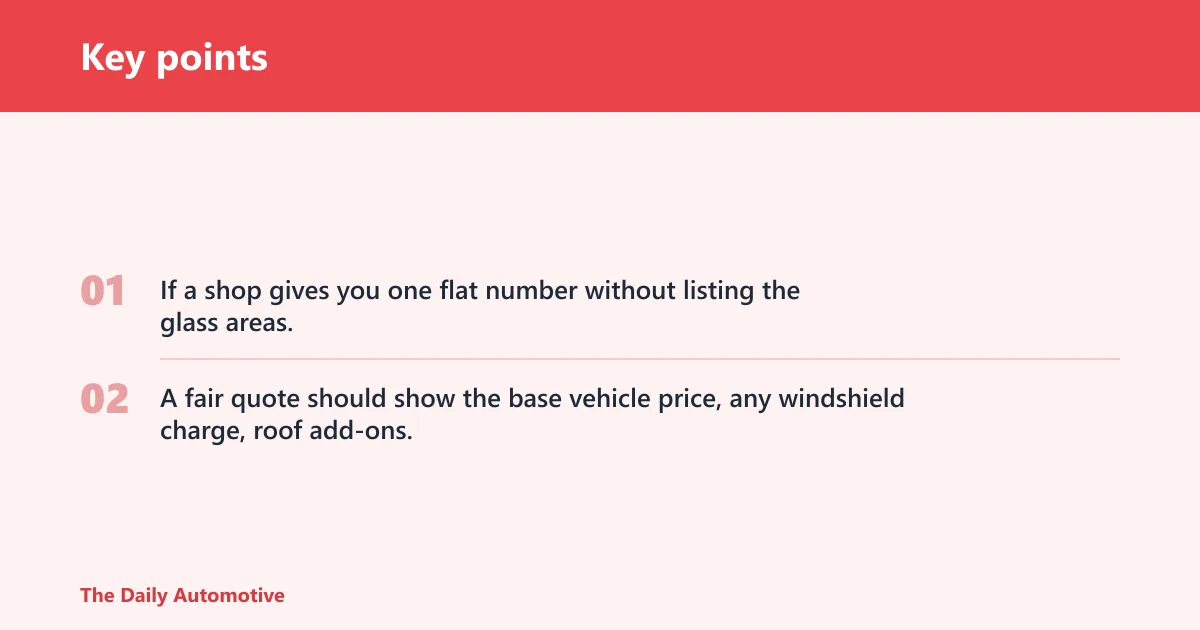
If a shop gives you one flat number without listing the glass areas, ask for a split quote. A fair quote should show the base vehicle price, any windshield charge, roof add-ons, and whether the film is standard ceramic or a higher tier. That makes comparison possible.
How much does ceramic tint cost by vehicle size?
Vehicle size matters because more glass means more material, more cutting, and more labor. Coupe pricing starts lower than sedan pricing, while SUVs, crossovers, trucks, and vans usually cost more because they have larger or taller glass areas and more difficult rear sections.
Coupe and sedan pricing band
Coupes and 2-door cars cost $300 to $450 for standard ceramic tint. Sedans and 4-door cars cost $350 to $550. The gap is small, but the sedan often includes more glass and more labor time, especially on rear doors and backlight glass.
SUV and crossover pricing band
SUVs and crossovers cost $450 to $700 for standard ceramic tint. That higher band reflects more side glass, larger rear glass, and more curved panels in many models. Some modern crossovers also have roof glass that gets priced separately.
Truck and van pricing band
Truck and van pricing commonly falls in the same $450 to $700 band for standard ceramic film, though the final number depends on window count and shape. Large vans and high-roof utility models can move above that band when the glass is tall or awkward to access.
Say your sedan has steeply curved rear windows and a narrow backlight. A quote that looks average on paper can still run higher if the installer expects more shrink time and trimming around the edges.
How much for two front windows or a windshield?
Two front windows typically cost $150 to $250, while a full windshield with clear ceramic film typically costs $200 to $400. A sun strip is much cheaper at $75 to $120, and it is often the better value if you want glare reduction without paying for full windshield coverage.
Two front windows price range
Front two windows are the simplest add-on for many owners. The price is lower because the glass area is smaller, but the installer still has to cut the film accurately and fit it cleanly against the seals and trim.
Full windshield ceramic tint cost
A full windshield costs more than side windows because it is large, curved, and highly visible. Clear ceramic film is used here to reduce heat and UV exposure without making the glass look obviously dark. Expect the quote to reflect extra labor and a stricter fit standard.
Sun strip versus full windshield coverage
A sun strip covers only the top band of the windshield. It is the cheaper route if your main issue is glare. Full windshield coverage costs more, but it gives broader heat rejection and a more complete cabin comfort benefit.
What changes the final quote?
Three things usually move the quote most: VLT choice, glass complexity, and wasted film from large or curved panels. Legal tint limits can force a lighter VLT than you planned, while panoramic roofs and tough rear glass increase labor time and material use.
VLT and legal limits
Visible Light Transmission, or VLT, is the tint darkness percentage. Lower VLT means darker tint. The legal limit depends on your state, so the right product is the one that meets the law and still gives the privacy and heat control you want. A lower VLT can sometimes require a different film choice, which changes price.
Curved glass, panoramic roofs, and EVs
Curved glass takes more time because it may need shrinking, precise alignment, and careful edge finishing. Panoramic roofs are a separate cost category because they use more film and more labor. That is common on modern EVs, where oversized glass can also increase waste rate if the panel shape is complex.
Suppose a crossover has a full panoramic roof and a steeply raked rear hatch. The roof alone may add $300 to $600, and the rear glass can push the installer toward a higher labor line because the film needs more shaping before it settles correctly.
Labor time and material waste
Professional installation usually costs more than DIY because the shop is paying for skilled labor, cutting equipment, and warranty coverage. That higher price often reduces bubbling and peeling risk. Cheap film or rushed work can still haze, shrink, or install poorly, even if the product label says ceramic.
Standard ceramic tint installations usually run between $350 and $850 nationwide. High-end luxury vehicles or large SUVs can cost between $900 and $1,500 when the film tier is premium and the glass is difficult. That is not markup by itself; it often reflects the time and risk involved.
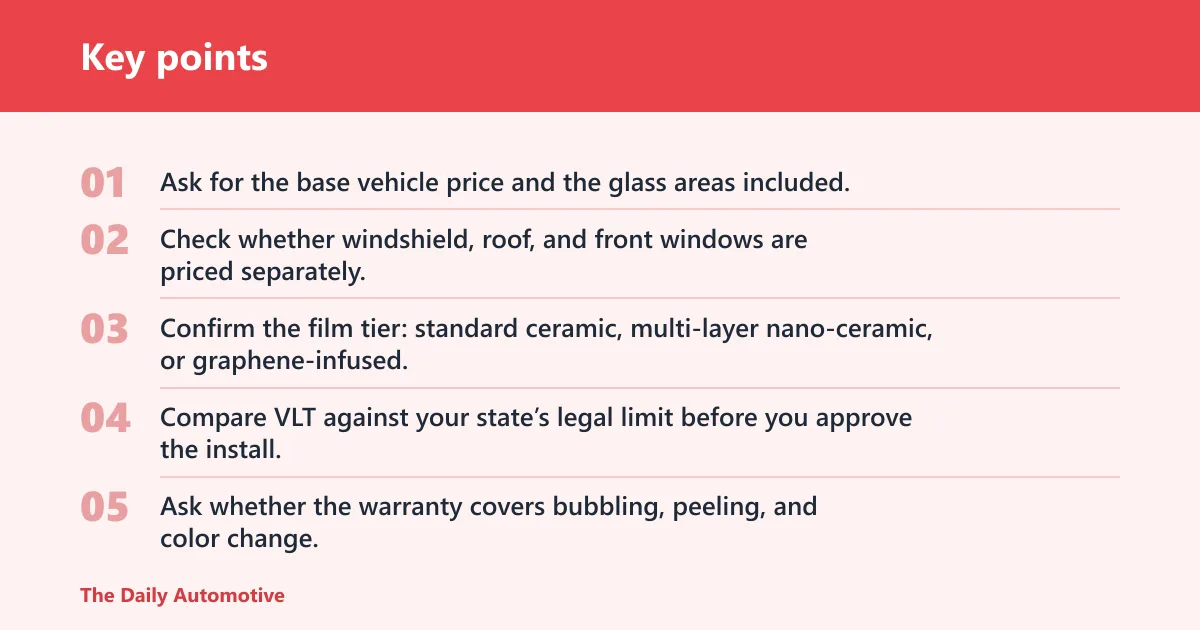
- Ask for the base vehicle price and the glass areas included.
- Check whether windshield, roof, and front windows are priced separately.
- Confirm the film tier: standard ceramic, multi-layer nano-ceramic, or graphene-infused.
- Compare VLT against your state’s legal limit before you approve the install.
- Ask whether the warranty covers bubbling, peeling, and color change.
- Look for a labor line if the car has curved glass or a panoramic roof.
Is ceramic tint worth the extra cost?
Ceramic tint is worth the extra cost when you care about heat rejection, UV protection, signal-friendly performance, and better long-term durability. It is less attractive if your main goal is the lowest possible upfront price, because dyed film is cheaper and carbon film sits below ceramic in cost.
Heat rejection and UV protection
Ceramic film blocks up to 99% of harmful ultraviolet rays and rejects more than 80% of infrared heat. That matters most on vehicles that sit in sun or run hot cabins. The benefit is especially noticeable on large glass areas, where heat load can build fast.
Clarity, durability, and signal performance
Ceramic film is favored because it does not interfere with GPS or cellular signals. It also tends to hold up better than dyed film, which can fade or bubble over time. Good ceramic film should stay clear and consistent, but low-grade product or poor installation can still fail early.
When carbon or dyed tint makes more sense
Carbon tint makes sense when you want better durability than dyed film without paying ceramic pricing. Dyed film makes sense when budget is the main concern and heat rejection is secondary. If you mostly want privacy and are not chasing the best thermal performance, a lower-cost film may be enough.
Frequently asked questions
How much is ceramic tint for a car?
For a full vehicle, professional ceramic tint usually ranges from $350 to $850 nationwide. Coupes often fall lower, sedans sit in the middle, and SUVs or trucks can move higher. Premium film, difficult glass, windshield coverage, and panoramic roofs can all push the final number up.
Why does ceramic tint cost more than regular tint?
Ceramic tint costs more because the film uses non-conductive nano-particles, offers stronger heat rejection, and usually comes with better clarity and warranty support. Dyed film is cheaper but can fade or bubble. Carbon sits between the two, with better durability than dyed film and less heat rejection than ceramic.
How much does ceramic tint cost for an SUV?
SUVs and crossovers cost $450 to $700 for standard ceramic tint. Large luxury SUVs can reach $900 to $1,500 when the quote includes premium film, difficult rear glass, or a panoramic roof. A fair quote should spell out whether the roof and windshield are separate charges.
How much does ceramic tint cost for two front windows?
Two front windows typically cost $150 to $250. That price usually covers film, cutting, and installation for a small job, though curved glass or a premium film tier can move the total. It is one of the most affordable ways to add ceramic tint to a vehicle.
How much does ceramic windshield tint cost?
A full windshield with clear ceramic film typically costs $200 to $400. A sun strip costs $75 to $120 and is the cheaper alternative if glare is the main issue. Full windshield coverage costs more because the glass is large, visible, and labor-intensive to fit correctly.
What factors change the price of ceramic tint?
The biggest price factors are vehicle size, glass shape, film tier, VLT choice, windshield coverage, and roof glass. Curved panels, panoramic roofs, and EV glass roofs add labor and waste. Warranty terms matter too, because lifetime coverage for bubbling, peeling, and color change usually comes with a higher quote.
Products related to this article
Sponsored / affiliate links. As an Amazon Associate I earn from qualifying purchases. I may earn additional commission from eligible campaigns.