Car Paint for Scratches: Best Fixes That Work
For minor clear-coat scratches, use a scratch remover or polish; for light paint transfer, a cleaner wax may mask the mark; if you see primer, metal, or rust, use touch-up paint or a body shop repair. Miss the depth, and a cheap fix can turn into peeling paint, rust, and a repair bill that climbs fast. Judge the scratch first, then pick the product.
What scratch depth are you fixing?
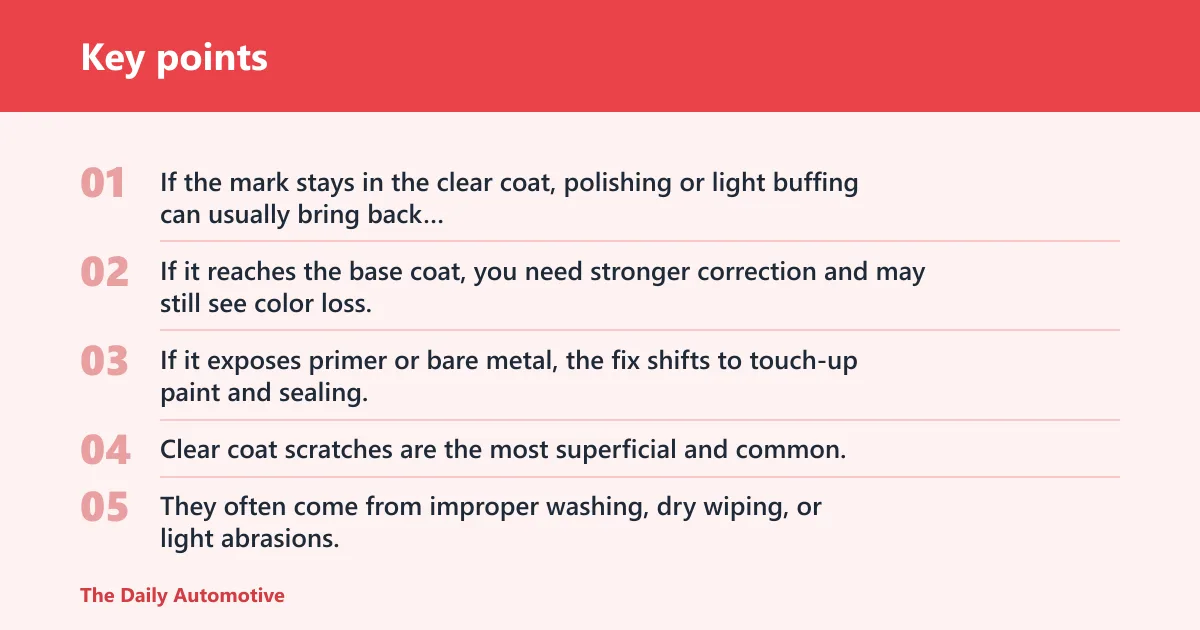

Scratch depth sets the repair. If the mark stays in the clear coat, polishing or light buffing can usually bring back gloss. If it reaches the base coat, you need stronger correction and may still see color loss. If it exposes primer or bare metal, the fix shifts to touch-up paint and sealing.
Clear coat scratches: what they look like
Clear coat scratches are the most superficial and common. They often come from improper washing, dry wiping, or light abrasions. In bright light, they look like fine gray or white lines, but the paint color stays intact underneath.
These marks respond to polishing, waxing, or light buffing because the damage sits in the top layer. If the scratch disappears when the panel is wet, that is a strong clue it is in the clear coat rather than deeper paint.
Base coat scratches: what changes in the paint
When a scratch cuts past the clear coat into the color layer, the mark usually looks sharper and more visible from more angles. The line may stay obvious even after washing. A compound can reduce the appearance, but it cannot replace missing paint.
At this stage, the goal is often paint correction, not full removal. If the color layer is thinned or broken through in spots, scratch remover can improve gloss around the damage, but it will not restore missing pigment.
Primer or bare metal scratches: when the damage is too deep
If you can see gray primer or shiny metal, the damage is deep enough that scratch remover alone is the wrong tool. Primer or metal-level scratches need touch-up paint and sealing to lower corrosion risk. Bare metal should not be left exposed.
Deep scratches may also need primer before paint application. That extra step matters because the repair has to build back protection, not only appearance.
Scratch triage table
Use this table to sort the damage before you buy. The stop point matters as much as the product, because the wrong fix can hide a scratch for a few days and leave the damage unresolved.
| Scratch type | Visual test | Recommended product category | Stop point or failure case |
|---|---|---|---|
| Clear coat scratch | Fine line, no color loss, may fade when wet | Polish, light scratch remover, or light buffing | Stop if the line still catches a fingernail or shows color change; DIY cost often lands in the $10-$50 range |
| Base coat scratch | Color layer looks dulled or thinned, but no gray primer visible | Compound, targeted polish, or correction kit | Stop if the scratch remains visible after correction or the paint edge looks broken through; DIY cost often lands in the $10-$50 range |
| Primer scratch | Gray or off-white underlayer shows | Touch-up paint with clear coat resin or separate clear coat | Stop if the scratch is broad, uneven, or close to a body crease; DIY cost often lands in the $10-$50 range, but materials can rise with multiple steps |
| Bare metal scratch | Shiny metal is visible, sometimes with rust starting | Touch-up paint, primer, and clear coat | Stop if rust has spread, the edge is chipped, or the panel needs color blending; professional repair is often the safer choice, and DIY cost may still sit in the $10-$50 range for materials only |
Which product matches the scratch?
Match the product to the layer you are correcting. Polish and light scratch removers fit clear coat damage. Compound handles deeper clear coat marks and some base-coat haze. Touch-up paint is for exposed primer or metal, and it must be sealed afterward.
Polish and light scratch removers for clear coat marks
Clear coat marks are the best match for polish, cleaner wax, or a light scratch remover. These products do not add paint; they refine the surface so the haze and micro-marring disappear. That is why they work best on superficial damage.
Chemical Guys VSS Scratch & Swirl Remover is positioned as a hybrid polish. It can be used by hand or with a dual-action polisher, and it targets swirls and light defects on clear coat, plastic, and glass. That makes it a practical choice when the defect is visible but shallow.
Compound and correction kits for deeper clear coat scratches
When the scratch is deeper but still stays within the clear coat, a compound can do more than a polish. Compound cuts more aggressively, then polish refines the finish. This is where a multi-step system often makes sense.
3M’s scratch repair option is a three-step system that uses abrasive pads, compound, and polish. It is suited to deeper clear coat scratches, where a single wipe-on product may reduce the mark but leave the finish uneven.
Touch-up paint and clear coat for exposed primer or metal
If primer or metal shows, a consumer scratch remover is the wrong fix. Touch-up paint is needed to rebuild color, and clear coat follows to restore protection and gloss. Clear coat resin is used in some hybrid repair kits to fill and protect the repaired area.
That extra sealing step matters. Without it, moisture can work into the repair and rust can start at the damaged edge.
Can scratch remover fix deep scratches on a car?
Scratch remover can reduce the visibility of many shallow marks, but it cannot rebuild missing paint. If the scratch reaches primer or metal, the best result from scratch remover is often less glare, not a true repair. It should not be treated as a substitute for touch-up paint or body work.
What scratch remover can actually correct
On clear coat defects, scratch remover can level fine damage and restore gloss. On light paint transfer, it may also clean up the foreign material so the mark fades. That is a correction, not a cover-up.
Meguiar’s Quik Scratch Eraser Kit uses a drill-mounted pad and microfiber cloth. It is described as removing light-to-moderate blemishes, not deep gouges, so it fits the middle of the damage range rather than the deepest end.
When it only reduces visibility
If the scratch reaches the base coat, the product may improve the look without removing the damage fully. If it reaches primer or metal, the scratch remover only changes how the edge reflects light. The missing layers remain missing.
Picture a 2-inch mark on a black door handle area. If the line is gray under bright sun and still obvious after washing, a scratch remover may soften the outline, but it will not rebuild the color layer beneath it.
When it should not be used at all
Do not use a scratch remover on exposed metal as your final fix. Do not use a heavy compound on matte paint unless the product is specifically approved for that finish. Matte, metallic, and clear-coat-sensitive surfaces can react badly to the wrong abrasive level or polishing method.
Best repair tools for shine
The best tool depends on depth and finish. A beginner-friendly hand product is fine for shallow clear coat marks. A machine helps when the damage is larger, the finish is uneven, or you need more uniform correction across a panel.
Meguiar’s Quik scratch Eraser Kit
Meguiar’s Quik Scratch Eraser Kit is a drill-activated option that includes a pad and microfiber towel. It is a sensible choice for light-to-moderate scratches where a faster cut than hand work is useful but the damage still sits in the clear coat.
Use it when the scratch is visible but not gouged. Stop if the mark still catches a fingernail or if the panel begins to look uneven from overworking one spot.
Chemical Guys VSS scratch & swirl Remover
Chemical Guys VSS Scratch & Swirl Remover is a one-step hybrid polish. It can be used by hand or with a dual-action polisher, and it is built for swirls and light defects rather than deep gouges.
That makes it useful for finishing after a stronger correction or for direct use on shallow clear coat marks where speed and simplicity matter more than aggressive cutting.
3M scratch removal system
3M’s scratch repair option is a three-step system built around sanding, compounding, and polishing. It is a better fit when the scratch is deeper in the clear coat and a one-step product does not clean it up enough.
Its abrasive pads, compound, and polish give you a clearer progression: cut, refine, and finish. That sequence matters when the repair has to remove damage without leaving a cloudy patch behind.
Dual-action polisher versus hand work
A dual-action polisher speeds up correction and usually leaves a more uniform finish than hand work. It also pairs well with compounds and polishing pads. Hand application is slower, but it gives more control on small spots and lowers the risk of overcutting if you are new to correction.
A common first-timer mistake is leaning on a heavy compound by hand and expecting deep scratches to vanish. They usually do not. The result is often partial improvement and a lot of labor, while the scratch edge stays visible.
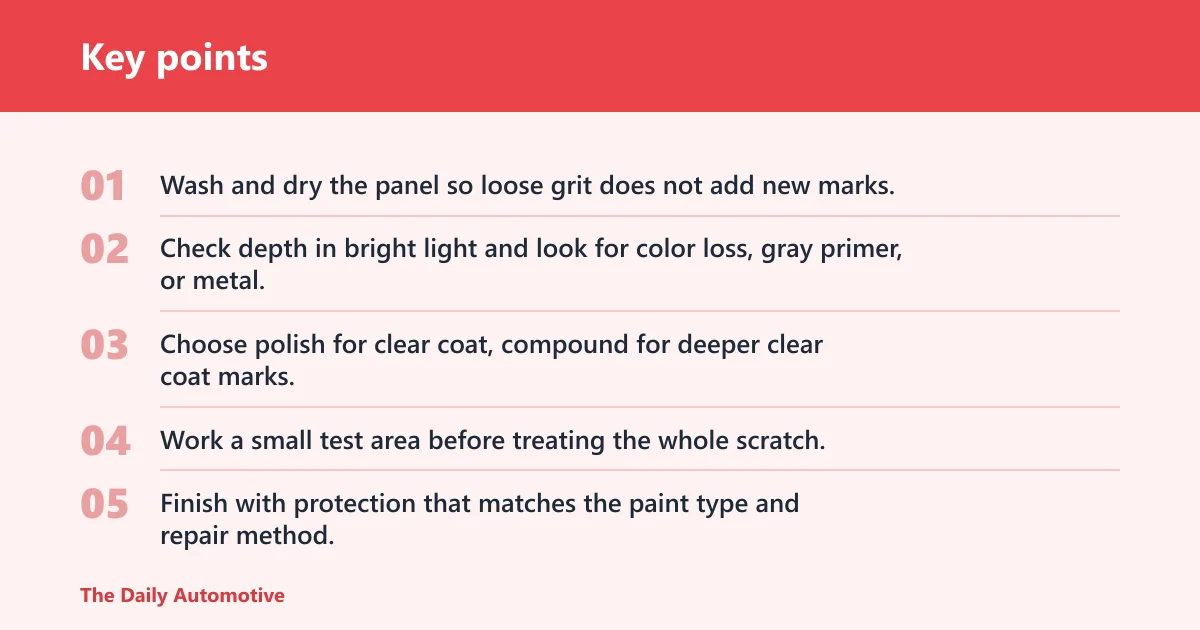
- Wash and dry the panel so loose grit does not add new marks.
- Check depth in bright light and look for color loss, gray primer, or metal.
- Choose polish for clear coat, compound for deeper clear coat marks, or touch-up paint for primer and metal.
- Work a small test area before treating the whole scratch.
- Finish with protection that matches the paint type and repair method.
When do you need touch-up paint instead of scratch remover?
You need touch-up paint when the scratch has broken through to primer or metal. Scratch remover can polish the surrounding finish, but it cannot replace missing color or block corrosion. Once the underlayer is visible, the repair changes from surface correction to rebuilding the coating stack.
Primer exposure and rust risk
Primer or metal-level scratches need touch-up paint and a sealing layer. Rick’s Reflections notes that primer or metal-level scratches need touch-up paint and PPF or ceramic coating. The key point is protection: exposed edges need a barrier, not only cosmetic cleanup.
If rust has already started, stop using consumer scratch removers as the main fix. Rust has to be stabilized before you restore the finish.
Why clear coat resin and clear coat matter after repair
Some hybrid repair kits use clear coat resin to fill and protect the repaired area. That matters because the top layer restores gloss and helps smooth the edge between the old finish and the new material. Without a clear top layer, the repair can look flat and collect dirt.
When to stop and send the panel to a body shop
Send the panel out if the scratch is broad, reaches metal across a large area, crosses a body line, or sits on a matte or specialty finish that should not be polished heavily. CyPaint lists professional repair at $150-$500 depending on severity, which is often the better move once the damage is beyond a small touch-up.
Suppose a roughly 6-inch scratch runs along the edge of a fender and exposes primer in a couple of places. A touch-up pen may help at the worst spots, but a body shop can blend the surrounding finish more cleanly than a spot repair.
Frequently asked questions
What is the best car paint for scratches?
The best product depends on depth. Use polish or a light scratch remover for clear coat marks, compound for deeper clear coat damage, and touch-up paint for primer or metal exposure. There is no single best product for every scratch because the fix has to match the layer that was damaged.
How do I know if a scratch is only in the clear coat?
A clear coat scratch usually looks like a fine line that does not change the paint color beneath it. It may fade when wet and often comes from washing or light abrasion. If the mark disappears in water or responds well to light polishing, it is likely in the clear coat.
Should I use a compound, polish, or touch-up paint?
Use polish for light clear coat haze, compound for deeper clear coat scratches, and touch-up paint when primer or metal shows. If you are unsure, start with the least aggressive option that matches the damage, then stop once the scratch is no longer affecting the surface layer.
Can I remove scratches by hand or do I need a polisher?
You can remove some shallow marks by hand, especially with a fine polish or light scratch remover. A dual-action polisher gives more even results and speeds up correction on larger areas. For a beginner, hand work is safer on tiny spots; machine work is better once the scratch spans a wider panel.
How much does DIY scratch repair cost compared with body shop repair?
DIY kits commonly land in the $10-$50 range, according to CyPaint, while professional repair can run $150-$500 depending on severity. The price gap widens when the scratch reaches primer or metal, because the repair then needs more steps, more blending, and more protection.
Products related to this article
Sponsored / affiliate links. As an Amazon Associate I earn from qualifying purchases. I may earn additional commission from eligible campaigns.