JBL Car Speakers Review: Fitment, Power, and Value
For factory radios, JBL’s easiest wins are coaxial upgrades with higher sensitivity; choose component sets only if you can place tweeters properly and want the cleanest front stage. Pick the wrong size or load, and you waste money on weak output, buzz, or poor dash balance. This guide compares JBL coaxials, components, and vehicle-specific options by fitment, power needs, and the kind of sound each one delivers.
This guide is part of our Car audio systems guide series.
Verdict

JBL car speakers are a sensible upgrade when you want clearer mids and easier fitment without moving straight to an amplifier. The line works best with stock head units, older cars, and owners who need a factory-size replacement first and a sound-shape change second.
Pros and cons
- Pros: High sensitivity options suit weak factory power; several sizes and formats cover common OEM openings; Plus One, UniPivot, and I-Mount help with output and install flexibility.
- Cons: Bass gains are limited on a stock radio; component sets take more install work; bright cabins can make tweeters sound too forward if placement is poor.
Who it’s for
These speakers suit factory-radio owners who want a cleaner front stage, older-car owners who need straightforward replacement sizing, and commuters who care more about clarity than heavy bass. They are a weaker match for buyers who want deep low end without adding an amp or sub.
📊 JBL was founded in 1946 by James Bullough Lansing. Source: JBL.
Specs at a glance
| Item | What JBL lists or positions | Why it matters |
|---|---|---|
| Plus One woofer cone | Used across JBL car speakers | More cone area can help output and low-frequency authority for the size |
| UniPivot tweeter positioning | Aimable tweeter directionality | Helps imaging and gives more placement flexibility |
| I-Mount system | Tweeter mounting system | Useful when you need different flush or surface mounting choices |
| High Sensitive Design | Efficiency-oriented merchandising filter | Better match for factory head units with modest power |
| Club 622 | 6-1/2 inch two-way car speaker | Simple coaxial path for common factory openings |
| Club 602C | 6-1/2 inch two-way component speaker system | Separate woofer and tweeter setup for cleaner front-stage placement |
| Club 625SQ | 6-1/2 inch 2-way car speaker for ultimate sound quality | Sound-quality positioning for listeners who value detail |
| Stage2 604C | 6-1/2 inch two-way component speaker system | Entry to midline component path in the Stage2 family |
| GTO329 | 8.7 cm 2-way custom fit speaker | Factory replacement option when space is too tight for a 6-1/2 inch swap |
JBL was founded in 1946 by James Bullough Lansing. It is a subsidiary of Harman International, owned by Samsung Electronics, and JBL lists car audio among its home products.
The buying point is fitment, efficiency, and whether you need a coaxial, component, or custom-fit replacement.
Who it is for
JBL car speakers are for buyers who want a practical upgrade path, not a full rebuild. If your car has a weak factory radio, a tired OEM paper cone, or a noisy cabin that needs clearer vocals, the brand’s high-sensitivity and custom-fit options make sense.
They are also a good match for older cars where you want to keep the dash and door panels close to stock. In that case, a speaker that fits the opening cleanly matters more than one with a longer spec sheet.
Common buyer profiles
- Factory-radio owners: Need decent output from low power.
- Older-car owners: Need OEM-size replacements and minimal fabrication.
- Clean-sound buyers: Want clearer vocals, tighter imaging, and less smear than worn factory drivers.
- Easy-install shoppers: Prefer coaxial speakers over a full component build.
Say your car has 6-1/2 inch door openings and a stock radio. A sensitive coaxial speaker can give you a cleaner top end and fuller mids without asking the head unit for power it does not have.
Is JBL a good car audio brand?
Yes, JBL is a good car audio brand when you judge it by fitment range, efficiency, and clear product segmentation. JBL car speakers are sold as aftermarket upgrades for factory systems, and the line includes Club, Stage2, and GTO families for different install needs.
That matters because JBL is not only selling one sound profile. The brand offers coaxial speakers, component systems, tweeter-focused parts, and custom-fit replacements. That spread gives you a better chance of matching the speaker to the car instead of forcing the car to match the speaker.
Where JBL fits well
- Stock head units with limited power.
- OEM doors and dash locations that need common sizes such as 6-1/2 inch or 16.5 cm.
- Owners who want more clarity and better imaging without a full amplifier build.
Where JBL is weaker
- Installations that need deep bass without an amp or sub.
- Cars that need major fabrication to fit oversized drivers.
- Bright cabins where tweeter energy can become tiring if placement is poor.
What works
JBL’s strongest car speakers are the ones that match real OEM openings and weak factory power. Club 622 and Club 625SQ make sense for simple 6-1/2 inch upgrades, while Club 602C and Stage2 604C are better when you want component-style imaging and can place tweeters correctly.
The brand’s technical terms also matter in practical use. Plus One woofer-cone technology is JBL’s proprietary cone design, and JBL says it helps across multiple car speaker listings. In plain terms, it points to more cone area for a given size, which can support better output and a little more body from the same door opening.
Model-specific takeaways
- Club 622: A straightforward 6-1/2 inch two-way car speaker for common swaps.
- Club 602C: A 6-1/2 inch two-way component system for cleaner front-stage placement.
- Club 625SQ: A sound-quality-focused 6-1/2 inch option for listeners who care about detail.
- Stage2 604C: A component system for users who want a step toward better imaging without jumping into a full custom build.
UniPivot tweeter positioning is useful when the cabin does not offer ideal tweeter aim. I-Mount also helps because it gives more tweeter mounting flexibility during installation. That matters in door sails, A-pillars, and mirror triangles where direct placement can change the stereo image.
Suppose the factory tweeter location fires at your knees in a small sedan. An aimable tweeter can reduce the dull, low-dash feel that happens when high frequencies never reach the listening position cleanly.
What does not
JBL car speakers are not a cure for every weak system. If the stock head unit has very little clean output, even a sensitive speaker can still sound restrained. If the door has poor sealing or the dash is bright and reflective, tweeters can become sharp before the rest of the system sounds truly full.
That is the main drawback of buying on brand name alone. A speaker can be efficient and still underperform if the install path is wrong, the opening needs adapters, or the vehicle’s acoustics push the tweeter too hard.
Common failure cases
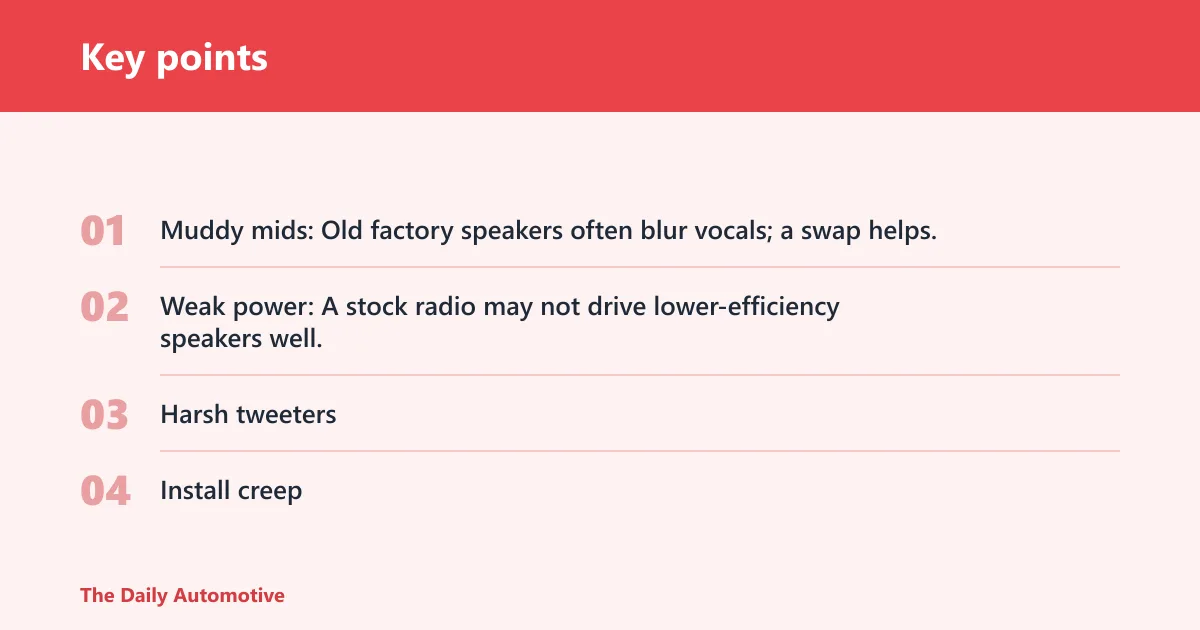
- Muddy mids: Old factory speakers often blur vocals; a swap helps, but only if the new speaker fits the opening and mounts securely.
- Weak power: A stock radio may not drive lower-efficiency speakers well, which leads to thin sound at normal volume.
- Harsh tweeters: Bright cabins can make metal or bright-dome tweeters feel tiring if they aim directly at your ears.
- Install creep: A low sticker price can rise once you add brackets, harnesses, and labor.
Fitment and use-case matrix
Fitment should come before brand loyalty. A 6-1/2 inch speaker that needs adapters, trimming, and extra labor can cost more to install than a custom-fit replacement that drops into the OEM opening.
| JBL family / model type | Format | Likely install complexity | Best-use scenario | Add-on cost for adapters, harnesses, labor |
|---|---|---|---|---|
| Club 622 | 6-1/2 inch two-way coaxial | Low to moderate | Stock-radio owners wanting a simple front or rear upgrade | Low to moderate; adapters or harnesses may be needed, labor often modest |
| Club 602C | 6-1/2 inch two-way component | Moderate to high | Clean-sound upgrades where tweeter placement is possible | Moderate to high; tweeter mounting, crossover placement, and labor add cost |
| Club 625SQ | 6-1/2 inch 2-way coaxial | Low to moderate | Commuters who want clearer sound without a full front-stage build | Low to moderate; usually less than component installs |
| Stage2 604C | 6-1/2 inch two-way component | Moderate to high | Listeners who want better imaging and can route tweeter wiring cleanly | Moderate to high; expect more install time than a coaxial swap |
| GTO329 | 8.7 cm custom-fit two-way | Low when the car matches the opening | Factory replacement in older cars or vehicles with tiny OEM speaker spaces | Low to moderate; may save money if it avoids fabrication or large adapters |
What stands out here is the custom-fit case. The GTO329 is an 8.7 cm 2-way custom fit speaker, and that can beat a 6-1/2 inch upgrade when the car simply does not have the depth, diameter, or trim clearance for a larger driver.
JBL car-speaker merchandising also includes a High Sensitive Design filter, which matters for factory radios. High sensitivity is not a magic fix, but it does help when the head unit power is thin and you want the speaker to give back more output from the same wattage.
Which JBL car speaker is the best?
The best JBL car speaker depends on fitment and use case, not a universal ranking. For most daily drivers with stock radios, a high-sensitivity coaxial is the safest bet. For the cleanest front stage, a component set with proper tweeter placement is better. For exact OEM replacement, the custom-fit GTO329 can be the smarter move.
For mixed use, the Club 625SQ is the best starting point among the models named here because it is positioned for sound quality while staying in a simple 6-1/2 inch format. For easy OEM replacement, Club 622 is the more straightforward answer. For clarity and imaging, Club 602C or Stage2 604C makes more sense if the car can accept the tweeter hardware.
Best by use case
- Best overall for mixed daily use: Club 625SQ.
- Best for clarity and imaging: Club 602C or Stage2 604C.
- Best for easy OEM replacement: Club 622.
- Best if the car needs custom fitment: GTO329.
Alternatives
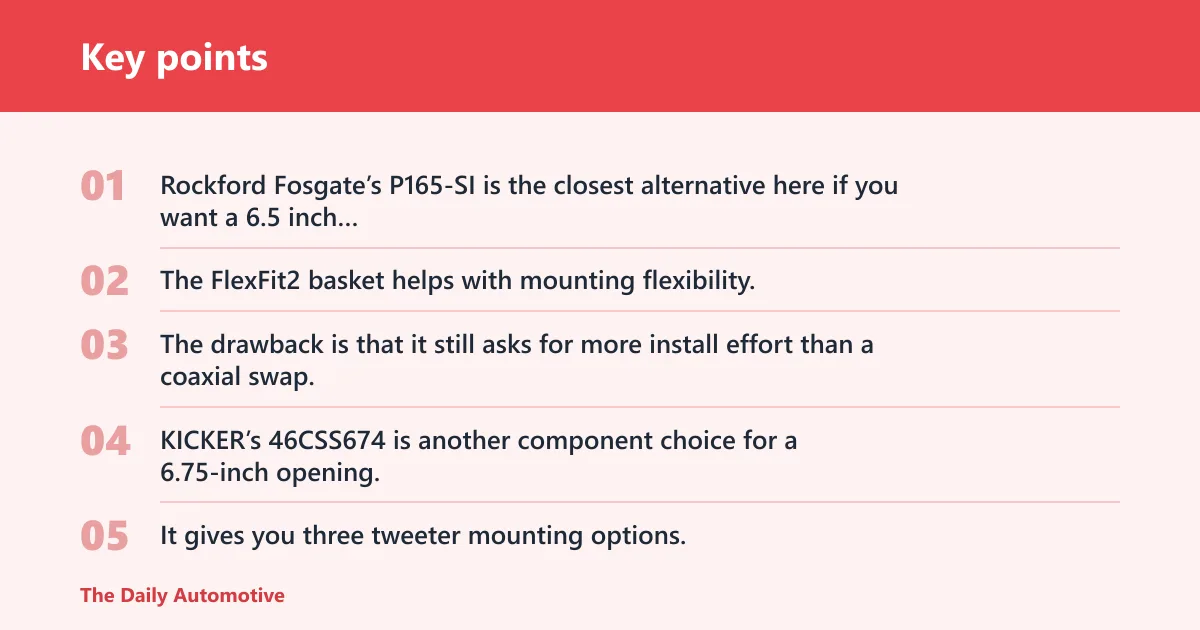

Rockford Fosgate’s P165-SI is the closest alternative here if you want a 6.5 inch component system with a simpler tuning path. The FlexFit2 basket helps with mounting flexibility, while the PEI dome tweeters lean toward clear high frequencies. The drawback is that it still asks for more install effort than a coaxial swap.

KICKER’s 46CSS674 is another component choice for a 6.75-inch opening. It gives you three tweeter mounting options, which is valuable when you need to steer around poor factory positions. The tradeoff is the same component-system reality: more wiring, more placement decisions, and more labor than a direct replacement coaxial.
JBL Club 64C is the strongest JBL alternative in the list if you want a component system with specific sound-shaping tools. The 92dB sensitivity, 3.0 ohm impedance, and adjustable tweeter output make it appealing for a front-stage refresh. The drawback is that the 3.0 ohm load deserves careful head-unit matching, especially in older vehicles.
Should you buy it
Buy JBL car speakers if your main goal is a cleaner OEM replacement, better sensitivity for a stock radio, or a clearer front stage without a full system build. They make the most sense when the size fits first and the sound goal comes second. That order matters.
Skip them if your car needs serious low-end output, amplifier-driven dynamics, or custom fabrication. Speaker price is only part of the budget. Adapters, harnesses, and labor can change the total quickly, especially on component systems.
A common first-timer mistake is buying a 6-1/2 inch component set for a door that only accepts a shallow custom size, then paying again for brackets and extra labor. In that case, a factory-size replacement like the GTO329 may be the smarter buy even if the speaker itself looks less ambitious on paper.
Frequently asked questions
Is JBL car speakers good?
Yes, JBL car speakers are good when you match them to the car and the power source. The brand’s car line includes coaxial, component, and custom-fit options, plus high-sensitivity designs that suit factory head units better than many less efficient speakers.
What JBL car speakers fit my car?
That depends on the OEM opening, mounting depth, and whether the car uses 6-1/2 inch, 16.5 cm, or smaller custom sizes. If your vehicle has a tiny factory opening, an 8.7 cm part like the GTO329 may be a better choice than forcing a larger speaker into the door.
Are JBL component speakers better than coaxial speakers?
Component speakers are better when you want stronger imaging and can place tweeters well. Coaxials are better when you want a simpler install, especially with a stock radio. For many daily drivers, the best answer is not “better” but “easier to fit and easier to power.”
How much do JBL car speakers cost?
Speaker price is only part of the total. You also need to factor in adapters, wiring harnesses, and labor. A coaxial swap can stay relatively modest, while a component install can cost more once tweeter placement and crossover mounting are added.
Products related to this article
Sponsored / affiliate links. As an Amazon Associate I earn from qualifying purchases. I may earn additional commission from eligible campaigns.