Active Crossovers vs Passive Crossovers
Passive crossovers fit simple, low-cost upgrades. Active crossovers fit builds that need exact tuning, separate amplifier channels, and more time for level, slope, and alignment setup. Pick the wrong one and you can waste money on gear that is hard to tune, sounds off-axis, or clips a tweeter after a bad crossover setting. This guide compares wiring, cost, tuning control, and which setup makes the most sense for daily drivers, budgets, and sound-quality builds.
| Decision factor | Active Crossovers | Passive Crossovers | Winner |
|---|---|---|---|
| Signal path | Splits signal before amplification. | Splits signal after amplification. | tie |
| Channel demand | Needs separate amplifier channels per driver or band. | Can run multiple drivers from one amplifier channel. | Passive Crossovers |
| Tuning control | Adjustable crossover frequency, slope, and DSP functions. | Fixed network behavior once built or supplied. | Active Crossovers |
| Install complexity | More wiring, more setup, more calibration. | Less wiring, fewer channels, simpler layout. | Passive Crossovers |
| Cost pressure | More amp channels, DSP, and tuning time. | Fewer amp channels and less tuning time. | Passive Crossovers |
| Sound-shaping range | Strong control over staging, time alignment, and equalization. | Limited to what the network and amp setup allow. | Active Crossovers |
Splitting the signal before or after amplification
Active Crossovers split the audio signal before amplification, while Passive Crossovers split it after amplification. Both protect drivers and keep a tweeter from seeing bass it cannot handle, but they do that work at very different points in the signal chain. That difference drives the whole build decision.
Signal path and protection
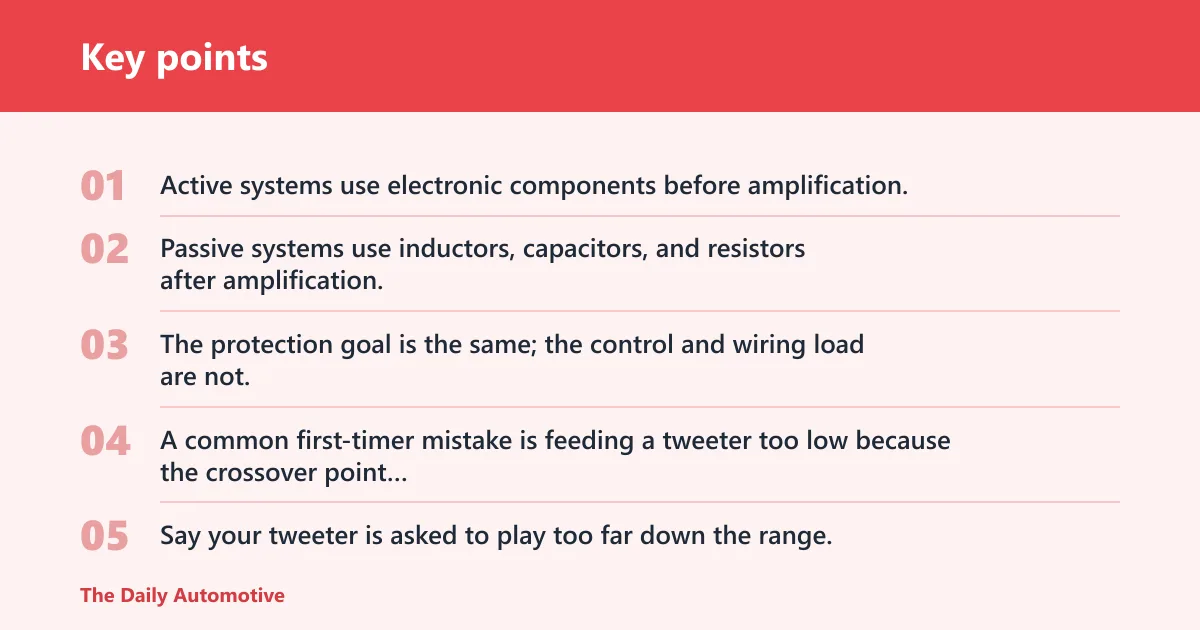
Active systems use electronic components before amplification, so each driver or band gets its own amp channel. Passive systems use inductors, capacitors, and resistors after amplification, which lets one amp channel feed more than one driver in a component speaker system. The protection goal is the same; the control and wiring load are not.
A common first-timer mistake is feeding a tweeter too low because the crossover point was set by ear with no real target. Say your tweeter is asked to play too far down the range. It can fail quickly if low frequencies are sent to it, and the problem often shows up as harshness before it becomes silence.
Why component speaker kits often include passive networks
Most component speaker systems are sold with Passive Crossovers because they fit common two-way and three-way installs. That keeps the build to one amplifier channel per side, which is practical for daily drivers and budget upgrades. It also gives the driver protection the moment the system is wired correctly.
Active Crossovers vs Passive Crossovers at a glance
Active Crossovers win on tuning control, while Passive Crossovers win on simplicity and channel economy. The real choice is less about theory and more about how many amplifier channels you can spare, whether you want DSP, and how much time you want to spend setting crossover points and slopes. Cost follows those choices.
Parts, labor, and tuning time
Active builds usually add more amplifier channels, a DSP in many cases, and more setup time for level matching, crossover points, slope choice, and alignment. Passive builds often need fewer parts and less labor because the network is already doing the split. That makes passive the lower-friction path for many upgrades.
Failure modes that matter
Active systems can go wrong with poor staging, wrong slope choice, and bad crossover placement. Passive systems can go wrong when the factory speaker set does not match the network well, or when impedance interaction changes how the parts behave in the car. In both cases, the symptom is often audible before it is obvious on a meter.
What do crossover frequency and slope change?
Crossover frequency is the handoff point between drivers, and the right point must match what the speaker can handle. Crossover slope is measured in dB per octave and describes how steeply the signal is filtered. Set either one poorly and you can get tweeter damage, midrange distortion, or a front stage that sounds smeared.
Handoff points for woofer, midrange, and tweeter
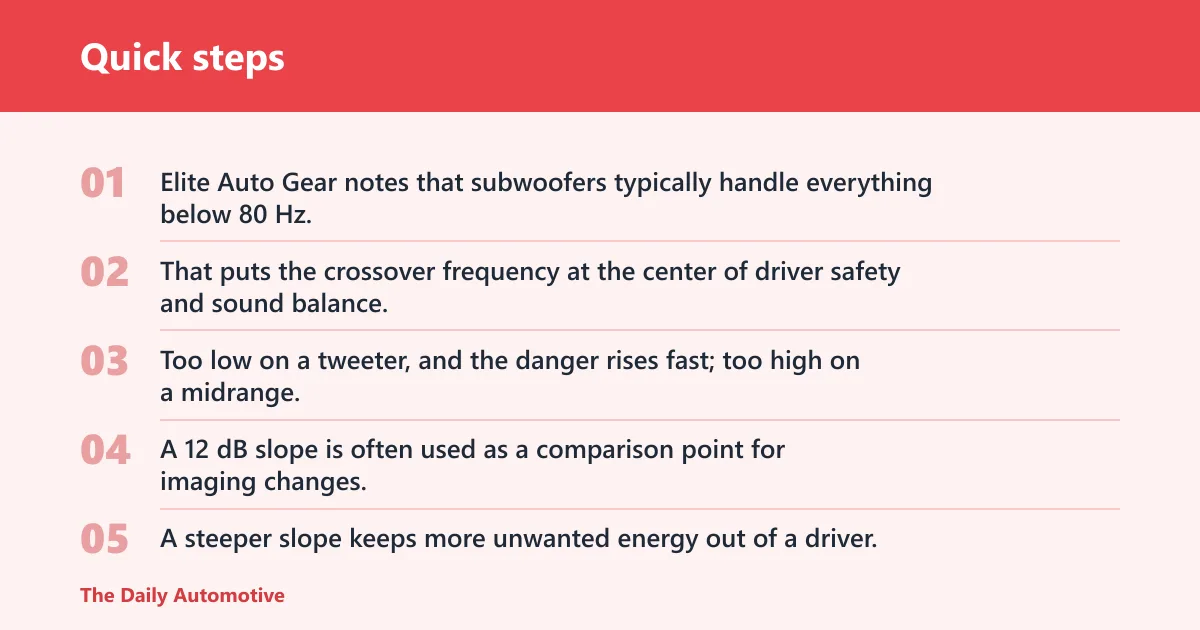
Elite Auto Gear notes that subwoofers typically handle everything below 80 Hz, while mid-range drivers cover 80 Hz to 3,000 Hz. That puts the crossover frequency at the center of driver safety and sound balance. Too low on a tweeter, and the danger rises fast; too high on a midrange, and distortion can creep in where the driver is being asked to work outside its comfort zone.
What 12 dB and 24 dB slopes change
A 12 dB slope is often used as a comparison point for imaging changes, while a 24 dB slope provides maximum protection and separation. A steeper slope keeps more unwanted energy out of a driver, but it can also change the way the front stage blends if the rest of the system is not aligned well. The right slope depends on the driver, the target handoff, and the rest of the install.
Say your front tweeter sounds sharp at normal volume. Suppose the crossover point is set too low and the slope is too shallow. The tweeter gets more low-frequency energy than it should, which can make it sound strained before it fails outright. Moving the handoff up and increasing slope can reduce that load, but only if the rest of the system still blends cleanly.
Do active crossovers need more amplifier channels?
Yes. Active Crossovers need separate amplifier channels per driver or band, so they demand more channels than passive wiring does. That is the main reason they fit better in larger builds, where bi-amping or tri-amping is part of the plan and a DSP can manage the tuning load.
Bi-amping in 2-way systems
Bi-amping means using separate amplifiers for different frequency bands. In a 2-way front stage, that usually means one amp channel for the woofer and one for the tweeter on each side. The payoff is independent control of level and crossover settings for each driver.
Tri-amping in 3-way systems
Tri-amping uses three amplifiers or channels for low, mid, and high. The same source states that a three-way active front stage needs six channels, which is the cleanest way to think about channel demand for a left-right front stage. That channel count grows fast once you add rear fill or subwoofers.
When DSP becomes part of the plan
AudioControl says active systems can adjust crossover frequencies and slopes, and they can also support equalization, phase correction, and time alignment. That matters because once each driver is fed directly, the DSP becomes the main tool for balancing output and staging. Without it, active can become more work than payoff.
Crossover decision matrix
This matrix maps common car-audio situations to the crossover type that fits the build, the minimum amp channels, whether DSP is needed, the top risk, and the owner skill level. The point is to match the system to the job, not to force every build into active control. In several cases, passive is the right answer even if active would give more control in theory.
| Scenario | Recommended crossover type | Minimum amp channels | DSP needed yes/no | Top risk | Owner skill level |
|---|---|---|---|---|---|
| Daily driver with one amplifier | Passive Crossovers | 2 | No | Limited tuning control if the cabin is awkward | Beginner |
| Budget component speaker upgrade | Passive Crossovers | 4 | No | Cost creep from extra amp channels | Beginner |
| OEM integration with factory head unit | Active Crossovers | 4 | Yes | Bad factory tuning and level mismatch | Intermediate |
| Two-way SQ build with DSP | Active Crossovers | 4 | Yes | Wrong slope or crossover point | Intermediate |
| Three-way front stage | Active Crossovers | 6 | Yes | Channel shortage and alignment errors | Advanced |
| Competition-style tuning project | Active Crossovers | 6 or more | Yes | Long tuning time and setup drift | Advanced |
Daily driver with one amplifier
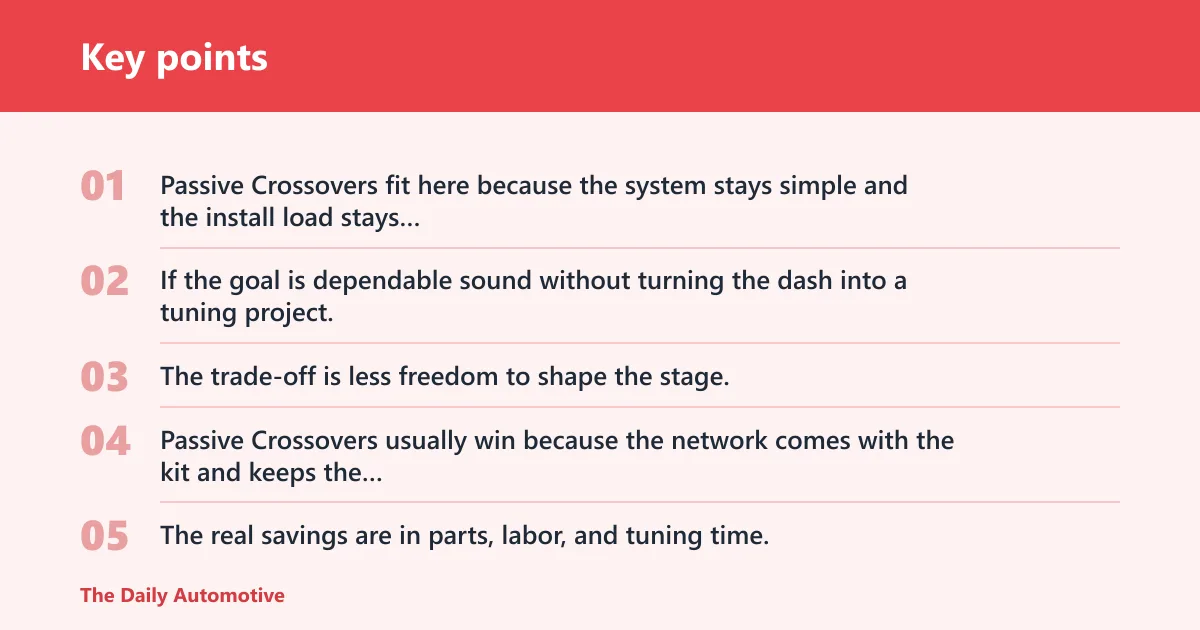
Passive Crossovers fit here because the system stays simple and the install load stays low. If the goal is dependable sound without turning the dash into a tuning project, passive is the cleaner answer. The trade-off is less freedom to shape the stage.
Budget component speaker upgrade
Passive Crossovers usually win because the network comes with the kit and keeps the channel count under control. The real savings are in parts, labor, and tuning time. That matters when the budget is tighter than the wish list.
OEM integration with factory head unit
Active Crossovers are often the stronger fit when the factory signal needs correction and the install needs alignment work. The downside is that OEM integration can reveal mismatched levels and odd factory EQ fast, so DSP becomes part of the baseline plan. Without it, the build can sound thin or uneven.
Two-way SQ build with DSP
Active Crossovers give the control that a sound-quality front stage usually needs. The ability to set crossover frequency, slope, equalization, and time alignment gives more room to place the image where it belongs. The price is more setup time and more chances to make a bad choice if the tuner is rushed.
Three-way front stage
Active Crossovers are the practical choice when the goal is full control over woofer, midrange, and tweeter. AudioControl’s active-system guidance and Elite Auto Gear’s six-channel three-way example point in the same direction: the build needs channels, tuning tools, and patience. Passive can work in a three-way system, but control is narrower.
Competition-style tuning project
Active Crossovers are the norm when precise staging and repeated adjustment are part of the build. That does not make them simpler. It means the owner accepts more setup work in exchange for deeper control over how the front stage behaves.
Choose Active Crossovers if… / Choose Passive Crossovers if…
Choose Active Crossovers if you have enough amplifier channels, want to set crossover frequency and slope yourself, and plan to use DSP for time alignment and equalization. Choose Passive Crossovers if you want a cleaner install, fewer channels, lower tuning load, and a component speaker kit that is ready to wire. The right answer follows the build, not the badge on the box.
Choose active crossovers if…
- You are building a two-way or three-way front stage with separate amp channels for each driver or band.
- You want to set crossover points and slopes by system need, not by the fixed parts in a network.
- You are already planning DSP for equalization, phase correction, or time alignment.
- You can spend time dialing in levels, slopes, and handoff points without chasing a fast install.
Choose passive crossovers if…
- You want a component speaker upgrade with fewer wires and less setup work.
- You have one amplifier and do not want to buy more channels just to separate drivers.
- You want a practical daily-driver or budget build where labor and tuning time matter.
- You prefer the network to handle driver protection without a larger tuning stack.
Frequently asked questions
What is the difference between active and passive crossovers?
Active Crossovers split the signal before amplification, while Passive Crossovers split it after amplification. Active systems need separate amp channels and usually more tuning control. Passive systems use a network of parts to divide the signal after the amp, which keeps the install simpler.
Is an active crossover better than a passive crossover?
Active Crossovers are more flexible, but that does not make them the right choice for every car audio build. They pay off when you need precise control, DSP, and enough amplifier channels to run each driver or band separately. Passive Crossovers are often the better fit for simpler, lower-cost installs.
Can I run a component speaker set active without a passive network?
Yes, if the system has the right amplifier channels and tuning control. A component speaker system can run active without the passive network when the crossover points, slope, and levels are set in the active chain or DSP. Without those tools, the setup is risky for the tweeter.
What does crossover frequency and slope mean in car audio?
Crossover frequency is the handoff point between drivers. Crossover slope is measured in dB per octave and shows how steeply the system filters sound beyond that point. The wrong handoff or slope can leave a tweeter exposed or make a midrange work too hard.
When is a passive crossover the better choice for car audio?
Passive Crossovers are the better choice when the goal is a simpler build with fewer channels, less wiring, and less tuning time. They make sense for daily drivers, budget component upgrades, and installs where the owner wants solid results without building a full active system around the front stage.
Products related to this article
Sponsored / affiliate links. As an Amazon Associate I earn from qualifying purchases. I may earn additional commission from eligible campaigns.