Car Registration Cost: How Much Does It Cost?
Car registration cost usually includes a base registration fee plus title, plate, local tax, and county or city charges, so the total can range from under $50 to several hundred dollars depending on where you live. Miss one fee, and your DMV visit can turn into a second trip, extra paperwork, or a larger-than-planned bill. This guide breaks each line item apart and shows you how to estimate the total before you go.
This guide is part of our Car laws and compliance guide series.
Understanding base fees, taxes, and local add-ons
Car registration cost is rarely one line on a receipt. At the counter, you may pay a base registration fee, a title fee if the vehicle is being titled in your name, plate fees, and local charges such as county wheel taxes or city vehicle taxes. Some states also add EV or hybrid surcharges.
Base registration fee vs. title fee
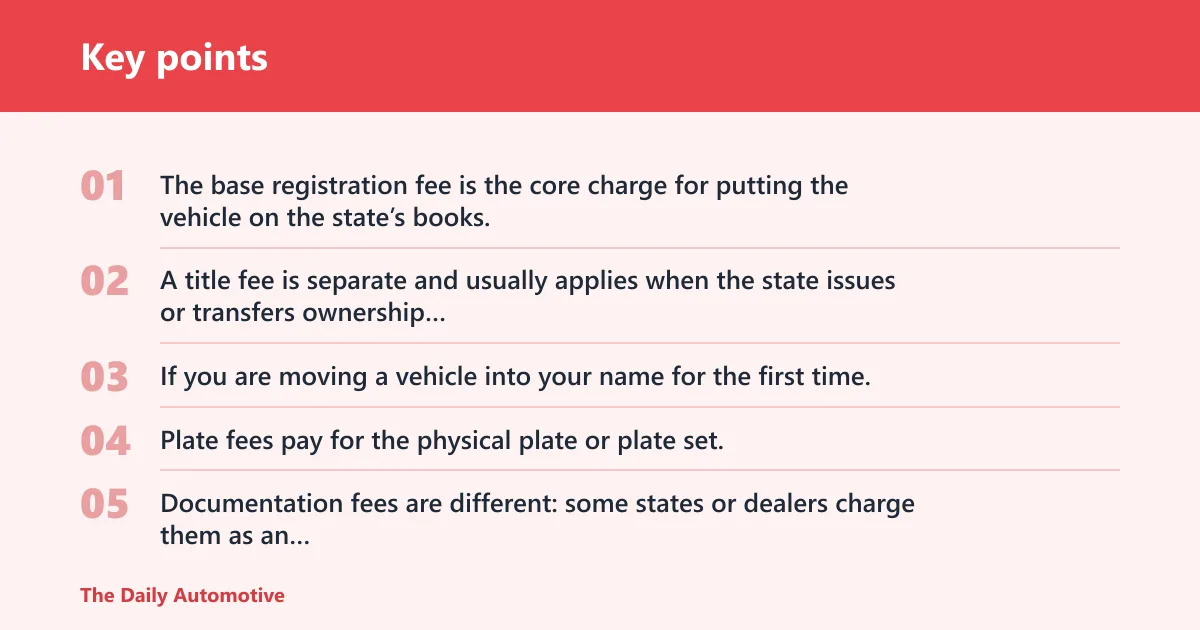
The base registration fee is the core charge for putting the vehicle on the state’s books. A title fee is separate and usually applies when the state issues or transfers ownership paperwork. If you are moving a vehicle into your name for the first time, you may see both on the same bill.
Plate fee, documentation fee, and local add-ons
Plate fees pay for the physical plate or plate set. Documentation fees are different: some states or dealers charge them as an administrative charge, and they are not the same thing as a DMV registration fee. Local add-ons can include wheel taxes, city taxes, or county use taxes, which can push the total up fast.
What is and is not part of the DMV bill?
Think of the DMV bill as the government-required part of the transaction. Dealer documentation fees may appear on your total out the door, but they are not a registration fee. Sales tax, dealer add-ons, and financing charges can also sit outside the DMV line items, even though they affect what you pay to drive away legally.
How much does it cost to register a car in the U.S.?

There is no single U.S. registration price because states use different formulas and add different charges.
Why the national answer is a range, not one number
States set fees in different ways. Some use flat charges. Others tie the bill to vehicle weight, age, or MSRP, then add county or city fees on top. A small older sedan and a newer high-MSRP SUV can fall into very different fee buckets before local taxes or special plates enter the total.
Flat-rate states vs. variable-fee states
Flat-rate states keep the formula simple. Variable-fee states can scale the bill based on vehicle data and local rules, which is why two drivers in the same state may not pay the same amount. Renewal can also follow a different schedule than first-time registration.
Car registration cost how table
The figures below are listed registration and documentation fee totals from the referenced state ranking, not a pure registration-only comparison. They are still useful for spotting the spread between states.
| State | Listed registration and documentation fee | Relative position in this sample |
|---|---|---|
| Delaware | $2,159 | Highest listed |
| Florida | $1,296 | High |
| Colorado | $1,294 | High |
| Mississippi | $1,144 | High |
| Wyoming | $1,116 | High |
| North Carolina | $1,069 | High |
| Arkansas | $157 | Lowest listed |
Why registration is expensive in some states
Some states charge more because their formulas pull in vehicle weight, age, or MSRP, and some add local taxes on top. EV and hybrid fees can also raise the total. The result is a bill that reflects both the car and the county where it is registered, not just the base state charge.
Vehicle weight, age, and MSRP formulas
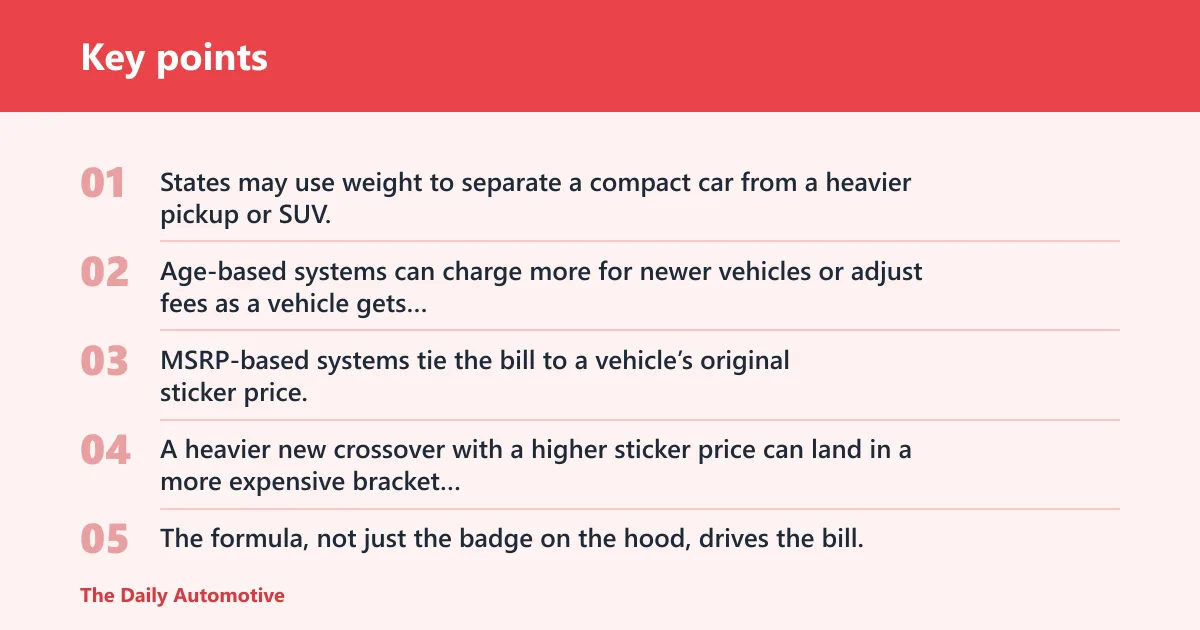
States may use weight to separate a compact car from a heavier pickup or SUV. Age-based systems can charge more for newer vehicles or adjust fees as a vehicle gets older. MSRP-based systems tie the bill to a vehicle’s original sticker price, so a pricier new vehicle can cost more to register.
Say your state uses MSRP and weight. A heavier new crossover with a higher sticker price can land in a more expensive bracket than an older compact car, even if both are registered on the same day. The formula, not just the badge on the hood, drives the bill.
Local wheel taxes and county charges
Wheel taxes and county charges are easy to miss because they are not always included in statewide averages. A driver can see a low base fee in one county and a higher final bill in another because the local add-on gets stacked on top of the state charge.
EV and hybrid surcharges in select states
Some states add EV or hybrid fees to make up for gasoline tax revenue that those vehicles do not pay at the pump. These charges can be separate from the base registration fee, and they may not appear in summary averages unless the source spells them out.
Registration cost table
The table below gives common situations and the fee buckets that usually matter. The ranges are planning figures, not official quotes, because the final amount depends on state rules, county charges, and the vehicle itself.
| Scenario | Likely fee buckets | Expect to pay |
|---|---|---|
| First registration of a new gas car | Base registration, title, plate, local taxes | About $100 to $700+ |
| First registration of an EV | Base registration, title, plate, local taxes, EV surcharge in some states | About $150 to $900+ |
| Renewal | Renewal fee, plate renewal, local add-ons | About $25 to $300+ |
| Out-of-state transfer | Base registration, title transfer, plate, inspection or local fees where required | About $75 to $500+ |
| Specialty plate | Base registration, specialty plate fee, possible donation or program charge | About $50 to $400+ |
A common first-timer mistake is treating the renewal notice as the full answer. If your state adds a county wheel tax or a specialty plate fee, the number on the notice may not match the total you owe once every line item is counted.
How to estimate your total before you go
You can estimate your DMV bill by identifying the fee rules your state uses, then adding the vehicle-specific and local charges. The key step is to separate the base registration fee from title, plate, and any extra state or county add-ons before you assume the total.
- Find your state DMV fee schedule and confirm whether the state uses a flat rate or a formula.
- Check whether the fee depends on vehicle weight, age, or MSRP.
- Confirm whether your county or city adds wheel taxes or local vehicle use taxes.
- Check whether you owe title and plate fees for a first registration or transfer.
- Look for EV or hybrid surcharges if the vehicle is electric or partly electric.
- Add any documentation fee only if it applies to the seller or state process you are using.
Suppose you are registering a newer SUV in a county with a wheel tax. If the state fee is based on weight and the county adds its own charge, your final total can be much higher than the base registration number on the state website. That is why the notice alone is not enough.
How much is car registration in my state?
Your state DMV or tax office is the only place that can give the exact number for your vehicle. Start with the state fee schedule, then plug in the vehicle’s weight, age, and county. If the state publishes a calculator, use it before you visit, because local add-ons can change the total materially.
What to check on the state fee page
Look for the base registration fee, title fee, plate fee, renewal rules, and any local surcharges. If the state lists special charges for EVs, hybrids, or specialty plates, include those too. If the fee page separates documentation or processing charges, keep them apart from the DMV charges.
Is renewal cheaper than first-time registration?
Often, yes. Renewal usually skips some first-time charges, such as a new title transfer or initial plate issuance, so the bill can be lower. But renewal is not always cheap, because local taxes, plate fees, and vehicle-based formulas can still keep the total high.
Typical differences in fee buckets
First-time registration usually includes more line items because ownership is being set up or transferred. Renewal generally focuses on keeping the existing registration active. That means the renewal bill may drop the title fee and some plate charges, but the base fee and local add-ons can remain.
When renewal can still be high
Renewal can still be expensive when the state uses weight-, age-, or MSRP-based pricing, or when local taxes apply every year. Specialty plates can also keep the total elevated if the plate program carries an annual fee.
When a transfer triggers first-time charges
If you bought the car from out of state, the DMV may treat the transaction like a first registration rather than a simple renewal. In that case, title transfer, plate issuance, and inspection fees may all come back into the total.
Frequently asked questions
How much does it cost to register a car?
The cost depends on your state, vehicle type, and local add-ons. Your actual bill can be much lower or much higher.
Why is car registration so expensive in some states?
Some states build the fee from vehicle weight or age, which can raise the price for newer or more expensive vehicles. Local wheel taxes, county charges, and EV or hybrid surcharges can also stack on top of the base fee and push the total higher.
What fees are included in car registration costs?
Common fee buckets include the base registration fee, title fee, plate fee, and local taxes or county charges. Some states also add special charges for EVs, hybrids, or specialty plates. Documentation fees may appear in the overall purchase paperwork, but they are not the same as DMV registration fees.
What is the average car registration fee in the U.S.?
The exact average depends on the source and on whether documentation fees are included. That figure should not be treated as a pure registration fee or a guarantee of what your state will charge at the counter.
Do EVs and hybrids cost more to register?
In some states, yes. EV and hybrid fees are separate surcharges that can be added to the base registration cost. They are meant to offset fuel-tax revenue gaps, and they may not appear in summary averages unless the source specifically includes them.
Products related to this article
Sponsored / affiliate links. As an Amazon Associate I earn from qualifying purchases. I may earn additional commission from eligible campaigns.