
Dealer Tag vs Temporary Registration: What Buyers Need
Use a dealer tag only if your state allows it for dealer-owned inventory or test drives; for a customer purchase, you usually need a temporary registration or temporary operating permit until the permanent plate arrives. Drive without the right paper and you can face tickets, impound fees, or an unusable car. This guide shows which document fits each buy scenario and what to do when the dealer or DMV stalls on the permanent plate.
This guide is part of our Car laws and compliance guide series.
| Decision factor | Dealer Tag | Temporary Registration | Winner |
|---|---|---|---|
| Who it is for | Licensed dealer inventory, demos, road tests, transport, auctions | Buyer’s vehicle while permanent registration is being processed | Temporary Registration |
| Issuer | DMV or dealer-authorized dealer plate system, depending on state | Dealer, DMV, county office, or electronic system | Tie |
| Buyer suitability | Usually the wrong document for a retail buyer | Built for customer drive-away use after purchase | Temporary Registration |
| Common format | Metal plate or dealer plate credential | Paper, metal, or electronic temporary record | Tie |
| Risk if used wrong | Misuse can trigger enforcement action | Expired or altered tags can trigger enforcement action | Tie |
Dealer tag vs temporary registration: what each one does

Dealer plates belong to dealers. Temporary tags and temporary registration belong to a short-term bridge period while ownership paperwork and permanent plates catch up. That split matters because the wrong document can turn a legal purchase into a dead stop before the buyer gets home.
Dealer plate: who gets it and what it is for
A dealer plate is issued to a licensed motor vehicle dealer and is generally used for dealership business purposes. It is used for demos, transport, road tests, and auctions, and rules vary by state. Some states limit personal use tightly; buyers should not assume a dealer plate is theirs to keep after a sale.
Temporary tag and temporary registration: short-term road use while papers catch up
A temporary tag is a short-term marker that lets a vehicle operate legally while permanent registration is processed. It can be paper, metal, or electronic depending on the state, and it is usually tied to one transaction or one vehicle. Temporary registration is the legal status behind it.
Why buyers should not assume a dealer plate is their drive-away document
A buyer leaving a lot needs a document that matches buyer use, not dealer inventory use. Dealer plates are not a substitute for a temporary registration unless the state specifically says so, and even then the rule often applies only in narrow situations. That is why the buyer should ask, before signing, what paper or plate will be issued at handoff.
| Purchase scenario | What the buyer should expect | Who usually issues it | What to verify before driving off |
|---|---|---|---|
| New dealer purchase | Temporary registration or dealer-issued temp tag | Dealer, often through the state system | Vehicle VIN, expiration date, and proof of insurance |
| Private sale | Temp tag or temporary permit if the state allows it | DMV, county office, or a state electronic system | Bill of sale, title status, and your name on the permit |
| Out-of-state purchase | Temporary registration for transport and home-state processing | Dealer, DMV, or transit authority, depending on route and state | Whether your home state accepts the temp document |
| Title held by lienholder | Temporary registration tied to title processing | Dealer or DMV | How the lienholder title release will be handled |
According to Dealer Plates vs. Temporary Tags – quickerbonds.com — Texas eliminated several paper temporary-tag categories effective July 1, 2025.
Which one should you have when you leave the lot?
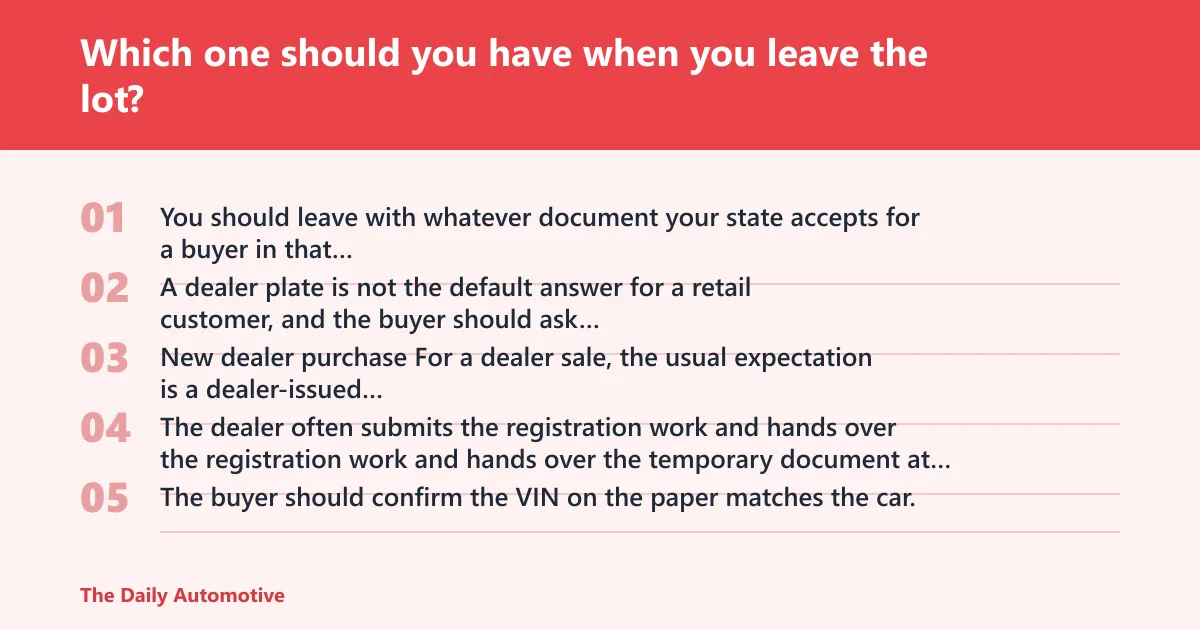
You should leave with whatever document your state accepts for a buyer in that transaction, usually a temporary registration or temporary operating permit. A dealer plate is not the default answer for a retail customer, and the buyer should ask for the specific temporary paperwork before taking possession of the vehicle.
New dealer purchase
For a dealer sale, the usual expectation is a dealer-issued temporary tag or electronic temporary registration if permanent plates are not ready. The dealer often submits the registration work and hands over the temporary document at delivery. The buyer should confirm the VIN on the paper matches the car.
Private sale
Private sales are the hardest place to generalize because the rules differ by state. Some states allow a DMV-issued temporary permit; others expect the buyer to register first and drive only with the paperwork the agency provides. A private seller’s plate is not a buyer permit.
Out-of-state purchase
An out-of-state buy adds tax, title, and home-state registration questions at the same time. The buyer usually needs a temporary registration that is accepted for transit and enough time to complete local registration after arrival. A dealer plate from the selling state is not a safe assumption.
Title held by lienholder
When a lender holds title, the buyer may need a temporary registration while the dealer, lender, or state office finishes title processing. The temporary paper should spell out who is handling the title path and how long the vehicle may be operated. Keep every receipt and title application copy in the car.

Who issues the temporary paperwork: dealer, DMV, or county office?
The issuer depends on the transaction and the state. In dealer sales, the dealer often issues the temporary tag through a state system; in private sales, the DMV or a county office may handle it; and some states use electronic registration systems that replace or supplement paper forms.
Dealer-issued temporary tags and electronic temporary registration
Dealer sales often run through an electronic temporary registration platform. Florida is a clear example: dealer sales use an Electronic Temporary Registration system, and dealer-issued temporary tags are printed as a 30-day temporary tag. That is a dealer workflow, but the authority still comes from the state rules.
DMV or motor vehicle agency issuance
The DMV, or the state motor vehicle agency by another name, sets the rules for issuance, eligibility, and enforcement. In some states, the buyer must go directly to the agency for temporary registration, especially after a private sale or an out-of-state purchase. The agency’s document is the one that matters at roadside.
When a county or other local office may be involved
Some states route temporary paperwork through county tax offices or local clerks. That usually happens when title, tax, or local registration functions are split across offices. If the dealer sends you to a local office, ask for the exact office name and the exact form you must bring.
How long is a temporary tag valid, and can it be extended?
Validity depends on the state and transaction type. Temporary tags can last only long enough for title processing, tax payment, or plate printing, and extensions are sometimes allowed only if the delay is outside the buyer’s control. The printed expiration date is the only date that matters.
Paper, metal, and electronic formats
Paper tags are still common, but some states use metal temporary plates or electronic temporary registration records. The format does not change the legal duty to keep the vehicle within the permit period. If the state uses an electronic system, keep the printed receipt or electronic proof in the vehicle.
What usually triggers an extension request
An extension request usually starts when the permanent plate has not arrived, title processing is incomplete, or the state has not finished verification. The buyer should contact the issuer before the current permit expires. Waiting until after expiration is where people get stopped.
Decision table: the right document in each purchase scenario

Use the document that matches the way you bought the vehicle, not the document that happens to be nearby. This table is the buyer’s shortcut: identify the scenario, confirm the expected paper or plate, and make the first call before leaving the lot or DMV.
| Scenario | Expected document or plate | Issuer | Validity window | First action if something goes wrong |
|---|---|---|---|---|
| New dealer purchase | Temporary registration or dealer-issued temp tag | Dealer through the state system | State-specific; often short-term until permanent plate is processed | Call the selling dealer and ask for the temporary record number and printed expiration |
| Private sale | DMV- or county-issued temporary permit, if allowed | DMV, county office, or electronic system | State-specific; usually tied to registration completion | Call the DMV or county office and confirm the required title and insurance papers |
| Out-of-state purchase | Temporary registration for transit and home-state registration | Dealer or agency, depending on state route | Short enough to cover travel and initial filing | Ask whether your home state accepts the document before driving across the state line |
| Title held by lienholder | Temporary registration linked to title release | Dealer or DMV | Until title and plate processing move forward | Contact the dealer finance office and the lienholder title department |
| Delayed plate delivery | Written extension or replacement temporary tag, if allowed | Dealer, DMV, or state system | Depends on extension approval and the reason for delay | Get written confirmation of the new expiration date before the old one ends |
What to do when the plate or title is delayed
Call the issuer first, keep proof in the car, and write down every new expiration date. If the dealer promised permanent plates and they have not arrived, the buyer should press the dealer’s title or registration desk before calling the DMV. That order saves time because the seller often controls the submission.
Call the dealer or DMV first
If the sale was dealer-based, the dealer is the first stop. If the vehicle came from a private sale or a DMV office already issued the temporary permit, call the state agency next. Ask for the status of the registration, the plate shipment, and any extension rules in writing.
Keep proof of purchase and insurance in the vehicle
Drivers should keep the bill of sale, temporary registration, proof of insurance, and any receipt or printout that shows the permit number and expiration date. If the vehicle is stopped, that paper trail helps show the car is not operating on a fake or expired tag. Keep it with the registration, not buried at home.
Track expiration dates and written extension notices
Do not rely on a memory check or a sales promise. Put the expiration date on the dashboard calendar and save any extension notice that names the vehicle and new date. If the new paper never arrives, the buyer should not keep driving past the old date.
What happens if you use the wrong plate or a fake tag?
Using the wrong plate type can lead to tickets, tow risk, and a police stop that gets worse fast. Expired temporary tags, dealer plate misuse by a buyer, and fake or altered tags all create enforcement problems because the vehicle no longer matches the authority shown on the plate or paper.
Expired temporary tags
An expired temporary tag is the simplest failure case and one of the easiest to avoid. Once the date passes, the vehicle may be treated as unregistered, even if the buyer is still waiting on the permanent plate. The fix is to get a valid extension or stop driving until lawful paperwork is in hand.
Dealer plate misuse by a buyer
If a buyer uses a dealer plate like a personal plate, the risk is not just a citation; it can also be an accusation of unauthorized use of dealership credentials. Dealers issue those plates for business-related movement, not for a customer’s private commute. Buyers should never borrow a dealer plate for convenience.
Fake or altered temporary tags
Fake or altered tags are the most serious problem in this group. Florida warns that fake temporary tags can be a third-degree felony, and Texas eliminated several paper temporary-tag categories effective July 1, 2025, which is another sign that states are tightening control. If the tag looks suspicious, do not drive on it.
What documents do I need to get a temporary tag?
The usual stack is simple: identity, proof of insurance, bill of sale or purchase contract, title or title application, and any sales tax paperwork the state requires. Some states also require the dealer or buyer to file directly through an electronic system, so the missing item may be an online submission rather than a paper form.
Florida example: form, identity, insurance, and tax
Florida requires Form HSMV 83091 for a temporary license plate application. That application is tied to identity, insurance, bill of sale, and sales tax paperwork. Florida dealer sales use an Electronic Temporary Registration system, and the state also issues 30-Day Temporary Tag, 10-day temporary tags in certain cases, and 90-day temporary tags for personalized plates.
Texas example: dealer plate categories changed
Texas now distinguishes between Standard Dealer Plates and Dealer Temporary Plates, and Texas eliminated several paper temporary-tag categories effective July 1, 2025. Standard Dealer Plates can be used for certain business and personal uses, while Dealer Temporary Plates are restricted to business purposes. That split is why a buyer should never assume a dealer plate means personal driving is allowed.
Can I drive home with a dealer plate?
Usually, no. A dealer plate is issued to a dealer for dealership-related work, not as a default drive-away document for a retail buyer. If a state has an exception, the dealer should show the buyer the exact rule in writing before the car leaves the lot.
Can a temporary tag be extended if my plate hasn’t arrived?
Sometimes, yes, but only if state rules allow it and the delay is documented. The buyer should ask before the current tag expires and should get the new date in writing. If the dealer or DMV says no extension is available, the car should stay parked until lawful paperwork arrives.
Do dealer plates work for private sales?
No, not as a buyer solution. A dealer plate is for a licensed dealer’s business use, while a private sale usually needs whatever temporary permit or registration the state allows for buyers. Using the seller’s plate is a separate issue and is often not lawful after the sale closes.
Is it legal to buy a fake temporary tag online?
No. A fake temporary tag is not a legal workaround; it is a fraud and enforcement problem. States treat these tags seriously because they hide whether the car is insured, titled, or registered. If the tag source is not the DMV, dealer system, or other authorized office, treat it as illegal.
What happens if I use the wrong plate type on a vehicle?
The stop can start as a simple registration check and turn into a citation, tow, or impound if the plate does not match the vehicle or the use case. Wrong-plate use includes putting a dealer plate on a buyer’s car, driving past the temp tag date, or swapping in a fake plate. The safest move is to match the paper to the transaction before leaving.
Verdict: Dealer Tag or Temporary Registration?
Choose Dealer Tag if you are using a licensed dealer plate for dealer-owned inventory, demos, road tests, transport, or auctions, as the article says dealer plates belong to dealers and are for dealership business purposes.
Choose Temporary Registration if you are a buyer leaving a new dealer purchase, handling an out-of-state purchase, completing a private sale where allowed, or waiting on a title held by a lienholder, because the article says buyers usually need a temporary registration or temporary operating permit until the permanent plate arrives.
Frequently asked questions
What is the difference between a dealer tag and a temporary registration?
A dealer tag is for a licensed dealer’s business use, such as inventory movement, demos, road tests, and auctions. A temporary registration is short-term legal authority for a vehicle that has been sold or is waiting on permanent plates. One belongs to the dealer; the other belongs to the purchase process.
Can I drive home with a dealer plate?
Usually not. Buyers should expect a temporary registration or temporary operating permit, not a dealer plate, unless state law clearly says otherwise. If a salesperson says the dealer plate is fine, ask for the state rule and the written expiration or permit record before driving off.
Who issues a temporary tag when buying from a dealer?
Often the dealer issues it through a state electronic system or dealer registration process. In Florida, for example, dealer sales use an Electronic Temporary Registration system and the dealer-issued temporary tag is printed as a 30-day temporary tag. The key is that the dealer acts through state authority, not personal discretion.
How long is a temporary tag valid?
There is no single national срок, and that matters. The validity window depends on the state, the type of sale, and whether the document is paper, metal, or electronic. Florida uses several different temporary tag windows, including 30-day, 10-day, and 90-day formats in specific cases.
Can a temporary tag be extended if my plate hasn’t arrived?
Sometimes, but not by default. The buyer should contact the dealer or DMV before the tag expires and ask whether the state allows an extension or replacement temporary permit. If no extension is authorized, the car should not be driven after the old date.
What documents do I need to get a temporary tag?
Expect identity, proof of insurance, bill of sale or purchase contract, and title or title application paperwork. Some states also require sales tax forms or a specific application, such as Florida’s Form HSMV 83091. If the state uses an electronic system, the dealer or office may submit part of it digitally.
Products related to this article
Sponsored / affiliate links. As an Amazon Associate I earn from qualifying purchases. I may earn additional commission from eligible campaigns.