Carfax Vehicle History Report Review: Is It Worth It?
Carfax may be worth paying for when the car’s value is high enough that a hidden title, odometer, or damage problem would matter more than the report’s price; otherwise a free dealer copy plus an inspection may be enough. Skip it badly and you can miss a branded title, flood event, or repeated auction sale that knocks thousands off resale value. I have seen clean-looking cars turn into bad buys on that alone. This guide breaks down what Carfax catches, what it misses, and when cheaper checks beat it.
This guide is part of our Car laws and compliance guide series.
Carfax vs cheaper history checks: what you are really paying for
The trade-off is plain. Carfax lowers the odds of buying a car with bad history, while a pre-purchase inspection lowers the odds of buying a car with bad condition. A free dealer copy cuts the cost of history screening. Paying full price only makes sense when the car’s value and your exposure are high enough to justify it.
| Option | Best at catching | Common blind spots | When it fits |
|---|---|---|---|
| Carfax Vehicle History Report | Title brands, reported accidents, theft, ownership changes, some service and inspection records | Unreported repairs, out-of-pocket body work, many missed service events, mechanical wear | Higher-value used cars, title-risk cars, buyers without another report |
| Free dealer copy | The same broad history signals, if the copy is complete and tied to the right VIN | Still misses anything never reported; dealer may provide only a screen grab or partial version | Most normal private-buy or dealer-buy situations |
| AutoCheck | Another history check with similar title and event screening | Same basic reporting gaps as any history database | When price or listing bundle makes it cheaper than Carfax |
| Professional pre-purchase inspection | Mechanical faults, leak clues, brake and suspension wear, signs of poor repair | Title brands, theft history, prior ownership chain | Any car you might actually buy |
Which risks each option catches best
Carfax is strongest on history events that were reported to partners. It can surface accidents, damage, thefts, ownership changes, recalls, import information, and service or inspection records. A physical inspection is stronger on what the car feels and looks like today: noises, fluid leaks, scan-tool faults, and repair quality.
Which risks each option can miss
No history report can see every repair. A bumper respray paid out of pocket may never appear. A flood cleanup done quietly may never appear either. That is why a report should be treated as a filter, not as proof that the car is sound.
According to carfax.eu — CARFAX says it has access to more than 45 billion historical events.
What a Carfax report includes
A Carfax Vehicle History Report is a VIN-based lookup that pulls together records tied to the car’s Vehicle Identification Number. Carfax says the report is available instantly after payment, that you get a PDF by email immediately after purchase, and that online access lasts 30 days. The report may include accidents, damage, thefts, ownership changes, maintenance, inspections, mileage manipulations, import information, taxi or rental use, and recall-related history.
How the lookup works
The VIN is the primary lookup input and is required for most markets. That is the first thing to verify before paying for any report. If the VIN on the dash, door label, title, and listing do not match, stop there. A history report attached to the wrong VIN is worse than useless.
Where the report gets its data
Carfax says it pulls from multiple sources, including NMVTIS, state DMV records, insurance claim data, and service and inspection records. NMVTIS is an important title and stolen-data source for U.S. vehicle title history. State DMV records are where title brands, ownership, and registration history often enter the file. Insurance data helps too, but only for participating insurers.
CARFAX says it has access to more than 45 billion historical events, covers known accidents, damages, or theft reports from 32 countries, and collects events from millions of used cars. That scale helps, but it does not mean every event on every car is visible.
What Carfax misses on a used car
Carfax can miss out-of-pocket repairs, unreported body work, and incomplete service history, which are common concerns for buyers. It can also miss accidents that never reached an insurer, shop, or state database. A clean report can still hide a bent subframe, a poor repaint, or a car that spent a month sitting in water.
Out-of-pocket repairs and unreported body work
If the owner paid cash for the fix, the event may never appear. That includes parking-lot damage, bumper swaps, cosmetic paintwork, and some flood cleanup. The more the prior owner stayed outside insurance and dealer channels, the less useful the report becomes.
Incomplete insurer and shop reporting
Insurance claim data is not universal. It covers participating insurers only, and even then the report may not show every detail. Service and inspection records can also be patchy. A car may have ten oil changes and show two. It may also have a long gap where the real story is buried in invoices the database never saw.
Why a clean report still does not prove the car is sound
History and condition are different problems. A clean report can sit beside bad brakes, worn timing components, rust, coolant loss, or flood damage that was hidden well. I have checked cars that looked clean on paper and still needed major work. That is why a professional pre-purchase inspection matters more than any report for mechanical condition.
Is a free Carfax from a dealer worth trusting?
Yes, a free dealer copy is usually worth trusting more than paying full price, as long as the VIN matches and the report looks complete. It still has the same reporting gaps, but it removes the easiest waste: paying retail for a report the dealer already has. The catch is that it should be verified, not assumed.
What to verify on the copy before relying on it
Check the VIN, the report date, and the mileage trail. Look for title brands, accident entries, ownership count, auction or rental use, and any service or inspection history. If the dealer only shows a screenshot, ask for the full PDF or the direct report view so the record is not missing pages.
When the dealer copy is enough and when it is not
For an ordinary commuter with average value, a free copy plus an inspection may be enough. For a flood-state car, a branded-title candidate, an auction car, or anything expensive enough to sting on resale, paying for your own report can still be justified so you control the source and timing.
Is the Carfax Buyback Guarantee worth anything?
The Buyback Guarantee is useful as a title-brand safeguard, not as repair coverage. Carfax says it may repurchase a vehicle under this program if a qualifying DMV-reported title brand was missing from the report. It does not pay for mechanical failures, wear items, or ordinary accident history.
What it covers and what it does not
It matters when the worry is a hidden title problem that should have been in the file. It does not make a rough car safe to buy. It does not replace an inspection. And it does not turn a minor crash into a refundable mistake. The protection is narrow by design.
When the guarantee should affect your decision
It is most useful on higher-value cars where a missed title brand would change the deal completely. It matters less on low-value cars, where the cost and paperwork of pursuing a claim may exceed the benefit. Treat it as backup, not as a reason to skip due diligence.
Should I get Carfax or another vehicle history report?
Pick the cheapest report that gives you enough title and event coverage for the car’s risk level. Carfax and AutoCheck are both history filters, not truth machines. If you already have a free dealer copy, paying extra for Carfax only makes sense when the car’s value or title risk justifies the additional check.
Carfax compared with AutoCheck on coverage and price
Carfax is often the better-known option and is commonly used as the benchmark. AutoCheck is the main comparator when price matters or when a listing bundle includes it. The practical difference is usually not “one sees everything and the other sees nothing.” It is whether the extra spend changes the buying decision.
Why inspection catches problems reports cannot
A history report can hint at risk. An inspection can find it. That matters more than branding arguments. A technician can spot paint mismatch, uneven tire wear, brake issues, fluid leaks, poor alignment, flood clues, and signs that the car was repaired badly after whatever happened in its past.
How to stack the checks without overpaying
Use the free report first. Pay for a second report only if the car sits in a high-risk lane or the first report is thin. Then spend money on the inspection before you sign anything. History screens the deal. Inspection screens the car.
Choose Carfax if… / choose another option if…
Carfax is the right spend when the risk being reduced is a hidden title brand, odometer issue, or serious damage event on a car worth enough to matter. Skip or downgrade it when the car is cheap, the dealer gives you the report for free, or the inspection budget would do more good than another database check.
Choose Carfax if…
- The car is expensive enough that a bad history entry would change your purchase decision.
- The listing is from a flood-prone, title-risk, or auction-heavy market.
- You do not already have a free full report from the seller.
- You want one more check before paying for an inspection.
Choose another option if…
- The dealer already provides a complete report tied to the correct VIN.
- The car is low value and inspection money would be better spent on the mechanic’s time.
- You are comparing several similar commuter cars and just need a quick filter.
- The seller has strong documentation: title, maintenance records, and recent inspection paperwork.
Buyer-decision matrix: when Carfax is worth it
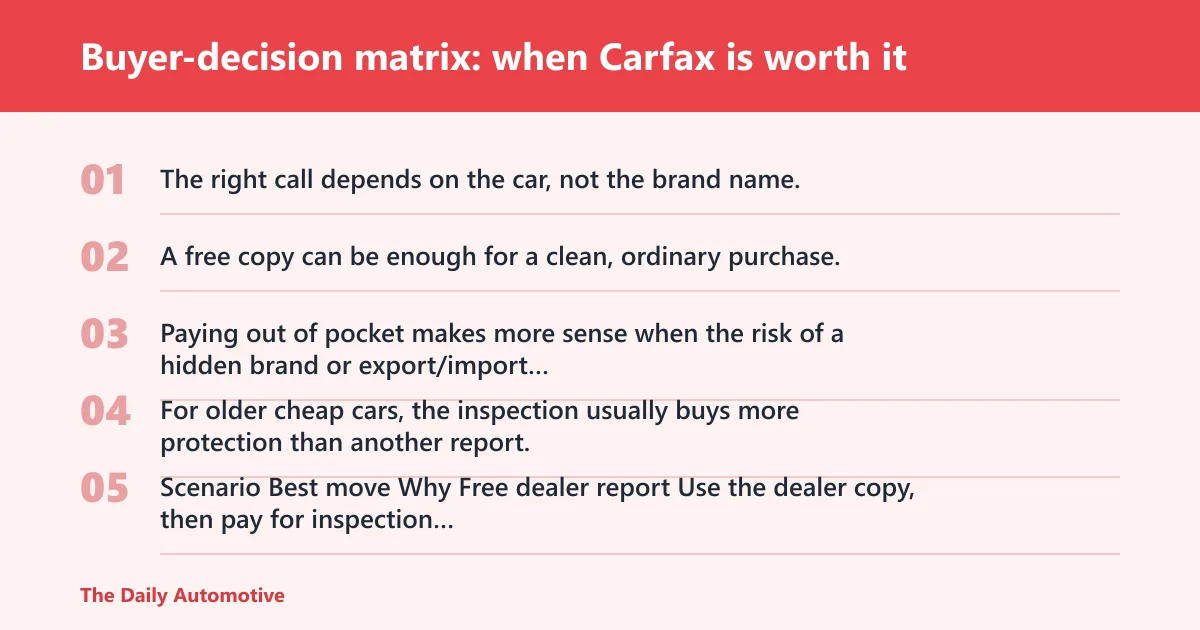
The right call depends on the car, not the brand name. A free copy can be enough for a clean, ordinary purchase. Paying out of pocket makes more sense when the risk of a hidden brand or export/import history is high. For older cheap cars, the inspection usually buys more protection than another report.
| Scenario | Best move | Why |
|---|---|---|
| Free dealer report | Use the dealer copy, then pay for inspection if the car still looks good | Same basic history screen without paying twice |
| Paying out of pocket | Buy Carfax only if the car is valuable or the history risk is unclear | Extra spend makes sense when one missed event would hurt resale or safety confidence |
| High-risk title or flood-state car | Use Carfax plus inspection, and verify title paperwork carefully | Title-brand and flood clues matter more here than on a routine commuter |
| Low-value older car | Skip paid Carfax unless the title story is odd; put money into inspection | Mechanical condition and basic rust checks matter more than another database lookup |
Scenario 1: free dealer report
Worth it if the copy is complete and the VIN matches. The dealer already paid, so the shopper should not duplicate the same purchase unless something about the car’s story looks wrong.
Scenario 2: paying out of pocket
Worth it when the vehicle is costly, rare, or likely to carry a painful resale hit if a brand appears later. If the car is ordinary and cheap, the return falls fast.
Scenario 3: title or flood-state risk
Worth it because the downside of a missed brand is larger than the report cost. In this lane, the report is part of the paperwork defense, not the whole decision.
Scenario 4: older low-value cars
Often not worth it. On these cars, a professional pre-purchase inspection and a careful title review usually matter more than a paid history report.
What to do before buying a used car
Start with the VIN. Confirm it on the dash, door label, title, and listing. Read the seller’s records. Check recalls. Look for title paperwork that matches the story in the report. Then get a professional pre-purchase inspection before money changes hands.
- Verify the VIN on every document and label.
- Check the title for brands, liens, and mismatched names.
- Review the report for accidents, theft, ownership changes, and service gaps.
- Confirm recall status with the seller’s paperwork or your own lookup process.
- Read maintenance invoices, inspection sheets, and repair notes.
- Pay for an independent inspection before you sign.
Frequently asked questions
Is Carfax worth it for buying a used car?
It is worth it when the car’s value is high enough that a hidden title brand, odometer issue, or major damage record would hurt you more than the report cost. For cheaper cars, a free dealer copy and a good inspection often make better use of the money.
What does a Carfax report include?
It can include accidents, damage, thefts, ownership changes, service and inspection records, mileage manipulation flags, import information, taxi or rental use, and recall-related history. The exact result depends on what was reported by source partners and whether the VIN has a strong paper trail.
How much does a Carfax report cost?
Pricing varies by seller and package, but VinPassed says a single Carfax report costs $44.99. Because price changes are common, the smarter question is whether the report is worth more than the risk it removes for that specific car.
Is a free Carfax from a dealer worth trusting?
Usually yes, if the VIN matches and the report appears complete. A free copy is better than paying full price for the same information, but it still has the same coverage limits. Trust it enough to guide your next step, not enough to skip an inspection.
What does Carfax miss on a vehicle history report?
It can miss out-of-pocket repairs, unreported body work, and accidents that never reached insurers, dealers, or state records. Service history can also be incomplete. That is why a clean report should be treated as a screening tool, not as proof the car has no problems.
Can a clean Carfax still hide problems?
Yes. A clean report does not rule out worn brakes, hidden rust, flood cleanup, poor collision repair, or other mechanical faults. The report can reduce history risk, but only an independent inspection can judge condition well enough for a final buying decision.
Products related to this article
Sponsored / affiliate links. As an Amazon Associate I earn from qualifying purchases. I may earn additional commission from eligible campaigns.