Hertz Rental Insurance Review: Is It Worth It for Drivers?
Hertz insurance makes sense when the daily fee is lower than the deductible gap and any coverage holes you would carry yourself. I buy it on long trips, higher-value cars, and in states with thin liability protection. Skip it poorly, and a small scrape can turn into a four-figure bill plus a claims mess. This guide breaks down the decision tree for personal auto insurance, credit-card coverage, and going bare.
This guide is part of our Car laws and compliance guide series.
Hertz rental insurance: what you are actually buying
At checkout or at the counter, Hertz offers optional rental car insurance and waivers. The label changes by location and state, but the choice usually falls into four buckets: damage to the rental car, liability to other people, medical costs, and belongings in the car. The rental agreement controls the final terms, limits, and exclusions.
Damage coverage vs liability coverage vs medical and belongings coverage
Do not treat every add-on as the same product. Loss damage waiver, sometimes called LDW or CDW, generally covers damage to or theft of the rental vehicle. Supplemental liability coverage generally covers injuries and property damage you may cause to others. Medical and belongings options cover separate losses and do not replace liability or vehicle damage protection.
Where the checkout options appear, and why names vary by location and state
These products are usually shown during booking or at the counter. The display name can change by branch, state, or vehicle class, so the printed rental agreement matters more than the screen label. That is where the actual sold coverage, exclusions, and conditions are written.
What the rental agreement controls
State rules, branch inventory, and the rental agreement itself can affect what is available and how it applies. That matters most for liability protection, where built-in protection may be limited and often pays after your own insurance. In several states, Hertz provides primary liability protection instead.
What does Hertz rental car insurance cover?
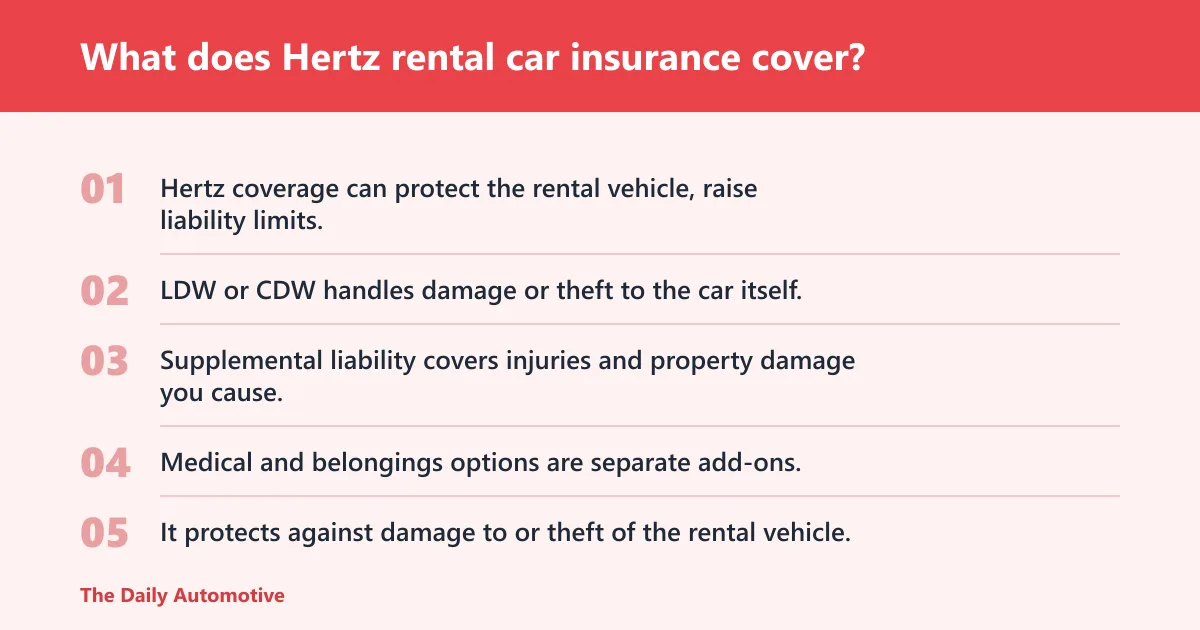
Hertz coverage can protect the rental vehicle, raise liability limits, and add medical or belongings protection, but each piece covers a different loss. LDW or CDW handles damage or theft to the car itself. Supplemental liability covers injuries and property damage you cause. Medical and belongings options are separate add-ons.
Hertz LDW / CDW for damage or theft of the rental vehicle
LDW or CDW is the core damage decision. It protects against damage to or theft of the rental vehicle, and availability and naming can vary by location and state. For many renters, this is the product that decides whether a scratched wheel, broken mirror, or theft claim lands on Hertz or on the renter’s own policy.
Hertz supplemental liability coverage for injuries and property damage you cause
Supplemental liability coverage is different from damage protection. It increases protection for injuries and property damage you cause to others, which matters when your own liability limits are low or when you are driving with a gap in borrowed-car coverage. It does not fix rental-car damage by itself.
Medical and belongings options, and their limits
Medical and belongings add-ons may cover medical costs for you or passengers, and may cover theft of items from the vehicle. They are not a substitute for auto liability or vehicle damage protection. They also do not solve every loss that follows a crash, especially if another driver, a pedestrian, or a rental-car repair bill is involved.
How does Hertz compare with your own auto policy?
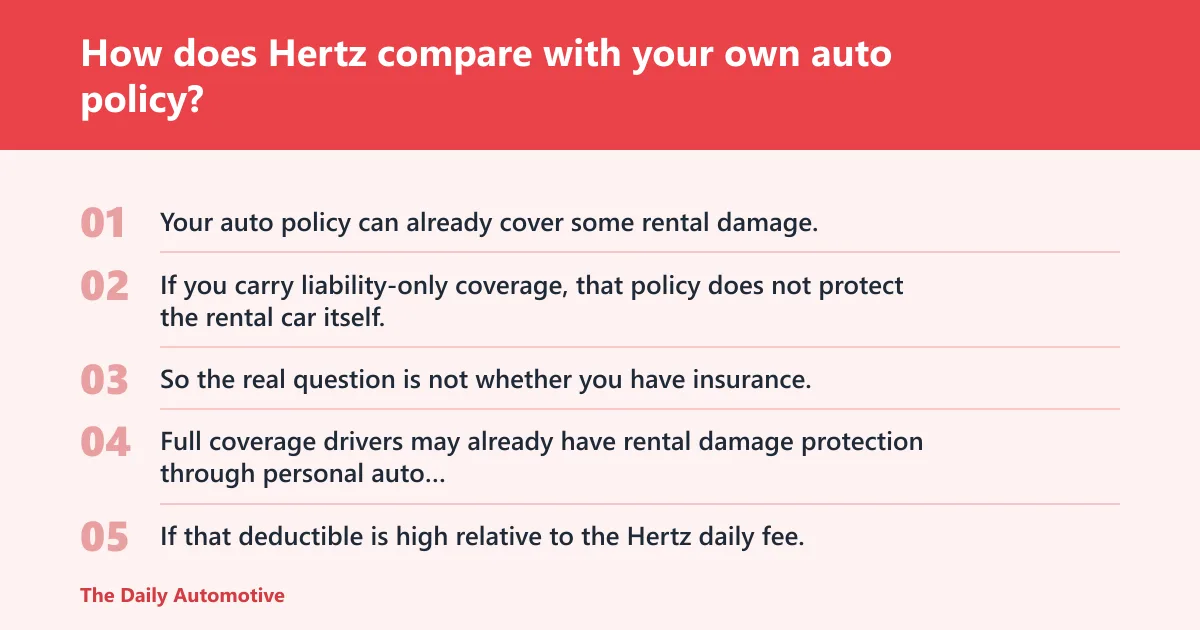
Your auto policy can already cover some rental damage, but the deductible usually still applies. If you carry liability-only coverage, that policy does not protect the rental car itself. So the real question is not whether you have insurance, but which loss is still sitting on your balance sheet after a claim.
Full coverage: where your collision and comprehensive may already apply
Full coverage drivers may already have rental damage protection through personal auto insurance, meaning the rental car loss can fall under collision and comprehensive. The catch is the deductible. If that deductible is high relative to the Hertz daily fee, buying LDW or CDW can be rational even when the damage itself would otherwise be covered.
Liability-only: the gap that Hertz can fill
Liability-only policies do not cover damage to the rental vehicle. That is a major gap, not a small one. If a renter with liability-only coverage backs into a post or takes a door ding that turns into a claim, Hertz LDW or CDW may be the difference between a limited hassle and a full vehicle-damage bill.
Deductible math and the real out-of-pocket risk
The deductible is the number that decides a lot of these purchases. If your policy deductible is around $1,000 and the LDW fee is around $18 a day, a six-day rental would cost roughly $100 for the waiver. One covered claim can justify that fast if your own policy would still leave you paying the deductible.
That math changes when the risk is low. If the trip is short, the vehicle is cheap, and the deductible is modest, paying Hertz can look expensive. If the trip is long, urban, or includes valet parking and tight garages, the daily fee may be easier to defend.
Do you need Hertz CDW if you have credit card rental coverage?
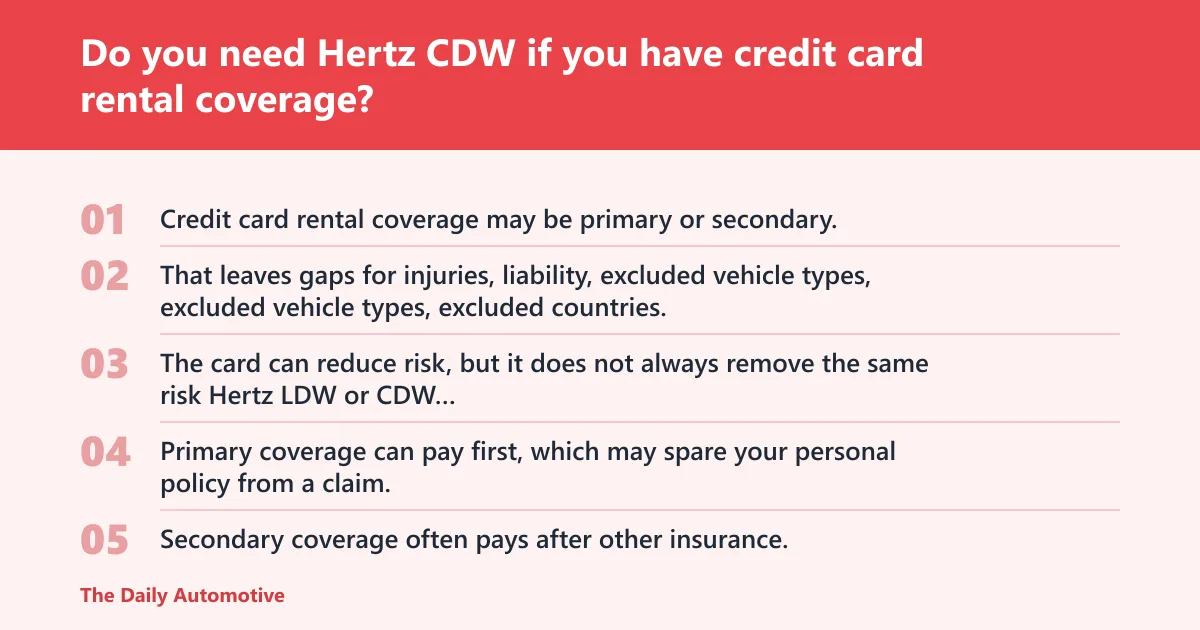
Not automatically. Credit card rental coverage may be primary or secondary, and it often focuses on damage to the rental car. That leaves gaps for injuries, liability, excluded vehicle types, excluded countries, and certain damage types. The card can reduce risk, but it does not always remove the same risk Hertz LDW or CDW would remove.
Primary vs secondary card coverage
Primary coverage can pay first, which may spare your personal policy from a claim. Secondary coverage often pays after other insurance, so the renter may still have to trigger a personal auto claim first. If the card is secondary and your policy has a deductible, the renter may still be exposed to that deductible. (medicare.gov)
Common exclusions by vehicle type, country, and damage type
Credit card rental coverage often excludes some vehicle types, locations, or kinds of damage. That matters on premium rentals, large SUVs, trucks, and international trips. It also matters when the damage is not a clean collision claim, such as theft-related loss, undercarriage problems, or claims tied to specific rental-agreement exclusions.
When a card leaves the same deductible or loss exposure you were trying to avoid
A card that is secondary may still leave the deductible in place. A card that excludes the vehicle, the country, or the damage type leaves the entire claim gap open. In those cases, Hertz LDW or CDW can be the cleaner way to close the exposure rather than hoping the card terms fit the rental.
Renter decision matrix: four coverage setups
The right choice depends on which loss is still not covered after your own policy and card benefits are considered. This matrix shows what Hertz coverage fills, what it duplicates, and what loss remains in each setup. That is the practical way to judge whether the daily cost is justified.
| Coverage setup | What Hertz fills | What it duplicates | Loss that may remain |
|---|---|---|---|
| Full coverage plus a deductible | Rental vehicle damage or theft if LDW/CDW is bought; added liability if supplemental liability is bought | Collision and comprehensive damage protection may already exist through your auto policy | Your deductible, plus any exclusion in your auto policy or card |
| Liability-only policy | Damage to the rental vehicle if LDW/CDW is bought; liability if supplemental liability is bought | Very little on vehicle damage, because the base policy does not cover the rental car itself | Vehicle damage, theft, and possibly medical or belongings losses if not separately covered |
| No personal auto policy | Vehicle damage, theft, and added liability if selected | Nothing from a personal auto policy, because none exists | Any excluded loss type, plus whatever the rental agreement does not cover |
| Credit-card-only coverage | Possible vehicle-damage help if the card is primary and the claim fits its rules | May duplicate some vehicle-damage protection | Liability to others, injuries, excluded vehicles, excluded countries, and any deductible or secondary-claim gap |
Choose Hertz if… / Choose your own coverage if…
A practical rule is to consider buying Hertz only when the daily fee is lower than the deductible, exclusion, or liability risk you still have. Skip it when your own policy or card already closes the same loss cleanly. That decision gets easier once the trip type and vehicle class are known.
Choose Hertz if…
- Your personal policy has a high collision or comprehensive deductible.
- Your card is secondary and would leave you paying that deductible first.
- Your card excludes the vehicle, the country, or the damage type.
- You are renting a vehicle where a scratch, theft, or tow bill would be expensive relative to the daily fee.
Choose your own coverage if…
- Your auto policy already covers rental damage and the deductible is small.
- Your card gives primary rental coverage that cleanly applies to the trip.
- You already have enough liability protection and do not need extra limits.
- The Hertz add-on would duplicate protection you already own without closing any extra gap.
- Check whether your policy includes collision and comprehensive on rentals.
- Write down the deductible amount.
- Read the card benefit guide for primary or secondary status, exclusions, and vehicle limits.
- Compare those numbers to the daily Hertz fee and the trip length.
- Buy Hertz only when it closes a real gap, not a duplicate one.
Does Hertz insurance make more sense in some states or trip types?
Yes. Primary liability rules, state law, trip length, and driving environment can change the value of Hertz coverage. Massachusetts, Michigan, New York, South Carolina, Virginia, and West Virginia are listed among states where Hertz provides primary liability protection, depending on the rental agreement and state rules. That matters when your own liability limits are thin.
Primary liability states and why they matter
Built-in liability protection may be limited and often pays after your own insurance, but Hertz primary liability protection is specifically mentioned for Massachusetts, Michigan, New York, South Carolina, Virginia, and West Virginia. If you are renting in or through one of those states, the liability decision needs a close look at the agreement and state rules.
Out-of-state renters and business travelers
Out-of-state renters and business travelers often rely on card benefits and employer policies that were written for a different trip profile. That can create coverage drift. A renter may assume the corporate or card benefit applies, then find a state rule, vehicle class, or secondary-coverage clause that leaves a gap.
When a one-way, urban, or international-style trip raises exposure
One-way rentals, dense city parking, valet handling, and international-style driving conditions can raise the chance of a claim. The more handoffs, curbs, garages, and tight spaces a trip includes, the more useful Hertz LDW or CDW can become. Liability exposure also grows when traffic density and injury risk go up.
What coverage gaps should I watch for when renting from Hertz?
The main gaps are deductible exposure, secondary card coverage, liability limits, and exclusions tied to vehicle type or state rules. The renter should also separate damage, liability, medical, and belongings coverage instead of assuming one add-on fixes all four. The rental agreement, not the checkout label, decides the final gap.
Deductible exposure on your own policy
Even when personal auto insurance covers the rental car, the deductible still matters. A renter who would pay $750 or $1,000 out of pocket after a claim may find Hertz LDW or CDW worth buying if the rental lasts long enough for the daily fee to stay below that exposure.
Secondary card coverage that does not pay first
Secondary card coverage can leave the renter in the middle of two claims processes. If the card pays after other insurance, the personal policy may still be the first bill. That means the rental can still create deductible loss, paperwork, and timing delays even when a credit card benefit exists.
Belongings and medical coverage are not liability coverage
Medical and belongings options sound broad, but they do not replace auto liability or vehicle damage coverage. A renter who is worried about hitting another car, injuring a passenger, or totaling the rental should look at liability and LDW or CDW first. Those are different risks with different fixes.
Frequently asked questions
Is Hertz rental insurance worth it if I already have full coverage?
It can be, but only when the deductible or an exclusion is large enough to justify the daily fee. Full coverage may already protect the rental car, yet the renter still pays the deductible if a claim is filed through the personal policy. That is the number to compare against Hertz pricing.
What does Hertz rental car insurance cover?
Coverage options can include protection for damage or theft of the rental vehicle, supplemental liability for injuries and property damage you cause, and possibly medical or belongings coverage. These are separate products. LDW or CDW is about the car itself, while liability and medical add-ons address different parts of the loss.
How much is Hertz rental car insurance?
The daily price varies by location, vehicle, and the specific add-on presented at booking or the counter. Because names and availability can vary by state, the smart comparison is not a generic rate but the fee versus your deductible and any uncovered loss that would remain after a claim.
Do I need Hertz CDW or LDW if I have credit card rental coverage?
Maybe not, but many card benefits are secondary, not primary, and often focus on damage to the rental car only. They can also exclude certain vehicles, countries, or damage types. If the card leaves the same deductible or liability gap you want to avoid, Hertz may still be worth buying.
What happens if I only have liability insurance and rent from Hertz?
Liability-only insurance does not protect the rental car itself. That leaves a large damage gap if the car is scratched, stolen, or damaged in a crash. In that setup, Hertz LDW or CDW is often the main way to avoid paying the rental-vehicle repair or replacement bill personally.
Does Hertz provide primary liability coverage in every state?
No. Built-in liability protection is usually limited and often pays after your own insurance. Primary liability is mentioned for Massachusetts, Michigan, New York, South Carolina, Virginia, and West Virginia, depending on the rental agreement and state rules. The rental contract and location still control the final answer.
Products related to this article
Sponsored / affiliate links. As an Amazon Associate I earn from qualifying purchases. I may earn additional commission from eligible campaigns.