Car Seat Sun Shade Cost / Price / How Much
Car seat sun shades are often priced at about $8 to $30 for a single shade, about $12 to $25 for a two-pack, and about $20 to $50 for premium or specialty designs. Choose too cheap a shade, and fit often suffers, sun blocking drops, or the adhesive fails after a few weeks. This guide breaks down prices by shade type, pack count, and feature level so you can compare options fast.
What you pay

Price follows use case first, then fit, materials, and attachment quality. Side-window shades sit in the widest middle band because they need to hold while driving. Infant car seat canopies can cost less or more depending on coverage and headrest compatibility. Windshield shades cost more when you want bigger coverage, faster setup, or easier storage.
Price bands by use case
For side windows, a basic mesh or polyester panel is usually the lowest-cost choice. Add a stronger frame, curved-window coverage, or a better cling or clamp system, and the price rises. For infant car seat canopies, you pay for universal fit, shell coverage, and extras like mesh windows or bug protection. Windshield shades cost more when they use silver-coated fabric, a stiff foldable frame, or an umbrella-style design.
What drives the price up
Three things usually move the number: coverage, attachment method, and claims. A larger published size does not always mean better fit if the window is curved, but larger panels and better shape memory often cost more. UPF 50+ and claims like 98.6% UV blocking or 99% UV can also put a product into a higher band, especially when paired with better storage or more durable materials.
Sale price versus regular price
Sale pricing can make a shade look like a bargain, but it should not be confused with the normal market price. One infant-car-seat shade in the Manito collection starts at $32.99 for one variant, and the stroller-and-car-seat shade shows a sale price of $31.99 on several colors. That gives useful context, but the regular price, fit, and pack count still matter more than a temporary discount.
Car seat sun shade table
This table turns use case into a practical buying range. The cost per panel or per use matters because a cheap-looking listing can hide a weak fit, a small panel, or a one-off design that only works on one window shape.
| Use case | Typical entry price | Typical mid price | Typical premium price | Cost per panel or use | What justifies paying more |
|---|---|---|---|---|---|
| Side-window shades | $8-$12 | $15-$25 | $25-$40 | About $4-$20 per panel, depending on 1-pack, 2-pack, or 4-pack count | Better fit on curved glass, stronger cling or clamp systems, UPF 50+ claims, and larger panels such as 20 x 12 in or 15 x 19 in |
| Infant car seat canopies | $12-$20 | $20-$35 | $35-$60 | About $12-$35 per use, since many are sold as a single canopy | Universal-fit coverage around the shell, mesh windows, bug protection, and compatibility with seats that need headrest or side-bolster support |
| Windshield shades | $10-$18 | $18-$30 | $30-$50 | About $10-$50 per shade, depending on whether it is a single foldable panel or a specialty umbrella-style design | Wider coverage around 57-64 inches, better heat reflection, easier storage, and sturdier frames for repeated parked use |
Which shade type do you need?
The right price starts with the right job. Side-window shades are for driving and rear-passenger windows. Infant car seat canopies are for the seat itself. Windshield shades are for parked cars, not for driving. If you buy the wrong category, even a low price becomes poor value.
Say your rear passenger window is the problem, not the front glass. A side-window shade with a two-pack listing and a published size around 20 x 12 in may make more sense than a windshield shade, because the job is to cut glare and UV while the car is moving.
Suppose you are trying to shade an infant carrier during a stroller-to-car transfer. A canopy that covers the seat shell and uses UPF 50+ fabric is a better fit than a clip-on side-panel shade, even if the canopy costs more per item.
Side window shades for driving
These are the most common car seat sun shades for families with children in back. They usually come as a 1-pack, 2-pack, or 4-pack, and many use mesh, polyester, or silver-coated fabric. Popular attachment methods include cling, clips, suction cups, and clamp systems. A shade that stays up while driving should fit the actual glass, not just the trim around it.
Infant car seat canopies
These wrap around the seat shell rather than covering the window. The infant car seat canopy guide treats UPF 50+ as a core filter, and the best overall infant-car-seat shade measures 15.75 x 27.5 inches. A universal-fit canopy can work well, but some seats need headrests or side bolsters to keep the canopy positioned correctly.
Windshield shades for parked cars
Windshield shades are built for parked use and cabin heat reflection. They usually fold flat or use an umbrella-style frame. The listed sizes in this category are often wide, with examples such as 57.1 x 31.5 in, 57 x 33 in, or 64 x 32 in. Price rises when the shade covers more glass and stores more easily.
How much do side-window shades cost?
Side-window shades usually cost less than premium windshield shades, but the price depends on panel size, attachment method, and pack count. A normal range for a rear-window pair is often in the mid-teens to mid-twenties, while better-fitting or higher-claim versions can move higher. The best value is usually the shade that actually covers the glass without sagging or leaving gaps.
Typical sizes and coverage
Published panel sizes matter because side windows vary more than people expect. One best overall side-window pick is a 20 x 12 in two-pack. Another side-window option lists 15 x 19 in panels in a two-pack. If the shade is too small, sunlight slips around the edges, especially on curved windows.
Attachment methods and price
Cling panels tend to be the cheapest. Suction cups and clips often sit in the middle. Clamp systems and patented clamp systems usually cost more because they are designed to hold better on heat-softened trim or unusual glass shapes. A higher price is worth it when the shade must stay put on a rear passenger window all summer.
1-pack, 2-pack, and 4-pack value
Pack count can hide the real unit cost. A 2-pack may cost more up front than a single shade, but it can be the better value if you need both rear windows covered. A 4-pack can look cheap per panel, yet still be a poor buy if two panels are too small for your rear doors or if only one seat needs shade.
What does an infant car seat canopy cost?
Infant car seat canopies usually cost more than the cheapest side-window shades, because they cover the seat shell rather than a flat window. A normal price for a baby car seat sun shade depends on whether it is a simple cover or a fuller canopy with mesh panels and bug protection. Universal-fit claims help, but they do not remove all fit limits.
Universal-fit claims and limits
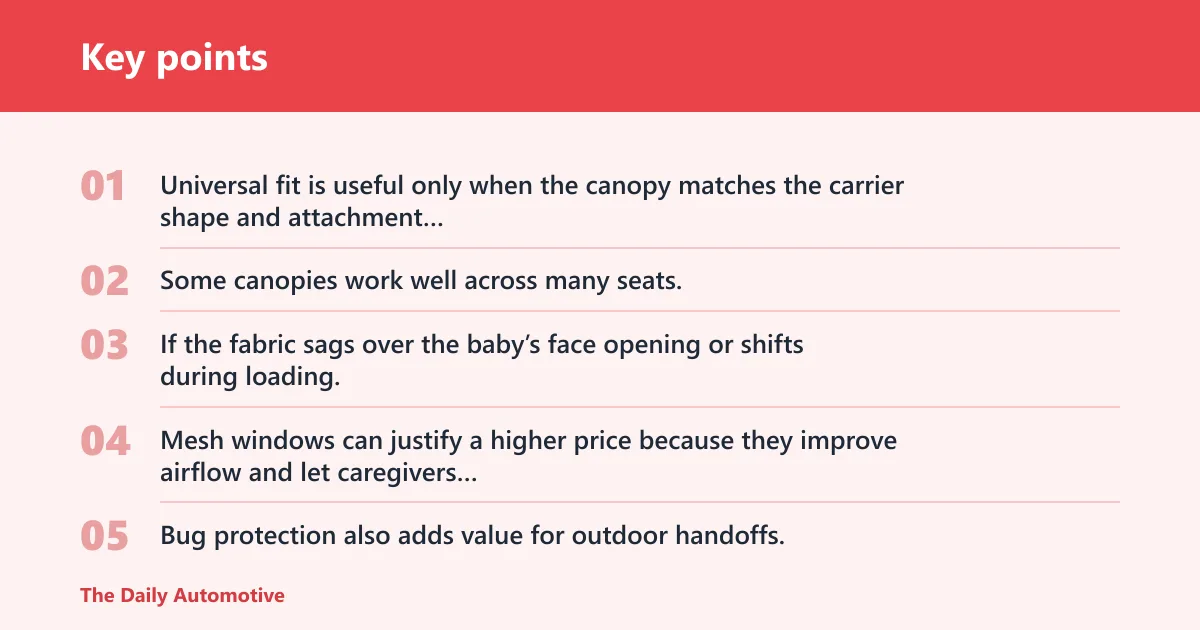
Universal fit is useful only when the canopy matches the carrier shape and attachment points. Some canopies work well across many seats, but others need headrests or side bolsters to stay centered. If the fabric sags over the baby’s face opening or shifts during loading, the shade is not doing its job, even if the label looks generous.
Mesh windows and bug protection
Mesh windows can justify a higher price because they improve airflow and let caregivers check on the child without removing the canopy. Bug protection also adds value for outdoor handoffs. These features tend to push a canopy into the mid or premium band, especially when the fabric is paired with UPF 50+ coverage.
When higher-cost canopies make sense
Pay more when the carrier needs full shell coverage, the canopy has to stay aligned during frequent in-and-out use, or you want a design that is easier to fold and pack away. The Manito line shows how price can land in the low-$30s for one variant, which is reasonable when the product combines canopy coverage with stroller use and better materials.
What makes a windshield shade pricier?
Windshield shades cost more when they are larger, easier to store, or built to handle repeated folding. They are not meant for driving. They are for parking, where the goal is to cut direct sun and help keep the dash and cabin from heating as quickly. A larger shade with better reflection usually costs more than a basic panel.
Foldable versus umbrella-style designs
Foldable shades are common and often cheaper. Umbrella-style shades cost more because the frame opens fast and folds into a smaller bundle. A windshield umbrella shade is listed at 57 x 33 in, while a premium windshield shade is listed at 64 x 32 in. That extra coverage can matter on wider windshields and larger dashboards.
Width, height, and coverage
Coverage size is where many buyers lose value. A shade can have a good-looking price and still leave exposed sun gaps if the width is too narrow or the top corners do not match the windshield slope. Actual glass coverage matters more than marketing language. If your vehicle has a tall windshield, a 57.1 x 31.5 in shade may be too short or too narrow to fully block the glass.
Heat reflection and storage features
Silver-coated fabric and stiff reflective panels usually push the price up. So does a design that folds cleanly without fighting you every time it goes back into the door pocket. These features are worth paying for when the shade will be used daily and stored often, because a floppy shade that is annoying to install gets abandoned quickly.
Frequently asked questions
How much do car seat sun shades cost?
Most car seat sun shades land between $8 and $30 for a basic single shade, with two-packs often between $12 and $25. Premium or specialty designs can run $20 to $50 or more. The real price depends on shade type, pack count, attachment method, and whether the product is for a window, a carrier, or a windshield.
What is a normal price for a baby car seat sun shade?
A normal price for a baby car seat sun shade is usually in the low-to-mid $20s for a solid universal-fit canopy, with cheaper entry options below that and premium versions above it. If the canopy includes UPF 50+, mesh panels, or extra coverage around the shell, a higher price is easier to justify.
Are cheaper car sun shades worth it?
Cheaper shades can be worth it when you only need light glare reduction and the window shape is simple. They are less appealing when the window is curved, the shade must stay up while driving, or you need stronger fit and UV claims. A low price is not a bargain if the shade falls off or leaves exposed edges.
What size sun shade do I need for a rear car seat?
Start with the actual rear-window measurements, then compare them to the published panel size. A side-window shade that is too short can leave sun gaps near the top or along the door frame. For many rear windows, a 20 x 12 in two-pack or a 15 x 19 in pair is in the right neighborhood, but the glass shape still decides the fit.
Do car seat sun shades block heat or just light?
They block some UV and reduce glare, but they do not usually drop cabin temperature dramatically by themselves. Windshield shades with reflective or silver-coated fabric do more for parked heat, while side-window shades are mainly for driving comfort and sun control. A UPF 50+ claim says more about UV protection than about total heat removal.
What is the difference between side window shades and windshield shades?
Side window shades are made to stay on while the car is moving, usually with cling, clips, suction cups, or clamps. Windshield shades are parked-car tools. They are larger, often foldable or umbrella-style, and usually focus on heat reflection rather than daily driving visibility. They solve different problems, so they should not be compared as the same product.
Products related to this article
Sponsored / affiliate links. As an Amazon Associate I earn from qualifying purchases. I may earn additional commission from eligible campaigns.