Car Seat Mirror Cost: What You’ll Pay
A baby car seat mirror usually costs about $10 to $40, while a rear-facing car seat camera often runs about $60 to $200. Pick the camera if you want a clearer view and can pay more. Buying the wrong mirror wastes money, gives poor visibility, or creates a distraction for the driver. This guide breaks down car seat mirror prices, what changes the cost, and how mirrors compare with cameras for rear-facing travel.
Typical cost range
Most baby car seat mirrors are commonly grouped into three price bands: under $15, $15 to $30, and $30 and up. Price usually tracks with mirror size, strap quality, vibration control, and the finish on the mirror surface.
Budget mirrors under $15
At the low end, you usually get a simple convex mirror, basic headrest straps, and limited adjustability. These work best in cars with a straightforward rear-seat headrest layout and a stable seatback, but they may shake more on rough pavement and often use thinner frames.
Midrange mirrors from $15 to $30
This band is where many shoppers land. You tend to get stronger straps, broader adjustment, and better resistance to blur from vibration. Many universal-fit models sit here because they balance price and day-to-day usefulness without moving into camera-system pricing.
Premium mirrors at $30 and up
Premium mirrors usually justify the extra cost with larger viewing surfaces, wider tilt or rotation ranges, more secure mounting hardware, or bundle pricing with more than one mirror. Some brands also use higher-grade materials or add anti-glare treatments, which can help in bright backlight or at dusk.
Car seat mirror cost table
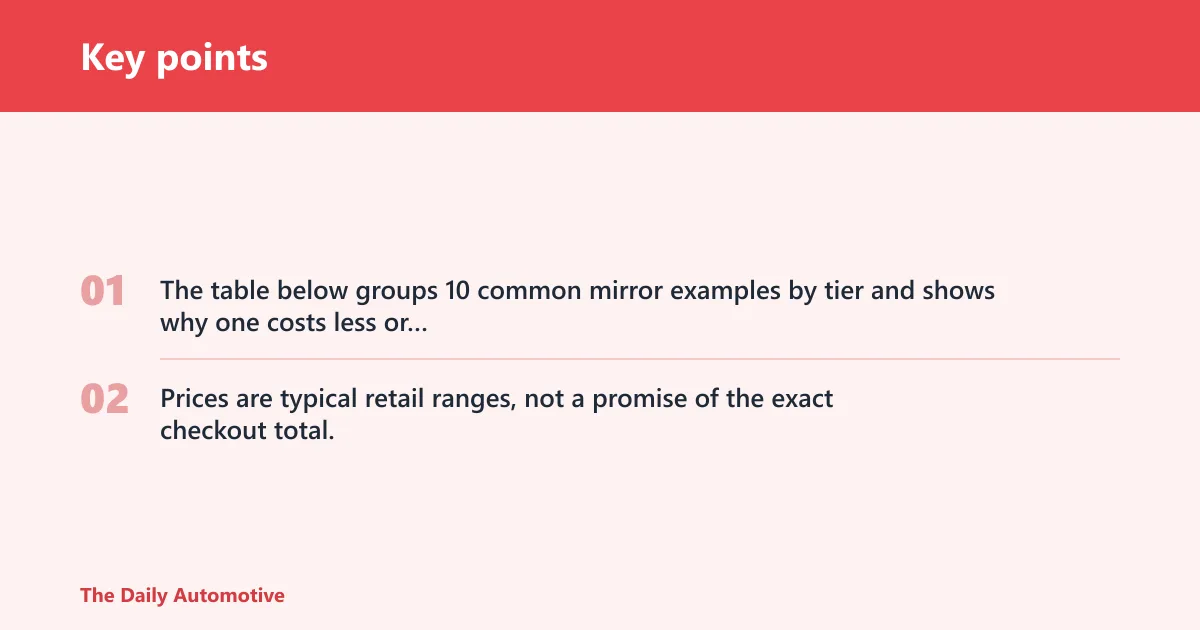
The table below groups 10 common mirror examples by tier and shows why one costs less or more than another. Prices are typical retail ranges, not a promise of the exact checkout total, because promotions and bundle deals change often.
| Tier | Example | Price | Mounting style | Mirror size | Adjustability | Shatter-resistant material | Better for |
|---|---|---|---|---|---|---|---|
| Budget | Shynerk basic rear-seat mirror | $10–$13 | Headrest straps | Medium | Simple tilt | Yes, acrylic | Small cars |
| Budget | BabyLoupe compact convex mirror | $11–$14 | Strap-on headrest mount | Small | Basic angle set | Yes, acrylic | Small cars |
| Budget | Brica mini mirror | $12–$15 | Elastic straps | Medium | Moderate tilt | Yes, shatter-resistant plastic | SUVs |
| Budget | Munchkin rear-view mirror | $13–$15 | Headrest straps | Medium | Limited swivel | Yes, acrylic | Small cars |
| Midrange | Itomoro extra-large mirror | $16–$20 | Wide strap mount | Large | Wide tilt range | Yes, acrylic | SUVs |
| Midrange | Sunferno panoramic mirror | $18–$23 | Dual strap headrest mount | Large | Multi-angle | Yes, acrylic | SUVs |
| Midrange | Benbat deluxe mirror | $20–$28 | Adjustable straps | Large | Good rotation | Yes, acrylic | SUVs |
| Premium | Diono XL mirror | $30–$35 | Reinforced straps | Extra-large | Broad tilt and swivel | Yes, acrylic with anti-glare finish | SUVs |
| Premium | GroomTech extra-wide mirror | $32–$38 | Stabilized strap system | Extra-large | High adjustability | Yes, safety glass or acrylic | SUVs |
| Premium | Bundle pack mirror pair | $35–$45 | Headrest straps | Large | Independent positioning | Yes, acrylic | Minivans |
Why prices vary
Two mirrors can look similar and still sit in different price bands. The difference usually comes from the strap hardware, the size of the reflective surface, how much the mirror moves, and whether the maker adds coatings or sells the mirror as a single unit or in a bundle.
Mounting straps and vibration control
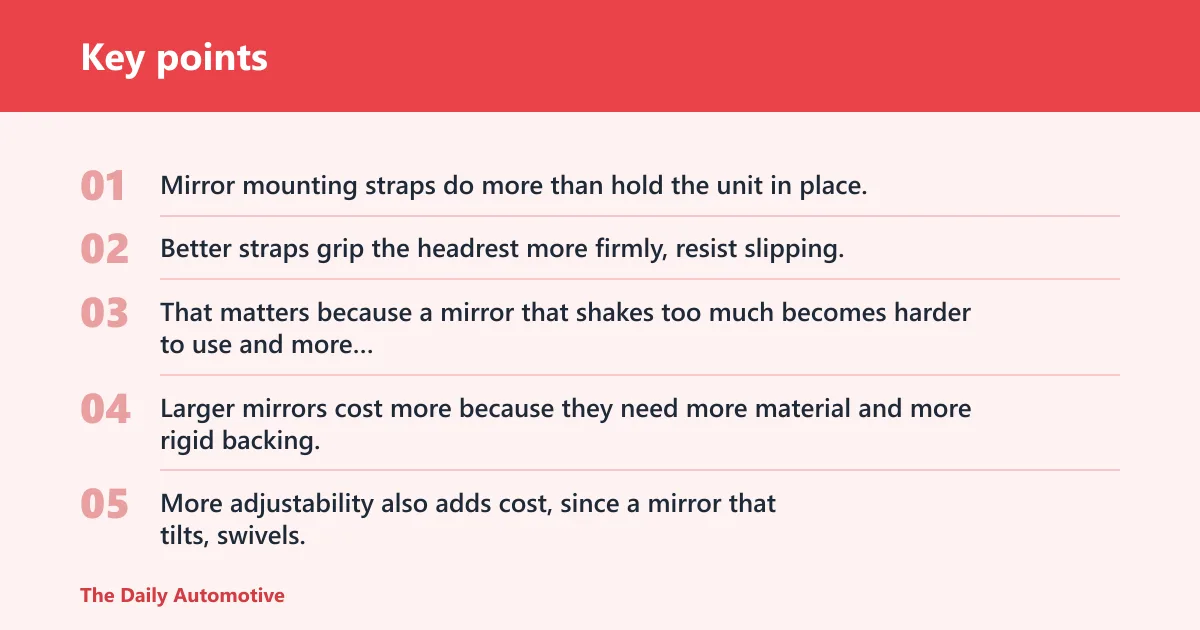
Mirror mounting straps do more than hold the unit in place. Better straps grip the headrest more firmly, resist slipping, and reduce vibration blur at highway speed. That matters because a mirror that shakes too much becomes harder to use and more distracting than helpful.
Mirror size and adjustability
Larger mirrors cost more because they need more material and more rigid backing. More adjustability also adds cost, since a mirror that tilts, swivels, and rotates smoothly takes better hardware than a fixed-angle unit. This matters most in vehicles where the baby seat sits low or off-center.
Materials and coatings
Look for shatter-resistant acrylic or safety glass, a convex shape for a wider view, and, on some premium models, an anti-glare coating. Those details usually cost more than a plain reflective surface, but they can improve night visibility and cut down on washed-out daytime glare.
Brand and bundle pricing
Branded baby gear names, including Chicco and other nursery brands, often cost more than no-name products with the same general layout. Bundle pricing also changes the number. A pair of mirrors for two rear-facing seats can cost more upfront, even if the per-unit price drops.
What a car seat mirror does for rear-facing seats
A baby car seat mirror is a rear-facing visibility accessory that usually straps to the rear-seat headrest so the driver can glance at the infant without twisting around. Most models are universal-fit, but headrest shape, seatback angle, and rear-seat layout still decide whether the mirror sits where you need it.
How the view works
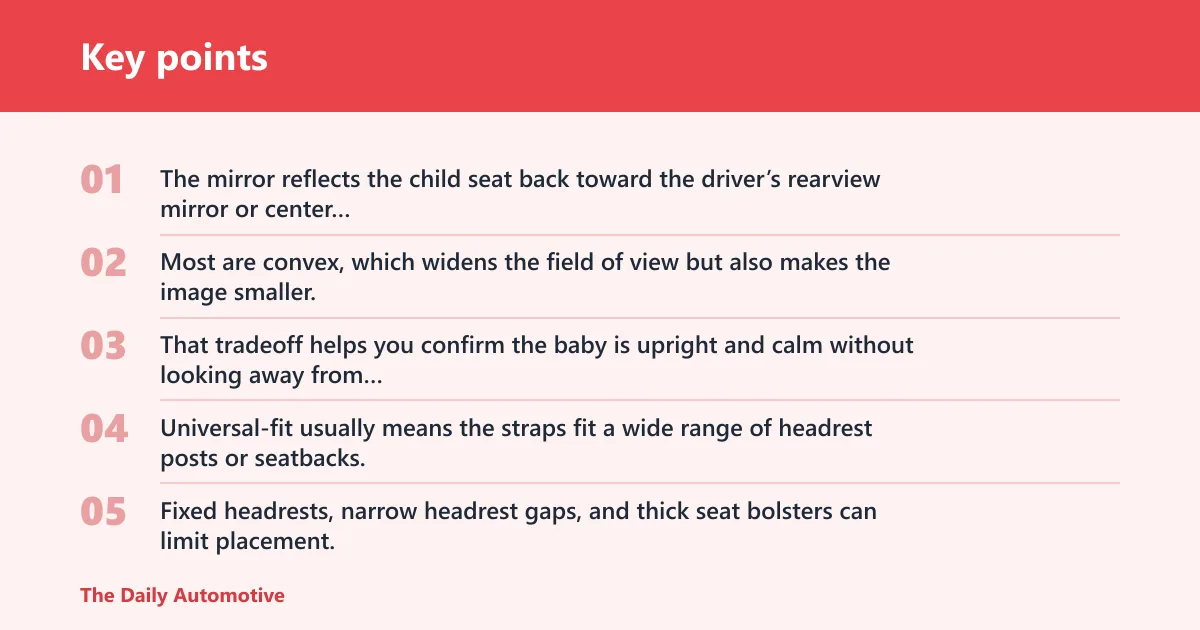
The mirror reflects the child seat back toward the driver’s rearview mirror or center mirror line. Most are convex, which widens the field of view but also makes the image smaller. That tradeoff helps you confirm the baby is upright and calm without looking away from the road for long.
What universal fit usually means
Universal-fit usually means the straps fit a wide range of headrest posts or seatbacks, not every vehicle with equal ease. Fixed headrests, narrow headrest gaps, and thick seat bolsters can limit placement. A mirror may install, then still point at the wrong angle.
Where mirror placement matters most
Placement matters because the mirror must line up with your driving position, not only the car seat. In a compact sedan, the rear-seat view may be shorter and easier to center. In a minivan or SUV, more distance can require a larger mirror or a stronger tilt range.
Suppose a compact hatchback has fixed rear headrests and the mirror sits too high. The view may catch the headliner instead of the infant seat, even though the listing says “universal.” In that case, a lower-profile mount or a different strap path matters more than brand name.
A common first-timer mistake is buying the largest mirror on the shelf for a small sedan. The extra size can create more shake and make the driver look through a bigger area than needed. A medium mirror with better stability often works better.
How much does a car seat camera cost?
A car seat camera usually costs about $60 to $200. It also needs power or charging, which adds setup steps and another failure point.
Mirror vs camera price gap
The price gap is the main reason many parents start with a mirror. A mirror can cost under $15 and install with straps in minutes. A camera system adds a display, wiring or battery management, and the risk that the screen or power supply stops working when you need it.
Power and charging requirements
Unlike a mirror, a camera is not passive. It needs a power source, a charged battery, or a cable routed through the cabin. That can be fine in a family vehicle, but it is more complicated than a strapped-on mirror, especially if you want a clean installation.
When a camera may be worth the extra cost
A camera can be worth it if your rear seat sits too low for a mirror, if glare keeps washing out the reflection, or if you want a live view with less guesswork at night. It also helps when a rear-facing seat blocks the line of sight from the front cabin.
Will it fit your vehicle?
Fit depends less on the label and more on your rear-seat hardware. Adjustable headrests usually make mirror placement easier. Fixed headrests, short seatbacks, and odd seat angles can limit how well the strap system holds the mirror and whether you can aim it at the child seat.
Fixed headrests vs adjustable headrests
Adjustable headrests usually offer more anchor points and better strap tension. Fixed headrests can be trickier because the straps may not tighten evenly around the seat structure. If the mirror shifts after cornering or braking, the problem is usually the mount, not the reflective surface.
Small cars vs SUVs and minivans
Small cars often need a compact mirror because the distance from the front seat to the rear seat is shorter. SUVs and minivans usually benefit from a larger reflective area and stronger adjustability, since the driver sits farther from the baby seat and needs a clearer angle.
Chicco and other brand compatibility
Some baby gear brands sell mirrors that are marketed alongside their seats, but the fit still comes down to headrest geometry and strap length. Universal-fit claims are useful, yet not enough by themselves. Compare the mirror’s width, strap reach, and rotation range with your rear-seat layout.
Choose a mirror if… / Choose a camera if…
Choose a mirror if you want the lowest cost, a quick strap-on setup, and no power cable to manage. Choose a camera if you want a live image, your rear-seat layout makes a mirror hard to aim, or you are willing to pay more for a clearer view.
| Choose a mirror if… | Choose a camera if… |
|---|---|
| You want to stay under $30. | You can spend $60 to $200. |
| Your vehicle has usable headrests. | Your seat layout blocks a mirror angle. |
| You want simple, battery-free setup. | You want a live display. |
| You can live with some reflection blur at speed. | You want less dependence on rear-view alignment. |
Frequently asked questions
How much does a car mirror cost?
For a baby car seat mirror, expect about $10 to $40 depending on size, strap quality, and materials. For an exterior vehicle mirror, the number is much higher because you are replacing a powered, painted, and often heated assembly, not a simple rear-facing accessory.
How much is a new car mirror?
If you mean a baby seat mirror, a new one usually stays around $10 to $40. If you mean the side mirror on a car, the replacement cost is a different category entirely and can run from under $100 to several hundred dollars with labor.
How much to replace car mirror
Replacing an exterior car mirror can cost roughly $150 to $700 or more depending on the vehicle, paint match, heating, blind-spot hardware, and whether the shop needs to program electronics. A baby seat mirror does not belong in that cost bucket.
How much to replace passenger side mirror
Passenger-side mirror replacement is usually a body shop or dealer repair, not a baby accessory purchase. The cost depends on whether the mirror is manual, power-adjustable, heated, or camera-equipped. That is separate from a rear-facing child seat mirror, which straps to the interior.
Best car seat mirror
The best car seat mirror is the one that fits your headrests, stays stable, and gives a clear view without wobble. For many shoppers, that means a midrange model with a secure strap system, a convex surface, and enough tilt to aim through the rearview mirror.
Car seat camera vs mirror
A mirror costs less, installs faster, and has no power requirement. A camera costs more, needs power or charging, and can give a clearer live image, especially at night or when the rear seat blocks the line of sight. The right pick depends on budget and cabin layout.
Products related to this article
Sponsored / affiliate links. As an Amazon Associate I earn from qualifying purchases. I may earn additional commission from eligible campaigns.
 PartsTo Adjustable Kids Travel Car Seat Headrest Pillow with Lean Support Cushion Sleeping Travel Neck Safeguard Cushion Suitable for Kids Children Teenagers and Adults
 FLORICH Front Car Seat Covers, Leather Seat Covers for Cars, Waterproof Car Seat Protector Breathable, Front Seat Covers for Cars, Automotive Seat Covers Universal Fit for Most SUV Pick-up Truck