Chicco Car Seat Mirror Review: Is It Worth the Price?
The Chicco mirror is worth the extra money only if you want a Fit360-specific fit and cleaner installation. For most parents, a good generic mirror is the better value, while a baby monitor wins if you want no seatback hardware at all. A bad fit can mean a shaky view, more installation friction, and a mirror that gets in the way of rear-seat access. This guide checks compatibility, fit on the Fit360, installation steps, safety concerns, and whether the price premium makes sense.
Verdict: is the Chicco mirror worth it?
For a Chicco Fit360 owner who wants an accessory built around that seat and base, the mirror can make sense. If you only need a rear-facing view, though, a cheaper generic mirror often gives the same basic benefit for less money and with fewer brand ties.
The value question is simple: what are you paying for? Here, you are paying for a manufacturer-approved mirror made for the Fit360 Rotating Convertible Car Seat, sold separately from the seat, and intended for rear-facing use only. That narrower fit can reduce guesswork, but it also cuts down flexibility.
Suppose your toddler is still rear-facing in a Fit360 and you want a cleaner, integrated setup for daily school runs. The Chicco mirror may be worth the premium. Suppose you switch vehicles often, or may replace the seat soon. A generic rear-facing mirror is usually the better buy.
Bottom line for Fit360 owners
If you already own the Fit360 and plan to keep using it rear-facing, the Chicco mirror is the more tailored choice. The factory-specific attachment matters most when you care about fit, reduced clutter, and staying inside the manufacturer’s intended system.
When the premium makes sense
The premium makes the most sense when you want one accessory built to pair with the seat, base, and rear-facing setup. It also makes sense if you want a matched look; the Anthracite/Grey colorway is intended to coordinate with the seat.
When a cheaper mirror is the better buy
If your main goal is simply seeing a rear-facing child without turning around, a generic mirror can do the job. You do not get a new function from the Chicco version, you mainly get Fit360-specific integration.
📊 The mirror accessory is sold separately from the Fit360 seat. Source: Chicco Fit360 Rotating Convertible Car Seat Review.
What the Chicco Fit360 mirror actually fits
The Chicco Fit360 Mirror Car Seat Accessory is designed specifically for the Fit360 Rotating Convertible Car Seat. It is rear-facing only and attaches to the Fit360 base, so it is not a universal mirror for other seats.
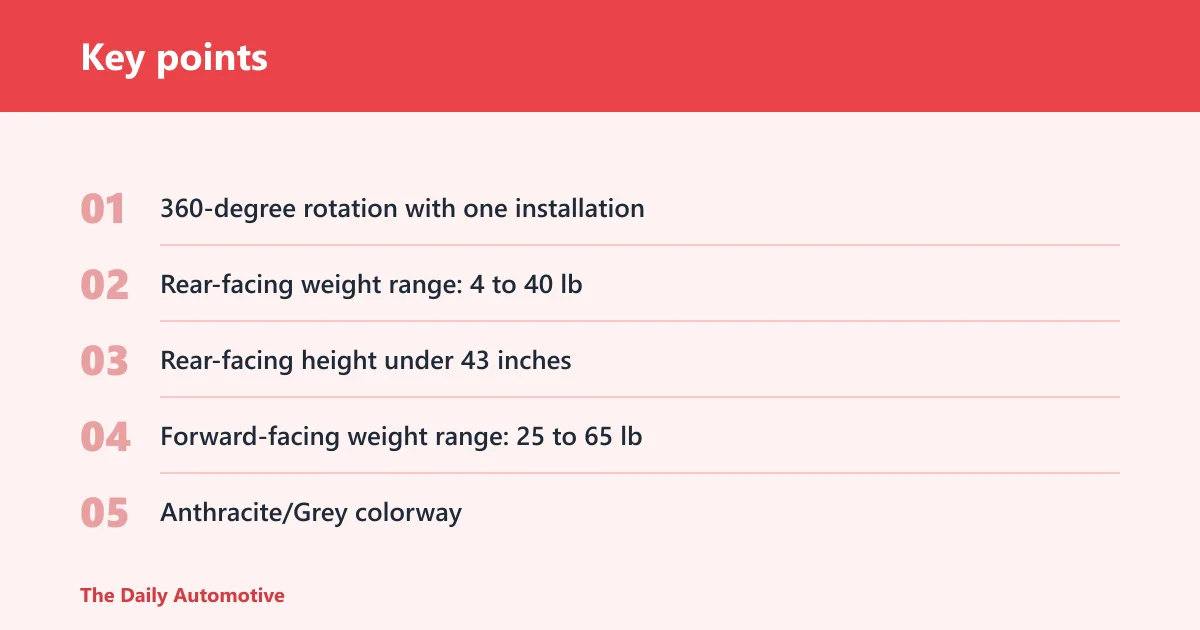
That matters because the Fit360 itself is a rotating seat with one-installation convenience, six recline positions, and a no-rethread strap system. The seat’s rear-facing weight range is 4 to 40 pounds, and its rear-facing height range is under 43 inches. Forward-facing use runs from 25 to 65 pounds and 28 to 49 inches tall, but the mirror does not follow the seat into that mode.
The accessory is sold separately from the seat. It is presented as manufacturer-approved and crash-tested, which is a stronger fit claim than a generic mirror can usually make.
How the rotating seat changes the value question
A rotating seat changes how much convenience a mirror can add. If you can turn the seat toward the door for loading, the mirror matters less for daily access and more for keeping a steady view once the seat is locked back into rear-facing position.
That also raises the bar for fit. A mirror that works on a fixed seat can become annoying on a rotating base if it sits too low, bumps trim, or adds handling friction every time the seat turns.
Key seat specs that matter for compatibility
- 360-degree rotation with one installation affects how much clearance the accessory needs.
- Rear-facing weight range: 4 to 40 lb defines the phase when the mirror is relevant.
- Rear-facing height under 43 inches limits which children remain in that mode.
- Forward-facing weight range: 25 to 65 lb shows when the mirror stops mattering.
- Anthracite/Grey colorway is mainly a visual match, not a performance feature.
How does the Chicco mirror attach?
The Chicco mirror attaches to the Fit360 base, not to the child seat shell the way a universal accessory would. That base-mounted approach is the feature that gives the accessory its specific fit, but it is also the part that can create clearance and handling issues in some vehicles.
Because the mirror is for rear-facing mode only, it is meant to work with the base system as installed. The fit depends on the seat, the base, and the rear-seat geometry around it. That is why the installation feels less flexible than a generic strap-on mirror.
Base-mounted installation
Base-mounted attachment can be cleaner than looping straps around a headrest, especially in vehicles with odd-shaped seats or busy rear headrests. It also keeps the mirror tied to the same system as the rotating base.
But base-mounted does not always mean simpler. It can mean one more part near the floor line, where feet, bags, and seatback adjustments create wear and handling friction.
Clearance, rotation, and handling friction
The real-world downside of base-mounted accessories on rotating seats is clearance. If the mirror sits in the wrong place, it can snag on vehicle trim or make rotation feel less natural during loading.
That friction does not mean the mirror fails to work. It means the setup may feel more specific, and less forgiving, than a generic mirror mounted high on the rear headrest.
LeverLock door and Ready to ride indicator
The Fit360 base uses a LeverLock door lockoff panel. The review notes a base issue where a child’s feet can lift the LeverLock handle, so parents need to keep an eye on the base’s status after buckling the child in.
The Ready to ride indicator changes from red to green, which gives a clear cue about base status. That is useful when the mirror is part of a larger routine, because a clean mirror setup does not replace a correct lockoff or the right base position.
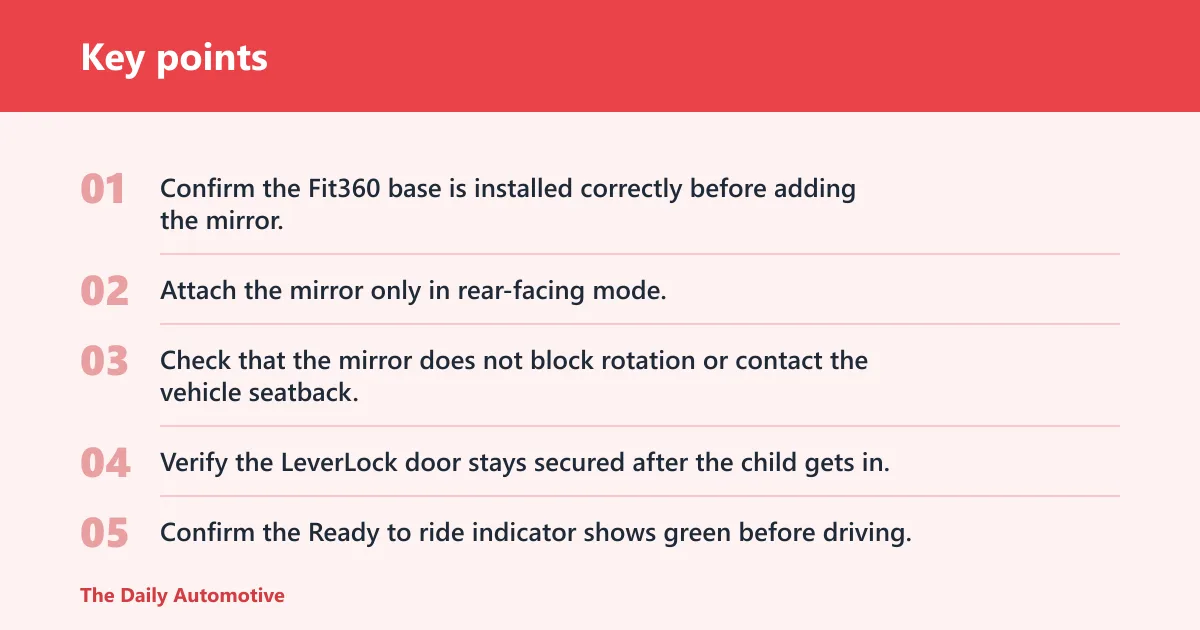
- Confirm the Fit360 base is installed correctly before adding the mirror.
- Attach the mirror only in rear-facing mode.
- Check that the mirror does not block rotation or contact the vehicle seatback.
- Verify the LeverLock door stays secured after the child gets in.
- Confirm the Ready to ride indicator shows green before driving.
Is the Chicco mirror safe for rear-facing babies?
A rear-facing mirror can be safe when it is made from shatter-resistant acrylic or polymer, attaches securely, and does not create a distraction that pulls the driver’s eyes away from the road. The safest mirror is the one that stays put and gives a quick, stable view without extra movement.
The Chicco mirror is presented as manufacturer-approved and crash-tested, which matters more here than design details. For a rear-facing accessory, the key safety issues are fit, attachment, and whether it fits cleanly with the seat system.
What a safe rear-facing mirror should be made of
Look for a wide-angle convex view and shatter-resistant acrylic or polymer construction. Those are the baseline materials and optics most parents should expect from a rear-facing car seat mirror.
Why secure attachment matters more than extras
A mirror with lights, gimmicks, or extra bulk can be worse than a plain mirror if it vibrates or loosens. Secure attachment matters more than extras because a shaky reflection is harder to read and more distracting.
Driver sightline and distraction risk
The mirror should support a driver sightline without forcing shoulder checks or long glances away from the road. If the mirror sits at a bad angle, reflects glare, or bounces with every bump, it stops being helpful.
A common first-timer mistake is buying a mirror that looks large and helpful in the store, then finding that it reflects rear-window glare at dusk. At that point, the issue is not visibility in theory; it is readability in a real cabin.
Pros and cons
Pros
- Designed specifically for the Fit360 Rotating Convertible Car Seat.
- Rear-facing only fit keeps the use case narrow and clear.
- Base-mounted attachment can look and feel cleaner than generic strap systems.
- Manufacturer-approved and crash-tested presentation adds confidence.
- Anthracite/Grey colorway matches the seat.
Cons
- Sold separately, so the premium is on top of the seat cost.
- Only useful in rear-facing mode.
- Base-mounted design can add clearance and handling friction.
- Less flexible than a generic mirror if you change seats or vehicles.
- May not solve glare, vibration, or awkward sightlines in every car.
How does a Chicco mirror compare with a generic baby car mirror?
The Chicco mirror is for parents who value factory-specific fit; a generic baby car mirror is for parents who value low cost and flexibility. If the Fit360 is staying in one vehicle and the accessory fits cleanly, the Chicco version has an edge. If not, generic often wins on value.
A generic rear-facing mirror is widely available and often cheaper. It usually offers the same basic wide-angle rear-view benefit, but it may rely on straps or headrest loops instead of a seat-specific attachment. That can work well, especially in vehicles with simple rear headrests.
Use the factory-specific mirror when you want integration. Use the generic one when you want function without paying for a brand-matched part.
When the factory-specific fit is worth paying for
Pay for the Chicco mirror if you are committed to the Fit360 and want the accessory to feel like part of that system. The premium is easier to justify when it replaces a mirror that would otherwise need awkward strap routing or trial-and-error placement.
When a generic mirror is enough
A generic mirror is enough when your vehicle has a straightforward rear headrest layout and you do not mind a less tailored look. It is also the better value when you expect the seat to move between vehicles or age out soon.
Is a baby car mirror better than a baby monitor?
A mirror is better if you want a simple visual check with no extra electronics, no pairing, and no camera setup. A baby monitor is better if you want no seatback hardware and a live image that does not depend on rear-window reflection or mirror angle.
The tradeoff is straightforward. A mirror depends on cabin geometry and line of sight. A monitor depends on power, mounting, and screen management. For some parents, the monitor solves the exact problems that make a mirror annoying.
When a monitor makes more sense
Choose a monitor if your rear seat geometry makes any mirror hard to place, if you dislike hardware near the child, or if you want more detailed visibility than a mirror can provide. It is also appealing when rear headrests, cargo screens, or sloped seatbacks limit mirror placement.
Who should buy it?
This fits the parent who already owns a Fit360 and wants a rear-facing mirror made for that seat’s base and rotation. It is less compelling for anyone who simply wants a basic view of a rear-facing child and does not care about brand-specific integration.
It does not suit every vehicle. If your rear seat has busy headrests, tight clearance, or a cabin layout that already makes rear access awkward, a simpler mirror or a monitor may solve the problem with less fuss.
Fit360 owner
Yes, this is the primary audience. The accessory is designed specifically for the Fit360 Rotating Convertible Car Seat, so this is where the fit premium has the clearest logic.
Frequent solo driver
Yes, if you want a fast rear-facing check without turning around. No, if you are already comfortable with a basic mirror and do not need the factory-specific attachment.
Long-legged rear-facing toddler
Maybe. A tall rear-facing child can increase the chance that any accessory feels crowded, especially if the base area is already busy. The mirror helps only if it does not interfere with legroom or loading.
Vehicle with busy headrests
No, in many cases. Busy headrests can make generic mirror straps awkward too, but a base-mounted accessory still has to clear a complicated cabin. A monitor may avoid the problem entirely.
Mirror-vs-monitor preference
Choose the mirror if you prefer a simple visual check and do not want another screen in the car. Choose the monitor if you want to avoid seatback hardware and can handle an electronic setup.
Decision table: who gets a yes and who gets a no
| Scenario | Verdict | Main risk | Best alternative if no |
|---|---|---|---|
| Fit360 owner | Yes | Paying extra for a fit-specific part when a cheaper mirror may do | Generic rear-facing mirror |
| Frequent solo driver | Yes | Mirror angle or vibration may still need adjustment | High-stability generic mirror |
| Long-legged rear-facing toddler | No | Base clutter and clearance issues can add frustration | Baby monitor |
| Vehicle with busy headrests | No | Complicated geometry may defeat the fit advantage | Monitor or headrest-free mirror |
| Mirror-vs-monitor preference | No if you want no hardware | Seatback accessory still leaves hardware in the cabin | Baby monitor |
What should I look for in a rear-facing car seat mirror?
Look for a wide-angle convex view, shatter-resistant material, and a stable attachment that does not bounce with road vibration. Compatibility matters first. Then check whether the mirror gives a driver sightline without forcing extra shoulder checks or adding glare at night.
Cleaning should be simple, usually with a microfiber cloth. That is a baseline expectation, not a premium feature. The best mirror is the one that stays secure, stays clear, and fits the seat and vehicle without creating new problems.
Frequently asked questions
Is the Chicco car seat mirror worth it?
It is worth it mainly for Fit360 owners who want a manufacturer-specific accessory and cleaner integration. If you only need a basic rear-facing view, a generic mirror usually delivers similar function for less money. If you want no seatback hardware, a monitor is the better value.
Does the Chicco mirror work with the Fit360 rotating car seat?
Yes. The Chicco Fit360 Mirror Car Seat Accessory is designed specifically for the Fit360 Rotating Convertible Car Seat. It attaches to the Fit360 base and is intended for rear-facing mode only, so it is not a universal mirror for other seats or for forward-facing use.
How does the Chicco mirror attach to the car seat?
It attaches to the Fit360 base rather than functioning as a generic headrest mirror. That base-mounted approach can look cleaner and fit better with the rotating system, but it can also create clearance and handling issues if your vehicle’s rear seat area is tight or busy.
Will the mirror interfere with the rotation or installation?
It can, depending on the vehicle and how much clearance the rear seat offers. The main concerns are access around the base, extra handling friction during rotation, and whether the accessory adds clutter near the LeverLock door or other base features.
What problems do owners report with the Chicco mirror accessory?
The likely pain points are vibration, glare, blocked sightlines, and base-access clutter. The larger issue is not the mirror itself, but whether a base-mounted accessory feels awkward in a specific car. If the setup is cramped, the mirror may be more nuisance than help.
Products related to this article
Sponsored / affiliate links. As an Amazon Associate I earn from qualifying purchases. I may earn additional commission from eligible campaigns.