Car Sun Shade Cost: What to Expect Before You Buy
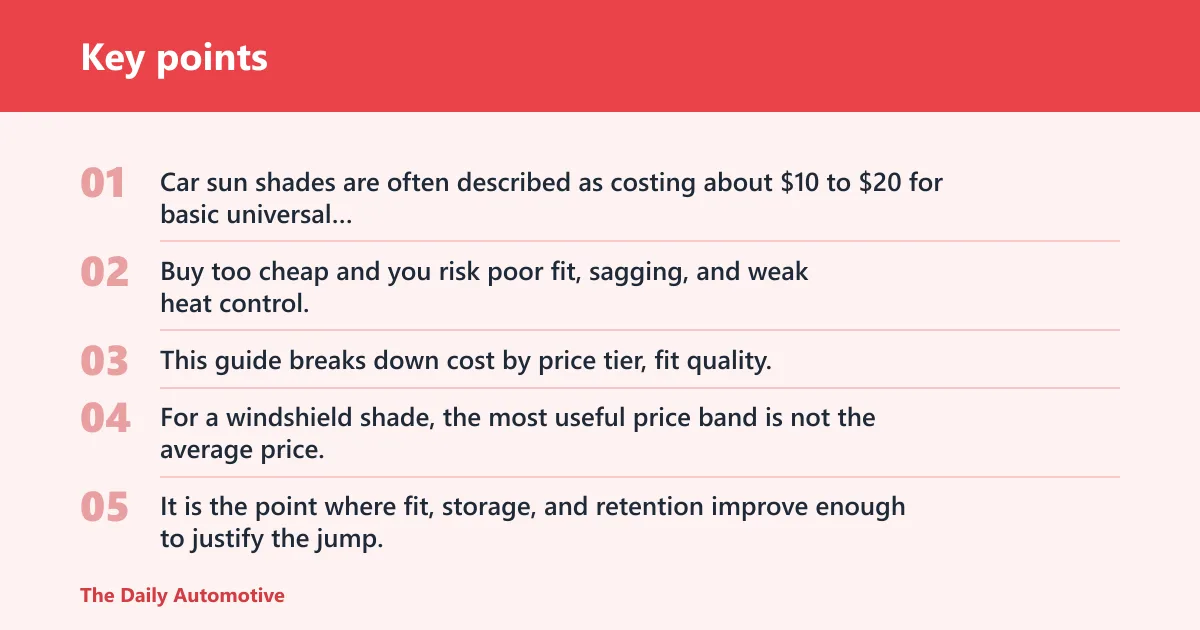
Car sun shades are often described as costing about $10 to $20 for basic universal panels, about $20 to $40 for better-fit semi-custom versions, and about $40 to $80 or more for vehicle-specific shades. Buy too cheap and you risk poor fit, sagging, and weak heat control. This guide breaks down cost by price tier, fit quality, and failure risk so you can judge value before you buy.
This guide is part of our Car accessories for comfort and convenience series.
Typical cost range

Typical windshield-shade price bands
For a windshield shade, the most useful price band is not the average price. It is the point where fit, storage, and retention improve enough to justify the jump. Most sun shades cost between $30 and $90, with vehicle-specific models pushing toward the top end when they are shaped for a particular windshield.
The difference matters because a shade that covers the full glass and stays up with visor support can beat a cheaper one that leaves gaps around mirrors, rain sensors, or the rearview mount. If the shade does not cover the windshield, it fails at its main job.
Why vehicle fit changes price
Vehicle size changes material use, patterning, and how much trimming or shaping the maker must do. A larger windshield needs more coverage and more structure. Odd glass shapes, sensor housings, and deep mirror mounts also push cost up because they demand a tighter pattern and more precise retention.
That is why a model-year-specific shade can cost more than a generic panel, even when both use the same broad material type. You are paying for fit quality, fewer gaps, and less hassle during installation.
What a higher price buys
Higher-priced shades usually buy firmer construction, better retention, and easier storage. The material may be thicker, laminated, or backed by a foam core. The tradeoff is weight and bulk. Some drivers want the smallest folded shape possible; others want a shade that sits flat and blocks more glass.
| Price tier | Typical construction | Expected fit quality | Storage convenience | Common failure modes |
|---|---|---|---|---|
| $20–$35 | Standard aluminum shade, basic reflective surface | Often universal; coverage can be uneven on larger or curved windshields | Light and simple to stow, usually folds or rolls quickly | Edge gaps, sagging, mirror interference, weak retention |
| $36–$55 | Better-cut universal or semi-custom build; sometimes reinforced edges | Better windshield coverage on common sizes | Moderate bulk; storage is still easy | Minor light leaks, imperfect sensor clearance, wear at fold points |
| $56–$75 | Firmer core, double-sided or layered construction, more durable materials | Good to very good fit on matched vehicles | More rigid; takes more room than budget panels | Bulk, slower stowage, higher cost if the vehicle changes |
| $76–$100 | Thick foam core, laminated construction, vehicle-specific patterning | Best chance of full windshield coverage and secure retention | Bulkier, but often still quick to place and remove | Price, storage space, fit mismatch if the vehicle is not the intended one |
What drives the price
Sun-shade pricing comes down to three things: material build, fit type, and storage style. Aluminum shades are usually the lowest-cost route. Foam core and laminated construction add stiffness and longer service life. Vehicle-specific shaping adds cost because it narrows the fit to one windshield size or a small group of models.
Material build and heat reflection
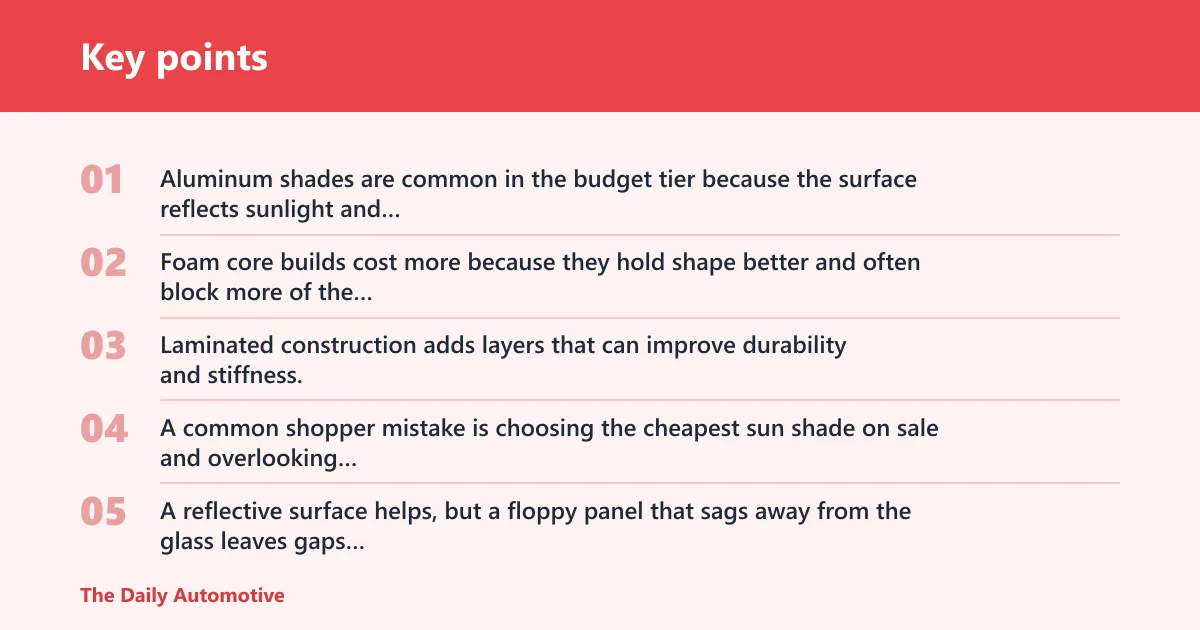
Aluminum shades are common in the budget tier because the surface reflects sunlight and the material stays light. Foam core builds cost more because they hold shape better and often block more of the windshield. Laminated construction adds layers that can improve durability and stiffness.
A common shopper mistake is choosing the cheapest sun shade on sale and overlooking whether it is custom-fit or a disposable fold-up model. A reflective surface helps, but a floppy panel that sags away from the glass leaves gaps where heat and light still enter.
Custom fit versus universal fit
Universal shades are cheaper because they are made to fit many vehicles well enough. Vehicle-specific shades cost more because they are cut for a narrower range of cars, trucks, or SUVs. That usually improves coverage around the windshield edges and reduces light leaks near the mirror stem or sensor module.
Suppose a compact sedan has a straightforward windshield. A lower-cost universal shade may be enough. Now suppose the vehicle has a wide windshield, a large mirror mount, and a rain sensor pod. The higher-priced custom pattern starts to make more sense.
Fold, roll, or umbrella storage
Storage design affects both cost and day-to-day use. Roll-up shades are often simpler to stash. Folding shades can be firmer and more structured, but they usually take a flatter, wider storage shape. Umbrella-style shades are prized for compact storage and quick deployment, though they can be more awkward on some windshields.
Do car sun shades really work?
Yes, car sun shades can work well when they cover the windshield fully and sit close to the glass. They reduce direct sunlight, slow heat buildup, and add UV protection for trim and upholstery. Their performance drops fast when fit is poor or when gaps appear around sensors and mirrors.
Heat reduction through the windshield
A windshield shade works by reflecting sunlight before it reaches the cabin. That lowers the amount of direct solar load entering through the glass. It will not make the cabin cool in every condition, and it will not act like a parked car under shade trees, but it can reduce the heat penalty from direct sun.
Do not expect every shade to perform the same way. A full-coverage model with a firm edge sits differently from a thin panel that bows inward at the top.
UV protection for trim and upholstery
UV exposure fades dashboards, seats, and trim over time. A sun shade helps limit that damage by reducing direct rays through the windshield. That matters most for vehicles parked outside in long, repeated sun exposure.
Where poor fit causes gaps
Poor fit creates the failure cases that competitors often skip. Gaps around the mirror stem, rearview sensor, and top corners can let in heat and light. A shade that is too narrow leaves uncovered glass. A shade that is too soft may slip down because the sun visors cannot hold it tightly enough.
Picture a midsize SUV parked nose-first in afternoon sun. If the shade misses the upper corners by a few inches, the uncovered glass becomes the weak point. The shade still helps, but it no longer gives full windshield coverage.
Roll-up, folding, or umbrella style?
The best style depends on storage space, install speed, and how much stiffness you want. Roll-up shades are compact and simple. Folding shades usually hold shape better. Umbrella-style shades stow small and are fast to open, which is why they appeal to drivers who want quick use more than perfect rigidity.
Roll-up shades and firm-core builds
The WeatherTech Sunshade is a roll-up style, starts at $65, weighs about 3 pounds, and uses a double-sided design with a built-in strap for storage. That mix points to a firmer, more structured shade rather than a thin universal panel. Roll-up storage can be practical if you want something flat enough to tuck away behind a seat or in a cargo area.
Folding shades and storage space
The Covercraft UVS100 costs $80 to $90, weighs about 3 lbs, and uses a folding style with thick foam core and laminated construction. Folding shades often suit drivers who want a sturdy piece that covers the windshield cleanly, but they do take more storage room than a basic rolled panel.
Umbrella-style shades for fast stowage
The CarCovers.com Platinum Sunshade Umbrella costs $50 and is the most compact of the named options here. Umbrella-style storage is appealing if you want a shade that opens and closes quickly, then folds into a small package. The tradeoff is that the shape must still match the windshield well enough to avoid edge gaps.
When a cheaper shade is enough
A cheaper shade is enough when you have a straightforward windshield, short parking stops, and low tolerance for bulk. Standard aluminum shades can be a smart buy for daily drivers that sit outside for brief periods. If the fit covers the glass and the shade stays in place, price should not be your main filter.
Standard aluminum shades
The AutoTech Zone Sunshade is priced at $30 and uses a standard aluminum shade design. That makes it a budget pick for drivers who want basic windshield coverage and reflected heat reduction without paying for a thicker build or a vehicle-specific cut.
Daily drivers and short parking stops
Cheaper shades fit best when the car is parked for errands, commutes, or quick stops rather than all-day exposure. They are easier to justify if you only need a simple barrier against sun and glare. For many drivers, that is enough.
When price should not be the main filter
If the windshield is standard in shape and the shade covers it fully, a budget model can be the right answer. The main rule is simple: if a cheaper shade fits, stays put, and does not leave big gaps, extra spending may not buy enough improvement.
When to pay more for fit
Pay more when your windshield is large, curved, or crowded by sensors and mirror hardware. Those details make fit and retention more important than the sticker price. A better shade can be worth it if it covers the full windshield and uses the sun visors for support so installation takes only seconds.
Large windshields and odd glass shapes
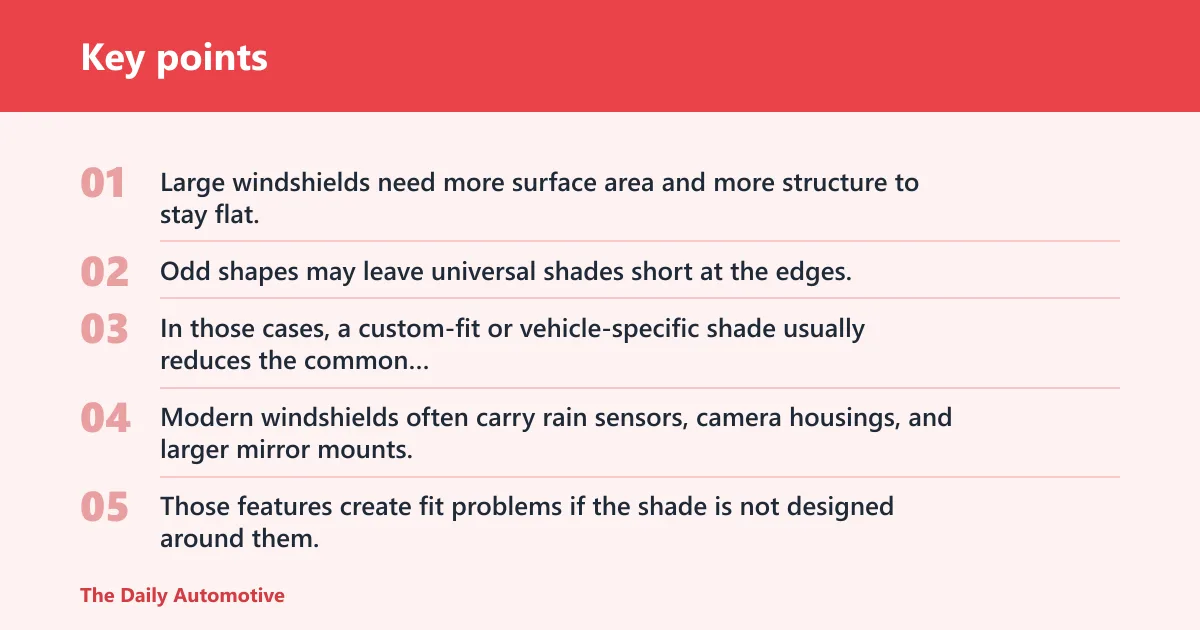
Large windshields need more surface area and more structure to stay flat. Odd shapes may leave universal shades short at the edges. In those cases, a custom-fit or vehicle-specific shade usually reduces the common failures that budget panels show.
Sensor housings and mirror cutouts
Modern windshields often carry rain sensors, camera housings, and larger mirror mounts. Those features create fit problems if the shade is not designed around them. A good shade should leave those areas clear without creating wide openings elsewhere.
Retention that uses sun visors
Retention matters because a shade that falls or shifts is not doing its job. The better designs press against the glass and use the sun visors for support. Installation in seconds is a real advantage when the shade also holds its place after the doors close.
Seasonal use and alternatives
Sun shades are not only for summer. They can help reduce cabin heat in warm months and can also aid winter frost prevention when used as a reversible design. They are cheaper than many tint jobs and more portable than garage parking, but they solve a different problem than a permanent window film.
Summer heat reduction and winter frost prevention
In summer, a shade limits direct sun and slows heat buildup through the windshield. In winter, a reversible design can help with frost prevention on the glass by acting as a barrier against overnight buildup. That does not replace defrosting, but it can cut down on scraping time.
Shade cost versus window tint
Window tint is a different purchase. Tint is permanent and usually costs far more than a sun shade, especially when the goal is broad cabin heat control or UV reduction across multiple windows. If your budget is tight, a windshield shade is the cheaper first step. If you want all-day, all-window coverage, tint may be the longer-term option.
Garage parking changes the equation again. If you can park indoors, a premium shade may be less important. If you cannot, a better-fitting shade can be a sensible middle ground between no protection and a permanent film job.
Frequently asked questions
How much do car window shades cost?
Car window shades usually start around $30 for basic windshield models and can run to $90 or more for vehicle-specific versions. Side-window shades and full kits vary by count and fit, so the price rises with more coverage and more precise shaping. The windshield shade is usually the main cost driver.
Are car sun shades worth it?
Yes, if the shade fits your windshield and stays in place. They are worth it for drivers who park outside, want less heat buildup, or want some protection for trim and upholstery. A poor-fit shade is a bad value, so fit quality matters more than the lowest price.
What size sun shade do I need for my car?
You need a shade sized to cover the full windshield, including the upper corners and the area around the mirror mount. Vehicle-specific listings are the safest route. If you buy a universal shade, compare the stated width and height with your windshield, not just the vehicle class.
Should I buy a roll-up or folding sun shade?
Buy roll-up if storage simplicity matters most and you want something quick to stash. Buy folding if you want a firmer panel with better shape retention and do not mind a bulkier storage footprint. Umbrella-style shades sit between the two for compact stowage and fast use.
How much car window tint cost
Window tint usually costs much more than a sun shade because it is a permanent installation. The exact price depends on film type, vehicle size, and local labor rates. If your goal is lower up-front spending, a windshield shade is the cheaper choice. Tint makes more sense for all-window, year-round use.
How much do sun shades cost?
Most sun shades cost between $30 and $90. Budget panels sit near the bottom of that range, while custom-fit and thicker builds push higher. The right price depends on whether you need basic heat reflection or a tighter fit with better retention and less gap risk.
Products related to this article
Sponsored / affiliate links. As an Amazon Associate I earn from qualifying purchases. I may earn additional commission from eligible campaigns.