Car Title Transfer Cost When Selling a Car
Car title transfer cost when selling a car is usually paid by the buyer, but the seller can still owe lien release, duplicate title, notarization, or state filing fees if the title is missing or not signed correctly. Skip those steps and the handoff can stall, or the seller can be stuck paying to fix paperwork after the sale. This guide breaks down who pays, what fees to expect, and which mistakes raise your out-of-pocket cost.
What the seller may actually pay
The headline title fee is only part of the closing cost. In a private sale, the seller may still need to cover a duplicate title, a notary, lien payoff paperwork, or a late penalty if the transfer misses the state deadline. Some states also add county processing charges or an online convenience fee.
Base title fee versus duplicate title fee
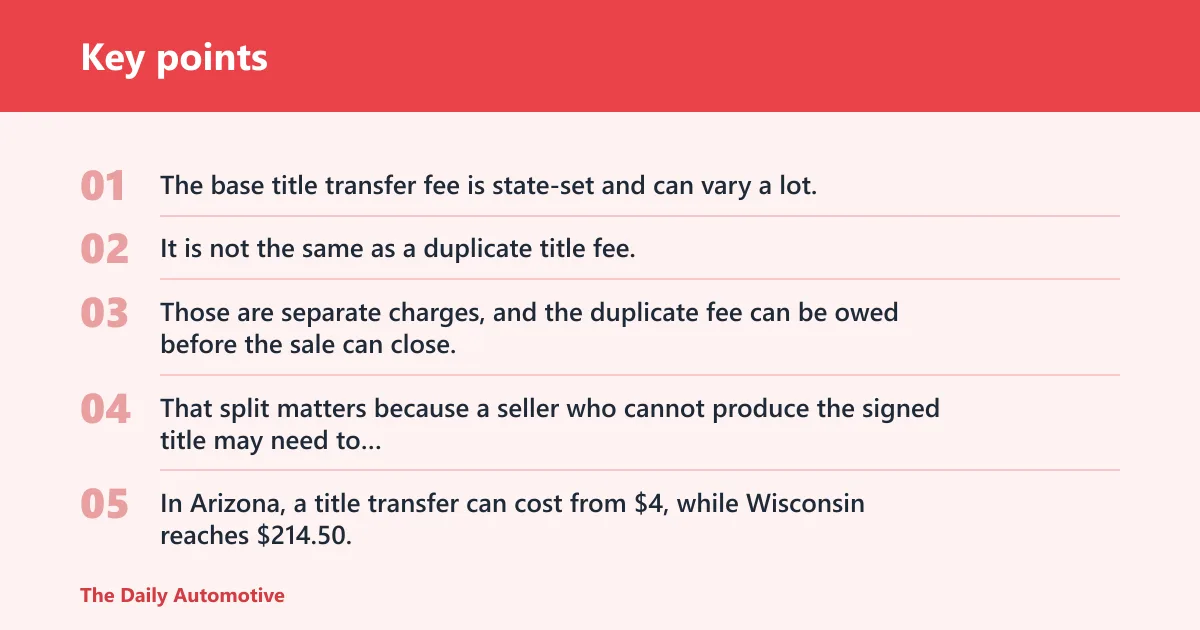
The base title transfer fee is state-set and can vary a lot. It is not the same as a duplicate title fee, which applies when the original title is lost, damaged, or never arrived. Those are separate charges, and the duplicate fee can be owed before the sale can close.
That split matters because a seller who cannot produce the signed title may need to replace it first. In Arizona, a title transfer can cost from $4, while Wisconsin reaches $214.50. For a duplicate title, the range can run from $2 by mail in Texas to $192 for an all-electric car in Oregon.
Sales tax, county charges, and convenience fees
Sales or use tax is often added to the total transfer cost, but it is usually a buyer-side item and the rule depends on the state. It may be based on purchase price or taxable value, and some states reduce it for a trade-in or exempt certain gifts and family transfers. County fees and online processing fees can sit on top of the base title fee.
That means the seller should not assume the title fee is the whole bill. Idaho lists a $14 title fee plus a county fee. Ohio title fees vary by county; most charge $18, some charge $23. NCDMV also says title fees can be paid through PayIt, which charges a $3 fee per online transaction plus 1.85 percent card processing. (Ncdot)
Who usually pays each line item in a private sale
In many private sales, the buyer pays the title fee when applying for the new title, while the seller covers anything needed to hand over a valid title. That usually means the buyer handles transfer tax and the filing fee, while the seller may pay to cure paperwork problems that block the transfer. The split is often negotiable.
Say your car has a clean title but the buyer asks you to order a duplicate because the original was lost. The buyer may still pay the transfer fee, but the seller may need to pay for the duplicate title first if the title cannot be signed over as-is. The closing cost follows the paperwork problem, not the sale price alone.
What does title transfer cost?
Title transfer cost is not one flat national number. It is set by the state, and in some places by county or local office rules as well. The final total can also include tax, duplicate title charges, late penalties, and optional online processing fees, so the seller should estimate the whole closing package rather than one line item.
State-set fees and why totals vary
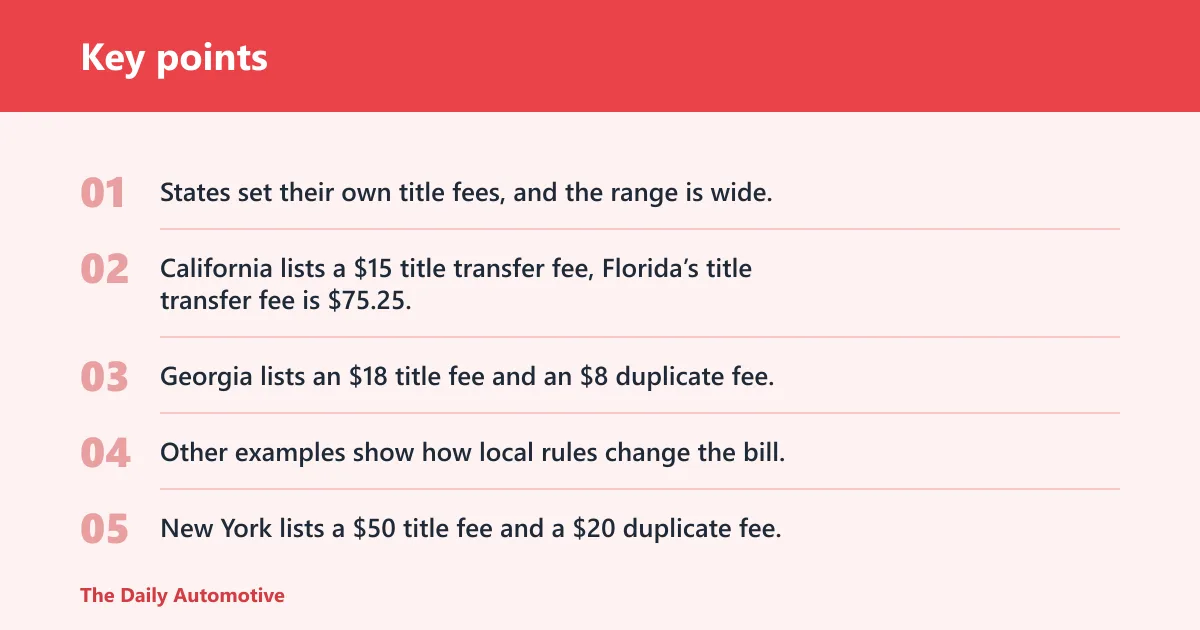
States set their own title fees, and the range is wide. California lists a $15 title transfer fee, Florida’s title transfer fee is $75.25, plus $2.50 if a paper title is printed, and Pennsylvania lists a $72 title fee. Georgia lists an $18 title fee and an $8 duplicate fee, while Maryland lists a $200 title transfer fee and a $40 duplicate fee.
Other examples show how local rules change the bill. New York lists a $50 title fee and a $20 duplicate fee. North Carolina’s title fee is $66.75. Oklahoma has an $11 title fee plus a $17 transfer fee. That mix explains why a seller should never rely on a single national estimate.
When taxes are added to the transfer total
Sales or use tax is often added at or after the transfer filing, but it is usually calculated from the purchase price or taxable value, not the title fee itself. In some states, a trade-in can reduce the tax base. In others, certain family or gift transfers may be exempt.
That is why a sale that looks simple can still produce a larger closing bill for the buyer. The seller should still flag tax issues early, because a buyer who expects one number and sees a higher tax total may delay filing. That delay can trigger a penalty or leave the title in limbo.
Why registration and plate fees are separate
Registration and plate fees are separate from title transfer fees. A title changes ownership on paper. Registration and plates cover the vehicle’s authority to operate on the road. Some buyers pay both at once, but the seller should not fold them into the title transfer estimate.
A common first-timer mistake is quoting the buyer only the title fee and then discovering the buyer still owes registration, plate, county, or tax charges at the DMV. That mistake can make a fair deal look misleading, especially when the buyer expected one closing number.
Who pays the title transfer fee?
The buyer usually pays the title transfer fee, but not always. In private sales, the parties can split the fee, the seller can agree to pay it to close the deal, or the buyer can ask for a lower purchase price in exchange for taking on the filing cost. The agreement should be written into the sale terms.
Typical seller-buyer split in private sales
Most private sales follow a simple pattern: the buyer pays the state filing cost, and the seller delivers a properly signed title, bill of sale, and any release needed to complete the transfer. That arrangement keeps the seller from paying the state for the new title in the buyer’s name.
But the seller can still owe money if the title is lost, the lender has not released the lien, or the state requires notarization on the seller’s signature. Those are closing costs tied to the seller’s ability to transfer ownership, not the buyer’s future registration choice.
When the buyer takes over the filing fee
The buyer usually takes over the filing fee when the car is sold “as-is” and the title is ready to sign. The buyer then handles the DMV, MVD, BMV, or county filing steps after the sale. Some states also allow online or mail processing, but the state office remains the primary authority.
When the seller may agree to pay part of the cost
The seller may agree to pay part of the cost to keep the sale moving, especially if the car needs a duplicate title or the buyer wants a faster closing. That can be a practical tradeoff. It should be clear whether the seller is paying the state fee, the notary charge, or a convenience fee.
Paperwork you need at closing
You need more than a signed title. A clean handoff usually includes the title, a bill of sale, odometer disclosure, any lien release, and whatever notarization or filing method your state requires. Missing one item can delay the transfer or force the seller to fix the paperwork after the buyer has taken the car.
Title, bill of sale, and odometer disclosure
The title is the core ownership document. The bill of sale records the sale price and vehicle description, and it is commonly recommended even when not required everywhere. The odometer disclosure is a federal mileage disclosure requirement at sale, and a false statement can bring penalties.
Keep the sale price and mileage consistent across the title, bill of sale, and odometer statement. If those numbers conflict, the filing office may reject the transfer or ask for corrections. That can delay payment, title release, or both.
Lien release if the car still has a loan
If the seller still owes money on the car, the lender must release the lien before the transfer can go through. That release may appear on the title itself or come as a separate letter. Without it, the title may not clear, even if the buyer has already paid.
That delay is a real handoff risk. Suppose the seller signs the title on Friday but the lender has not sent the lien release yet. The buyer may be unable to file the transfer, and the seller may have to keep following up until the lender clears the record.
Notary rules and state office filing options
Some states require notarization, and others do not. The rule depends on the issuing state, not the buyer’s preference. If a notary is needed, add that fee to the seller’s closing estimate. Some states also allow online or mail-in filing, but many sales still move through the DMV, MVD, BMV, or county office.
To transfer title when selling a car, sign the title exactly as your state requires, complete the odometer and sale-price sections, and hand over any lien release, bill of sale, and notary-backed signature if required. Then file the transfer through the state DMV, MVD, BMV, county office, or approved online or mail channel.
Sign the title exactly as your state requires
The signature must match the name on the title and follow the state’s signing instructions. Some states require the seller to sign in a specific box, use a full legal name, or have the signature notarized. A mismatch can stop the transfer before it starts.
Complete odometer and sale-price details
Fill in the mileage and sale price carefully. Those fields are used to support the transfer and tax calculation. If the car is exempt from a normal tax rule, the buyer may still need to provide the correct documentation at filing.
File with the DMV, MVD, BMV, or county office
After the paperwork is complete, file with the proper state office or county office if your state uses one. Some states offer online or mail-in options, but the local motor vehicle agency still controls the transfer. If the filing is late, a penalty can apply.
Seller closing-cost worksheet
Use this worksheet to estimate the seller’s real closing cost and the risk of a failed handoff. The key question is not only who pays each fee, but whether the fee or document can block the transfer if it is missing.
| Item | Who usually pays | Common failure points |
|---|---|---|
| Base title fee | Buyer | Wrong filing office, incomplete title, late filing |
| Duplicate title fee | Seller or negotiable | Lost original title, damaged title, name mismatch |
| Notary fee | Seller if required by state | Missing notarization where required, unsigned sections |
| Lien payoff and release | Seller | Loan not paid off, release not issued, lender delay |
| Late penalty risk | Seller if delay is on the seller side; otherwise negotiable | Missed deadline, incomplete paperwork, filing office rejection |
| Optional DMV convenience fee | Buyer or seller, depending on who files | Online payment charge, card processing charge, office service fee |
| Common failure points | Negotiable | Missing signatures, missing odometer disclosure, missing bill of sale, unpaid lien, title not available at handoff |
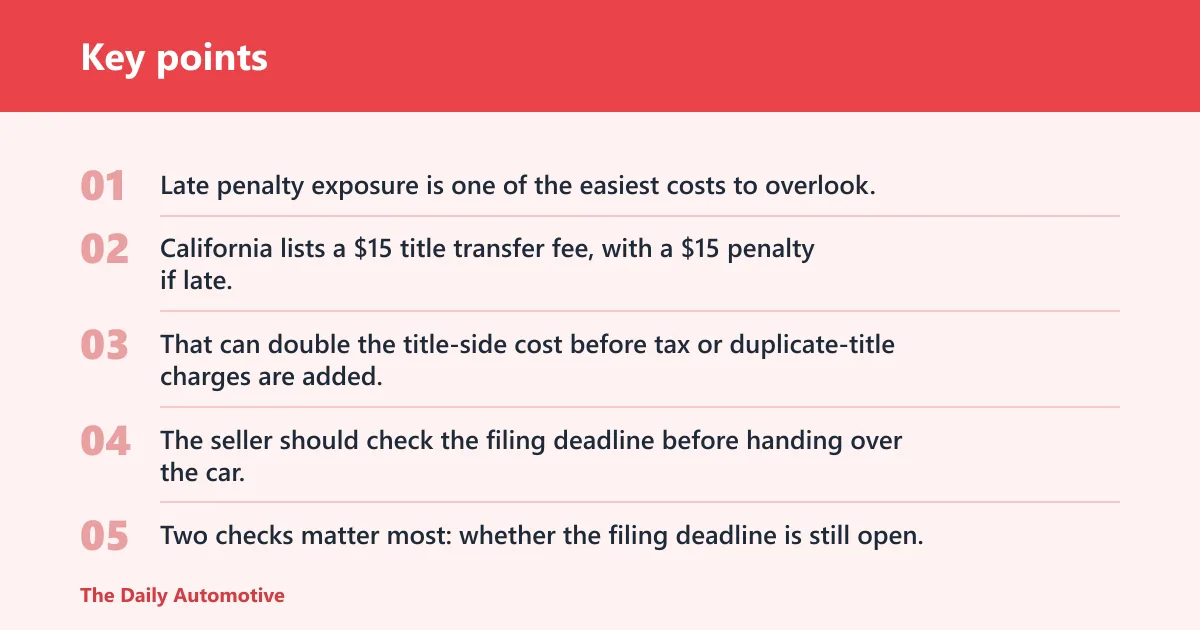
Late penalty exposure is one of the easiest costs to overlook. The same source lists a $15 title transfer fee, with a $15 penalty if late. That can double the title-side cost before tax or duplicate-title charges are added. The seller should check the filing deadline before handing over the car.
Late penalty and lien delay checkpoints
Two checks matter most: whether the filing deadline is still open, and whether the lien release is ready. If either one fails, the transfer may stall. The seller may then need to pay extra filing costs, resubmit documents, or wait for the lender to release the title.
Common failure points that can stall the handoff
Missing signatures, a missing title, a missing lien release, or an odometer mismatch can stop the transfer. A bill of sale helps document the deal, but it does not fix a title that was never signed correctly. If the filing office rejects the packet, the seller may have to correct it after the sale.
To do a car title transfer safely, verify the payoff and release status first, match every signature and mileage entry to the title record, and keep copies of all sale documents. That order reduces the chance of a delayed filing, a penalty, or a dispute over who owes the final fee.
Verify the payoff and release status first
Before handoff, confirm whether the vehicle still has a loan and whether the lender has issued the release. If the release is not ready, the seller should not assume the deal is complete. The title may not transfer until the lender clears it.
Match signatures and mileage to the title record
Check the seller name, buyer name, sale price, and odometer disclosure against the title. A mismatch can trigger a rejection or a correction request. That is especially important in states that require notarized signatures or specific transfer wording.
Keep copies of every document after the sale
Keep copies of the signed title, bill of sale, odometer disclosure, lien release, and any receipt for a filing fee or duplicate title fee. Those records matter if the state office questions the transfer or if a fee dispute comes up after closing.
Frequently asked questions
How much to transfer a car title?
The cost depends on the state and sometimes the county. A title transfer can cost from $4 in Arizona to $214.50 in Wisconsin. The seller should also check for duplicate-title charges, late penalties, tax, or online processing fees that can change the total.
Who pays the title transfer fee when selling a car?
The buyer usually pays the title transfer fee in a private sale, but the split is negotiable. If the seller needs a duplicate title, lien release work, or notarization to finish the deal, the seller may end up paying part of the closing cost.
What paperwork do I need to transfer the title after selling my car?
Use the signed title, bill of sale, odometer disclosure, and any lien release required by the state. Some states also require notarization. Keep copies of everything, because a missing signature or missing lender release can delay the transfer and create extra cost.
How much does transfer of title cost?
There is no single national price. The same source lists a $15 title transfer fee, Florida’s title transfer fee is $75.25, plus $2.50 if a paper title is printed, and Pennsylvania lists a $72 title fee. County fees and late penalties can add more.
Products related to this article
Sponsored / affiliate links. As an Amazon Associate I earn from qualifying purchases. I may earn additional commission from eligible campaigns.