Cars for Videos: Why Certain Cars Work on Screen
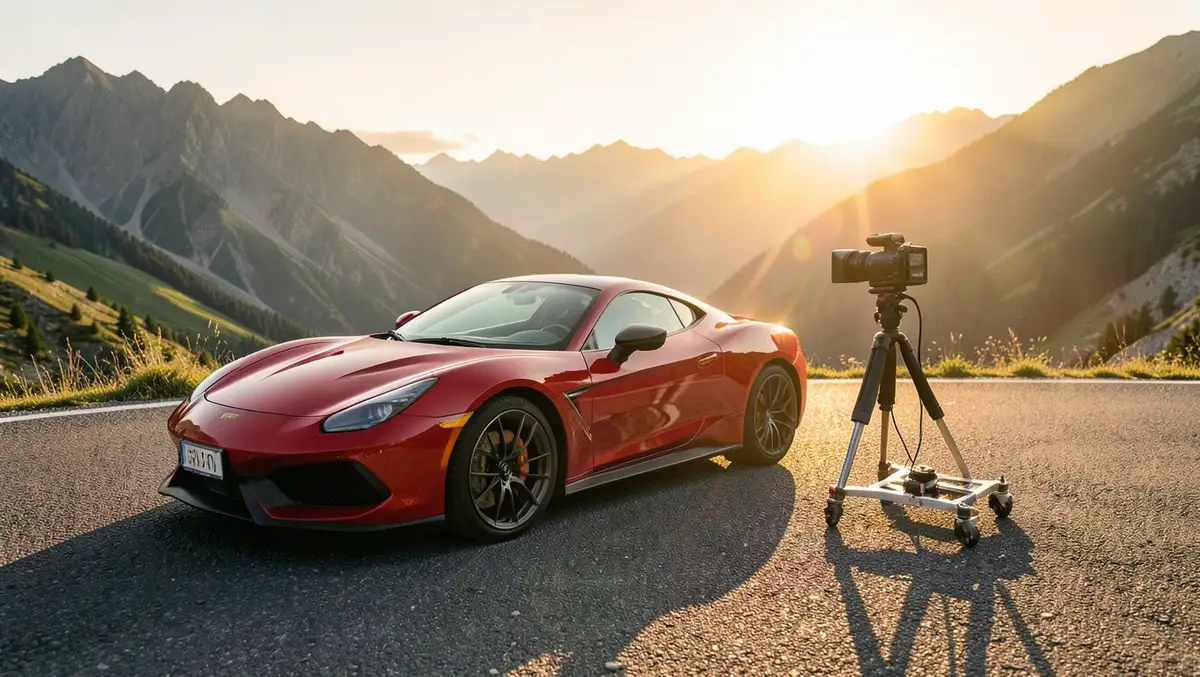
The best cars for videos are the ones with a simple, recognizable shape, repeatable trim, and period details the camera can read fast. Screen readability matters more than rarity or flash. Get that wrong and the car looks generic, unconvincing, or too distracting for the scene, which can weaken the whole production. This guide explains why certain cars read well on camera, how duplication and accuracy affect credibility, and what filmmakers should look for.
Why some cars read better on screen
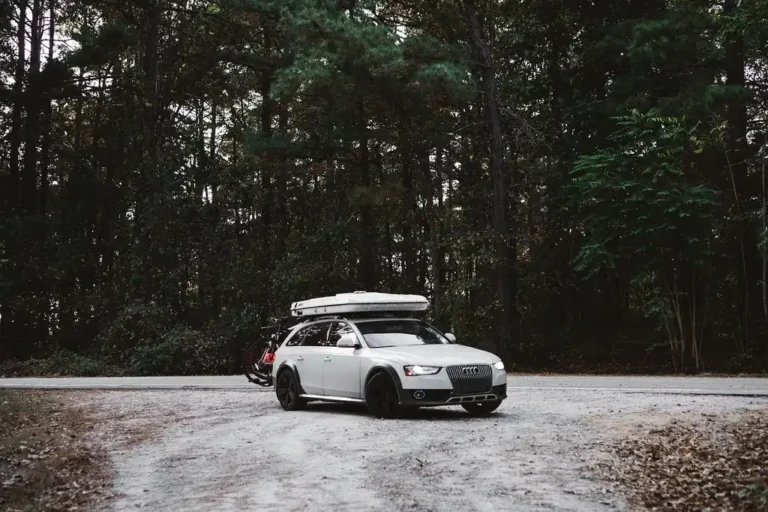
Cars read well on screen when the camera can identify them at a glance from multiple angles. A clean roofline, a clear side profile, and proportions that separate the cabin from the body help the viewer understand the car even in a moving shot or a fast cut. Busy shapes can lose that clarity.
Silhouette and side profile matter most
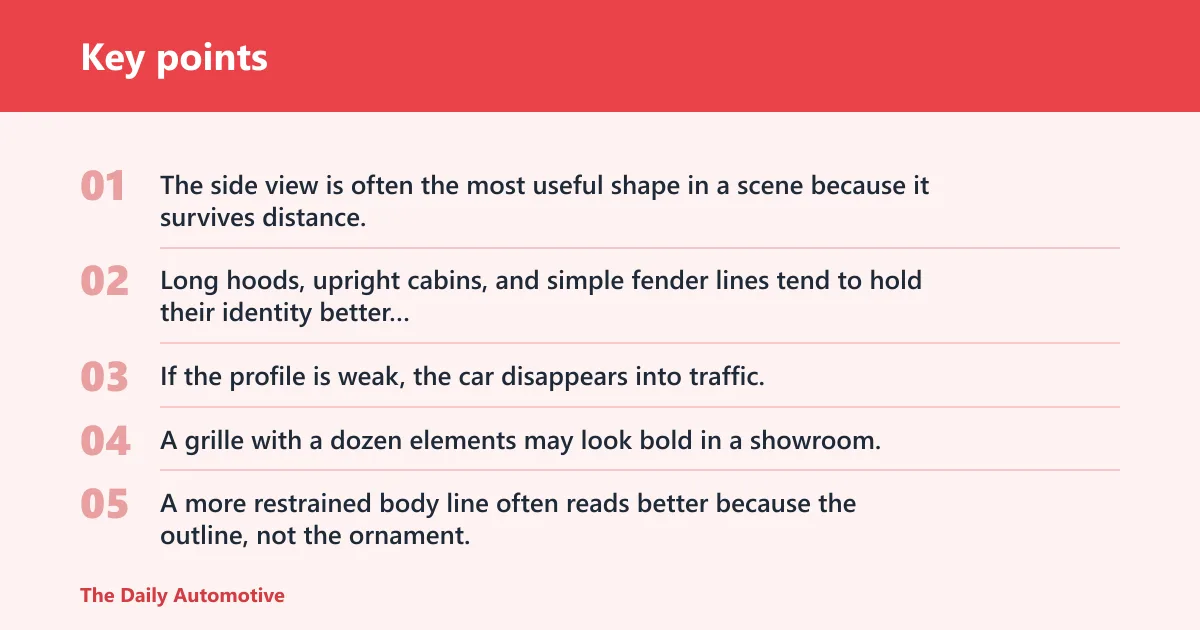
The side view is often the most useful shape in a scene because it survives distance, motion blur, and partial framing. Long hoods, upright cabins, and simple fender lines tend to hold their identity better than chopped shapes with too many visual interruptions. If the profile is weak, the car disappears into traffic.
That matters more than raw styling drama. A grille with a dozen elements may look bold in a showroom, but the camera can flatten it into glare and shadow. A more restrained body line often reads better because the outline, not the ornament, carries the image.
Color contrast and reflections change the shot
Color affects separation from the road, sky, and set dressing. A dark car against a dark street can vanish; a light car against pale concrete can do the same. Production teams often look for colors that hold contrast in the location, not just in a catalog photo.
Reflections are another filter. Gloss paint, chrome, and large glass areas can bounce crew, cameras, and lighting into the frame. Sometimes that is manageable. Sometimes it turns every close shot into a reset.
Why certain grilles and glass areas photograph poorly
Wide, mirror-like grilles can break up into harsh highlights. Tall glass areas can reveal more of the interior than the scene wants, including headliners, cage work, or temporary camera fittings. Sharp body creases can also create hot spots that read differently from one angle to the next.
Suppose a sedan has a flat black hood, a chrome grille, and a steep windshield. In a sunny curbside setup, the hood may hold detail while the grille blows out and the windshield mirrors the lighting rig. The car still exists in frame, but the shape becomes harder to read.
What makes a good screen car?
A good screen car is readable, repeatable, and controllable. It must look like itself in wide shots and hold up in close shots, while also surviving resets, repositioning, and camera placement. For productions, the best choice is often the one that can be duplicated, driven safely, and matched across takes.
Readable identity from wide shots to close shots
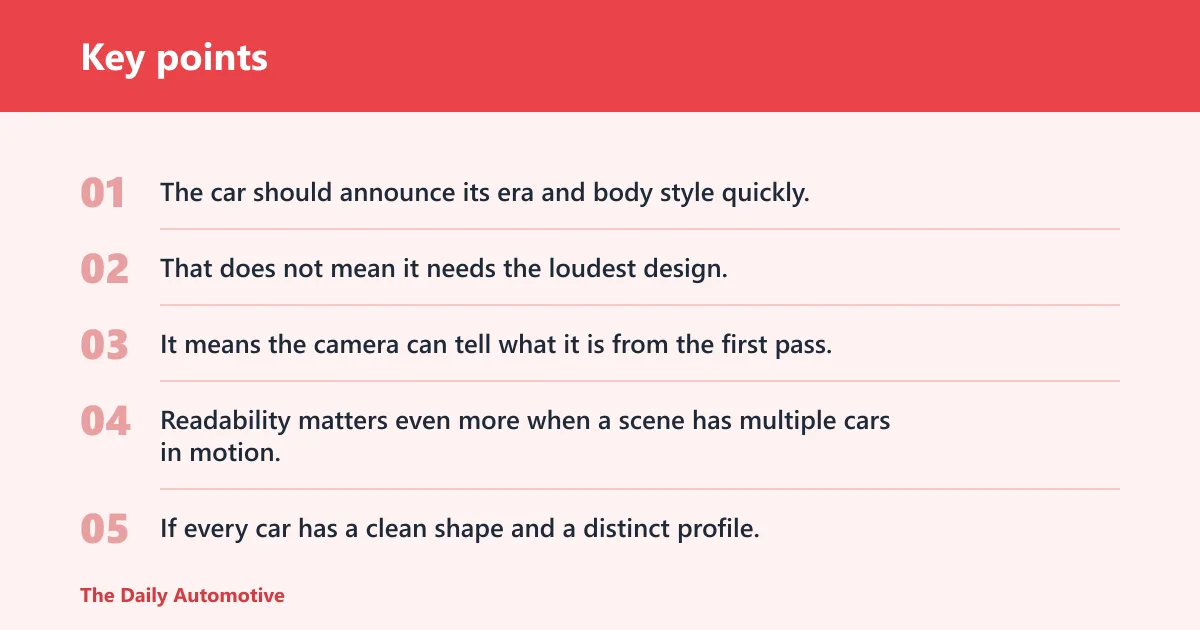
The car should announce its era and body style quickly. That does not mean it needs the loudest design. It means the camera can tell what it is from the first pass, then keep that identity when the lens moves closer to trim, glass, or interior detail.
Readability matters even more when a scene has multiple cars in motion. If every car has a clean shape and a distinct profile, the audience can track the action without effort.
Stable camera behavior and process trailer use
A process trailer or camera car rig is used for through-the-windshield shots, moving dialogue, and other safety-controlled filming. That puts the car under a different set of demands. It must be stable, predictable, and easy to drive at controlled speeds without drama from suspension, steering, or power delivery.
Some cars look better parked than moving. A car that wanders in lane, rocks excessively, or shakes under load can make dialogue scenes harder to shoot. Stability matters because the camera is often inches from the glass.
Mechanical reliability and continuity control
Mechanical reliability is not a bonus. It is part of the selection. Productions need a car that starts, idles, moves, and resets on a schedule that may be tighter than the script suggests. Television is especially compressed, with only about 10 days to shoot an episode, while feature films often have 72 to 90 days.
Continuity also matters. A car that changes trim, tire stance, or body fit between takes forces extra checks and extra resets. That is one reason a picture car coordinator works so closely with script needs, period accuracy, and stunt safety.
Hero cars vs background vehicles
A hero car is the camera-facing vehicle that carries story importance. It may need detailed interior work, polished paint, duplicate units, and stunt prep. A background vehicle supports street realism instead, so it usually needs to be available in multiples and close enough in appearance to blend into traffic without drawing attention.
What hero cars must do
Hero cars need to survive close scrutiny. That means correct trim, clean panel fit, visible interior details, and a level of finish that matches the shot distance. If the story uses the car heavily, multiple versions are often needed for static shots, driving shots, and stunt work.
The budget can climb fast. 2 Fast 2 Furious required a vehicle budget over $7 million and 188 vehicles built in-house. That scale shows how much duplication and rebuild work a high-demand production may need.
What background vehicles must do
Background vehicles are there to sell the street. They need to fill lanes, create depth, and match the local car mix. They are often less detailed up close, but they still matter because visible ensemble shots expose the whole neighborhood of vehicles, not one star car.
A background vehicle may also need faux wear, color changes, or quick trim adjustments so it blends into the scene. Productions may place 125 vehicles throughout a town to create that density, and even then the mix has to look believable from street level.
How requirements change by role
| Car type | Primary job | Typical prep focus | Risk if chosen poorly |
|---|---|---|---|
| Hero car | Camera-facing story vehicle | Interior accuracy, duplicate units, stunt readiness | Close-up errors and continuity breaks |
| Background vehicle | Street realism and crowd depth | Multiples, quick disguise, local availability | Traffic that looks staged or too repetitive |
| Period piece | Setting accuracy in visible scenes | Trim, wheels, paint, accessories, era fit | Historic mismatch that breaks credibility |
Period car selection rules
Period-correct vehicle choice depends on the setting year and the local car mix, not only on whether the model was built in the right decade. Trim level, wheel style, paint color, and accessories all matter because visible ensemble shots expose mistakes quickly. In historical work, small errors are easier to spot than big ones.
Era fit and local car mix
A car may be old enough and still be wrong for the street. The production needs vehicles that fit the city, the socioeconomic setting, and the kind of traffic that would actually be present. That is why a vehicle catalog or car casting agent becomes useful; it lets the team search body styles, years, and colors by availability.
One Albuquerque production asked for every 1972 or older vehicle in a catalog. After culling, only 12 or 15 cars could be used, even though one Albuquerque source had 45 cars available. That gap is why local realism and actual inventory matter more than a wish list.
Wheel, paint, and accessory accuracy
Wrong wheels can date a car instantly. So can paint that is too modern, too glossy, or simply unavailable in the period. Badges, mirrors, roof racks, and exterior accessories matter for the same reason. The audience may not name the error, but it will feel off.
Social media has made this harsher. A period scene can be paused, zoomed, and compared against reference photos in seconds. Small mistakes that once slipped past viewers now travel fast.
Screen car selection checklist
This checklist gives productions a simple way to score a vehicle before it is assigned to hero, background, or period duties. Use it as a pass/fail filter first, then as a ranking tool when several cars fit the script. Availability and duplication should be weighed against authenticity, not treated as afterthoughts.
| Criterion | Pass | Fail | Why it matters |
|---|---|---|---|
| Silhouette clarity | Easy to identify in profile | Generic or cluttered outline | Holds shape in motion and distance |
| Era fit | Matches the setting year | Looks from the wrong decade | Protects period credibility |
| Color contrast | Separates from location tones | Blends into road or set | Improves visual separation |
| Duplicate availability | Multiple units can be sourced | Only one usable car exists | Supports stunts and continuity |
| Stuntability | Can be prepped safely | Too fragile or unstable | Needed for action and controlled filming |
| Wheel correctness | Correct for year and trim | Wrong style or finish | Visible in close and side shots |
| Paint accuracy | Believable for the period | Too modern or incorrect | Key for historical scenes |
| Camera reflections | Manageable glare profile | Mirror-like surfaces create noise | Affects close-ups and daylight shoots |
| Interior readability | Dashboard and cabin read cleanly | Dark, busy, or obscured interior | Important for dialogue and inserts |
| Local sourcing | Can be found near production | Requires long-distance shipping | Controls cost and turnaround |
| Mechanical reliability | Starts, idles, and drives cleanly | Unstable or unpredictable | Reduces downtime on set |
| Continuity risk | Easy to match across takes | Hard to duplicate or reset | Protects repeated scenes |
| Production use | Minimum standard | Common reason to reject |
|---|---|---|
| Hero car | Pass on every criterion above except minor wear if scripted | No duplicate, weak close-up detail, or poor stuntability |
| Background car | Pass silhouette, era fit, color contrast, and local availability | Wrong period mix or obvious mismatch to surrounding cars |
| Period piece | Pass era fit, wheel correctness, paint accuracy, and accessory match | Any visible detail that breaks the setting year |
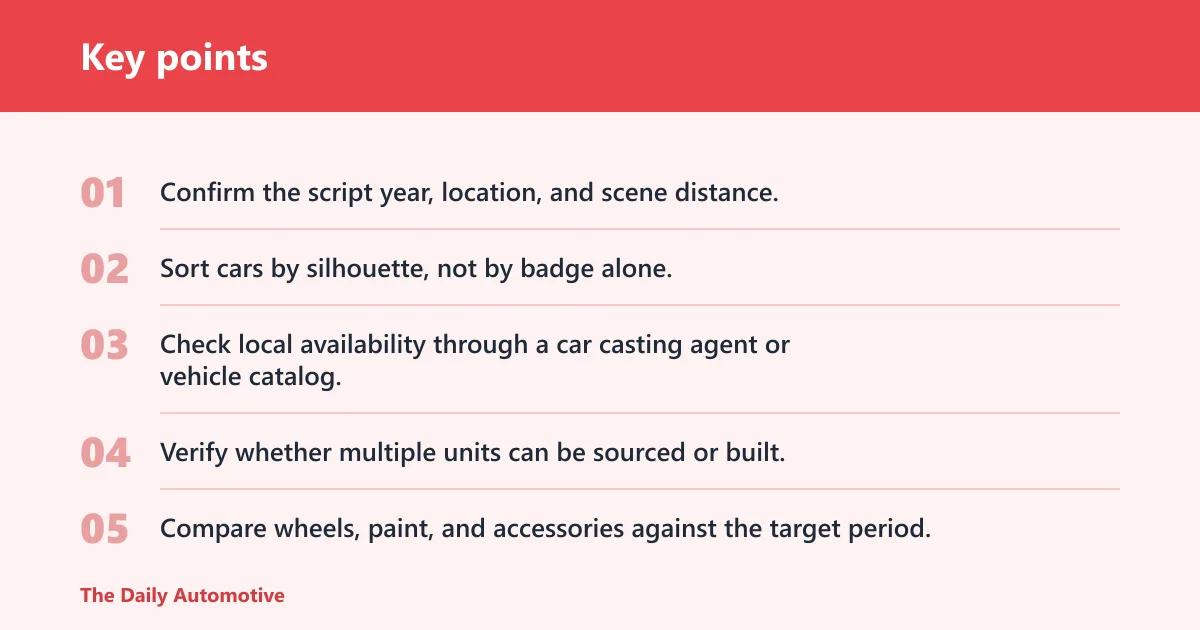
- Confirm the script year, location, and scene distance.
- Sort cars by silhouette, not by badge alone.
- Check local availability through a car casting agent or vehicle catalog.
- Verify whether multiple units can be sourced or built.
- Compare wheels, paint, and accessories against the target period.
- Confirm whether the car can support process trailer or camera car work.
- Reject any car with unmanageable glare, weak profile, or high continuity risk.
Who chooses the cars?
The picture car coordinator is responsible for sourcing, preparing, and managing production vehicles. That includes working with the script, matching period needs, coordinating hero cars and background cars, and making sure the vehicles are safe for filming. The job sits between creative intent and practical supply.
Vehicle catalogs and local sourcing
Car casting agents and vehicle catalogs help the production search by year, body style, color, and location. That is useful because a car may exist on paper and still be unavailable where the shoot takes place. Local sourcing reduces shipping pressure and often makes duplicate units easier to secure.
Picture Car Warehouse, for example, is a 44,000-square-foot facility that holds over 500 cars. A stockpile like that shows why sourcing is part inventory management, part visual matching, and part logistics.
How product placement fits without taking over
Automaker-studio cooperation can include free loaned vehicles or other brand support, usually because the screen exposure has marketing value. That can help a production access newer cars or specific trims quickly. It can also narrow the choice if the brand needs to approve how the vehicle appears.
But product placement does not replace story needs. If the script needs a beat-up local sedan, a glossy loaner with the wrong trim will not solve the scene. CarBuzz notes that movies and television can help automakers show what their products can do, and it also says the selection process is more complicated than most people expect.
Why some cars fail on camera
Cars fail on camera when their details work against the lens. The most common problems are glare, reflections, busy front ends, weak side views, and mismatched parts. A vehicle can be mechanically fine and still be the wrong visual tool for the shot.
Glare, reflections, and interior visibility
Glass and gloss paint can throw light into the frame, especially during daylight exteriors. Large reflective surfaces may also expose rigs, crew, or unwanted cabin details. If the scene depends on seeing the driver, the dashboard, or the passenger, that visibility has to be controlled from the start.
Picture a black coupe with polished wheels and a bright chrome strip. In a night exterior, the trim may pop. In a sunny street scene, the same surfaces may scatter light in a way that makes the car harder, not easier, to read.
Wrong wheels, wrong paint, mismatched accessories
Wrong wheels are one of the fastest ways to break a period piece. So are paint tones that do not belong to the year, or accessories that came from a different trim level. These details are visible enough to matter and small enough to be hard to fix late in production.
Continuity risk in repeated takes and multi-unit shooting
Continuity becomes more fragile as the same scene is repeated with more camera setups. If the car has a hard-to-match body kit, rare trim, or a one-off paint finish, every reset can become a problem. That is why duplicate availability is part of the selection score, not a backup plan after the fact.
TV is especially tight here. A production may have only about 10 days to shoot an episode, while stunt prep for a scene may need to be done in less than 10 days. Feature films have more room, but the schedule is still finite and the car still has to be ready.
Frequently asked questions
Why do certain cars look better on camera?
Cars look better on camera when their shapes are easy to read at a distance and in motion. A clear side profile, controlled reflections, and strong contrast against the location help the viewer identify the vehicle fast. Busy grilles, weak silhouettes, and mirror-like surfaces tend to work against that readability.
What makes a car good for movies and TV?
A good screen car is visually clear, mechanically dependable, and easy to duplicate. It should hold up in wide shots, close shots, and moving camera setups. Productions also need the car to fit the setting and to survive repeated takes without creating continuity problems or safety issues.
How do filmmakers choose cars for a scene?
Filmmakers start with the script year, the location, and how close the car will be to the camera. Then they check availability, duplicates, trim, wheels, paint, and whether the car can support process trailer work or stunt prep. The picture car coordinator usually manages that match between story and supply.
What cars are easiest to use in period pieces?
The easiest period cars are the ones that already match the setting year, local car mix, and trim level without heavy modification. Simple shapes, correct wheels, and believable paint are easier to keep accurate than rare or heavily modified vehicles. Background cars especially need to blend without drawing attention.
Why are some cars more iconic on screen than others?
Cars become memorable on screen when their shape, sound, and color are easy to recognize and repeat across scenes. But the reason they stick is not hype alone. A car that reads cleanly in close shots and wide shots gives the audience a stable visual identity, which helps the vehicle stand out.
Do filmmakers choose cars for brand deals or story reasons?
Both can matter, but story comes first. Product placement and automaker-studio cooperation can bring in loaned vehicles or support marketing goals, yet the car still has to fit the scene, the period, and the camera plan. If the car does not serve the script, the deal does not solve the problem.
Products related to this article
Sponsored / affiliate links. As an Amazon Associate I earn from qualifying purchases. I may earn additional commission from eligible campaigns.