Carwow Finance Review: Is It Worth Using?
Carwow isn’t the lender; it is a comparison layer that can help you gather finance quotes, but the dealer or lender sets the final APR, fees, and contract terms. Skip the paperwork checks, and you can end up with a higher monthly payment, extra charges, or an agreement that costs more than the headline quote. This guide shows where Carwow stops, where the dealer or lender takes over, and what to verify before you apply or sign.
Carwow finance at a glance
Carwow is useful when you want a fast way to compare offers from dealers without starting every conversation from scratch. It is less useful if you expect Carwow itself to write the finance agreement, approve the credit, or guarantee the same terms you saw in a quote summary.
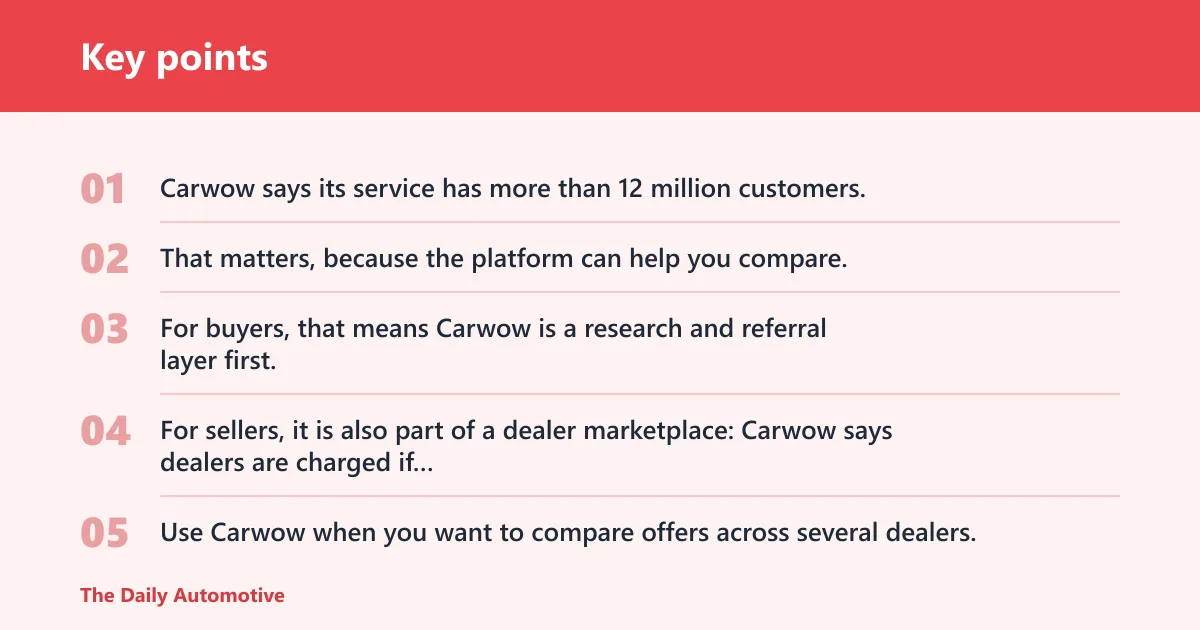
Carwow says its service has more than 12 million customers, and it says it does not sell the car itself. That matters, because the platform can help you compare, but the actual purchase or lease still happens with the dealer, and the finance contract sits with the dealer or lender.
For buyers, that means Carwow is a research and referral layer first. For sellers, it is also part of a dealer marketplace: Carwow says dealers are charged if a car is bought or leased through the platform, while consumers are not charged for buying or leasing.
When Carwow is useful
Use Carwow when you want to compare offers across several dealers, check what different finance types look like, or see what your car might be worth before you list it. Carwow’s valuation tool uses live market data and similar sales, so it is a starting point rather than a guaranteed cash offer.
That can save time if you are weighing PCP against HP, or if you want to compare a dealer quote with a bank loan. It can also help if you are trying to sell, because Carwow lists more than 6,000 dealers on its sell-my-car process.
When Carwow is not enough on its own
Carwow is not enough if you need the final contract terms explained line by line, or if the quote you saw does not match the paperwork you receive from the dealer. The dealership or lender controls the real contract, so the headline monthly payment is only part of the picture.
A common first-timer mistake is to focus on the monthly figure and ignore the mileage cap, balloon payment, or fees. That can turn a quote that looks competitive into a costlier agreement once the full contract appears.
Does Carwow arrange finance?
It can help you compare offers and move toward a deal, but the application, approval, and contract sit with the dealer, broker, or lender who actually provides the money or lease agreement.
That distinction is the key to understanding how the process works. Carwow can point you toward a quote, but it does not become the finance company. The lender’s own checks, approval rules, and contract wording decide what you can sign.
Where the application happens
In practice, the finance application is usually completed with the dealer, broker, or lender after you have expressed interest through the platform. If the quote is for PCP, HP, PCH, or a personal loan, the finance provider behind that quote is the party that will set the legal terms.
If the dealer says a rate is “through Carwow,” treat that as a lead source, not a guarantee. Ask who the lender is, what documents they need, and whether the figures are final or subject to credit approval and inspection of the car.
How to spot the actual finance provider
Look for the lender’s name on the agreement, the pre-contract credit information, or the formal quote. If the paperwork does not name the finance company clearly, stop and ask before you sign. You need to know who will own the credit agreement and who you will pay each month.
Suppose a dealer quotes a £299 monthly PCP payment for a used hatchback, but the finance paperwork later shows a different APR and a higher final payment. That means the quote was not the final contract. The signed documents control the real cost.
Is Carwow finance legit?
Yes, Carwow can be part of a legitimate buying or leasing process, but the legitimacy comes from the dealer and lender contract, not from Carwow acting as a finance provider. The platform can help you compare offers, yet the final agreement must still be checked like any other car finance deal.
The simplest way to judge a Carwow finance offer is to separate the platform from the product. Carwow may generate the lead; the lender supplies the money or lease; the dealer handles the handover and often the final sale paperwork. Those are different roles.
What makes a quote comparable
A quote is only useful if you can compare the same fields across offers: APR, deposit, monthly payment, final payment if there is one, mileage cap, fees, ownership outcome, cancellation rights, and the name of the actual lender. If one quote leaves out any of those items, it is incomplete.
Carwow’s own finance guide says there are four main car finance options: PCP, HP, PCH and a personal loan. That is a helpful framework, but the real comparison still comes from the terms on the deal you are offered.
Red flags before you sign
Watch for a quote that changes after credit checks, vehicle inspection, or dealer handover. Also watch for add-on fees that were not visible in the first quote, a different APR from the one you expected, or a mileage limit that is lower than the one you were led to believe.
If the final contract differs from the headline offer, pause. Ask for the revised figures in writing and compare them against a bank loan or a direct dealer quote before you commit.
Carwow finance comparison checklist

| Finance type | Quote source | APR | Deposit | Monthly payment | Final payment | Mileage cap | Fees | Ownership outcome | Cancellation rights | Who the actual lender is |
|---|---|---|---|---|---|---|---|---|---|---|
| PCP | Dealer quote surfaced through Carwow | Set by the lender on the formal offer | Usually required; varies by vehicle and lender | Lower than a similar HP deal if the balloon payment is large | Yes, a balloon payment is normally due if you keep the car | Yes, normally applies | Check admin, option-to-purchase, excess mileage and any add-ons | Return, part-exchange, or pay the final amount to own it | Depends on the agreement and the lender’s credit process | The finance company named in the agreement |
| HP | Dealer or broker quote, sometimes compared through Carwow | Set by the lender on the formal offer | Usually required; affects the monthly cost | Often higher than PCP because the balance is paid off over the term | No balloon payment in a standard HP deal | Usually no mileage cap | Check arrangement fees, late-payment charges and any option-to-purchase fee | You usually own the car after the final payment | Depends on the agreement and statutory rights | The finance company named in the agreement |
| PCH | Lease quote from the leasing provider, shown via a dealer route | Not usually presented as a standard APR quote | Advance rental often applies instead of a deposit | Monthly lease payment based on use, not ownership | No purchase payment at the end | Yes, a mileage allowance is central to the contract | Check excess mileage, damage charges, admin and collection fees | No ownership; you hand the car back at the end | Check the lease terms and cooling-off position before signing | The leasing company named in the contract |
| Personal loan | Bank, building society or other direct lender | Set by the lender on the loan offer | Not always required for the loan itself, though you may still choose to put money down on the car | Fixed loan repayment to the lender | No balloon payment | No mileage cap | Check early repayment rules and any setup fee | You usually own the car from purchase, subject to the car sale itself | Depends on the lender and the credit agreement rules | The bank or lender that issues the loan |
What finance options does Carwow cover?
Carwow’s finance guide covers four main options: PCP, HP, PCH and a personal loan. Those are the core choices most UK buyers will see when they compare ways to fund a new car or, in some cases, a used car.
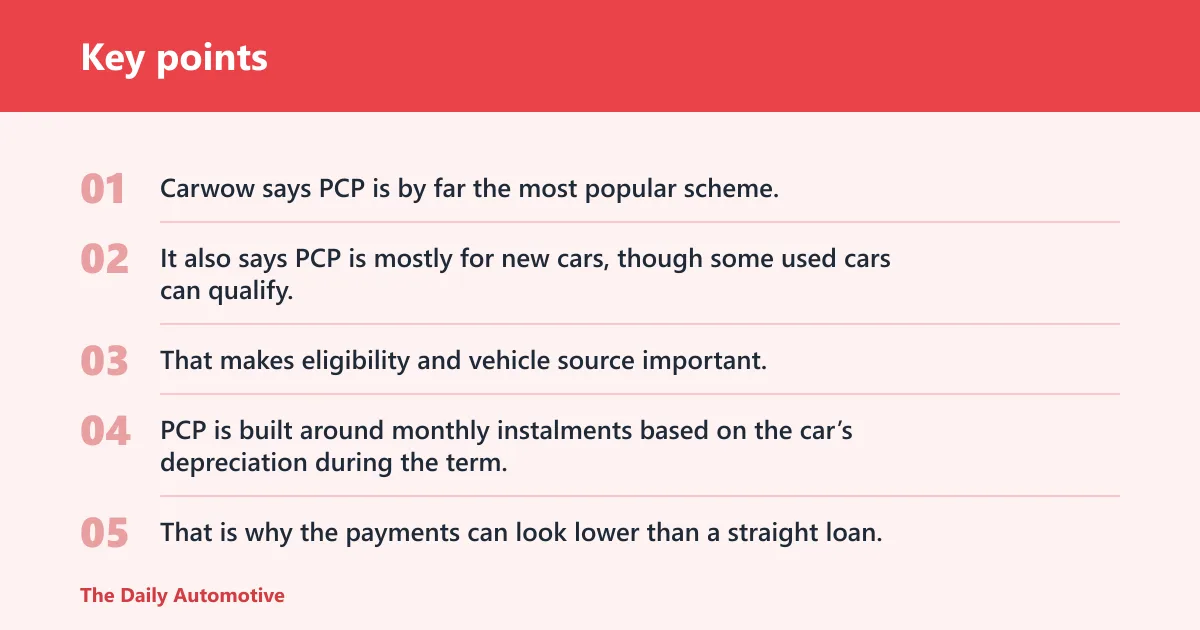
The same source says PCP is by far the most popular scheme. It also says PCP is mostly for new cars, though some used cars can qualify, and it is not for private sales. That makes eligibility and vehicle source important, especially if you are buying second-hand.
PCP
PCP is built around monthly instalments based on the car’s depreciation during the term. That is why the payments can look lower than a straight loan. At the end, there is usually a final payment if you want to keep the car.
PCP suits buyers who want lower monthly outgoings and are happy to decide later whether to keep, return, or part-exchange the car. It is not a private-sale route, so the car generally has to come through a dealer.
HP
HP is the ownership-focused alternative. You borrow the car’s value, pay it down over the term, and usually own it after the final payment. It sits naturally with dealer or broker finance and often makes sense if you want the car outright at the end.
HP can be simpler to understand than PCP because there is no balloon payment in a standard deal. The trade-off is usually a higher monthly payment than an equivalent PCP quote.
PCH
PCH is a leasing-style product. You pay to use the car for a fixed term and mileage limit, then hand it back. You are paying for access rather than ownership, so the contract focuses heavily on usage and return condition.
If you want no resale hassle and do not plan to own the car, PCH can be a clean option. If you want the asset at the end, it is the wrong fit.
Personal loan
A personal loan can also fund a car. In that case, the lender gives you cash, and you buy the car separately. That can be useful when you want to compare a bank rate against dealer finance, or when you want fewer car-specific contract conditions.
It is worth comparing the total cost, not only the monthly payment. A bank loan may be simpler than dealer finance, but the interest rate, repayment term, and early-settlement rules still matter.
Can you get used-car finance through Carwow?
Yes, but used-car finance needs extra checks. The same source says PCP can cover some used cars, yet age, mileage, deposit size and lender policy can change approval and pricing. A used vehicle can be perfectly financeable and still produce a very different quote from a new one.
That is because lenders price risk into the agreement. Older cars, higher mileage, and lower deposits can all push the terms in a less favourable direction, especially on PCP. The same car can produce different quotes from different lenders.
What to confirm on a used-car quote
Check the car’s exact age, mileage, service history and specification, then compare that against the finance term and the final amount due. Ask whether the car is eligible for PCP at all, and if it is, whether the mileage cap and balloon payment still make sense for your use.
Picture a three-year-old SUV with 42,000 miles and a modest deposit. One lender may accept PCP with a tighter mileage cap, while another may push you toward HP or a larger deposit. The car is the same; the finance terms are not.
What should I check before taking carwow finance?
Check the contract, not the advert. The key fields are usually APR, term length, deposit, monthly payment, any final payment, mileage cap, fees, cancellation rights and the name of the actual lender. If any of those are missing, you do not yet have a proper basis for comparison.
That checklist matters even more if you are choosing between a Carwow-sourced quote, a dealer quote, and a bank loan. The cheapest monthly payment can hide the highest total cost.
Checklist before signing
- Confirm the APR and whether it is fixed for the full term.
- Check the deposit or advance rental and how much cash you must pay upfront.
- Read the monthly payment and the total amount payable, not just the headline figure.
- Look for a final payment, balloon payment or option-to-purchase fee.
- Check the mileage cap and the excess mileage charge.
- Read all fees, including admin, arrangement, collection and late-payment charges.
- Confirm whether you are buying, leasing, or financing ownership at the end.
- Ask who the actual lender is and get the formal credit agreement before signing.
Why the dealer contract matters most
The dealer or lender contract is the legal document that controls the deal. If the quote on Carwow looked different, the signed paperwork wins. That is why consumers should read every figure on the final finance agreement and not rely on the summary alone.
Carwow can be a good way to compare offers and avoid starting from zero with every dealer. It is not a substitute for checking the final paperwork, especially where mileage caps, balloon payments and fees can change the real cost.
Frequently asked questions
Is Carwow any good?
Yes, if you want a comparison layer for buying, selling, leasing or valuing a car without dealing with every seller one by one. It is useful for collecting offers quickly, but you still need to check the dealer or lender paperwork before you sign anything.
What finance options does Carwow offer?
Carwow’s finance guide covers four main options: PCP, HP, PCH and a personal loan. Those cover the main UK choices for people comparing monthly payments, ownership outcomes and lease-style access to a car.
Can you get PCP through Carwow?
Yes, you can compare PCP offers through Carwow, but the actual PCP agreement is written by the dealer or lender. The same source says PCP is by far the most popular scheme, mostly for new cars and some used cars, and it is not for private sales.
Does Carwow charge buyers for finance help?
No, Carwow says it does not charge consumers for buying or leasing through the platform. Dealers are charged if a car is bought or leased through Carwow, so the consumer side is free for that transaction path.
Products related to this article
Sponsored / affiliate links. As an Amazon Associate I earn from qualifying purchases. I may earn additional commission from eligible campaigns.