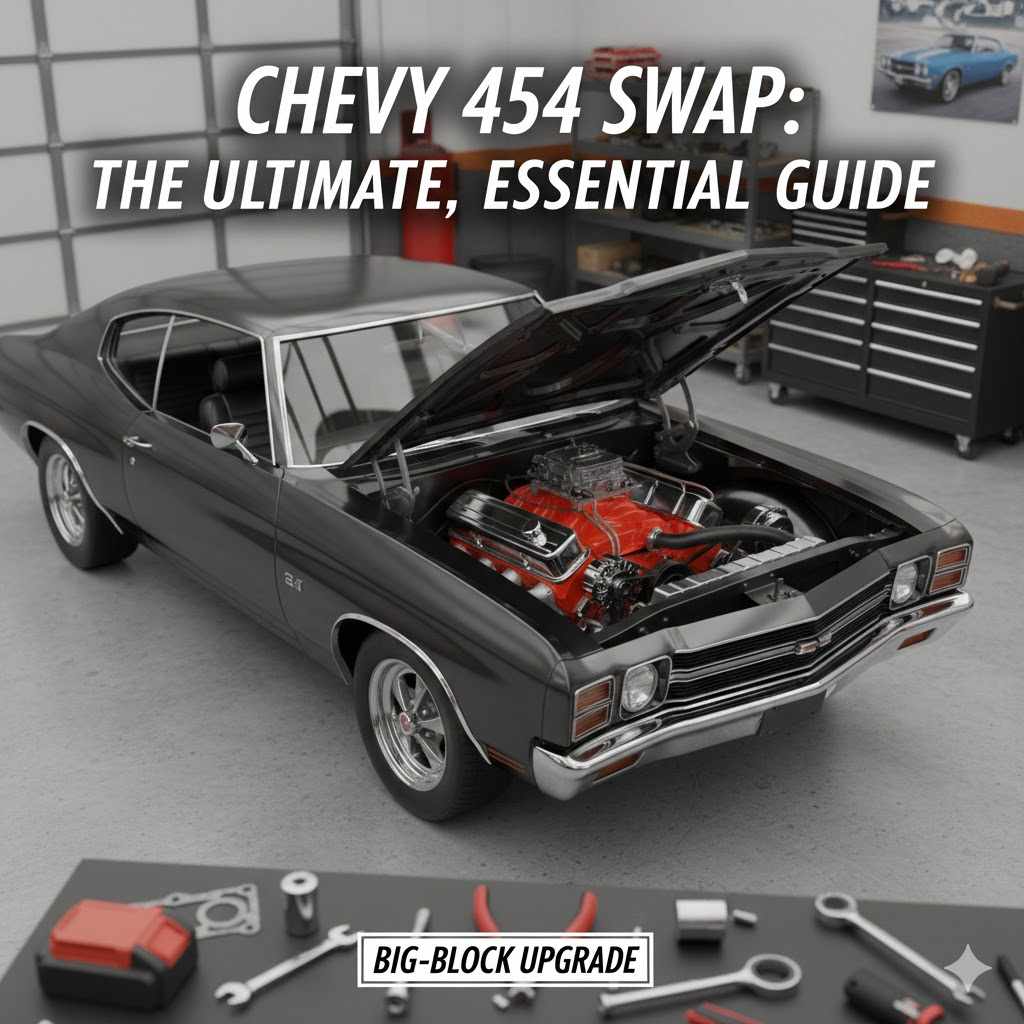
Chevy 454 Swap: The Ultimate, Essential Guide
A Chevy 454 swap involves replacing your car’s existing engine with a Chevrolet 454 cubic inch big-block V8. This popular upgrade provides significant gains in horsepower and torque. Success requires careful planning for engine generation compatibility, motor mounts, transmission, cooling, and fuel systems, but is a rewarding project for DIY enthusiasts.
Thinking about putting a legendary Chevy 454 big-block engine in your project car? You’re in the right place! The idea of all that power is exciting, but the process can feel a little intimidating. It’s a big job, but it’s absolutely doable, even for a beginner with the right guide.
Many people get stuck wondering about which parts fit, what tools they need, or if they’re getting in over their head. Don’t worry. We are going to break it all down, step by step. This guide will give you the confidence to tackle your 454 swap. Let’s get that monster motor in your ride!
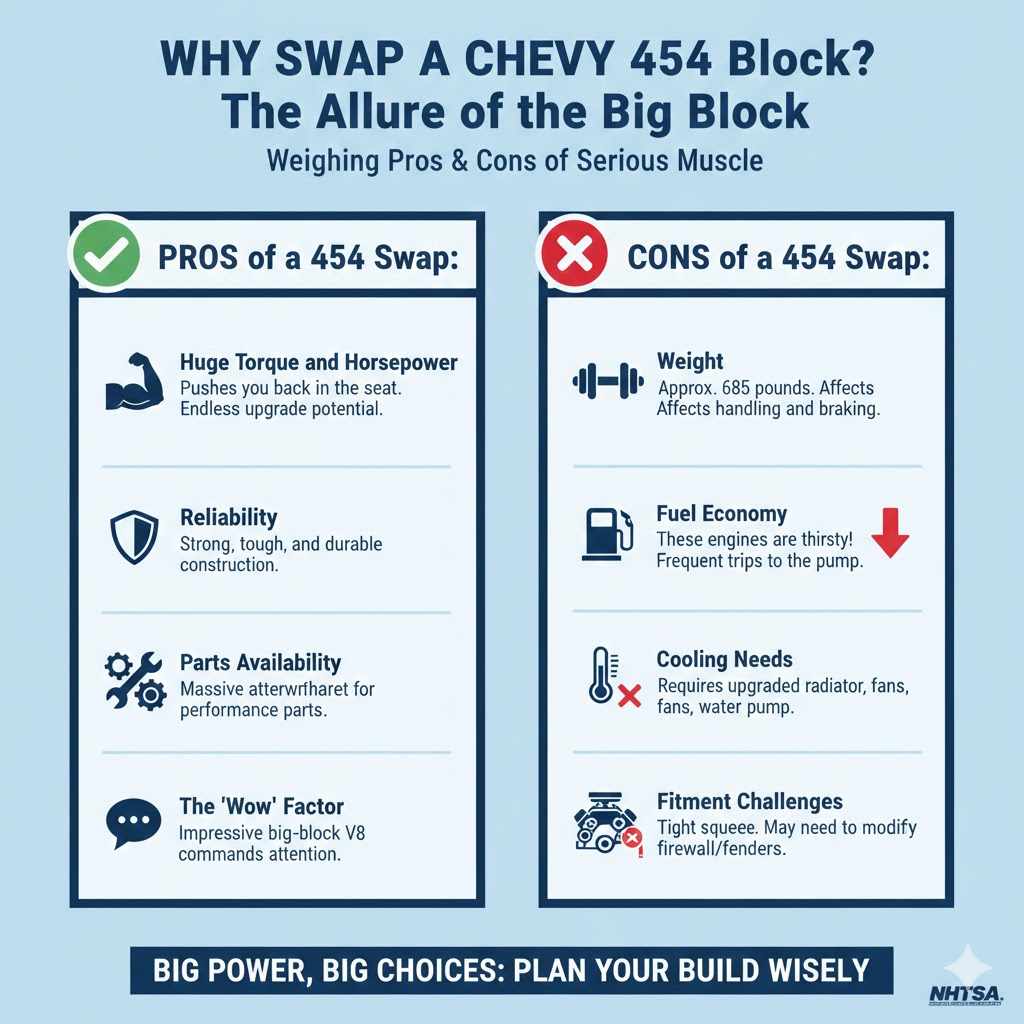
Why Swap a Chevy 454? The Allure of the Big Block
The Chevy 454 is an icon for a reason. It’s famous for producing massive torque, that low-end pulling power that pushes you back in your seat. It’s the kind of power you can feel. For muscle cars, classic trucks, and street rods, a 454 swap is a time-tested way to add serious muscle and a deep, rumbling exhaust note that commands attention.
But like any major car project, it’s good to look at the full picture. Let’s weigh the pros and cons.
Pros of a 454 Swap:
- Huge Torque and Horsepower: The main reason for the swap! Even a stock 454 delivers impressive power, and the potential for performance upgrades is nearly endless.
- Reliability: These engines are known for their strong construction. They were built to work hard in trucks and big cars, so they are tough and durable.
- Parts Availability: The 454 was made for decades. This means there’s a huge aftermarket for performance parts, making it easy to find everything from carburetors to cylinder heads.
- The “Wow” Factor: Opening your hood to reveal a big-block V8 is guaranteed to impress. It adds a level of authenticity and respect to any classic vehicle build.
Cons of a 454 Swap:
- Weight: A 454 is a heavy engine, usually around 685 pounds. This extra weight can affect your car’s handling and braking, and you may need to upgrade your front suspension.
- Fuel Economy: Let’s be honest, you’re not swapping in a 454 to save on gas. These engines are thirsty, so be prepared for more frequent trips to the pump.
- Cooling Needs: A bigger engine produces more heat. You will likely need to upgrade your radiator, fans, and water pump to keep temperatures in check.
- Fitment Challenges: Squeezing a large engine into a bay designed for a smaller one can be tricky. You might need to modify the firewall, inner fenders, or crossmember.
Understanding the Chevy 454 Generations: Mark IV vs. Gen V
Before you buy an engine, you need to know about the two main “generations” you’ll find: the Mark IV and the Gen V. They look similar, but have key differences that affect your swap. The Mark IV was produced from 1970 to 1990. The Gen V was made from 1991 to 1995 and was primarily used in trucks.
Understanding these differences is crucial, especially when it comes to swapping parts between them. Here’s a simple breakdown:
| Feature | Mark IV (1970-1990) | Gen V (1991-1995) |
|---|---|---|
| Block Type | 2-piece rear main seal (most years) | 1-piece rear main seal |
| Fuel Pump | Provision for mechanical fuel pump | No provision for mechanical fuel pump (designed for electric) |
| Cylinder Heads | “Peanut” or oval port heads, studs and nuts for rockers | Generally better flowing ports, non-adjustable rockers |
| Cooling Passages | Slightly different water passage locations | Revised water passages (gaskets are not interchangeable) |
| Crankshaft | Internally or externally balanced, forged or cast | Always externally balanced, cast steel |
| Hydraulic Lifters | Standard flat tappet camshafts | Hydraulic roller camshafts and lifters |
Can Gen V Internals Fit a Mark IV Block? The Big Question
This brings us to a very common question: “Will the internals from a 1993 Chevy Gen V 454 fit right in a 1989 Mark IV Chevy 454?”
The short answer is: some parts will, but not all of them, and it requires careful work. It’s not a simple drop-in affair. Let’s look at the main components:
- Crankshaft: This is the biggest challenge. The Mark IV (in 1989) uses a 2-piece rear main seal, while the Gen V (1993) uses a 1-piece rear main seal. The crankshafts are machined differently to accommodate these seals and are not interchangeable without significant and expensive machine work on the block. It’s much easier to use the correct crank for your block.
- Connecting Rods & Pistons: These are generally interchangeable. The rods (often called “peanut” rods in later models) are similar in design. As long as you match the pistons to the crankshaft (balanced assembly), you can often swap them. However, always have a machine shop check clearances and balance the entire rotating assembly (crank, rods, pistons, flywheel).
- Camshaft: A Gen V roller camshaft can be installed in a Mark IV block, but it’s not a direct drop-in. You’ll need a conversion kit that includes a cam button for thrust control and retrofit roller lifters. The Gen V block has mounting bosses for a cam retainer plate that the Mark IV block lacks.
So, while you can mix and match some internal parts, the crankshaft is the major roadblock. For a beginner, it is highly recommended to stick with internals designed for your specific block generation to avoid complex machine work and potential errors.
Planning Your 454 Swap: What You Need to Know First
Great projects start with great plans. Rushing into a swap is the fastest way to run into problems and go over budget. Take some time to think through these key areas.
1. Budgeting for Your Build
An engine swap is more than just the cost of the engine. Create a list and be realistic about the costs. Your budget should include:
- The engine itself (junkyard core or rebuilt)
- Machine shop work (cleaning, balancing, boring)
- New parts (gaskets, bearings, rings, oil pump)
- Supporting systems (transmission, cooling, fuel, exhaust)
- The “little things” (bolts, fluids, hoses, clamps) – these add up fast!
2. Vehicle Compatibility
Will the 454 physically fit? Get out a tape measure. Check the width and length of your engine bay against the dimensions of a 454 (roughly 27″ long, 22″ wide, 27″ tall). Pay close attention to steering components, the brake master cylinder, and the firewall. Many classic Chevy cars like the Chevelle, Camaro, and Impala were available with big blocks from the factory, making them easier swap candidates.
3. Transmission Choices
Your old transmission might not handle the torque of a 454. You need a strong transmission to back it up. Good choices include:
- Turbo 400 (TH400): A legendary 3-speed automatic known for its strength. A very popular and reliable choice.
- 4L80E: A modern, computer-controlled 4-speed automatic with overdrive. It’s strong like a TH400 but gives you better highway fuel economy. It does require a separate electronic controller.
- Manual Transmissions: A Muncie 4-speed or a modern Tremec 5-speed or 6-speed can be great fun, but you’ll need to account for the clutch, bellhousing, and flywheel.
4. Fuel and Exhaust Systems
How will you get fuel to the engine and exhaust out? You have two main choices for fuel delivery:
- Carburetor: Simple, traditional, and easy to tune. You’ll need a mechanical or electric fuel pump capable of delivering about 6-7 PSI.
- Fuel Injection (EFI): More complex but offers better cold starts, fuel economy, and adaptability. You can use a factory TBI (Throttle Body Injection) system from a Gen V or an aftermarket kit from brands like Holley or FiTech.
For exhaust, you will likely need custom headers designed for your specific vehicle and engine combination. Trying to use stock truck manifolds often leads to clearance issues with the frame or steering.
Essential Tools and Parts for Your Swap
Having the right tools makes any job easier and safer. You don’t need a professional-grade shop, but some key items are non-negotiable.
Must-Have Tools:
- Engine Hoist (Cherry Picker)
- Engine Stand
- Good quality socket and wrench set (SAE and Metric)
- Torque Wrench
- Floor Jack and Jack Stands
- Pry Bars and Screwdrivers
- Fluid Drain Pans
- Safety Glasses and Gloves
Common Parts You’ll Need:
- Big-block specific motor mounts for your vehicle
- Big-block compatible radiator and electric fans
- Swap headers and custom exhaust system
- High-torque starter motor
- Accessory brackets for alternator, power steering, etc.
- Correct flywheel or flexplate for your engine/transmission combo
- New belts, hoses, and fluids
The Step-by-Step 454 Swap Process: A Beginner’s Guide
Alright, let’s get to the fun part. Here is a simplified, high-level overview of the swap process. Remember to take your time, label everything, and take lots of pictures!
- Prepare Your Vehicle: Find a clean, level spot to work. Disconnect the battery. Safely lift the front of the vehicle and secure it on jack stands. Drain all the fluids (coolant, oil, transmission fluid).
- Remove the Old Engine: Label and disconnect all electrical wiring, fuel lines, and vacuum hoses from the engine. Remove the radiator, driveshaft, and exhaust. Unbolt the transmission from the engine and the motor mounts from the frame. Attach the engine hoist, and carefully lift the old engine out of the bay.
- Prepare the Engine Bay: Now is the perfect time to clean and degrease the engine bay. Check for rust and repair any issues. Test fit your new motor mounts. This is also a good time to upgrade steering or brake components if you plan to.
- Prepare the 454 for Installation: Mount your 454 on an engine stand. Install the flywheel or flexplate, starter, and any accessories like the alternator and power steering pump. It’s much easier to do this now than when the engine is in the car. Bolt the transmission to the back of the engine.
- Install the 454 Engine: This is a two-person job. Attach the hoist to the assembled engine and transmission. Slowly and carefully lower it into the engine bay. Be patient. You will need to wiggle, push, and tilt the engine to get it to line up with the motor mounts. Once it’s resting on the mounts, install the bolts but don’t tighten them fully yet.
- Connect Everything: With the engine in place, you can start hooking everything back up. Bolt up the transmission crossmember. Connect the driveshaft, exhaust system, fuel lines, and cooling hoses. Carefully reconnect all the electrical wiring. Double-check every connection.
- The First Start-Up: This is the moment of truth! Before you turn the key, you must prime the oil system. Use a priming tool with a drill to spin the oil pump until you have oil pressure. Fill the radiator with coolant. Check for any fuel or fluid leaks. Once you’re sure everything is safe, turn the key and listen to your new big block roar to life! Let it run for only a short time while you check again for leaks and monitor the temperature. For more detailed safety guidelines on handling automotive fluids, you can refer to resources like the NIOSH guide on hazardous materials.
Common Problems and Troubleshooting Tips
Even with careful planning, you might hit a snag. Here are a few common issues and how to approach them.
- Overheating: This is the #1 issue with big-block swaps. Ensure you have a high-quality aluminum radiator, a powerful electric fan with a shroud, and a high-flow water pump. Make sure all air is bled from the cooling system.
- Wiring Headaches: Electrical issues can be frustrating. Take your time and use a clear wiring diagram for your vehicle. If you’re converting from fuel injection to a carburetor, you’ll need to wire the ignition system and electric fuel pump separately.
- Vibrations: If you feel a bad vibration, it’s often due to an imbalanced driveshaft or incorrect flywheel/flexplate. The 454 is externally balanced, so you must use a weighted flexplate/flywheel designed for it.
- Fitment Issues: Sometimes things just don’t line up. Headers might hit the steering box, or the oil pan might hit the crossmember. Don’t be afraid to use a hammer for minor “clearancing” or to look for alternative parts designed for your specific swap.
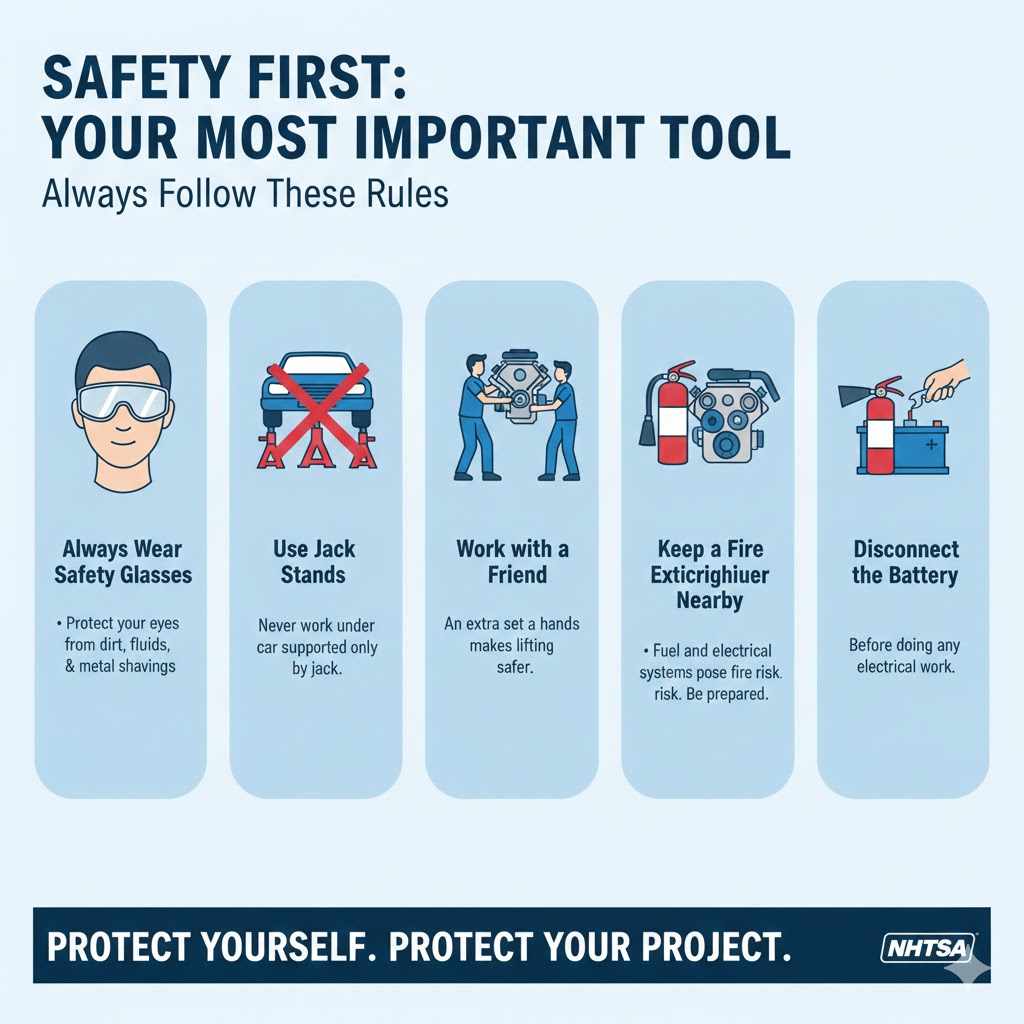
Safety First: Your Most Important Tool
Working on cars can be dangerous if you’re not careful. Your safety is more important than any project. Always follow these rules:
- Always Wear Safety Glasses: Protect your eyes from dirt, fluids, and metal shavings.
- Use Jack Stands: Never, ever work under a car supported only by a jack.
- Work with a Friend: An extra set of hands makes lifting heavy parts safer and easier.
- Keep a Fire Extinguisher Nearby: Fuel and electrical systems pose a fire risk. Be prepared.
- Disconnect the Battery: Before doing any electrical work, always disconnect the negative battery terminal to prevent shorts.
FAQ: Your Chevy 454 Swap Questions Answered
What is the easiest car to swap a 454 into?
Generally, full-size GM cars and trucks from the 1960s to the 1980s are the easiest candidates. Vehicles like the Chevy Chevelle, Impala, Monte Carlo, and C10 pickup often had big-block options from the factory, so the engine bay is large and aftermarket swap parts are widely available.
How much horsepower does a stock Chevy 454 have?
Stock horsepower ratings vary greatly by year and application. Early 1970s performance versions (like the LS6) made over 450 horsepower. Later truck versions from the 80s and 90s were tuned for torque and typically made between 230 and 290 horsepower, but with over 400 lb-ft of torque.
Do I need to upgrade my brakes and suspension?
It is highly recommended. The 454 engine is significantly heavier than a small-block V8 or a V6. You should at least install heavy-duty front springs to handle the weight. Upgrading to disc brakes, especially on the front, is a crucial safety improvement to help stop the heavier vehicle.
Can I use the transmission from my old small-block Chevy?
Maybe, but it’s risky. While a transmission like a TH350 will bolt up to a 454, it was not designed for the massive torque. It may work for gentle driving, but it will likely fail under heavy acceleration. It’s much safer to upgrade to a stronger transmission like a TH400 or a 4L80E.
Are Gen V 454 parts compatible with a Mark IV block?
Some parts can be swapped, but major components like the crankshaft are not directly interchangeable due to the different rear main seal designs (1-piece vs. 2-piece). While rods and pistons can sometimes be used, it’s best for beginners to avoid mixing internal parts between these two generations to prevent costly machine work and compatibility issues.
Is a 454 swap expensive?
The cost can vary widely. A budget-friendly build using a used junkyard engine and doing all the labor yourself could be done for a few thousand dollars. A professional build with a fully rebuilt, high-performance engine and new supporting systems can easily exceed $10,000 to $15,000.
Conclusion: Enjoy Your New Big-Block Power
Completing a Chevy 454 swap is a major accomplishment that will leave you with a huge sense of pride every time you turn the key. It’s a project that combines planning, problem-solving, and hands-on wrenching. The journey might have its challenging moments, but the reward is a classic vehicle with the heart and soul of American muscle.
Take it one step at a time, prioritize safety, and don’t be afraid to ask for help. By following this guide, you have a solid roadmap to success. Now, go out there, get your tools ready, and build the powerful ride you’ve always dreamed of!