Car Number Decals: Best Vinyl Stickers for Every Use
Cast vinyl is commonly used for longer-term vehicle numbers, calendared vinyl is often used for shorter-term fleet IDs, and reflective or perforated film is typically used when visibility or window mounting is needed. Wrong film can shrink, crack, lift at the edges, or fail early, which means replacement costs and unreadable numbers. This guide matches decal material, adhesive, finish, and size to trucks, service vans, race cars, and temporary markings.
Quick comparison
| Product | Badge | Best for | Price | ||
|---|---|---|---|---|---|
 |
PATIKIL 6" Reflective Number Stickers 0-9 Adhesive WhitePATIKIL | Our pick | 6 in · reflective · white | $13.99
Price as of 30 Oct 2026
|
View |
 |
TaoBary 8 Sheets Mailbox Numbers Stickers Self AdhesiveTaoBary | Pair with it | 8 in · black · vinyl | $21.99
Price as of 30 Oct 2026
|
View |
 |
5 Sets 2 inch Mailbox Numbers Sticker 0-9 Decal Die CutSIXQJZML | Budget pick | 2 in · black · die-cut | $5.99
Price as of 30 Oct 2026
|
View |
 |
EZ Line Vinyl Decals for Cars Red and Yellow Large NumberCarBowz | Also great | 7.5 in · fluorescent · red/yellow | $39.95
Price as of 30 Oct 2026
|
View |
Start with the job, then the look. A decal that appears fine on a screen can still fail on textured paint, tinted glass, or a hot rear bumper.
For drivers and small businesses, the main split is between cut vinyl, transfer stickers, printed vinyl, and front-adhesive window film. The best choice depends on where the decal lands, how long it needs to stay there, and whether you need easy removal later.
How we chose
We compared manufacturer specs, listing details, and published buyer feedback, then filtered the options by use-case fit rather than artwork alone.
The strongest signals were adhesive type, placement surface, visibility at distance, and the stated indoor or outdoor use. Also check for clear sizing information and plain limits around removal and bubble-free installation.
When a listing gave specific details, those details drove the recommendation. When it did not, the safe advice is to check the manufacturer’s listing for your model and surface.
Car decal decision matrix
| Use case | Best vinyl type | Surface location | Durability priority | Removability | Common failure mode |
|---|---|---|---|---|---|
| Business branding | Printed vinyl with UV printing | Doors, rear panels, tailgate | Fade resistance and clean logo edges | Medium, if service plans change | Edge lift on dirty paint or faded ink in sun |
| Bumper stickers | Removable adhesive | Rear bumper or smooth bumper cover | Moderate weather exposure | High, when removed on time | Residue after long heat cycles or old adhesive |
| Window decals | Front adhesive stickers | Inside glass | Readability through glass and tint | High on clean glass | Mirror-text error or trapped moisture on the pane |
| Fleet numbers | Cut self-adhesive vinyl | Doors, rear quarter panels, windshields where allowed | Legibility and weather resistance | Medium, depending on adhesive grade | Cracking, shrinkage, or poor contrast at distance |
| Temporary promotions | Calendared printed vinyl with removable adhesive | Doors, windows, bumper corners | Fast install and clean takeoff | High for short campaigns | Early edge curl if the surface was not cleaned well |
SIXQJZML 2 inch die-cut numbers: best for fleet IDs
This is the clearest fit for small fleet numbers, door codes, and other jobs where readable black digits matter more than decoration. The die-cut format makes custom combinations easier, and the waterproof, weatherproof vinyl fits a long-term labeling job on a clean, hard surface.
Based on the listing, the 2 inch size suits compact placements where the number must sit neatly on a door, window, or sign. That said, 2 inch digits can disappear fast at distance, especially on dark paint or in low light.
Use this style when the vehicle will carry short identifiers, lot numbers, or service-unit markings. For better contrast, keep the background simple and smooth, and avoid textured trim that can break the edge seal.
PATIKIL 6 inch reflective numbers: best for night visibility
This is the better pick when the job needs reflectivity after dark. The reflective finish helps nighttime visibility, and the waterproof vinyl is listed for indoor or outdoor use on smooth surfaces such as car doors, windows, or signs.
The 6 inch size gives the numbers more presence than a small utility decal, which helps on delivery vehicles and service cars. The drawback is simple: reflective film is about visibility first, not subtle styling, so it can look out of place on a low-key build.
Sticker Mule’s product notes also line up with the broader rule for vehicle decals: thick vinyl can help protect stickers from scratches, water, and sunlight. That matters on exposed panels and rear-facing surfaces.
TaoBary 8 inch black numbers: best for larger surfaces
This option is aimed at bigger placements where the number needs to be seen from farther away, such as larger doors, locker-style panels, or broad rear body sections. The listing calls out an 8 inch size, a classic font, and compatibility with smooth, clean, hard surfaces.
The main benefit is scale. Large black numbers are easier to read on light paint and bright glass, but they can feel oversized on small hatchbacks or narrow door panels.
Choose this style when the goal is fast recognition rather than discreet labeling. If the surface is curved or textured, check the vehicle surface carefully before ordering, because larger characters can bridge uneven panels poorly.
CarBowz fluorescent windshield numbers: best for high-contrast display
This is the strongest fit for situations where a windshield number needs to stand out quickly, such as dealer lots, auctions, or temporary route IDs. The fluorescent red and yellow colors are built to grab attention, and the listing says the vinyl is durable and waterproof for windshield use.
The tradeoff is visibility in a very specific lane. Fluorescent numbering helps on glass, but it is not the quietest look for a private vehicle, and it may not suit every tinted windshield or interior layout.
Use it when the number must be obvious at a glance and the placement is inside the windshield zone or another glass surface that allows the color to do the work.
What kind of vinyl sticker is best for car decals?
For most vehicle jobs, self-adhesive vinyl is the safest starting point because it is built for outdoor durability, weather resistance, and application on vehicle surfaces. For lettering and logos, transfer stickers are often better because they hold fine shapes more cleanly than a plain peel-and-stick label. For inside-glass placement, front adhesive stickers are the right construction.
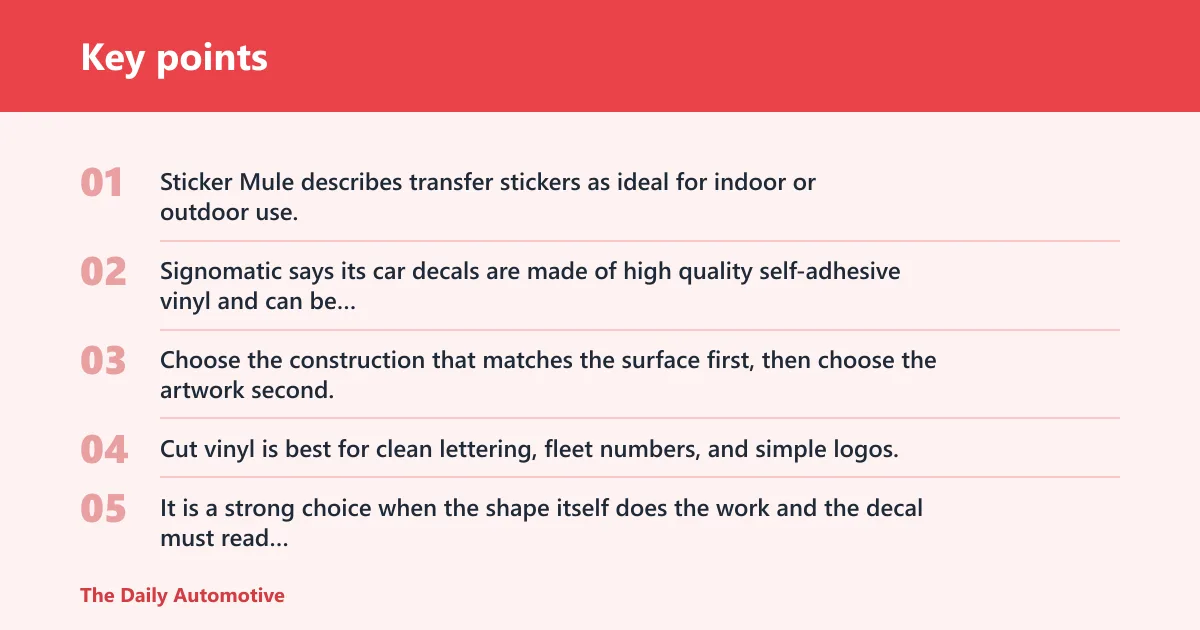
Sticker Mule describes transfer stickers as ideal for indoor or outdoor use, and front adhesive stickers as sticky on the front for inside-window use. Signomatic says its car decals are made of high quality self-adhesive vinyl and can be applied to all surfaces of the vehicle, which is broad language but still needs a surface check in real use.
The practical rule is simple. Choose the construction that matches the surface first, then choose the artwork second.
Cut vinyl decals
Cut vinyl is best for clean lettering, fleet numbers, and simple logos. It is a strong choice when the shape itself does the work and the decal must read cleanly from a short or medium distance.
It can fail on textured surfaces, dirty paint, and curves that are tighter than the film can follow. On dark paint, thin black vinyl may disappear unless the size or contrast is adjusted.
Printed vinyl decals
Printed vinyl is the better fit for full-color graphics, gradients, detailed logos, and photo-style motifs. UV printing matters here because it improves outdoor fade resistance and helps preserve the look of the image longer than a weak ink layer.
Opaque printed decals work best on dark paint or tinted glass when you need the design to stay visible. Transparent versions can look cleaner on some windows, but they may lose contrast if the background is busy or dark.
Are car decals safe for paint and windows?
They can be safe when the surface is clean, smooth, and compatible with the adhesive, but they are not safe for every finish or every glass area. Fresh paint, damaged clear coat, textured trim, and compromised window film all raise the risk of residue or damage during removal.
The same source recommends cleaning the surface before applying the decal, and its decals are described as weather-resistant. That is the minimum starting point, not a promise for every paint type or every pane of glass.
For paint, the safest path is to apply only to cured, sound surfaces and to remove the decal before the adhesive ages too far. For windows, keep the decal out of the driver’s view and follow local rules for visibility.
Front adhesive stickers on glass
Front adhesive stickers are made for inside-window use, so the adhesive sits on the front side of the film and the image faces outward. That makes them useful for shop fronts and vehicle windows where you want the graphic protected inside the glass.
Mirror-readable placement matters here. If the design is meant to read correctly from outside, the artwork usually needs to be reversed before printing.
Picture a service van with dark tint on the rear glass and a white phone number. A front-adhesive decal keeps the number inside the glass, where it is less exposed to weather and wash chemicals, but the layout must still be readable from outside.
What is the difference between car decals and bumper stickers?
Bumper stickers are a narrower category. They are usually built with removable adhesive for easier takeoff, while car decals can include a wider range of films for doors, windows, logos, fleet numbers, and windshield placement. That difference matters when you are choosing between short-term messaging and longer-lived vehicle branding.
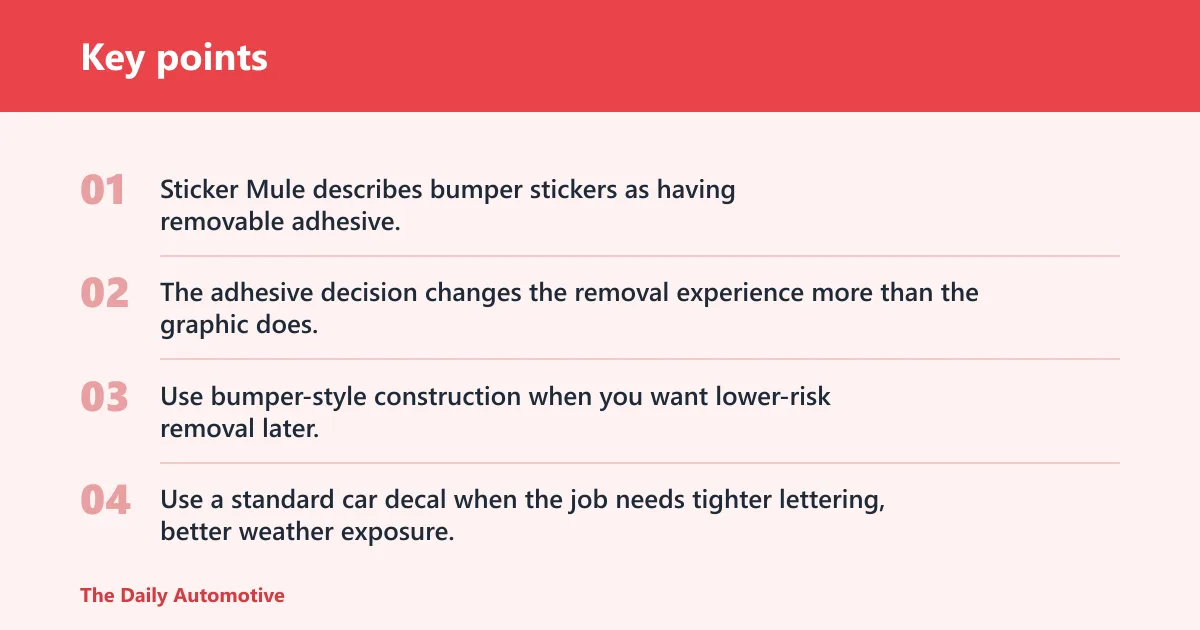
The same source describes bumper stickers as having removable adhesive, while its car decals are offered for cars, trucks, crossovers, and other vehicles. The adhesive decision changes the removal experience more than the graphic does.
Use bumper-style construction when you want lower-risk removal later. Use a standard car decal when the job needs tighter lettering, better weather exposure, or a more permanent business label.
Which car decal material lasts longest outdoors?
For outdoor use, the longest-lasting choice is usually the material with the best balance of vinyl thickness, adhesive quality, and UV resistance. In practice, that often means a high-grade vinyl decal with print protection or a reflective film made for weather exposure, not a thin temporary sticker.
The same source says thick vinyl protects stickers from scratches, water, and sunlight. The same source says its decals can withstand wind and weather, which supports the outdoor use case, but long life still depends on clean installation and the right surface.
Long outdoor life is less about the art style and more about the film staying flat. Edge lift, sun fade, and trapped moisture are the common failure modes that shorten service life.
UV printing and fade resistance
UV printing is the better choice when the decal needs a printed motif that stays readable outdoors. It helps the ink layer resist sun fade better than a weak print process, especially on rear-facing or side-mounted graphics that take direct light.
If the art has fine detail, keep the design simple enough that sunlight, dust, and road grime do not blur the message. High-quality motif output still depends on contrast, not only color count.
How do I apply a vinyl car decal without bubbles?
Start with a clean, dry surface, then apply the decal slowly from the center outward. Use a squeegee or scraper to push air toward the edge as you go, because bubbles usually appear when the film traps air against dust, wax, or moisture.
Signomatic specifically recommends cleaning the surface before applying the decal and removing bubbles from the center outward. That method works because it gives the air a path out instead of trapping it under the vinyl.
- Wash and dry the target area fully.
- Wipe off wax, road film, and loose dust.
- Align the decal before touching the adhesive down.
- Press from the middle toward each edge with a squeegee or scraper.
- Work slowly across curved sections, not in one fast pass.
A common first-timer mistake is trying to fix a large trapped bubble after the decal is already fully stuck. That usually pushes the air into a wrinkle or crease instead of moving it out cleanly.
Can car decals be removed without damage?
They can be removed without damage if the adhesive is designed for that and the surface is in good shape. Removable adhesive is the safer choice for bumper stickers and temporary markings, but even then, age, heat, and sun exposure can leave residue behind.
The same source describes bumper stickers as having removable adhesive, and its car decals are sold for vehicles of several types. Signomatic also says its decals are easy to apply and remove, though easy removal still depends on how long the decal has sat in the weather.
For paint-safe removal, avoid fresh paint and fragile surfaces. If the vehicle has compromised clear coat, older wrap film, or peeling surface treatment, removal can pull more than the decal itself.
Removal timing and residue
The longer a decal sits in sun and heat, the more likely it is to leave adhesive residue or break apart during removal. That is why temporary promotions should use a removable adhesive, not a long-life sign film.
If the decal has been on the car for months or years, expect more cleanup. If it is on a bumper or textured plastic, go slowly and stop if the surface starts to lift.
Should I choose opaque or transparent car decals?
Choose opaque decals when you need strong contrast on dark paint, tinted windows, or busy backgrounds. Choose transparent decals when the background should show through and the design itself is simple enough to stay readable without a solid backing.
Opaque film is the safer bet for most business branding because it stays visible across more vehicles and lighting conditions. Transparent film can look cleaner on glass, but mirror-readable layout and tint can complicate the result.
Reflective designs are a separate choice. They help with night visibility, but they can look brighter than expected and may not suit a low-profile look.
What size car decal should I buy for a vehicle?
Size should match the viewing distance, the panel, and the quantity you need. Width and height in mm matter because a decal that fits a door may still fail on a narrow window, and a number that looks fine on paper may be too small at road distance.
The same source lists an example decal size of 297 x 210 mm and an example vinyl decal price of $23.39 incl. VAT. That shows how manufacturers often frame size alongside quantity, not as a fixed one-size answer for every vehicle.
For doors, choose a width that leaves margin around body lines and handles. For windows, keep the height modest so the decal stays inside the visible glass area. For bumpers, size should avoid sensors, trim edges, and curved corners.
Say your service van needs fleet numbers on the rear doors and the side panel is narrow. A 297 x 210 mm layout may fit one area but not another, so the safe move is to measure the panel first and order by both size and quantity instead of guessing from a product photo.
Which one should you buy?
If the job is long-term fleet identification, start with cut self-adhesive vinyl and choose the size that fits the door or window without crowding the edges. If the job is temporary, removable adhesive is the better call because it lowers the removal risk later.
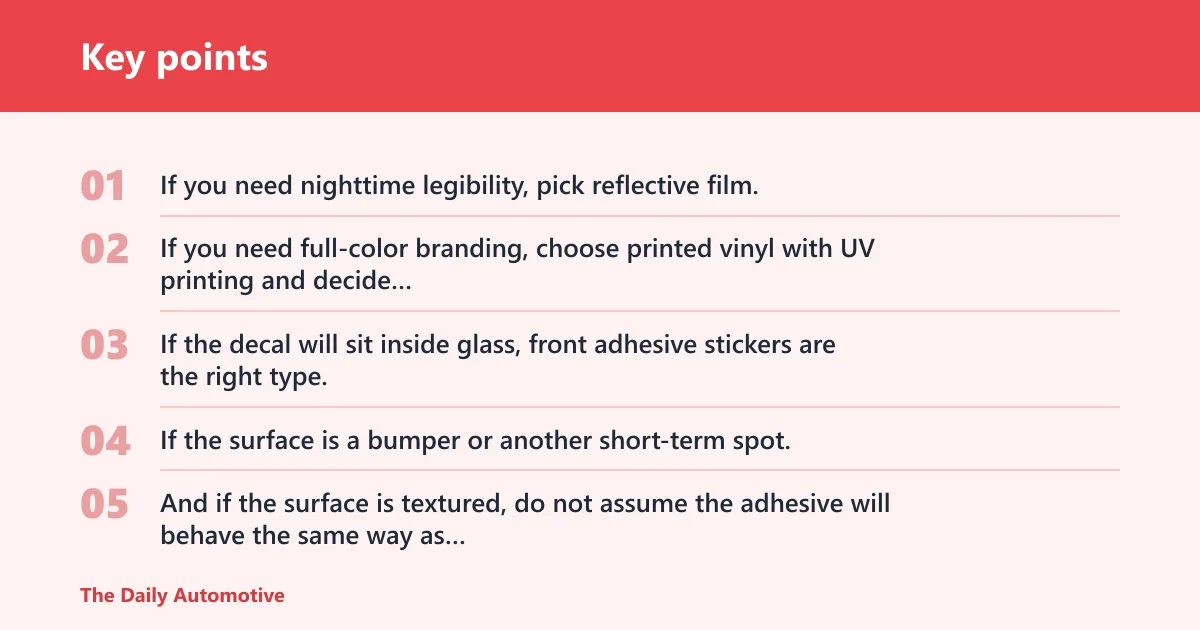
If you need nighttime legibility, pick reflective film. If you need full-color branding, choose printed vinyl with UV printing and decide whether opaque or transparent gives better contrast on your vehicle color and window tint.
If the decal will sit inside glass, front adhesive stickers are the right type. If the surface is a bumper or another short-term spot, a removable bumper sticker is easier to take off later. And if the surface is textured, do not assume the adhesive will behave the same way as it does on smooth paint.
For dark cars, tinted windows, or reflective designs, visibility should outweigh the artwork. For race numbers and dealer marks, readability wins again. For one-off promotions, removability matters more than lifespan.
Choose by vehicle surface
Use self-adhesive vinyl for smooth painted panels and hard exterior surfaces. Use front adhesive stickers for inside glass. Use removable adhesive for bumper jobs and other placements where you expect to take the decal off sooner.
Choose by removal timeline
If you will remove the decal soon, do not buy a long-life film just because it looks strong. A removable adhesive is less likely to leave a mess, especially on a clean bumper or window.
Choose by visibility and weather exposure
Higher exposure calls for stronger contrast, better print durability, and a film that can handle wind and weather. Lower exposure, such as an inside window, lets you prioritize placement and readability over raw weather resistance.
Products related to this article
Sponsored / affiliate links. As an Amazon Associate I earn from qualifying purchases. I may earn additional commission from eligible campaigns.