Best 3M Vinyl Stripes for Cars (2026): We Compared
The best 3M vinyl stripes for cars are the narrow 1/4-inch pinstripe for trim work, the wider hood-and-roof stripe for larger panels, and the lower-risk gloss or matte wrap film when you want a cleaner install path; choose by panel width and how many seams you can tolerate. Bad sizing or weak adhesive leaves bubbles, lifted edges, and wasted tape. This guide compares three stripe setups by install difficulty, coverage math, and failure risk so you can pick the right roll for your car, truck, hood, or roof.
Quick comparison
| Product | Badge | Best for | Price | ||
|---|---|---|---|---|---|
 |
3M 1/4" x 150′ Automotive Vinyl Pinstriping Tape (GlossAuto Restylers Inc | Our pick | 1/4" x 150′ · Gloss Black · 3M Film Series 7125 | $24.49
Price as of 25 Oct 2026
|
View |
 |
VViViD Gloss Black Adhesive Vinyl Racing Stripe Wrap FilmVViViD | Budget pick | 2" x 30ft · Gloss Black · Adhesive Vinyl Wrap Film | $12.98
Price as of 25 Oct 2026
|
View |
For most sedans, the narrow 3M 50 Pinstriping Tape is the safest all-around pick because the 150-foot roll gives you room to correct layout mistakes. SUVs and full-size trucks need more attention to stripe width and panel length, so the best choice shifts toward wider film only when you have a straight hood, roof, or bed-side run.
How we chose
The comparison below is built around four things that actually change results: roll length, stripe width, film thickness, and install risk. It also accounts for whether the stripe needs to follow curves, whether the finish hides paint flaws, and whether the adhesive gives you any room to reposition.
Durability matters, but failure mode matters more. Edge lift, shrinkage, surface telegraphing, and wash damage are what turn a good-looking stripe into a redo.
Cast vinyl is usually 2.5 to 3.5 mil thick and bends better over compound curves. Calendered vinyl is usually 3 to 4 mil thick, costs less, and carries more memory, which is why it can pull back on tight edges or show imperfections under the film.
3M 50 pinstriping tape: best for daily drivers
The 3M 50 Pinstriping Tape is the best fit for most DIY buyers who want a narrow accent stripe with long roll length and fewer material headaches. It is 1/4-inch wide, 150 feet long, and listed as 3 mil calendered vinyl, which should provide enough material for multiple passes along doors, fenders, and beltline trim.
This is the safer all-around choice when you want a clean pinstripe rather than a wide rally stripe. The narrow width is easier to keep straight on body lines, and the 150-foot roll gives you margin for trim pieces, mistakes, and touch-ups.
The trade-off is curve behavior. Calendered vinyl has more memory than cast film, so it is less forgiving on tight curves, sharper corners, and panel transitions. That can matter on modern front fascias and body creases.
Likely install risk: easy to moderate. Common failure points are edge lift on dirty lower-body panels, shrinkage at ends if the stripe is stretched too hard, and visible telegraphing on paint with minor surface flaws.
Who it suits
Pick this if you want a trim stripe for a sedan, coupe, hatchback, or lightly contoured SUV panel. It also works well when you want the stripe to disappear into the car instead of becoming the main visual feature.
Where it falls short
It is not the best choice for a wide hood graphic or a full roof run. The 1/4-inch width is too narrow for that job, and calendered construction is less forgiving on compound curves than cast vinyl.
ORACAL 651 pinstriping: best for curved panels
ORACAL 651 pinstriping is the better choice when the stripe has to follow curved surfaces and you still want a gloss finish. The 1/4-inch by 150-foot roll gives you the same practical layout freedom as the 3M roll, and its up-to-five-years outdoor durability rating makes it a solid middle ground for side-body work.
This is the better option for curved doors, rounded fenders, and beltline accents where a little extra conformability matters. The gloss finish also tends to read more like paint than a matte stripe, which helps on factory-style trim work.
The drawback is that it still behaves like a narrow pinstripe, not a wide body stripe. If you need a hood graphic or a two-tone roof layout, you will outgrow this roll quickly.
Likely install risk: moderate. Common failure points are overstretching on curves, slight edge lift at the ends, and poor alignment if the installer tries to force the stripe around a tight radius instead of laying it with minimal tension.
VViViD matte black racing stripe roll: best for beginners
The VViViD roll is the easiest starter option in this group because its bubble-free backing and repositionable adhesive reduce the penalty for imperfect alignment. The listed size is about 2 inches by 30 feet, which makes it a compact roll suited to smaller projects and first-time installs.
That shorter roll is part of the appeal. It keeps the project manageable, especially if you are applying a single stripe on a hood, hatch, or a short side section instead of trying to run a car-length graphic in one shot.
The drawback is coverage. Thirty feet is enough for a smaller project, but not for the buyer who wants a full vehicle layout or a long dual-line layout. It also has less room for error than the 150-foot rolls.
Likely install risk: easy. Common failure points are minor edge lift on dirty edges, trapped debris under the film, and visible misalignment if the stripe is placed without a center reference.
Which one should you buy?
Buy the 3M 50 Pinstriping Tape if you want the safest all-around choice for trim work and a long roll that is hard to outgrow. Buy ORACAL 651 if your car has more curve than straight sheet metal and you want gloss rather than a flatter look. Buy VViViD if you want a shorter, easier first install and can live with less coverage.
Skip narrow pinstripe tape if you really want a hood stripe that reads from across a parking lot. A 1/4-inch line is a trim accent, not a rally stripe.
Say your sedan has a slightly curved hood and you want one clean center stripe. A 1/4-inch roll can outline trim, but a 6-inch hood stripe gives the car a very different visual weight and needs more careful alignment. The wrong width is the fastest way to make the layout look accidental.
Suppose your full-size truck has a long bed-side run and you want dual lines instead of a single accent. That is where a dual-line layout with longer material makes more sense than narrow pinstriping, because the wider spacing reads correctly at truck scale and avoids looking undersized.
How much vinyl do you need?
Roll length translates into real coverage only after you factor in vehicle size, stripe width, and how many cuts you need around mirrors, badges, or body seams. A 150-foot roll sounds huge, but a wide hood stripe can eat material much faster than a narrow pinstripe.
| Stripe setup | Approx. usable coverage on a sedan | Approx. usable coverage on an SUV | Approx. usable coverage on a full-size truck | Install risk | Common failure points |
|---|---|---|---|---|---|
| 3M 1/4-inch pinstripe, 150-foot roll | Multiple side-body passes and trim accents | Enough for side trim, wheel-arch accents, and short hood detailing | Enough for trim work, but not wide visual stripes | Easy to moderate | Edge lift, shrinkage at cut ends, telegraphing on imperfect paint |
| ORACAL 651 1/4-inch pinstriping, 150-foot roll | Multiple side-body passes with better curved-panel fit | Good for curved side panels and small hood details | Trim accents only unless the layout stays narrow | Moderate | Overstretching on curves, edge lift at the ends, alignment drift |
| VViViD 2-inch by 30-foot stripe | Short hood or hatch stripe with limited waste | Single-panel accent stripe or partial roof section | Usually too short for a full-length truck layout | Easy | Misalignment, trapped dust, short-roll coverage shortfall |
| Universal TFX Dual Pinstripe, 150-foot roll | Side-body dual-line layout with extra margin | Good for longer SUV beltline work | Best fit for full-size truck coverage | Moderate to hard | Line spacing drift, edge lift, compound-curve failure |
| A1A 6-inch by 72-inch blue stripe | Hood stripe or short roof accent | Small hood graphic only | Too short for full-body work | Moderate | Visible seam placement, edge lift on curved hoods, wash wear |
Width matters more than most buyers think
A 1/4-inch stripe works as trim. A 6-inch stripe works as a statement. Those two jobs do not need the same product, the same prep, or the same tolerance for mistakes.
Two mil versus 3 mil
Two mil film, like the Universal TFX Dual Pinstripe, is thinner and generally easier to conform over small surface changes. Three mil film is a bit heavier and usually gives a little more body, but it also carries more memory, so it can resist tight curves more than a thinner film would.
What stripe width fits your vehicle?
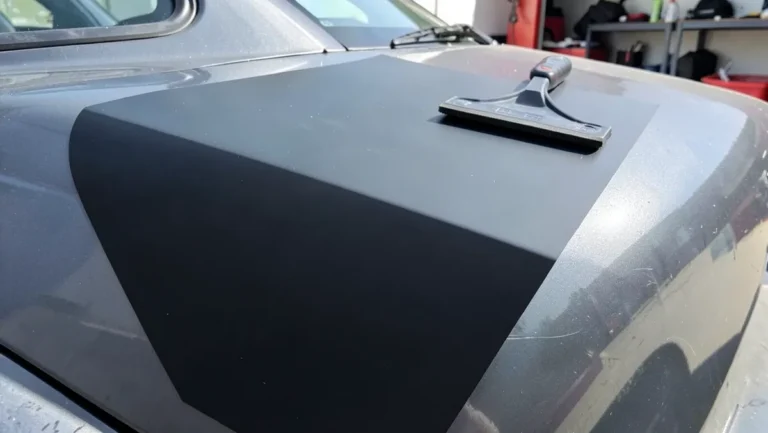
Use 1/4-inch pinstriping for side-body trim, door lines, and subtle accents. Use 6-inch film for a hood stripe or roof accent where the stripe needs to read as a visual panel, not a fine line. The larger the panel, the more width you can justify.
Hood stripe sizing
A 6-inch stripe makes sense on a hood when the hood is broad enough that a narrow line would disappear. The A1A 6-inch by 72-inch blue stripe is sized for that job, and its wet-or-dry application option gives you flexibility on placement method.
Side-body and roof layouts
Side-body layouts usually reward narrow tape because doors and fenders have more interruptions. Roof layouts can take a wider stripe, but only when the roof is long enough that the stripe does not crowd the edges.
Cast vinyl versus calendered vinyl
Cast vinyl is usually the better choice for tighter curves, longer service life, and cleaner behavior over complex surfaces. Calendered vinyl is more affordable and fine for simpler panels, but its extra memory can telegraph flaws and pull back sooner on difficult shapes.
Vinyl stripe coverage calculator
This table turns width and roll length into practical vehicle coverage. The numbers below are approximate layout guides, not fit guarantees, because panel shape, seam count, and wasted trim all change the final result.
| Width and roll | Approx. sedan use | Approx. SUV use | Approx. full-size truck use | Likely install risk | Common failure points |
|---|---|---|---|---|---|
| 1/4-inch, 150-foot roll | Side trim, door lines, accents on two to three panels | Full beltline accent with leftover material | Trim accents only, not a full visual stripe | Easy | Edge lift on dirty lower panels, shrinkage at cut ends |
| 2-inch, 30-foot roll | One hood or hatch stripe | Short roof or hood accent | Usually too short for meaningful truck coverage | Easy to moderate | Alignment drift, trapped dust, short-roll shortage |
| 6-inch, 72-inch roll | Single hood stripe with very little spare material | Small hood insert or accent panel | Too short for meaningful truck coverage | Moderate | Seam placement error, edge lift on curves, wash wear |
| Dual-line 150-foot roll | Extended side-body layout | Long SUV beltline layout | Best for a full-size truck | Moderate to hard | Spacing drift, corner lift, poor curve conformity |
How much vinyl you need depends on the panel, not just the car. A long sedan side stripe can use more material than a short SUV hood accent if the layout wraps around multiple cuts and returns.
Frequently asked questions
What is the best 3M vinyl stripe for cars?
The best all-around 3M choice here is the 3M 50 Pinstriping Tape because the 1/4-inch width works for trim, the 150-foot roll gives plenty of margin, and the 3 mil calendered build is practical for simple body lines. If you need a wider hood graphic, a pinstripe is the wrong format.
Which vinyl stripe tape is easiest to install on curves?
Thin, cast-based film with repositionable or air-release adhesive is the easiest on curves because it lets you correct placement before full bond and reduces trapped air. Among the options discussed, ORACAL 651 is the better curve-oriented narrow stripe, while VViViD is the easiest beginner choice for simple layouts.
How long does 3M pinstriping tape last outdoors?
Outdoor life depends on film type, sun load, and where the stripe sits on the car. The 3M 50 Pinstriping Tape is marketed as outdoor durable and car-wash resistant, but narrow calendered vinyl can still show edge lift or shrinkage sooner on hot, exposed panels than cast film would.
What width vinyl stripe should I use for a car hood?
Use about 6 inches when you want a visible hood stripe rather than a trim line. The A1A 6-inch by 72-inch stripe is sized for that kind of job. A 1/4-inch pinstripe is too narrow to read as a hood graphic on most cars.
Is 3M pinstriping tape better than ORACAL or VViViD?
Not in every case. 3M is the safest general-purpose trim choice, ORACAL is better when the panel curves more, and VViViD is the easier entry point for a short first project. The right pick depends on width, surface shape, and how much room you have for mistakes.
Can I apply vinyl stripes wet or dry?
Some stripes are built for wet or dry application, such as the A1A hood stripes. For most narrow pinstriping jobs, dry application is usually cleaner and faster on straight panels, while wet application can help with larger graphics if you need more slide time.
What is the difference between 2 mil and 3 mil pinstriping tape?
Two mil film is thinner and usually easier to conform to curves, while 3 mil film gives a bit more body but can hold more memory. That trade-off matters when you need a stripe to wrap around a fender or stop telegraphing paint imperfections under the film.
Will vinyl stripes survive car washes and sun?
They can, but only if the film quality, adhesive, and panel prep are right. Narrow stripes on high-wear edges fail first. Sun exposure usually shows up as edge lift, color change, or shrinkage before it causes a full peel.
Products related to this article
Sponsored / affiliate links. As an Amazon Associate I earn from qualifying purchases. I may earn additional commission from eligible campaigns.