Do Cars Run Better With Humid or Dry Air? Essential Guide
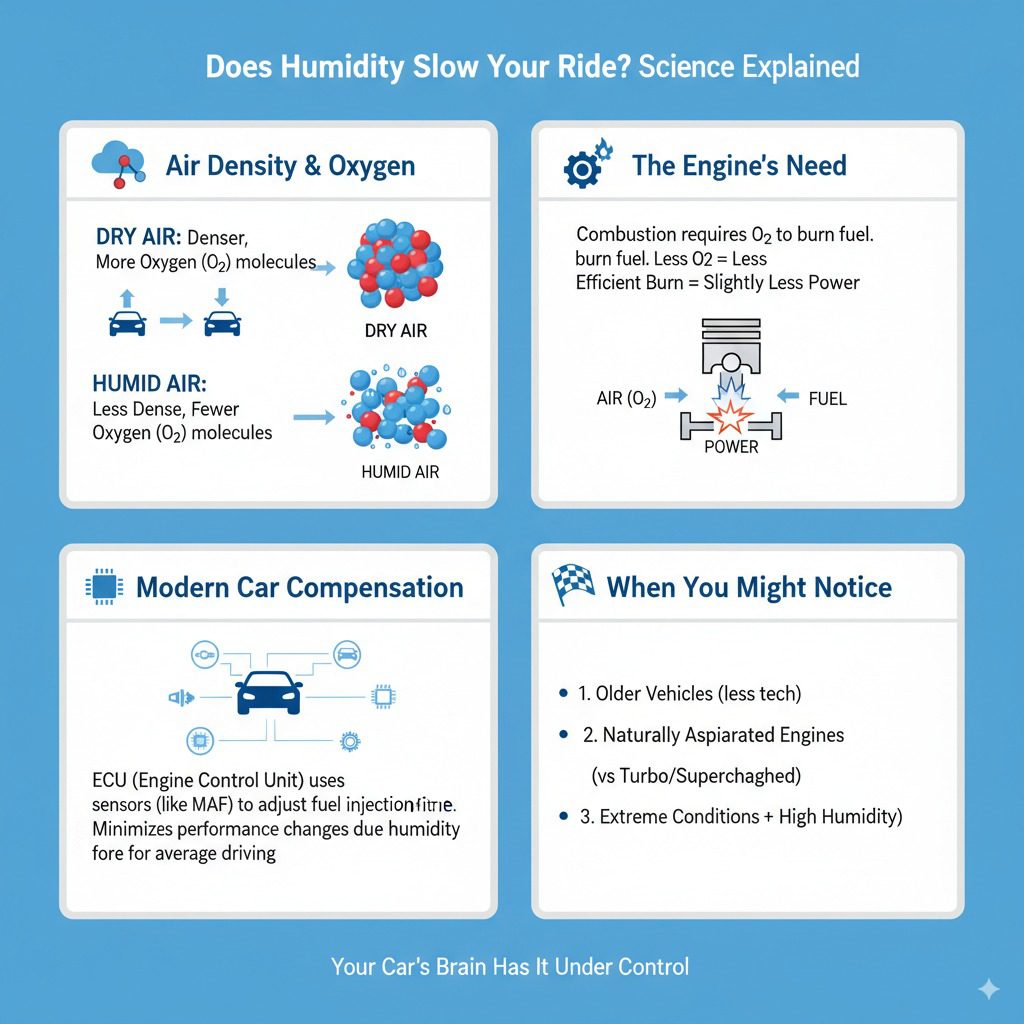
Yes, the humidity of the air can affect how your car performs. Generally, cars tend to run slightly better in drier air because it’s denser, allowing the engine to get more oxygen for combustion. However, the difference is usually very small for modern, fuel-injected vehicles.
Have you ever noticed your car acting a little differently on a super humid day compared to a crisp, dry one? It might not just be your imagination. The air around us, specifically its moisture content, plays a subtle but real role in how your car’s engine works. For many drivers, understanding these small factors can clear up a lot of confusion about why their car might feel a bit sluggish or more responsive. Don’t worry if this sounds technical; we’re going to break it all down in a way that’s easy to grasp. Get ready to discover how humidity impacts your car’s performance and what it all means for your driving experience.
The Science Behind Air and Your Engine
Think of your car’s engine like a person needing to breathe. Just like we need oxygen to live, your car’s engine needs air to burn fuel and create power. This process is called combustion. The air we breathe is a mixture of gases, primarily nitrogen and oxygen, along with small amounts of other gases like argon and carbon dioxide. Water vapor (humidity) is also present in the air. The amount of water vapor can change significantly depending on the weather.
The key here is that oxygen is the critical ingredient for combustion. When your engine takes in air, it’s the oxygen molecules that the fuel mixes with and ignites. The more oxygen available in the incoming air, the more efficiently the fuel can burn, leading to better performance and potentially better fuel economy. This is a fundamental principle in how internal combustion engines operate. The air-fuel ratio is carefully controlled by the car’s computer (Engine Control Unit or ECU) to ensure optimal burning.
How Humidity Affects Air Density
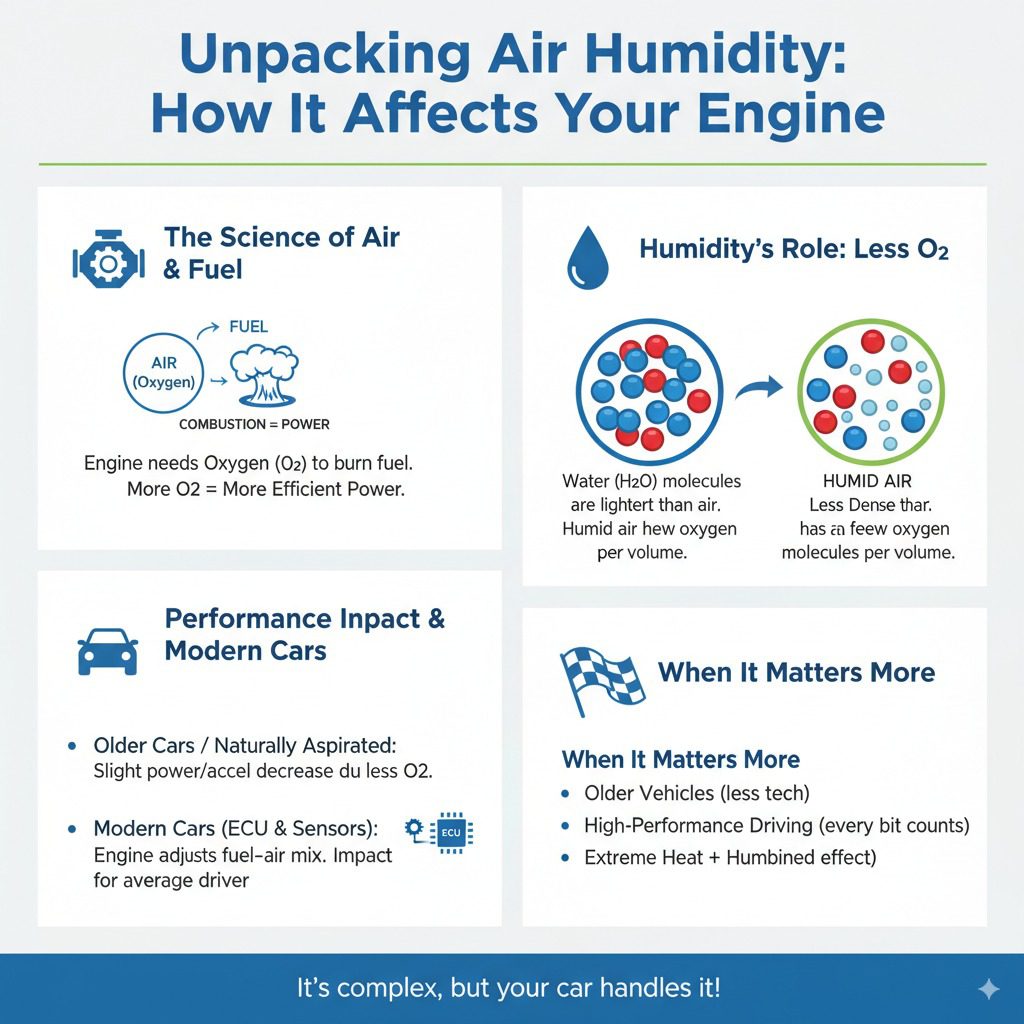
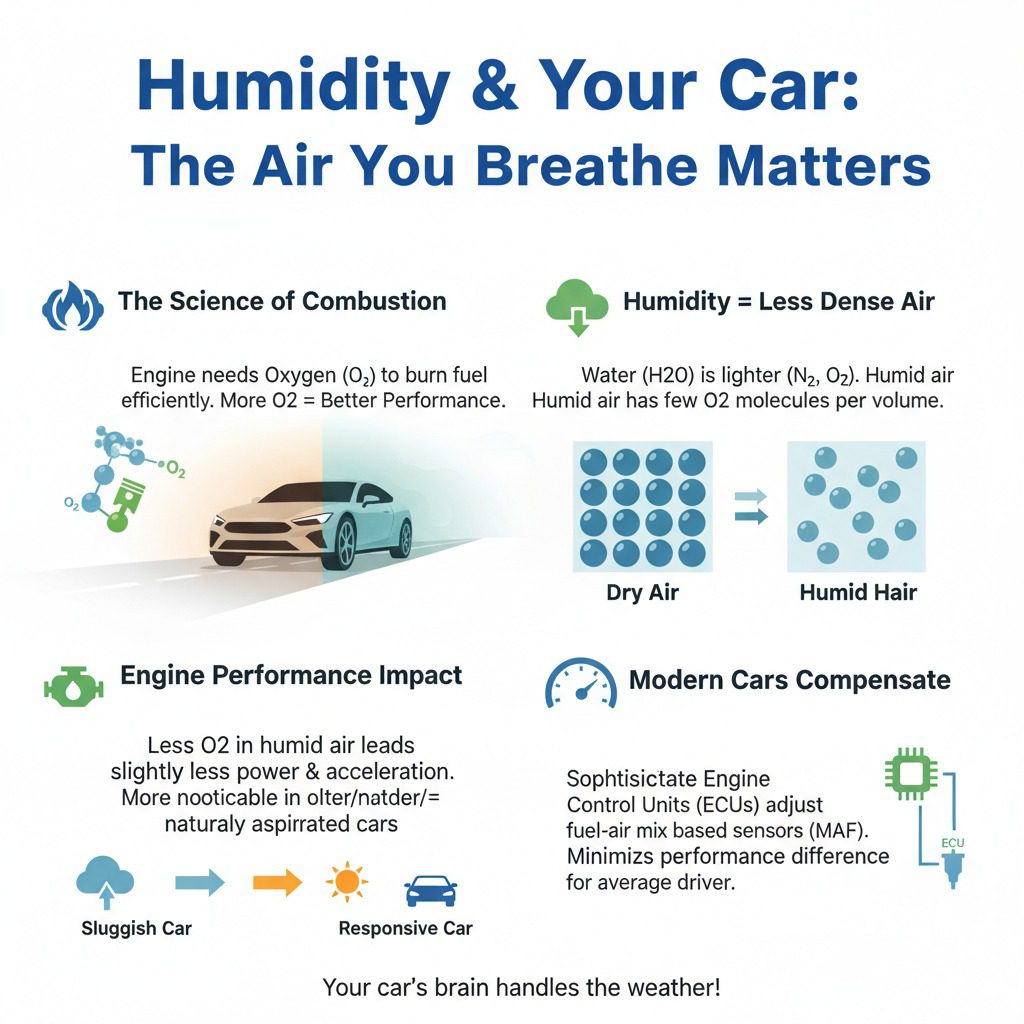
This is where humidity comes into play. Humid air, meaning air with a high concentration of water vapor, is actually less dense than dry air at the same temperature and pressure. Why? Because a water molecule (H₂O) is lighter than the average air molecule (which is mostly nitrogen, N₂, a diatomic molecule). When water vapor enters the air, it displaces some of the heavier nitrogen and oxygen molecules. So, in a given volume of air, humid air has fewer oxygen molecules compared to dry air.
Imagine a balloon. If you fill it with regular air, it has one weight. If you could somehow fill it with an equal volume of dry air (removing moisture), it would be slightly lighter because there are more of the heavier air molecules and fewer of the lighter water molecules. Conversely, humid air is like filling that balloon with slightly lighter stuff, reducing the overall density. This slight difference in density is what impacts your car’s engine.
The Impact on Engine Performance
Since engines rely on oxygen for combustion, a less dense air mixture (like humid air) means the engine is taking in less oxygen with each intake stroke. Less oxygen can lead to a slightly less potent combustion event. This can translate to a perceivable, though often minor, decrease in power and acceleration. Think of it like trying to run during a very humid day – you might feel a bit more winded than on a cool, dry morning.
In very hot and humid conditions, you might notice your car feels a bit “lazier,” requiring more throttle to achieve the same speed. Conversely, on a cool, dry day, the air is denser, packing more oxygen into the same volume, which can lead to a slightly more responsive and powerful engine. This effect is more pronounced in naturally aspirated engines (those without turbochargers or superchargers) and in older vehicle designs where air-fuel mixture control wasn’t as sophisticated.
Modern Cars and Humidity Compensation
This is great news for most modern car owners! Today’s vehicles are equipped with sophisticated engine management systems that constantly monitor various environmental factors, including air temperature and pressure. Many even have Mass Airflow (MAF) sensors that directly measure the mass of air entering the engine. These systems are designed to make adjustments to the air-fuel mixture in real-time to compensate for variations in air density caused by humidity, altitude, and temperature.
Your car’s computer uses data from sensors to calculate the precise amount of fuel to inject. If it detects that the air is less dense (due to humidity, for example), it will inject slightly less fuel to maintain the optimal air-fuel ratio. This sophisticated management system means that while the physics of air density still applies, the actual noticeable difference in performance for the average driver in a modern car is very minimal. It’s designed to ensure your car runs smoothly and efficiently regardless of typical weather changes. For more on how sensors work, resources like EPA’s automotive technologies provide a good overview of the systems at play.
When Humidity Makes a Bigger Difference
While modern cars handle humidity well, there are scenarios where the effect might be more noticeable:
- Older Vehicles: Cars produced before the widespread adoption of advanced electronic fuel injection and engine management systems are more susceptible to performance changes due to humidity. Carbureted engines or older fuel-injected systems often lack the sophisticated sensors and ECUs to make precise real-time adjustments.
- Naturally Aspirated Engines: As mentioned, engines that rely solely on atmospheric pressure to fill their cylinders (naturally aspirated) will show a more direct impact from air density changes compared to turbocharged or supercharged engines. Turbochargers and superchargers force air into the engine, effectively overcoming some of the density issues associated with humidity.
- High-Performance Driving or Racing: In competitive or high-performance driving scenarios where every bit of power and responsiveness counts, the subtle effects of humidity can become more relevant. Race teams often make adjustments based on ambient conditions to optimize engine output.
- Extreme Conditions: While less common, extreme levels of humidity combined with high temperatures can put more strain on an engine that isn’t as adept at compensating.
Temperature vs. Humidity: Which Matters More?
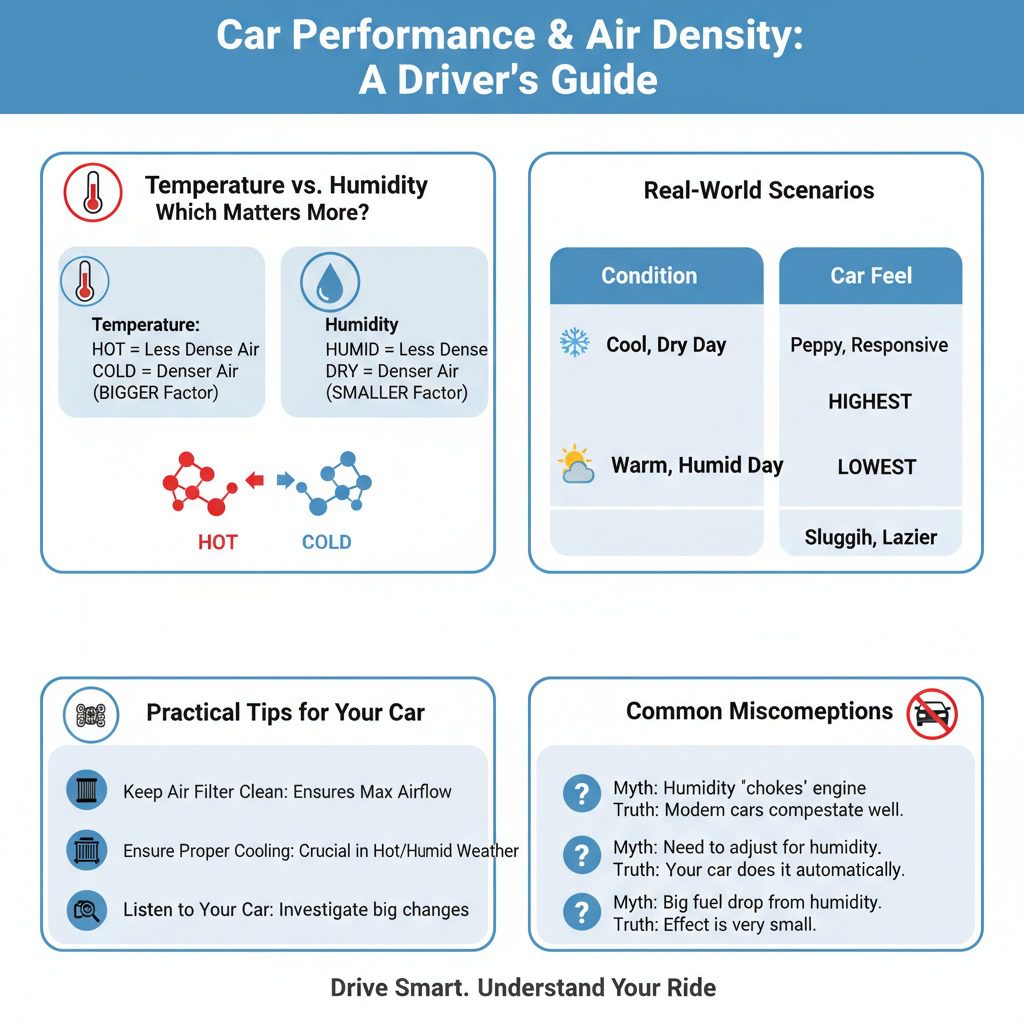
Both temperature and humidity affect air density, but they do so in different ways. Generally, temperature has a more significant impact on air density than humidity.
Here’s a simple way to think about it:
- Temperature: As air gets hotter, its molecules move faster and spread further apart, making it less dense. Cold air is denser.
- Humidity: As air gets more humid, lighter water molecules replace some of the heavier air molecules, making it less dense. Dry air is denser.
So, a very hot day, whether humid or dry, will have less dense air than a cool day. However, a very humid day will have slightly less dense air than a dry day at the exact same temperature and pressure, because of the lighter water molecules. For your car’s engine, the overall density matters most, and temperature is usually the bigger factor influencing that density.
Practical Tips for Your Car
For the average driver, there’s not much you need to do differently because of humidity. Your car’s systems are designed to handle it. However, understanding this can help you appreciate how your car’s engineering works. Here are a few general tips that indirectly relate to air intake and engine health:
Keep Your Air Filter Clean
Your engine’s air filter is its lung. A dirty or clogged air filter restricts airflow, which can have a much bigger negative impact on performance and fuel economy than humidity ever will. A clean air filter ensures your engine can breathe as freely as possible, regardless of the air’s moisture content.
When to check: Check your owner’s manual for recommended intervals, but generally, it’s good to inspect it every oil change and replace it when it looks dirty.
What it does: It stops dust, dirt, and debris from entering your engine, protecting vital components from wear.
Ensure Proper Cooling
While not directly related to air intake density, proper engine cooling is crucial, especially in hot and humid weather. Overheating can significantly degrade performance and damage your engine. Ensure your coolant levels are correct and that your cooling system is in good working order.
Listen to Your Car
Pay attention to how your car feels. If you notice a significant, consistent drop in performance that doesn’t seem weather-related, it might be worth having a mechanic check things like your mass airflow sensor, oxygen sensors, or fuel injectors. These components are critical for your engine’s ability to manage air intake and fuel mixture.
Understanding Seasonal Performance Changes
You might notice your car feels a bit peppier in the fall or winter than in the summer. This is largely due to the cooler, denser air, not just the change in humidity. Enjoy that extra pep when it’s available!
Comparing Air Density: Humid vs. Dry
Let’s look at how temperature and humidity play out in terms of air density. While precise calculations involve psychrometric charts and complex formulas, we can use a simplified comparison to illustrate the concept.
Consider two scenarios:
- Scenario 1: Cool, Dry Air (e.g., 50°F / 10°C, 30% relative humidity)
- Scenario 2: Warm, Humid Air (e.g., 80°F / 27°C, 80% relative humidity)
In Scenario 1, the air is cooler and drier. This means the air molecules are closer together, resulting in higher air density. This higher density means more oxygen molecules are available for the engine per volume of air.
In Scenario 2, the air is warmer and contains significantly more water vapor. Both the higher temperature and the presence of lighter water molecules contribute to lower air density. This means fewer oxygen molecules are available for the engine.
Here’s a table illustrating the general concept, keeping in mind that these are approximations and actual values depend on atmospheric pressure:
| Condition | Approximate Air Density (kg/m³) | Relative Oxygen Availability |
|---|---|---|
| Cool, Dry Air (e.g. 50°F, 30% RH) | ~1.22 kg/m³ | Highest |
| Warm, Dry Air (e.g. 80°F, 30% RH) | ~1.13 kg/m³ | Moderate |
| Cool, Humid Air (e.g. 50°F, 80% RH) | ~1.19 kg/m³ | Slightly Lower than Cool, Dry |
| Warm, Humid Air (e.g. 80°F, 80% RH) | ~1.06 kg/m³ | Lowest |
As you can see, the warm, humid condition results in the lowest air density and therefore the least amount of oxygen. This directly affects how efficiently the engine can combust fuel.
Common Misconceptions
It’s easy to get confused about what makes a car “run better.” While humidity is a factor, it’s often not the primary culprit for noticeable performance changes.
-
Myth: Humid air “chokes” the engine.
While humid air is less dense, modern cars compensate very well. The performance difference is usually subtle. -
Myth: You need to adjust something for humidity.
Unless you’re driving a vintage race car, modern vehicles manage this automatically. -
Myth: Humidity increases fuel consumption significantly.
While there might be a minuscule change, it’s generally overshadowed by other factors like driving style.
What people often attribute to humidity might actually be related to the combination of high temperature and humidity, which also causes driver fatigue and can make the car feel less responsive. For those interested in the physics of air, resources from institutions like the National Institute of Standards and Technology (NIST) offer detailed property data for air under various conditions.
Frequently Asked Questions (FAQ)
Q1: Do cars run better in humid or dry air generally?
Cars tend to run slightly better in drier air because it is denser, meaning there are more oxygen molecules for the engine’s combustion process. However, modern vehicles compensate for humidity so well that the difference is usually unnoticeable to the average driver.
Q2: Is humid air bad for my car’s engine?
No, humid air is not inherently bad for your car’s engine. While it is less dense and contains less oxygen, modern engine management systems adjust fuel delivery to compensate, ensuring optimal performance and preventing damage.
Q3: Why does my car feel slower on very humid days?
This feeling can be due to the less dense humid air meaning slightly less oxygen is available for combustion. However, it’s often a combination of factors, including the higher temperature that usually accompanies humidity, and psychological perception. Modern cars are designed to handle these variations.
Q4: Should I worry about humidity affecting my fuel economy?
The impact of humidity on fuel economy is generally very small, especially in modern fuel-injected cars. While theoretically, less dense air could lead to a minuscule decrease in efficiency if not perfectly compensated, other driving factors such as speed, acceleration, and tire pressure have a much larger effect.
Q5: What’s more important for engine performance: temperature or humidity?
Temperature generally has a more significant impact on air density than humidity. Cooler air is denser than warmer air, meaning more oxygen is available for combustion. Therefore, cars often perform slightly better in cool, dry conditions.
Q6: Are older cars more affected by humidity than newer cars?
Yes, older cars, especially those with carbureted engines or less advanced fuel injection systems, are more likely to show a noticeable difference in performance due to humidity. Modern cars with sophisticated engine control units (ECUs) and sensors are much better at adapting to varying air conditions.
Q7: What can I do to ensure my car runs well, regardless of humidity?
Focus on regular maintenance. Ensure your engine air filter is clean, your cooling system is functioning properly, and your tires are properly inflated. These factors have a more significant impact on your car’s overall performance than humidity alone.
Conclusion
As we’ve explored, the moisture content in the air, or humidity, does have a scientific basis for affecting your car’s engine performance. Drier air, being denser, carries more oxygen, which can lead to a slightly more efficient combustion and a subtle increase in power. Conversely, humid air is less dense, potentially causing a minor reduction in the oxygen available for the engine.
However, the most important takeaway for today’s car owners is that modern automotive technology has significantly minimized the impact of humidity. Sophisticated engine control units (ECUs) and an array of sensors work tirelessly to monitor ambient conditions and adjust the air-fuel mixture accordingly. This means that while the physics remains true, the difference you’ll actually feel in your vehicle’s performance is usually negligible. Your car is engineered to handle a wide range of atmospheric conditions, from the driest desert air to the most muggy tropical days.
Instead of worrying about humidity, you can drive with confidence knowing your car is designed to adapt. Keep up with your routine maintenance—a clean air filter, a healthy cooling system, and correctly inflated tires will contribute far more to your car’s optimal performance and longevity than any concern about the weather. So, the next time you feel your car performing a little differently, remember the science, trust your modern vehicle’s engineering, and focus on the basics of good car care.