
Do You Have to Pay BMW Diagnostic Fees Under Warranty
Many car owners wonder about paying for diagnostic fees when their BMW is under warranty. It can be a bit confusing, especially if you’re new to this. You might worry about unexpected costs popping up.
This guide will make it super clear and easy to follow. We will break down everything you need to know, step by step. Let’s figure out Do You Have to Pay BMW Diagnostic Fees Under Warranty? so you can feel confident.
Understanding BMW Warranty Diagnostic Fees
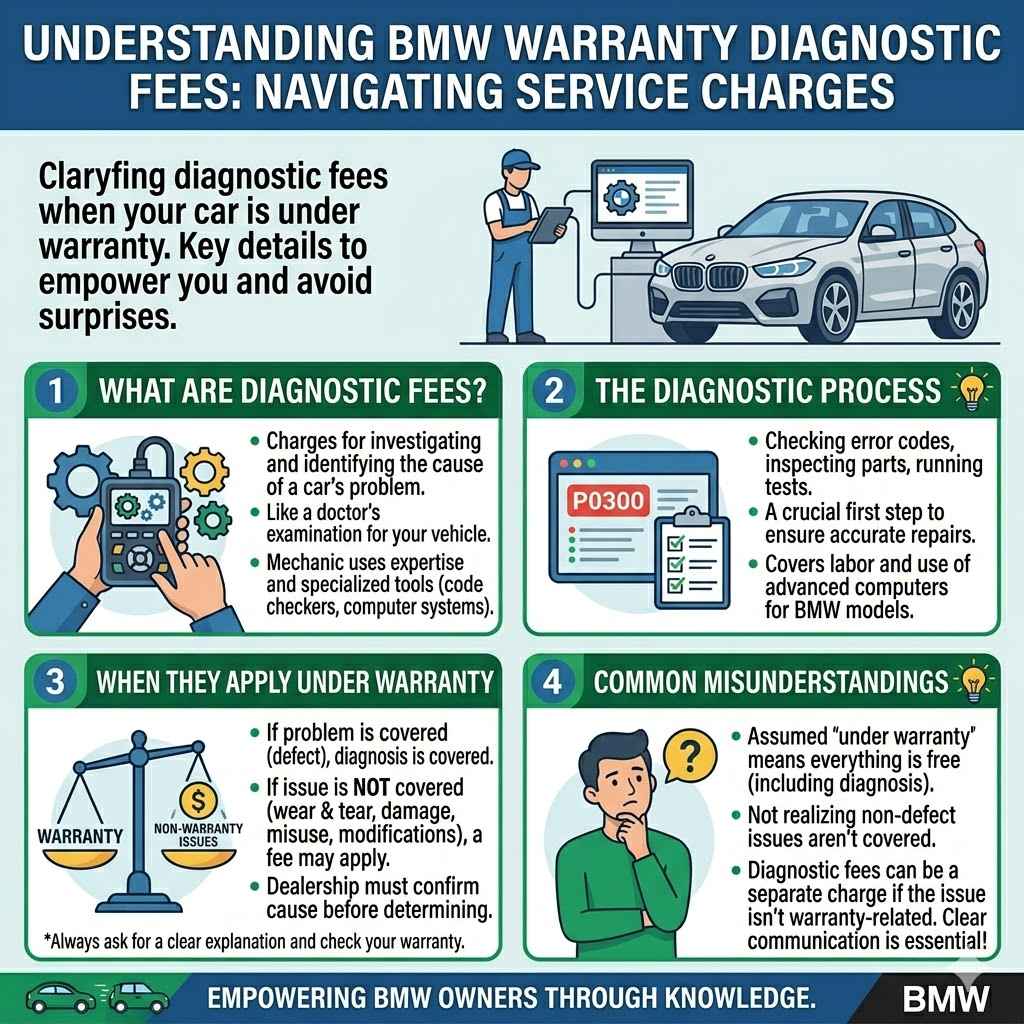
This section is all about clarifying what diagnostic fees are when your car is under warranty. It’s common to think that if your car is covered, everything is free. However, that’s not always the case with diagnostic charges.
We’ll explain why this fee exists and when it might apply even with a warranty. Knowing these details helps you avoid surprises and communicate better with your service center. It’s about empowering you with knowledge so you get the service you deserve without hidden charges.
We want you to feel in control and well-informed about your car’s care.
What Are Diagnostic Fees
Diagnostic fees are charges a repair shop or dealership applies for investigating and identifying the cause of a car’s problem. Think of it like a doctor charging for an examination to figure out what’s making you sick. A mechanic uses special tools and their expertise to pinpoint the issue with your BMW.
This process involves checking error codes, inspecting parts, and sometimes running tests. It’s a crucial first step before any actual repairs begin. Without a proper diagnosis, fixing the wrong thing could waste time and money.
The cost of a diagnostic fee usually covers the mechanic’s labor and the use of specialized equipment. Dealerships often have advanced diagnostic computers specific to BMW models. These tools can read complex data from your car’s computer system.
This helps them understand the intricate workings of the vehicle. The fee is a way for the shop to be compensated for their time and technical knowledge. It’s a professional service aimed at accurate problem-solving.
This ensures that when repairs are performed, they address the root cause effectively.
For example, if your check engine light comes on, a diagnostic fee helps the technician determine exactly why. It might be a simple loose gas cap or something more complex like a sensor failure. The diagnostic process saves you from unnecessary part replacements.
It ensures that the repair bill reflects actual issues found, not guesswork. This is why it’s a standard practice in auto repair, even for simple checks.
When Diagnostic Fees Might Apply Under Warranty
This is where things can get a little tricky and where many people get confused. The core idea is that your BMW warranty covers specific parts and issues. If a problem is covered by the warranty, the diagnosis and the repair should also be covered.
For instance, if your engine fails due to a manufacturing defect, the diagnosis to confirm that defect and the subsequent repair will be under warranty. BMW will pay for this.
However, diagnostic fees can sometimes be charged if the issue found is NOT covered by the warranty. For example, if you bring your car in for a strange noise, and the diagnosis reveals that the issue is due to wear and tear on a part not covered by warranty, or damage caused by misuse, you might be charged for the diagnostic time. Similarly, if the problem is caused by aftermarket modifications that interfere with the car’s systems, the diagnosis might not be covered.
The dealership needs to confirm the cause before they can determine warranty coverage.
It’s important to remember that the warranty contract is key. It outlines what is and isn’t covered. Always ask for a clear explanation if you are unsure why a diagnostic fee is being charged.
A reputable dealership will explain the situation thoroughly. They should show you the specific reason why the issue falls outside the warranty’s scope. This transparency helps avoid misunderstandings and builds trust.
Understanding the warranty terms beforehand is also a smart move.
Common Misunderstandings for Beginners
Beginners often assume that “under warranty” means absolutely everything is free. They might think that any visit to the dealership for a problem will automatically be covered in full. This isn’t always the case, especially with diagnostic work.
The confusion arises because the warranty typically covers parts and labor for defects. However, the process of finding that defect, the diagnosis itself, can sometimes have a gray area.
Another common misunderstanding is that the diagnostic fee is always a separate, fixed charge added on top of repairs. While some shops have a set diagnostic fee, it’s often factored into the overall repair cost. For example, if a repair is covered under warranty, the diagnostic time is usually part of that covered labor.
The confusion comes when a diagnostic fee is presented for an issue that turns out to be a customer-pay situation. This is why clear communication is vital.
Let’s say your car is making a squeaking sound. You take it in, and they spend an hour diagnosing it. If the squeak is from a worn brake pad (which is a wear-and-tear item and not typically under warranty), the shop might charge you for that hour of diagnosis.
If the squeak was from a faulty suspension component due to a manufacturing defect, that diagnostic hour would likely be covered under warranty. The beginner might not realize this distinction.
BMW Warranty Coverage and Diagnostics
Now let’s look more closely at how BMW’s warranty specifically relates to diagnostic procedures. BMW offers different types of warranties, each with its own set of inclusions and exclusions. Understanding these can help you determine if your diagnostic fees should be covered.
We will explore the basic BMW warranty, extended warranties, and how they interact with the costs of finding out what’s wrong with your car. This will give you a clearer picture of your rights and responsibilities.
The Standard BMW New Vehicle Limited Warranty
The standard BMW New Vehicle Limited Warranty is what comes with a new BMW when you first buy it. It’s designed to protect you from defects in materials or workmanship from the factory. This warranty typically covers major components like the engine, transmission, and drivetrain for a certain period or mileage, usually four years or 50,000 miles, whichever comes first.
It also covers other systems, like the electrical system and emissions control components.
When you bring your BMW to an authorized dealership with a concern during this warranty period, they will first perform a diagnosis. If the problem identified is a result of a manufacturing defect, and the component is covered under the New Vehicle Limited Warranty, then BMW covers both the diagnostic fee and the cost of the repair or replacement of the faulty part. They use specialized BMW equipment to confirm the issue and ensure it’s a warranty-valid repair.
For example, if your infotainment screen starts malfunctioning due to a faulty module installed at the factory, the dealership will diagnose the issue. If they confirm it’s a manufacturing defect, the diagnostic time and the replacement of the module will be covered under the New Vehicle Limited Warranty. You won’t have to pay for this diagnosis or repair.
This is the ideal scenario everyone hopes for.
Extended Warranties and Certified Pre-Owned (CPO) Warranties
BMW also offers extended warranties, which you can purchase to provide coverage beyond the original new vehicle warranty. Similarly, BMW Certified Pre-Owned (CPO) vehicles come with their own specific warranty coverage. These CPO warranties are generally quite comprehensive and often extend for a period of time after the original new vehicle warranty expires.
They are designed to give buyers confidence in a used BMW.
The rules for diagnostic fees under these extended or CPO warranties are usually very similar to the standard new vehicle warranty. If a problem arises that is covered by the terms of your extended or CPO warranty, the diagnostic work required to identify that problem should also be covered. The dealership will still need to confirm that the issue falls within the warranty’s parameters.
They will use their diagnostic tools to verify this.
For instance, imagine you have a CPO BMW, and you notice a leak in the cooling system. The CPO warranty typically covers many parts of the cooling system. When you take it in, the technician will diagnose the leak.
If it’s caused by a faulty water pump covered by the CPO warranty, the cost of the diagnosis and the repair will be covered. You typically won’t pay out-of-pocket for the diagnostic labor in such cases.
Here’s a comparison of typical coverage:
| Warranty Type | Diagnostic Fee Coverage | Common Examples of Covered Issues | Common Examples of NOT Covered Issues |
|---|---|---|---|
| New Vehicle Limited Warranty | Covered if issue is a manufacturing defect | Engine misfire, transmission slipping, faulty sensor | Brake wear, tire replacement, oil changes, accident damage |
| Certified Pre-Owned (CPO) Warranty | Covered if issue is a covered component failure | Many powertrain and electronic component failures | Cosmetic damage, routine maintenance, wear and tear items |
| Extended Warranty (BMW Platinum) | Covered if issue is a covered component failure (plan dependent) | Varies by plan, often includes powertrain, electronics, AC | Routine maintenance, wear and tear, damage from neglect |
It’s crucial to read the specific terms and conditions of your warranty document. Not all extended warranties are created equal, and their coverage for diagnostics can vary. Some plans might have a deductible that applies to diagnostics or repairs, while others don’t.
Always clarify this with the warranty provider or the dealership when you purchase the coverage.
What Constitutes a “Covered” Issue
A “covered” issue under a BMW warranty generally refers to a problem caused by a defect in the materials used to build the car or in the way the car was manufactured. This means that if a part fails because it was faulty from the factory, or if a system doesn’t work as designed due to an error in its construction, that’s typically a covered issue. BMW wants to ensure their vehicles perform as intended and are free from such defects.
This includes things like an engine component failing prematurely because of a flaw in its metal casting, an electronic module that stops working because of faulty wiring from the factory, or a transmission that slips because of an internal defect. The warranty exists to protect you from these kinds of failures that are outside of your control and are the manufacturer’s responsibility to correct.
Conversely, issues that are considered “wear and tear” or “maintenance items” are usually not covered. For example, replacing brake pads, changing your oil, replacing windshield wiper blades, or fixing flat tires are all part of owning a car and are your responsibility. Damage caused by accidents, improper maintenance, or modifications not approved by BMW is also typically excluded from warranty coverage.
The diagnostic fee would then usually fall on you in these non-covered situations.
Here’s a simple breakdown:
- Covered Issues: Problems arising from manufacturing defects, faulty components from the factory, or system failures not caused by external factors. The warranty is meant to address these.
- Not Covered Issues: Normal wear and tear (like tires or brake pads), routine maintenance (oil changes, fluid flushes), damage from accidents or misuse, modifications that alter the car’s original systems, and damage from neglect.
When you bring your car in, the service advisor and technicians work together to determine if the issue is covered. They will consult BMW’s service bulletins and warranty guidelines. If they determine the problem is due to a manufacturing defect, they will proceed with warranty repairs, and you won’t pay for the diagnosis.
If it’s not a covered issue, they will inform you about the diagnostic fee and the cost of repairs.
The Role of the Dealership Service Department
The dealership service department is your primary point of contact for warranty work. They are authorized by BMW to perform these repairs and have access to genuine BMW parts and diagnostic equipment. They are trained to identify issues and determine if they are covered under your BMW warranty.
Their expertise is crucial in the process of getting your car fixed under warranty.
When you report a problem, the service advisor will listen to your concerns and create a work order. They will then assign a technician to diagnose the issue. The technician uses advanced diagnostic tools, often proprietary BMW software, to read error codes, check system data, and physically inspect the vehicle.
This diagnostic process is where the fee might come into play.
If the diagnosis points to a covered warranty issue, the dealership will submit a claim to BMW for the diagnostic labor and the repair parts. If the issue is not covered by the warranty, the dealership will then present you with the diagnostic fee and an estimate for the necessary repairs. They are expected to be transparent about this and obtain your approval before proceeding with any paid work.
A common scenario involves a customer reporting a strange noise. The technician spends an hour using a stethoscope and checking under the car. If the noise is found to be a loose exhaust clamp, which is often not covered under warranty as it can be affected by road conditions, the customer might be charged for that hour of labor.
If the noise was due to a failing control arm, which could be a warranty item, the diagnosis would be covered. The dealership’s role is to make this determination accurately.
How to Handle BMW Diagnostic Fees Under Warranty
It’s one thing to know about the fees, and another to know how to handle them effectively when they arise. This section will provide you with practical steps to ensure you are treated fairly and that your warranty is utilized to its full potential. We will cover how to communicate with your dealership, understand your warranty document, and what to do if you disagree with a charge.
Following these steps can save you money and hassle.
Communicating Effectively with Your Service Advisor
Clear and direct communication is key when dealing with any car repair, especially under warranty. When you first bring your BMW in, explain the problem thoroughly to your service advisor. Be specific about the symptoms you are experiencing, when they occur, and any circumstances that seem to make them worse or better.
This detailed information helps the technician start their diagnostic process more efficiently.
Don’t be afraid to ask questions. If the service advisor mentions a diagnostic fee, ask them why it’s being charged. Inquire whether the fee will be waived or applied to the repair cost if the issue turns out to be covered under warranty.
Ask them to explain the warranty terms related to the problem they’ve found. A good service advisor will patiently answer your questions and provide clear explanations.
Here’s a sample conversation starter:
- “Hello, I’m here because my car is making a strange clicking noise when I turn left. It started a few days ago.”
- “I understand there might be a diagnostic fee. Can you explain what that covers and if it will be applied to the repair if it’s a warranty issue?”
- “Could you please show me in my warranty booklet where this specific issue falls in terms of coverage?”
It’s also important to get everything in writing. The initial repair order should detail the customer’s concern and the technician’s initial assessment. If there are any changes or additional findings, ensure they are documented and discussed with you before any work is done that you would have to pay for.
This documentation serves as a record of your interactions and agreements.
Reviewing Your Warranty Documentation
Your BMW warranty document is a legally binding contract that outlines the terms of coverage. Before you even need to worry about diagnostic fees, it’s a good idea to familiarize yourself with its contents. Pay close attention to sections detailing what is covered, what is excluded, and any specific procedures you need to follow for warranty claims.
Look for information about diagnostic labor. Some warranty documents might explicitly state whether diagnostic fees are covered for warranty-related repairs. Others might be more general.
If you are unclear about any part of the warranty, contact BMW Customer Relations or the dealership’s warranty administrator for clarification. Don’t wait until a problem arises to try and understand your coverage.
For example, the document might state: “All diagnostic labor performed to identify a defect covered under this warranty is included.” Or it might say something like: “Diagnostic charges will apply if the fault is not covered by this warranty.” Understanding these specific phrases is crucial. It’s important to know if there’s a deductible associated with diagnostic fees for certain types of warranty claims or specific extended plans.
Consider these points when reviewing your warranty:
- Scope of Coverage: What specific systems and components are covered?
- Duration and Mileage Limits: When does the warranty expire?
- Exclusions: What types of issues are specifically not covered?
- Customer Responsibilities: What are you required to do (e.g., regular maintenance)?
- Diagnostic Fee Policies: How does the warranty address charges for finding problems?
Having your warranty document handy when you speak with the service advisor can be very helpful. You can refer to specific clauses if needed. This shows you are informed and engaged in the process of getting your vehicle repaired correctly.
What to Do If You Disagree with a Charge
If you believe you’ve been wrongly charged for a diagnostic fee when your issue should have been covered by warranty, it’s important to address it calmly and professionally. First, ask for a detailed explanation from the service manager. Request a breakdown of the diagnostic labor performed and why it was deemed not a warranty repair.
They should be able to point to specific warranty exclusions that apply.
If you still disagree, escalate the issue. You can ask to speak with the dealership’s general manager. If you are unsatisfied with the dealership’s response, your next step is to contact BMW North America Customer Relations.
You will need to provide them with all the details of your situation, including your vehicle’s VIN, repair order numbers, and any communication you’ve had with the dealership. BMW corporate can investigate your claim and mediate a resolution.
Here’s a typical escalation path:
- Service Advisor: Initial explanation of the charge.
- Service Manager: Further discussion and explanation, potential resolution.
- Dealership General Manager: Higher level of dealership authority for resolution.
- BMW North America Customer Relations: Formal complaint and investigation by the manufacturer.
Keep copies of all repair orders, invoices, and any written correspondence. This documentation is vital if you need to make a formal complaint. Sometimes, manufacturers have specific processes for appealing warranty decisions.
Being persistent and well-documented can lead to a fair outcome. You are entitled to understand why you are being charged and to have your warranty honored if applicable.
Examples and Scenarios of Diagnostic Fees
To make this clearer, let’s walk through some real-life examples and hypothetical scenarios. These illustrations will help you see how diagnostic fees can apply in different situations with BMWs under warranty. Understanding these examples can prepare you for similar circumstances you might encounter.
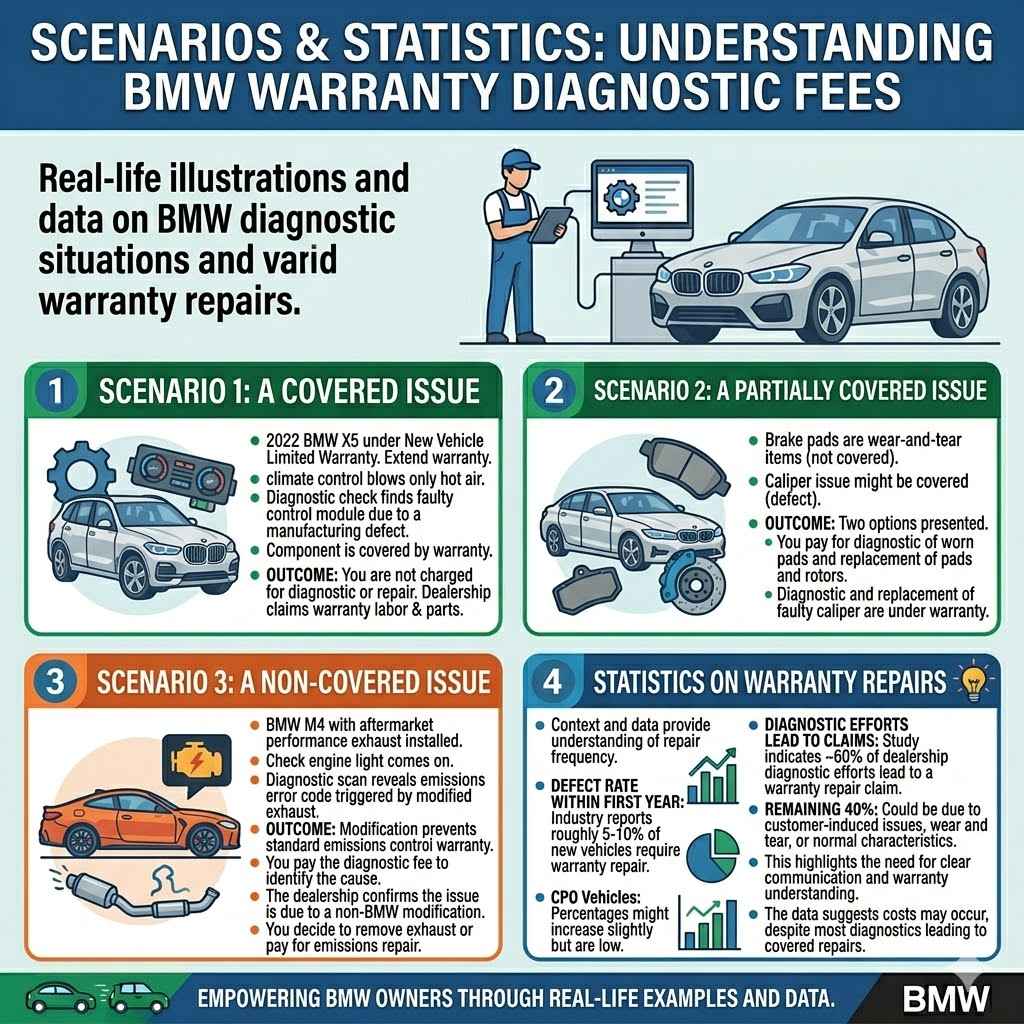
Scenario 1 A Covered Issue
Imagine you own a 2022 BMW X5 that is still under its original New Vehicle Limited Warranty. You notice that the automatic climate control system is blowing only hot air, even when set to cool. You schedule an appointment at your BMW dealership.
At the dealership, the service advisor notes your concern. A technician then performs a diagnostic check using BMW’s advanced software. The diagnostic reveals that a control module for the climate system has failed due to a manufacturing defect.
The module is an electronic component covered by the warranty.
In this case, the dealership submits a warranty claim to BMW for the diagnostic labor and the replacement of the faulty control module. You are not charged any diagnostic fee or for the part. The entire process, from diagnosis to repair, is covered by your warranty.
This is the outcome everyone hopes for when a genuine defect is found.
Scenario 2 A Partially Covered Issue
Consider a 2021 BMW 3 Series with an extended warranty that covers the engine and transmission but not routine maintenance or wear items. The car starts to make a faint grinding noise when braking.
You take it to the dealership. The technician diagnoses the problem. They find that the brake pads are worn significantly below the recommended thickness and are causing the noise.
Brake pads are considered wear-and-tear items and are not covered by the extended warranty.
However, the technician also notices that one of the brake calipers is sticking, which is not typical wear and tear and might be a covered component. The dealership will then present you with two options. They will inform you that the brake pads themselves are not covered, and you will likely pay for their diagnosis and
You would be charged for the diagnostic time related to identifying the worn brake pads and for the replacement of the pads and rotors. But the diagnosis and replacement of the faulty caliper would be under warranty. It’s important to understand which parts of the repair are covered and which are not.
Scenario 3 A Non-Covered Issue
Let’s say you have a BMW M4 with an aftermarket performance exhaust system installed. The check engine light comes on. You bring it to the dealership, suspecting it’s a warranty issue.
The dealership technician performs a diagnostic scan. They discover that the aftermarket exhaust system has triggered an emissions-related error code. They determine that the modified exhaust is causing the issue, and this modification prevents the standard emissions control warranty from applying to this problem.
In this scenario, the diagnostic fee to identify the cause of the check engine light would be your responsibility. The dealership would inform you that the problem stems from a non-BMW modification. You would likely be charged for the hours the technician spent diagnosing the fault, as it is not due to a manufacturing defect or a covered component failure under the original warranty.
You would then have to decide whether to remove the aftermarket exhaust or pay for the repair of the emissions system affected by it.
Statistics on Warranty Repairs
Understanding how often warranty issues arise can provide context. According to industry reports, roughly 5-10% of new vehicles experience a defect that requires warranty repair within the first year of ownership. For certified pre-owned vehicles, this percentage might slightly increase but is generally kept low by the rigorous inspection process.
Diagnostic efforts are a part of a significant portion of these repairs.
A study by an automotive research firm indicated that about 60% of diagnostic efforts performed at dealerships eventually lead to a warranty repair claim. This means that in a majority of cases where a customer brings in a car with a suspected issue under warranty, the diagnosis confirms a defect that BMW will cover. However, the remaining 40% could be due to customer-induced issues, wear and tear, or normal operating characteristics of the vehicle, leading to diagnostic fees for the owner.
This highlights why clear communication and understanding your warranty are so important. It’s not always a clear-cut “yes” or “no” regarding coverage. The specifics of the problem and the vehicle’s warranty terms play a significant role.
The data suggests that while most diagnostic efforts for warranty concerns do lead to covered repairs, there’s a notable portion where the customer may incur costs.
Frequently Asked Questions
Question: Do I always have to pay a diagnostic fee if my BMW is under warranty?
Answer: Not necessarily. If the problem diagnosed is due to a manufacturing defect or a faulty component covered by your BMW warranty, then both the diagnosis and the repair should be covered by BMW. You generally only pay diagnostic fees if the issue is found to be wear and tear, damage, or something not covered by your specific warranty terms.
Question: What if the dealership charges me a diagnostic fee even though I think it’s a warranty issue?
Answer: If you disagree with a diagnostic charge, first ask for a detailed explanation from the service advisor. If you are not satisfied, request to speak with the service manager. If the issue remains unresolved, contact BMW North America Customer Relations to formally dispute the charge.
Always refer to your warranty documentation.
Question: Are diagnostic fees for routine maintenance covered under warranty?
Answer: No, routine maintenance items like oil changes, tire rotations, and brake pad
Question: How long does a BMW diagnostic typically take?
Answer: The time a diagnostic takes can vary greatly depending on the complexity of the issue. Simple checks might take an hour or two, while more complex problems, especially those involving electronics or intermittent faults, could take several hours or even multiple days. Your service advisor should be able to provide an estimated timeframe.
Question: Can I get my BMW diagnosed at an independent mechanic if it’s under warranty?
Answer: While you can get your BMW diagnosed anywhere, for warranty repairs, it is generally best to use an authorized BMW dealership. This ensures that the diagnosis is performed using BMW-specific tools and procedures, and it simplifies the process of submitting a warranty claim. An independent mechanic’s diagnosis might not always be accepted by BMW for warranty purposes without further verification.
Conclusion
So, do you have to pay BMW diagnostic fees under warranty? Generally, no, if the issue is a covered defect. The key is understanding your warranty and communicating clearly.
Always verify what is and isn’t covered before authorizing any work. BMW wants you to have a good experience. You can get your car fixed right without unexpected costs by staying informed and asking questions.