Dog Car Seat for Middle Console: Safety, Sizing and Buying Guide
A dog car seat for the middle console works only for very small, calm dogs that fit fully inside the seat with a secure tether and a flat, stable lid; if the console is narrow, sloped, or opens under load, choose another restraint. Poor fit can tip the seat, let the dog fall, or turn a sudden stop into a head injury. This guide shows how to measure console geometry, check stability, and compare console-seat features before you buy.
Top console pick and quick picks
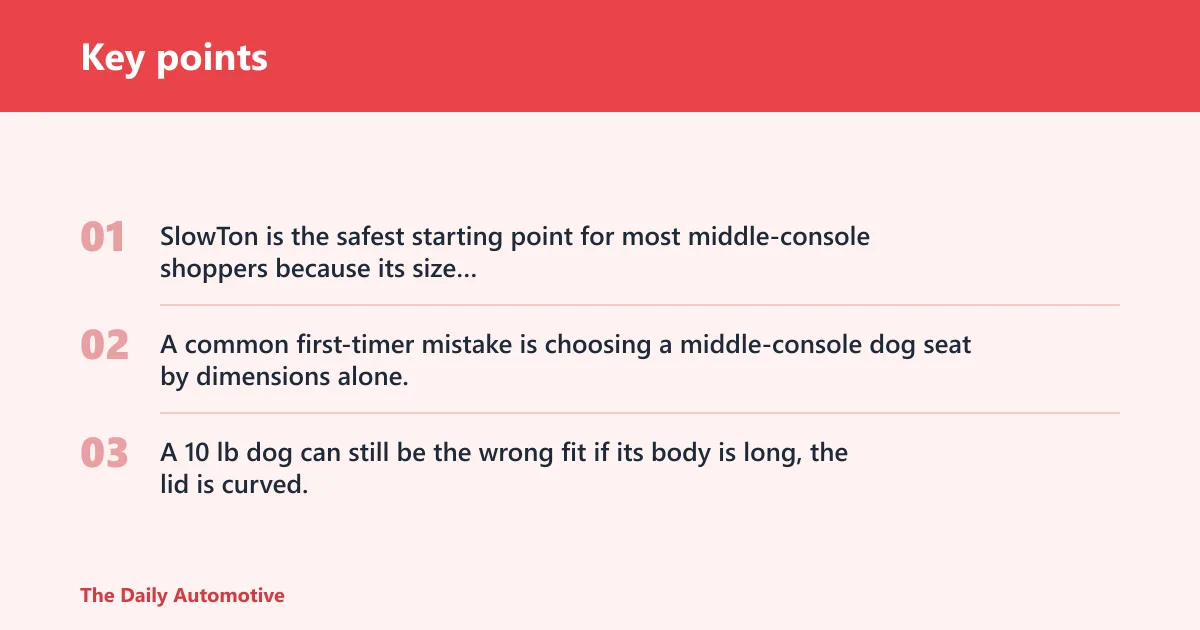


SlowTon is the safest starting point for most middle-console shoppers because its size and 11 lb rating are clearly within the small-dog range that console seats are built for, and its 16.5 by 8.6 by 8.6 inch footprint gives you a concrete fit target before you order.
| Pick | Best for | Key spec | Notes |
|---|---|---|---|
| SlowTon | Very small dogs | Up to 11 lbs; 16.5 by 8.6 by 8.6 inches | Good baseline if your console is close to that footprint. |
| BurgeonNest | Armrests with a wider top | Under 11 lbs; recommends at least 17 by 9.8 inches | Use only if your console lid meets or exceeds that armrest size. |
| QUMY | Tiny dogs in a compact setup | Designed for small dogs up to 11 lbs | Check the product dimensions and your console shape before buying. |
| Cullaby | Small dogs that need a little more room | Aimed at small dogs under 15 lbs | Still measure carefully; console geometry matters more than the label. |
| JOEJOY | Not a typical console-first choice | Suitable for small to medium dogs up to 35 lbs | That capacity points beyond the console use case for most vehicles. |
A common first-timer mistake is choosing a middle-console dog seat by dimensions alone, without checking your vehicle’s console shape or seatbelt anchor points. A 10 lb dog can still be the wrong fit if its body is long, the lid is curved, or the seat overhangs the console edge by even a little.
Why console seats work for some dogs
Console seats can help small dogs stay elevated, settled, and less likely to slide across a seat during routine driving. They are a fit-and-restraint product, though, not a universal solution. If the console does not support the seat evenly, another restraint is the safer choice.
What a console seat can solve
For a small dog that likes to sit upright and look out, a console seat can give a defined resting spot with a tether point and a smaller interior space than a full rear seat. That smaller space can reduce wandering, which matters for anxious dogs that pace or lean forward.
They also fit a narrow use case: a dog that is light enough to stay inside the shell, has enough body clearance to turn once, and does not need floor-level room to lie down.
When to choose a different restraint
Skip a console seat if the lid slopes, flexes, or pops open under pressure; if the seat must hang past the console edges; or if the dog is too long to sit without slumping. In those cases, a rear-seat strap setup or a larger crate-style restraint is the better match.
Say your dog weighs 9 lbs but has a long body and cannot sit squarely in a seat under 9 inches deep. That dog is a poor console candidate even if the weight limit looks fine on paper.
Console fit checklist
Measure the console first. Then compare the seat’s outside dimensions, the console lid shape, and the dog’s body size. If the numbers do not line up, do not try to “make it work” with extra padding or a looser strap setup.
- Measure the console width at the top where the seat will sit.
- Measure the usable depth from front edge to back edge.
- Measure the lid height and note whether it is flat, curved, or split.
- Check headrest spacing if the seat uses side straps that reach up and back.
- Confirm whether there is a clear seatbelt path or another intended vehicle anchor point for the model.
- Measure the dog’s body length from chest to base of tail.
- Measure standing height from floor to top of shoulders.
- Compare the dog’s size to the seat shell so the dog can sit without slouching and lie down without hanging over the edge.
| Console width | Depth | Height | Lid shape | Headrest spacing | Seatbelt path | Dog body length | Dog standing height | Pass/fail notes |
|---|---|---|---|---|---|---|---|---|
| Write actual inches | Write actual inches | Write actual inches | Flat, curved, split, or sloped | Enough for side straps to reach without strain | Clear path or no clear path | Write actual inches | Write actual inches | Pass only if the seat sits flat, does not overhang, and the dog can sit fully inside |
| Skip rule: If the lid is curved, the seat rocks, the straps cannot anchor without twisting, or the dog does not fit fully inside, choose a different restraint. | ||||||||
Simple decision rule: choose a console seat only when the console is flat enough to hold the base steady, the seat stays inside the console footprint, and the dog fits within the seat shell with room to sit or lie comfortably. If any one of those fails, skip it.
Are middle console dog seats safe?
Middle-console seats can work only in the right dog and the right vehicle, but they are not crash-safe by default. Look for independent crash-testing context, and use Center for Pet Safety certification as the standard to check when a brand claims crash testing. If a product lacks that proof, treat the safety claim as limited.
What CPS certification means
The Center for Pet Safety is the crash-test benchmark to check first. A seat that claims CPS certification has been evaluated against an independent crash-test standard rather than only a company claim. That matters because console seats are small, elevated, and more sensitive to wobble than floor-mounted restraints.
Why harness attachment matters
The tether should connect to a properly fitted dog strap, not a collar. Trending Car recommends leaving two fingers of space between the strap and the dog. That fit gives the restraint room to hold the dog without choking pressure while still limiting movement.
Do not use a loose collar connection as the main restraint point. A collar concentrates force on the neck, which is the wrong place for a sudden stop. Use the harness attachment point the product is designed to accept, and follow the manufacturer’s instructions.
Stability and anti-collapse features
Look for reinforced or anti-collapse construction, dual side straps, and anti-slip mounting. A good console seat should sit squarely on the lid and resist side-to-side roll when the dog shifts. Bottom strap orientation matters too: some seats use a horizontal bottom strap, others a vertical one, and the right layout depends on the console shape and anchor path.
Loose headrests can make the whole setup worse. If the side straps have nothing firm to work against, the seat can drift forward under braking or bounce on rough pavement.
Best options by use case
For tiny dogs, choose a model that fits the console exactly rather than one with the highest stated weight limit. For anxious dogs, a higher-sided seat can feel calmer if it still stays stable. For trucks and larger SUVs, the best answer is often not a console seat at all if the center console is too deep, too wide, or too split.
For tiny calm dogs
SlowTon is the clearest match here because it is rated for small dogs up to 11 lbs and measures 16.5 by 8.6 by 8.6 inches. Those numbers give you a practical starting point for compact consoles where overhang is the main risk.
QUMY also belongs in this small-dog group. Its published limit is up to 11 lbs, so it fits the same narrow-use category: very small dogs that can stay centered without leaning hard on the sides.
For anxious dogs that prefer height
BurgeonNest is the better fit to check if you need a seat that can sit on a wider armrest, because it recommends an armrest size of at least 17 by 9.8 inches and is designed for pets under 11 lbs. That makes it a candidate when the console top is broad enough to support the base fully.
Comfort alone is not enough. An elevated, plush seat that wobbles will make an anxious dog more unsettled, not less. Stability comes first, then padding.
For deeper consoles and non-console use
Cullaby is aimed at small dogs under 15 lbs, which may sound flexible, but that does not make it a universal console fit. Use it only if the actual shell dimensions and your console geometry line up. JOEJOY, at up to 35 lbs, points more toward broader pet-car use than a narrow console mount.
In many SUVs and trucks, the center console is too tall or too irregular for a stable middle-console seat. If the dog cannot sit inside the shell without pressing the lid open or forcing the seat to tilt, choose a rear-seat harness or crate-style setup instead.
How to choose the right model
Start with the dog’s size, then check the console, then check the strap layout. A seat that feels plush but cannot anchor correctly is the wrong buy. The best model is the one that fits your vehicle geometry and keeps the dog contained without forcing an awkward posture.
Weight and body-length limits
Most console seats in this category are built for about 8–12 lbs, with some models stretching to 11 lbs or, in Cullaby’s case, under 15 lbs. That range is not only about weight. The dog also has to fit by body length and standing height, or the seat will feel cramped and unstable.
For dogs that prefer lying down, console seats are usually a poor match unless the shell is unusually long and the lid is broad enough to stay level. A sitting dog puts less strain on the seat than a dog trying to stretch out.
Strap layout and anti-slip mounting
Dual side straps matter because they help keep the seat from shifting left or right. Anti-slip mounting helps on smooth leather lids and slick vinyl surfaces. If the bottom strap is too short, too long, or routed against the wrong edge, the seat can inch forward or tilt under braking.
Picture a console with a rounded top and loose headrests. Even a well-padded seat can rock because the straps never pull squarely against the vehicle. That is a fit problem, not a comfort problem.
Washable covers and wear points
Choose a removable or machine-washable cover if the dog rides often. Dirt, saliva, and fur build up fast in a closed seat, and odor gets worse when the padding stays damp. Cleaning is not only about appearance; it helps you inspect wear before it becomes a failure point.
Check strap fray, buckle fatigue, and cushion compression over time. A cover that still looks fine can hide flattened foam or stretched stitching. If the padding no longer springs back, the seat may sit lower and shift more easily.
Follow the vehicle and product manual, keep the setup out of airbag zones and the driver’s view, and check local laws before driving with any pet restraint.
Will it fit your vehicle?
It might, but vehicle type alone does not decide this. Some sedans have smaller, flatter console lids, which can help. SUVs and trucks may have taller or split consoles that interfere with the seat base, and some center consoles can be too curved or too deep to support a stable mount.
Sedans
Sedans are often the easiest place to fit a console seat because the center armrest is more likely to sit level and have enough side support. Even then, measure the lid, not just the seat width. A flat-looking console can still slope enough to make the base drift forward.
SUVs
In SUVs, the console may be wider or higher, which sounds helpful until the top becomes too rounded or too split for the seat to sit flat. Check whether the dog seat can remain fully supported without hanging off the edge or blocking nearby controls.
Trucks
Trucks often have the most variable console shapes. Some are broad but sloped. Others have storage lids that flex under load. If the lid moves when you press down with one hand, treat that as a warning sign and choose a different restraint.
Frequently asked questions
Are dog car seats for the middle console actually safe?
Only when the dog is very small, the seat fits the console exactly, and the restraint is anchored properly. They are not universally safe, and they are not the right choice for curved, loose, or unstable lids. Look for CPS certification or independent crash-testing context before buying.
How do I measure my center console for a dog car seat?
Measure width, depth, and height at the exact spot where the seat will rest. Then note lid shape, headrest spacing, and any seatbelt path or anchor route the product needs. Compare those numbers against the seat shell, not just the package label, and skip any model that overhangs.
What size dog fits in a middle console dog car seat?
Most of these seats are built for very small dogs, often around 8–12 lbs, with some models listed up to 11 lbs and one under 15 lbs. Weight is only part of the answer. The dog must also fit by body length and standing height without slouching or hanging over the edge.
Should I use a harness or collar in a console dog seat?
Use a properly fitted dog strap. The tether should clip to the strap attachment point, not to a collar. The same source recommends leaving two fingers of space between the strap and the dog. That keeps the fit secure while reducing neck pressure during sudden movement.
Will a middle console dog seat fit my SUV or truck?
Sometimes, but not by default. SUVs and trucks often have deeper, taller, or more curved consoles than sedans, and those shapes can create wobble or overhang. Measure the top surface and confirm the seat can sit flat before you order, especially if the lid flexes under pressure.
What features make a console dog car seat more stable?
Look for anti-collapse construction, dual side straps, anti-slip mounting, and a bottom strap layout that matches the console shape. A stable seat should not rock when the dog shifts. If the headrests are loose or the lid is rounded, stability drops fast, even with padding.
How do I clean a center console dog car seat?
Choose a model with a removable or washable cover, then clean it often enough to keep fur and odor from building up. While you clean, inspect stitching, strap wear, buckle fatigue, and cushion compression. Those are the places where a used seat usually starts to fail.
What is the difference between a console booster and a regular dog car seat?
A console seat is built to sit on the vehicle’s middle armrest or console and stay contained in that smaller footprint. A regular dog car seat usually sits on a seat cushion or in the rear seat area. The two are not interchangeable if the console needs a stable, narrow base.
Products related to this article
Sponsored / affiliate links. As an Amazon Associate I earn from qualifying purchases. I may earn additional commission from eligible campaigns.