Best Car Dog Seat Belts for 2026: Based on Specs and Reviews
The best car dog seat belts match your dog’s size and your car’s latch or seat-belt hardware; for most buyers, the right pick is one of four proven styles. A poor fit can let the tether slip, let a dog twist into risky positions, or fail in a sudden stop. This guide ranks four seat-belt options by fit problems, dog size, and vehicle attachment style so you can choose the right restraint.
Quick comparison
| Product | Badge | Best for | Price | ||
|---|---|---|---|---|---|
 |
Leash Boss Dog Car Seat Belt Restraint – No-Chew Heavy DutyLeash Boss | Our pick | 26 in · Coated Steel Rope · Latch Bar | $13.99
Price as of 22 Oct 2026
|
View |
 |
Mi PupJoy 2pcs Dog Car Seat Belt, Chew Proof Pet SafetyMi PupJoy | Budget pick | 32 in · Waterproof Steel Wire · 2-Pack | $12.99
Price as of 22 Oct 2026
|
View |
 |
COOYOO Dog Seat Belt, Durability Retractable Dog CarCOOYOO | Also great | Adjustable · Elastic Buffer · Universal Mount | $6.99
Price as of 22 Oct 2026
|
View |
 |
SlowTon Dog Seat Belt for Car, 2 Pack Dog Car HarnessSlowTon | Upgrade pick | Headrest Design · Elastic Buffer · 2-Pack | $12.99
Price as of 22 Oct 2026
|
View |
This table is meant to solve the first question fast: what fits your vehicle and your dog. Use it to separate simple buckle clips, LATCH-style setups, and tether designs that are better for restless or larger dogs.
Keep the limit clear. A dog seat belt is really a tether that clips a harness to your car, so it helps reduce roaming and driver distraction, but it is not the same thing as a crash-tested child restraint.
How we chose
This ranking leans on fit, not hype. The main filters were attachment style, how well the hardware resists twisting, whether the design adds shock absorption, how much length control it gives you, and how well each pick handles common vehicle layouts.
Dog size and temperament matter too. A calm 15-pound dog has different needs from a restless 70-pound dog, and a back seat with awkward buckles or mixed seating layouts can rule out otherwise decent straps.
We also weighed failure modes. Twisting, too much slack, buckle incompatibility, and escape risk at the harness connection matter more than a broad “top rated” label.
One more point: a tether should clip to a chest harness, never a collar. The harness spreads force across the torso instead of the neck, and the tether itself should stay short enough to block window or front-seat access.
Leash Boss dog car seat belt: best for buckle-and-latch simplicity
This is a strong pick if you want a basic, no-chew tether that connects through a latch bar and clips to a harness. Based on the published product details, its coated steel rope design favors durability over stretch, and that can suit owners who want a straightforward restraint without extra moving parts.
It stands out for a chew-resistant build and a latch-bar connection that should work well in vehicles with accessible anchor points. The drawback is that it is a simpler strap-style solution, so it does not bring the extra slack control or anti-twist features that some restless dogs need.
Use it when you want a durable tether for daily rides and do not need a bungee section. It is less attractive if your dog tends to spin, lean hard, or move around enough that a little elastic give would help.
Mi PupJoy dog car seat belt: best for spare-belt value
This 2-pack makes sense when you want one set for the car and one to leave in reserve. The listed features include a coated steel-wire build, a latch bar hook, and a seat-belt clip, so it suits owners who need flexibility across vehicles or who want a backup in case one restraint stays in a different car.
The main strength is value by vehicle count, not just sticker price. That said, a steel-wire design is not the most forgiving choice for dogs that lunge or settle in unevenly, and the listing gives less detail about stretch control than bungee-based options.
Choose it if you switch between cars or want a second restraint ready to go. Skip it if your dog needs softer motion control or if your vehicle layout already makes one simple attachment point hard to use.
COOYOO dog seat belt: best for adjustable everyday use
This is the clearest fit for owners who want an adjustable nylon tether with some give. Canine Bible lists the COOYOO length as 24″ to 31″, describes it as retractable, and notes a 360-degree swivel snap, while the product details call out an elastic buffer and a quick-release metal buckle.
That combination makes it useful for daily rides where you want to tune slack without giving the dog too much reach. The bungee section helps soften sudden stops, but the same stretch can be a drawback if you need a very fixed, close hold for a dog that tries to crowd the front seats.
It is a sensible first choice for many households because it balances adjustability, shock absorption, and low cost. The catch is that retractable or adjustable nylon tethers still depend on a good buckle fit, and some vehicles do not accept every seat-belt tab cleanly.
SlowTon dog seat belt: best for restless back-seat movement
This is the best fit when side-to-side motion is the bigger issue. The headrest-style restraint and elastic buffer make it better suited to dogs that shift, spin, or lean from seat to seat, and the 2-pack format helps if you need matching restraints for more than one vehicle or dog.
The strong point is stability. A double-point or headrest-based layout can limit swing better than a single, loose tether, which matters for restless dogs that keep changing position. The tradeoff is that headrest setups are not as universal as buckle clips, so fit depends more on your seat design.
Buy this if your dog is calm enough to stay in the back but restless enough to keep tangling a normal tether. Skip it if your vehicle has no useful headrest geometry or if you need a more universal latch-bar solution.
Which one should you buy?
If you want the shortest answer: pick COOYOO for the most balanced daily-use setup, Leash Boss for tougher hardware and a simple latch-bar fit, Mi PupJoy if you want a spare or a two-car setup, and SlowTon if your dog twists or slides around the back seat.
For small dogs, the right choice is usually the one that keeps the dog close without leaving slack near the window. COOYOO fits that use well because the length is adjustable, and the swivel snap helps when the strap twists behind the dog.
For large dogs, start by asking whether a tether is enough at all. A strong harnessed tether can help with containment and distraction, but a crash-tested harness or a secured crate is the better call if the dog is heavy, hard to manage, or likely to throw its body against the restraint in a hard stop.
For short commutes, a simple buckle clip or latch-bar tether is often enough, especially if your dog settles quickly. If your vehicle has mixed seating layouts, or if one seat uses buckles that do not accept every tab, a 3-in-1 setup is the safer buy because it gives you more attachment paths.
Say your 60-pound dog rides in a sedan with a narrow back seat and keeps turning sideways. A double-clip or headrest-style restraint is usually a better fit than a plain long tether, because the goal is to limit side-to-side swing before it becomes a harness tangle.
A common first-timer mistake is buying extra length because it sounds comfortable. In a car, that extra slack can let a dog reach the window or front seat, which defeats the point of the restraint.
Quick picks by need
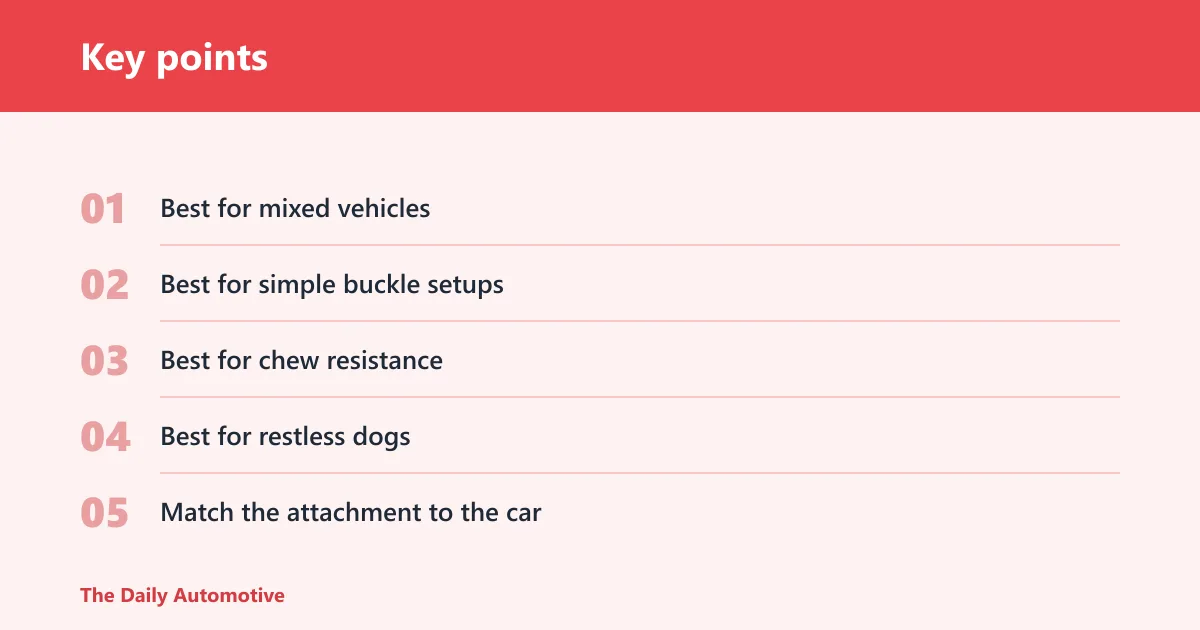
- Best for mixed vehicles: a 3-in-1 tether with seat-belt, LATCH, and buckle options.
- Best for simple buckle setups: COOYOO, if you want length control and elastic give.
- Best for chew resistance: Leash Boss, if a coated steel rope suits your setup.
- Best for restless dogs: SlowTon, because the headrest style helps limit swing.
How to choose a tether that fits
- Match the attachment to the car. Use a seat-belt clip, LATCH anchor, or buckle setup that your vehicle actually accepts; some seat-belt tabs work with most buckles, but not all vehicles.
- Check how much twisting the dog causes. If the strap spins easily, look for a swivel carabiner or another 360-degree rotating clasp so the harness connection does not bind up.
- Decide whether you need give or fixed length. Elastic or bungee sections soften sudden stops, while fixed or shorter straps keep the dog from roaming.
- Match the design to temperament. Calm dogs usually do fine with a simple tether; restless dogs often do better with a double-clip or headrest-style setup that limits side-to-side movement.
- Keep the ride short and controlled. The tether should be short enough to block window access and prevent a dog from climbing into the front seat.
What is a dog seat belt and what does it do?
A dog seat belt is a tether that clips a harness to your car. It helps reduce roaming, keeps the dog from moving across the cabin, and can cut driver distraction, but it should be treated as a containment aid, not a crash-proof system.
Most of these restraints use nylon straps, adjustable length, or some version of elastic buffering. The useful ones keep the dog close enough to stay out of the driver’s space while still allowing a normal seated position in the back.
What is the safest seat belt for dogs in cars?
The safest setup is not a simple tether. A crash-tested harness or a secured crate is stronger for collision protection, while a tether mainly limits roaming and keeps the dog from becoming a distraction. If you are choosing between those options for a heavy dog, the crash-tested route is the better call.
For everyday containment, a tether still has value. The safest tether is the one that clips to a harness, fits your car’s hardware cleanly, stays short enough to prevent excess movement, and does not twist itself into a knot during routine driving.
Should a dog seat belt clip to a harness or collar?
It should clip to a harness, not a collar. A proper harness attachment spreads force across the torso instead of concentrating it on the neck, which is safer and also lowers the chance that the dog slips out when the car stops or turns.
A collar connection can fail fast in the wrong moment. It also gives you less control over twisting, because the dog’s head can move independently of the body while the strap pulls at the neck.
Do dog seat belts actually protect dogs in a crash?
Not in the same way a crash-tested harness or crate does. Simple dog seat belts are mainly for distraction control and movement containment, so they are useful for daily rides but should not be mistaken for a collision-grade restraint.
That difference matters most for larger dogs and for vehicles with more open cabin space. If the goal is impact protection, a tether is the weaker choice; if the goal is to stop roaming and keep the dog in the back seat, it can still do useful work.
What length should a dog seat belt be in the car?
The right length is short enough to keep the dog from reaching the window, front seat, or driver area. A little room to sit and turn is fine, but too much slack creates the very roaming problem the restraint is supposed to solve.
For some dogs, an adjustable range helps. The same source lists the Active Pets seat belt length as 18″ to 28″, and the COOYOO length as 24″ to 31″, which shows how much variation brands build into these straps. The useful range is the one that keeps the dog in the back without binding the harness connection.
Do I need a 3-in-1 dog seat belt or a simple buckle clip?
Choose a 3-in-1 design if you move between cars or have a vehicle with awkward or mixed seating layouts. A simple buckle clip is fine when your car accepts it cleanly every time, but a multi-attachment tether gives you more ways to make the restraint work when one connection point does not fit.
The IOKHEIRA pick is a good example of why that flexibility matters: it uses three attachment options, including a seatbelt clip, LATCH anchor, and buckle. That said, “fits most vehicles” still does not mean every car, so you should still check compatibility before buying.
Frequently asked questions
What is the best car dog seat belt for daily use?
For most daily use, the best choice is the one that fits your car cleanly and keeps the dog close without twisting. COOYOO is the most balanced pick here because it combines length adjustment, elastic buffering, and a swivel snap that helps manage everyday movement.
Which dog seat belt works best for large dogs?
Large dogs usually need more than a loose tether. A crash-tested harness or secured crate is the safer choice if the dog is heavy, energetic, or likely to lunge; among simple tethers, a stable double-clip or headrest-style design is better than a long, flexible strap.
Products related to this article
Sponsored / affiliate links. As an Amazon Associate I earn from qualifying purchases. I may earn additional commission from eligible campaigns.