Driveway Ramps for Low Cars: Stop Scraping Your Car
Choose driveway ramps for low cars by measuring the steepest transition and matching ramp length to it: a common rule of thumb is that about 1 inch of rise needs 12-18 inches of ramp, while curb lips often use a two-piece threshold ramp. Get the angle wrong and you scrape splitters, crack lip spoilers, or keep dragging the underbody every time you enter. This guide compares ramp types by driveway shape, load rating, material, and fit for curb lips, aprons, and broken pavement.
Why scraping happens and when angle entry helps


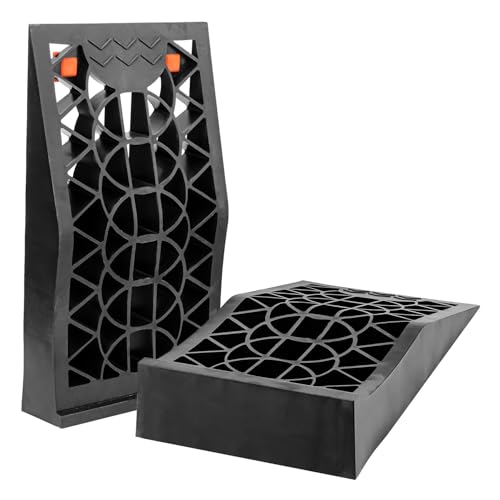
Low cars scrape where the driveway changes height too fast: the front bumper meets the lip first, then the undertray, splitter, exhaust, or rear diffuser follows. Sports sedans, lowered vehicles, EVs, and cars with long front overhangs are common problem cases because they run out of clearance before the tires finish climbing the transition.
The same driveway can hit different cars in different places. A short-nose hatchback may clear a sharp lip that a long-wheelbase sedan drags on, while a lowered car with a deep splitter may contact before the tires even reach the slope.
When an angle entry helps and when it does not
Driving in at an angle can reduce the amount of vehicle length that crosses the transition at once. That helps when the issue is a single steep point and the driveway has room for a wider approach. It does not always work, especially on narrow entries, tight street-to-driveway turns, or transitions that are too abrupt to clear cleanly.
If the scrape happens every time in the same spot, angle entry is only a partial fix. A ramp that changes the height difference is usually more reliable than asking the car to twist itself over the lip.
How do you measure the driveway rise?
Measure the vertical rise at the exact contact point before buying anything. The number that matters is not the driveway’s total slope, but the height difference your tire, splitter, or underbody has to cross where the scrape begins.
Use a straight edge, a tape measure, and a level if needed. Check the rise at the curb edge, driveway lip, threshold, or ridge separately, because one driveway can contain more than one problem spot.
Measure the contact point, not the whole driveway
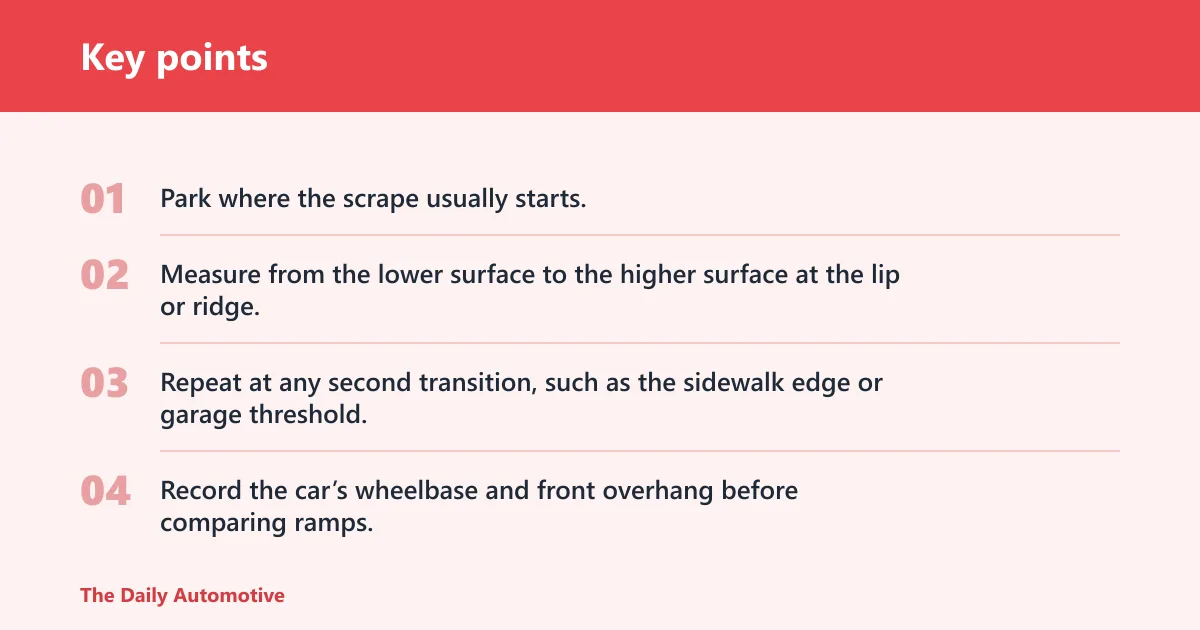
- Park where the scrape usually starts.
- Measure from the lower surface to the higher surface at the lip or ridge.
- Repeat at any second transition, such as the sidewalk edge or garage threshold.
- Record the car’s wheelbase and front overhang before comparing ramps.
That last step matters. A long front overhang needs a gentler approach than a short bumper, even when both cars have the same ground clearance.
Check lips, edges, and ridges separately
A rolled curb, an angled curb, and a driveway ridge are not the same problem. A rolled curb may only need a lower-profile ramp, while a sharper threshold can demand a longer or two-piece solution. If the transition is uneven or broken, the ramp has to bridge the highest point without rocking or bottoming out.
Driveway ramp table
Start with the scrape location, then match the measured rise to the vehicle and ramp profile. The common failure mode column is there for a reason: many buyers choose by load rating or vehicle type first, then find the ramp is too short, too steep, or poorly placed.
| Scrape location | Measured rise | Vehicle type | Recommended ramp profile | Common failure mode |
|---|---|---|---|---|
| Rolled curb | 1.2″ to 4″ | Low cars, sports sedans, lowered vehicles | Lower-profile rubber curb ramp with textured surface | Ramp is too short, so the nose still bottoms out at the lip |
| Driveway lip | 4″ to 7″ | EVs, cars with long front overhangs, lowered vehicles | Longer rubber ramp or modular sections that spread the rise | Single-piece ramp sits too steep and transfers the scrape to the underbody |
| Mid-driveway ridge | Modest to moderate rise | Low cars and daily drivers with limited clearance | Wider ramp profile with stable placement and non-slip base | Ramp shifts, flexes, or lands too high and creates a second bump |
| Street-to-driveway transition | 1.2″ to 4″ | Sports sedans and lowered vehicles | Rubber transition ramp with outdoor weather resistance | Placement leaves a gap, so the tire drops before climbing |
What ramp height and length fit your car?
Match ramp height to the actual rise, then use length to control slope. A lower-profile ramp may help when the height difference is modest, while a larger ramp is better when the curb rise is more significant. Longer ramps lower the climb angle, which is often the difference between clearing the lip and scraping it.
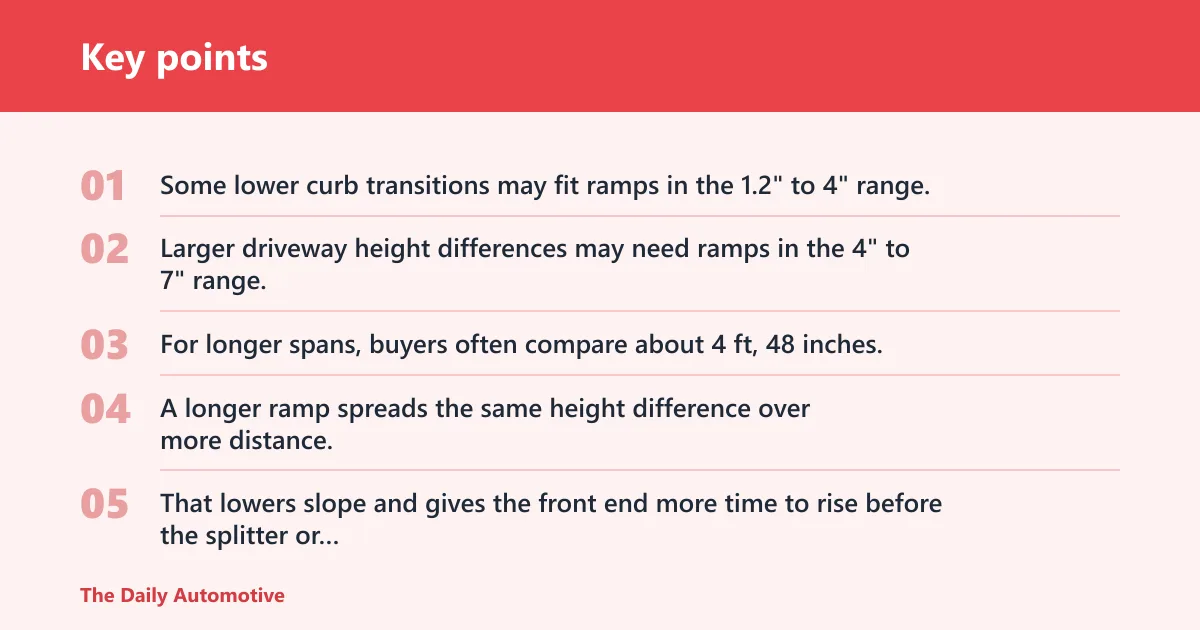
Some lower curb transitions may fit ramps in the 1.2″ to 4″ range. Larger driveway height differences may need ramps in the 4″ to 7″ range. For longer spans, buyers often compare about 4 ft, 48 inches, or modular and adjustable options in the 4 to 12 ft range when the transition is awkward.
How longer ramps help clearance
A longer ramp spreads the same height difference over more distance. That lowers slope and gives the front end more time to rise before the splitter or undertray reaches the highest point.
Picture a low coupe with a 6-inch driveway lip and a short ramp that ends too abruptly. The tires hit the slope, but the bumper still scrapes because the car has not started lifting soon enough. A longer ramp changes that geometry.
When modular or adjustable sections make sense
Modular or adjustable ramps are useful when the transition is uneven, when the driveway lip is irregular, or when one side of the driveway sits higher than the other. They can also help where a single piece would be too steep or too rigid for the available space.
They are not a cure for every entrance. If the driveway shape is severe enough, even a modular system may still leave too much angle at the start or end of the climb.
Is rubber better than plastic?
Rubber is the default choice for daily driveway use because it offers better traction and durability. It also tends to sit more firmly on outdoor surfaces, which matters when tires load the ramp in wet or cold conditions. Plastic can work for lighter-duty or temporary use, but it is more likely to feel less planted under repeated driveway traffic.
Metal ramps are less common for driveway transitions. They can be useful in some applications, but they are not the first pick for a low-car driveway lip where traction, noise, and weather exposure matter every day.
Material tradeoffs that matter at the curb
Rubber curb ramps are usually the safest default when the ramp will live outdoors. Plastic may be easier to move, but the lighter feel can come with less confidence on slick pavement. Metal can be durable, yet it is not the simplest answer for a household driveway where the goal is a smooth, quiet transition.
What load capacity should you buy?
Buy for load capacity even when the vehicle is “only” a passenger car. The ramp has to support static weight, tire loading, and repeated driveway entry without flexing or shifting. A 7000lb rating appears on some curb ramp products, and other products are listed at up to 15 tons or even up to 33,069 lbs.
Capacity is not just about the car’s curb weight. EVs and heavier trims can carry more mass than many buyers expect, so margin matters. A ramp that barely meets the number on paper leaves little room for real-world use, cargo, or repeated loading.
How to compare ratings
Do not compare a 7000lb driveway ramp with a 15-ton maintenance-style ramp as if they solve the same problem. The product category matters, and so does the way the load is spread across the ramp. For driveway transitions, aim for a rating that leaves practical headroom above the vehicle’s actual weight.
Say your EV has a heavy front axle and a long nose. A ramp with a thin safety margin may still flex enough to alter the angle at the exact moment you need clearance most.
Which ramp type fits different driveway problems?
The best ramp depends on the scrape pattern, not just the vehicle badge. A driveway curb ramp is meant to smooth the height difference between street and driveway. A car maintenance ramp is built for service access, not for bridging a curb lip or threshold, so the two categories should not be treated as interchangeable.
That distinction prevents the most common buying mistake. A maintenance ramp may be too tall, too steep, or shaped for lifting a car in a garage rather than easing a nose over a lip.
Ramp category versus driveway use
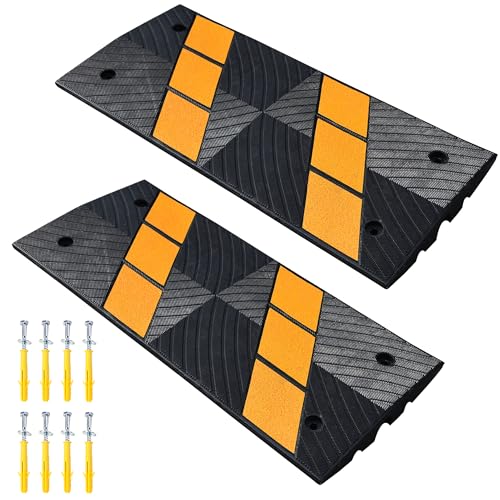
- Curb ramp: designed to smooth a street-to-driveway transition or curb lip.
- Threshold ramp: useful for smaller lips and indoor-outdoor changes.
- Maintenance ramp: intended for service work, not for easing over an outdoor transition.
Which safety features matter most?
Non-slip surfaces matter first. Deep ribbed treads, textured surfaces, or cross-pattern and punch-plate style patterns help tires stay planted as they climb. For outdoor use, weather resistance matters too, because rain, cold, and grime can turn a smooth surface into a poor fit for a low car.
Reflective strips help in low-light visibility. They make the ramp easier to see at night or in a dim driveway, which matters when the ramp sits close to the street or blends into dark pavement.
Placement and setup failures to avoid
A ramp can fail even when the size looks right. If it sits too high, the front bumper hits the ramp itself. If it sits too low, the car drops before the climb starts. If it shifts during entry, the angle changes under load and the scrape returns.
One common first-timer mistake is buying a ramp for the curb measurement but ignoring the driveway apron. The apron may be the part that actually needs the longer, gentler profile.
Can a driveway ramp stop my front bumper from scraping?
A properly matched ramp can stop many bumper-first scrapes, but not all of them. It works best when the problem is a defined curb lip, driveway ridge, or steep street-to-driveway transition that can be smoothed by adding length. If the bumper already hangs too low for the available space, the ramp may reduce contact without eliminating it.
The key is matching the ramp profile to the scrape pattern. Bumper-first contact often needs a longer, lower slope. Mid-underbody contact may need more span than a short curb ramp can provide, especially on cars with a long front overhang.
When a ramp will not solve the problem
If the driveway shape is extreme, a ramp may be only a partial answer. A driveway regrade, curb cut, or concrete fix can be the better option when the lip is too tall, the angle changes too abruptly, or the problem sits across a wide section of the apron.
Driving at an angle is not always practical, and neither is stacking more ramp pieces forever. When the transition is structurally wrong, the right fix is in the concrete, not in another accessory.
Do driveway ramps work for EVs and lowered cars?
Yes, when the ramp matches the measured rise and the vehicle shape. EVs and lowered cars often need more clearance than standard sedans because they combine weight, long overhangs, and limited ground clearance. That makes ramp length, profile, and placement especially important.
For these vehicles, a rubber ramp with a textured surface and a stable base is usually the most practical starting point. If the rise is modest, a lower-profile option may be enough. If the rise is larger, a longer modular setup usually makes more sense than a short, steep block.
Practical fit for EVs and lowered vehicles
Suppose a lowered sedan scrapes on a 5-inch driveway lip. A short ramp might lift the tire too quickly and leave the splitter still exposed. A longer ramp spreads the climb and gives the nose more time to rise before the lip is reached.
Frequently asked questions
What driveway ramp height do I need for a low car?
Start with the measured rise, not the car model. Some lower curb transitions fall in the 1.2″ to 4″ range, while larger driveway differences may need 4″ to 7″ ramps. Then choose the longest practical profile that fits the space, because length lowers the slope and often improves clearance more than height alone.
How do I measure the curb height before buying a ramp?
Measure the vertical difference at the exact point where the tire or bumper contacts the transition. Check the curb lip, driveway edge, and any ridge separately. Then note wheelbase and front overhang, because those dimensions affect whether a short ramp or a longer one will actually clear the problem area.
Is rubber better than plastic for driveway curb ramps?
For daily driveway use, rubber is the better default because it offers stronger traction and better outdoor durability. Plastic can suit lighter-duty or temporary use, but it is usually less secure on wet pavement. Metal is less common for driveway transitions because the surface and weather behavior are less forgiving.
What load capacity should a driveway ramp have for a passenger car?
Choose a rating with margin, even for a passenger car.
What is the difference between a curb ramp and a car maintenance ramp?
A curb ramp is built to smooth a street-to-driveway or curb-to-driveway transition. A car maintenance ramp is meant for service work, usually in a garage or shop setting. The shapes, placement needs, and traction priorities are different, so a maintenance ramp is not the same purchase as a driveway curb ramp.
Products related to this article
Sponsored / affiliate links. As an Amazon Associate I earn from qualifying purchases. I may earn additional commission from eligible campaigns.