3 Best Car Tire Inflator Kits in 2026
The best 3 car tire inflator kits in 2026 are the ones with corded power, a backup battery, and a 6-to-10-minute refill on a passenger tire. Pick the wrong one and a flat can turn into a tow. A dead battery can also leave a portable compressor useless. This guide ranks three kits by redundancy, fill speed, and dead-battery use for emergencies and daily top-offs.
Our top picks for car tire inflator kits
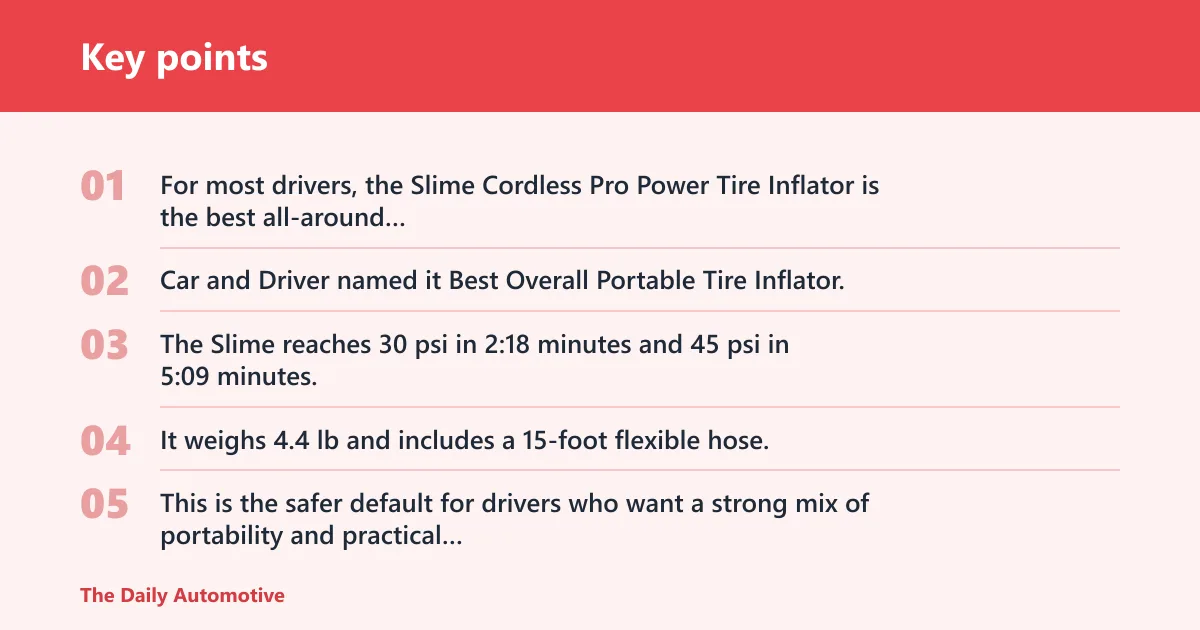


For most drivers, the Slime Cordless Pro Power Tire Inflator is the best all-around choice because it balances speed, hose reach, and cordless convenience better than the others here. Car and Driver named it Best Overall Portable Tire Inflator, and its 15-foot flexible hose helps when the valve stem sits awkwardly near a wheel spoke.
Top pick: Slime cordless pro power tire inflator
The Slime reaches 30 psi in 2:18 minutes and 45 psi in 5:09 minutes, which puts it squarely in the useful range for a normal passenger-car top-off. It weighs 4.4 lb and includes a 15-foot flexible hose, so it is easier to position around a parking lot than many bulkier units.
This is the safer default for drivers who want a strong mix of portability and practical speed. The tradeoff is simple, it is cordless, so it depends on its own battery when you need it most.
Budget pick: Avid power cordless Pistol Grip
The Avid Power Cordless Pistol Grip is the budget pick from Car and Driver. It uses both a 12-volt outlet and a 20-volt lithium-ion battery, which gives it more power options than many low-cost inflators and makes it more useful when the battery is partially depleted.
It inflated to 30 psi in 4:14 minutes and weighs 2.6 lb. That makes it slower than the Slime, but easier to store and less expensive to live with if you want dual-power flexibility without stepping up to a premium cordless unit.
Fastest pick: Milwaukee M18 tire Inflator
The Milwaukee M18 Tire Inflator is the fastest of this group. Car and Driver said it reached 30 psi in just over 90 seconds and 45 psi in under three minutes, which is a big advantage when you want to add air and get back on the road quickly. (Caranddriver)
The catch is ownership cost and battery dependency. The M18 battery and charger are not included, so the real buy-in is higher than the headline speed suggests. Rubber feet help it stay planted during use.
Quick picks by driver type
Choose based on the kind of tire job you face most often. A commuter top-off, a roadside repair, and a light-truck fill need different strengths. Airflow, hose reach, and power backup matter more than a big PSI number printed on the box.
- Commuter top-offs: Slime Cordless Pro Power
- Roadside emergency use: Avid Power Cordless Pistol Grip
- SUV and light-truck needs: Milwaukee M18 Tire Inflator
- Small-cargo storage priority: Avid Power Cordless Pistol Grip
Say your compact sedan drops from 35 psi to 30 psi after a week in cold weather. A cordless inflator with auto shut-off is enough for that kind of correction. Now suppose the tire is far lower after a slow leak. The inflator may still help, but an active leak changes the safety question fast.
Which tire inflator is best for emergencies?
The best emergency inflator is the one that still works when one power path fails. That is why redundancy matters more than peak PSI. A cordless tool is convenient, but a unit with a 12-volt backup or a battery-clamp connection gives you a better shot when the vehicle battery is weak or the main battery is dead.
Why power redundancy matters more than peak PSI
Emergency use is about getting air into one tire quickly enough to make the car drivable again, not about chasing the biggest pressure ceiling. If the compressor cannot power up, its max PSI rating does nothing. A lower-ceiling unit with a working power path is more useful than a higher-ceiling unit that stays in the bag.
Cordless backup versus 12V battery-clamp backup
Cordless inflators are easy to grab, but they rely on charge. A 12-volt plug-in unit can still work as long as the vehicle electrical system is alive. A battery-clamp model such as the VIAIR 88P can be a better emergency choice for large tires because it draws from the vehicle battery directly, though it has no auto shut-off.
What to buy if your car battery may be dead
If the battery may be dead, prioritize a unit that can draw power directly from a live source or from another vehicle. That makes the VIAIR 88P more relevant than a cordless-only inflator. It uses 12V battery-clamp power, weighs 4.75 lbs, and is built for off-road and large tires, though it lacks auto shut-off.
3 best tire inflator kits compared
These three picks are not interchangeable. One is the best overall cordless value, one is the best low-cost dual-power option, and one is the fastest. The right choice depends on whether you want a compact all-around tool, a backup path when the battery is weak, or the quickest refill time.
Slime cordless pro power tire inflator
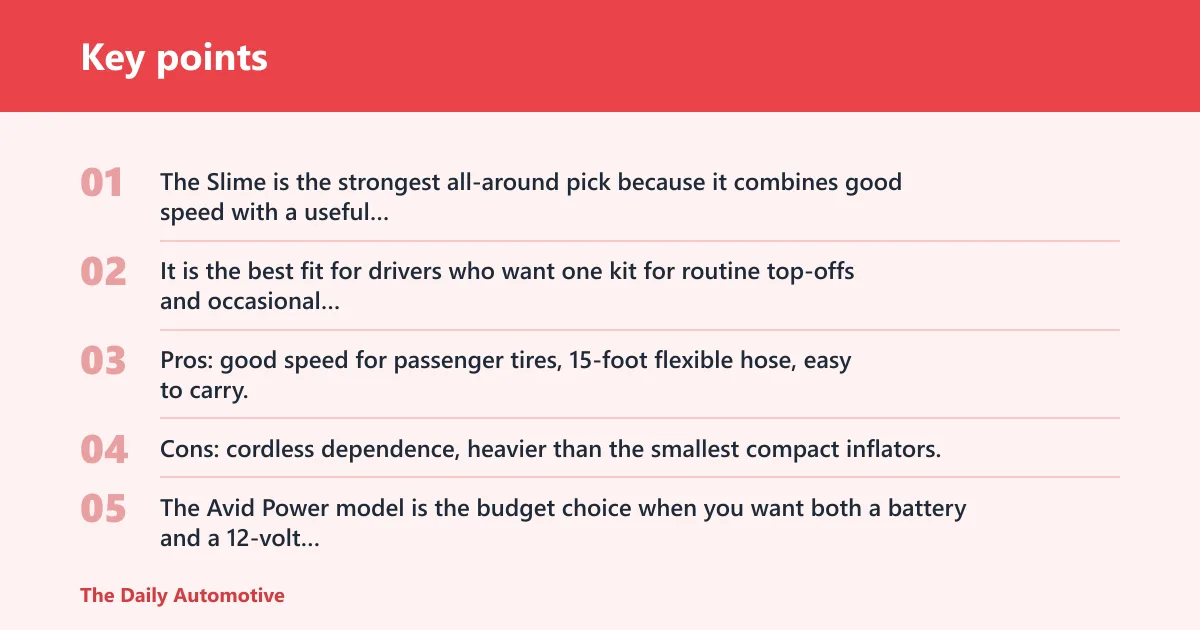
The Slime is the strongest all-around pick because it combines good speed with a useful hose length and a clear emergency role. It is the best fit for drivers who want one kit for routine top-offs and occasional roadside use, without going straight to a battery-clamp setup.
Pros: good speed for passenger tires, 15-foot flexible hose, easy to carry.
Cons: cordless dependence, heavier than the smallest compact inflators, battery runtime matters.
Avid power cordless pistol grip
The Avid Power model is the budget choice when you want both a battery and a 12-volt outlet. That dual-power design is its key advantage. It is slower than the Slime, but it can be a smarter purchase if you care more about ownership flexibility than about shaving a minute or two off a refill.
Pros: dual power, lighter weight, USB port, lower entry cost.
Cons: slower inflation, fewer emergency advantages than a true battery-clamp model.
Milwaukee M18 tire inflator
The Milwaukee is the speed pick. It is the one to choose when fill time matters more than price or size, especially for drivers who already own Milwaukee M18 batteries. The missing battery and charger are the main ownership hurdle.
Pros: fastest refill times, sturdy rubber feet, strong reputation for quick roadside use.
Cons: battery and charger not included, higher total ownership cost, still cordless-dependent without a separate power source.
Tire inflator comparison table
This table focuses on real ownership tradeoffs. The estimated 5 PSI figures are practical estimates for a standard passenger tire, not lab claims. A 225/60R18 tire is used as a benchmark.
| Model | Best for | Storage size | Battery dependence | Included accessories | Estimated time to add 5 PSI to a 225/60R18 tire |
|---|---|---|---|---|---|
| Slime Cordless Pro Power Tire Inflator | Best overall emergency and commuter use | Moderate; 4.4 lb | Yes, cordless battery use | 15-foot flexible hose | About 1 to 2 minutes |
| Avid Power Cordless Pistol Grip | Budget buy with dual-power flexibility | Compact; 2.6 lb | Yes, but it also runs from a 12-volt outlet | USB port | About 2 to 3 minutes |
| Milwaukee M18 Tire Inflator | Fastest top-off and heavier-use owner with M18 batteries | Bulkier than the Avid Power, but still packable | Yes; battery and charger not included | Sturdy rubber feet | About 1 minute or less |
Should you buy cordless or 12V?
Buy cordless if you want quick grab-and-go convenience and you mainly handle routine top-offs. Buy 12V if your priority is reliability during a roadside stop and you do not want to depend on a charged battery. Dual-power kits split the difference and make the most sense for drivers who want one tool to cover both needs.
Cordless convenience
Cordless inflators are easiest to keep in the car and easiest to deploy. They are best for small pressure corrections, especially when a tire is only a few psi low. Their weakness is obvious: if the battery is flat, they do nothing until charged again.
12V plug-in reliability
A 12-volt inflator stays useful as long as the vehicle can supply power. That makes it a better roadside tool for some drivers than a cordless unit with a dead pack. The downside is cable management, and the unit may be slower or less convenient to position near the tire.
Dual-power and battery-clamp options
Dual-power models and battery-clamp models are the strongest choices for emergency use. A dual-power kit such as the Avid Power gives you a second path if the battery is weak. A battery-clamp unit like the VIAIR 88P is even more direct for larger tires, but it is not as quick to set up as a grab-and-go cordless tool.
What features matter most?
Auto shut-off, a digital pressure display, hose length, and connector quality matter more than a high max PSI label. A good inflator should stop near the target pressure, be readable in poor light, and connect to the valve stem without constant fiddling. Those details decide whether the kit feels useful in a parking lot or annoying on the shoulder.
Auto shut-off and pressure accuracy
Auto shut-off is one of the most important features because it reduces the chance of overinflation. In reviewed models, target-pressure cutoff is commonly described as accurate to within about 2 PSI. That is close enough for normal passenger-car use, where the typical top-off range sits around 30 to 35 PSI.
Hose length and valve connector type
Longer hoses make a real difference on wheels with tight spoke openings or awkward valve placement. The Slime’s 15-foot flexible hose is a good example. A secure valve connector also matters because a poor seal wastes time and makes gauge readings less trustworthy during a roadside stop.
Digital gauge readability and accessory kit value
A clear digital display helps you stop at the right number, especially if you are adding just a few psi. Accessory value matters too. A carry case, extra adapters for bikes or balls, and a second power path are worth more than a flashy shell. The kit is only as useful as the pieces you actually have with you.
Airflow and duty cycle versus max PSI
Max PSI is not the main buying criterion. Airflow and duty cycle matter more, especially for SUV or truck tires. A compact cordless inflator can still be useful on larger tires, but it may work slowly and may not be the right tool for repeated fills. Max PSI alone does not tell you that.
Picture a driver with a midsize SUV that needs a few pounds added before a highway trip. A fast unit with decent airflow is better than a tiny compressor with a bigger PSI ceiling on the box. Now picture the same driver with a truck tire that is significantly low; a battery-clamp or more powerful 12V setup is the safer choice.
How to choose
Start with the failure mode you want to avoid. If a dead battery worries you most, pick a model with a second power path. If storage space is tight, choose a lighter cordless unit. If speed matters and you already own compatible batteries, choose the fastest model that fits your system.
- Match the inflator to your tire size and normal use.
- Check whether it still works if the cordless battery is dead.
- Look for auto shut-off and a digital display.
- Compare hose length and valve connector type.
- Account for batteries, chargers, and missing accessories before you buy.
A common first-timer mistake is buying the smallest compressor only because it fits in a glove box. Small size helps, but a unit that cannot finish the job quickly enough is not a good emergency tool. Another mistake is treating a high PSI number as proof that a model is suited to SUVs or trucks. It is not.
Frequently asked questions
What is the best car tire inflator kit for emergencies?
The best emergency choice is the one with power redundancy and a fast-enough fill rate. Among these picks, the Avid Power Cordless Pistol Grip is the safest budget emergency choice because it can run from both a 12-volt outlet and a 20-volt battery. For pure speed, the Milwaukee M18 is hard to beat if you already own the battery system.
Should I buy a cordless or 12V tire inflator?
Buy cordless if convenience and storage matter most, and you mainly need quick top-offs. Buy 12V if you want the better bet for roadside use and do not want to depend on a charged battery. A dual-power model is the most flexible option when you want both habits covered by one tool.
Which tire inflator fills a car tire the fastest?
The Milwaukee M18 Tire Inflator is the fastest of the three here. Car and Driver said it reached 30 psi in just over 90 seconds and 45 psi in under three minutes. That speed matters most when you need to add air fast rather than carry the smallest possible tool.
How accurate are portable tire inflator gauges?
Portable inflator gauges vary, but auto shut-off systems on reviewed models are commonly described as accurate within ±2 PSI. That is good enough for normal passenger-car top-offs around 30 to 35 PSI. For best results, stop at the target setting and verify the reading with a separate tire gauge if needed.
Can a portable inflator handle SUV or truck tires?
Yes, but not all of them are equally suited to the job. A compact cordless inflator can top off many SUV tires, but airflow and duty cycle matter more than max PSI. For larger tires, a stronger 12V or battery-clamp model is often the better buy, especially if the tire starts very low.
Which tire inflator is easiest to keep in the car?
The easiest to store is usually the lightest and simplest unit. The Avid Power Cordless Pistol Grip is the most compact of the three here at 2.6 lb, so it is the easiest to tuck away. The tradeoff is slower inflation than the fastest units, but it is still a practical everyday carry choice.
Products related to this article
Sponsored / affiliate links. As an Amazon Associate I earn from qualifying purchases. I may earn additional commission from eligible campaigns.
 Bullseye 12V DC Car Tire Inflator Portable Air Compressor - Rapid 2 Minute Inflation, Auto Shut-Off, Max 150 PSI, Easy Cord Storage, Digital Pressure Gauge, LED Display (Royal Blue) - As Seen on TV
 Bullseye 12V DC Car Tire Inflator Portable Air Compressor - Rapid 2 Minute Inflation, Auto Shut-Off, Max 150 PSI, Easy Cord Storage, Digital Pressure Gauge, LED Display (Yellow) - As Seen on TV