3 Best CV Boot Clamp Kits for Your Car (2026): We Compared
The best CV boot clamp kit is the one that matches your boot diameter and clamp style exactly; stainless ear clamps suit most OE-style boots, Oetiker pliers kits are easiest for repeatable installs, and banding kits fit odd sizes. Wrong fitment can slip, cut the boot, and turn a low-cost repair into axle contamination and joint failure. This guide compares three real clamp-kit types by fitment risk, tool needs, and installation reliability.
Quick comparison
| Product | Badge | Best for | Price | ||
|---|---|---|---|---|---|
 |
CV Boot Clamp Kit – Stainless Steel Universal AdjustableTabazy | Our pick | Stainless Steel · 24-Piece Kit · Universal Fit | $13.99
Price as of 21 Oct 2026
|
View |
 |
5 Pieces Earless Low Profile CV Boot Clamps 3.6" or 92.7 mmTJ Longda | Budget pick | Stainless Steel · 5-Piece Kit · Earless Low Profile | $13.99
Price as of 21 Oct 2026
|
View |
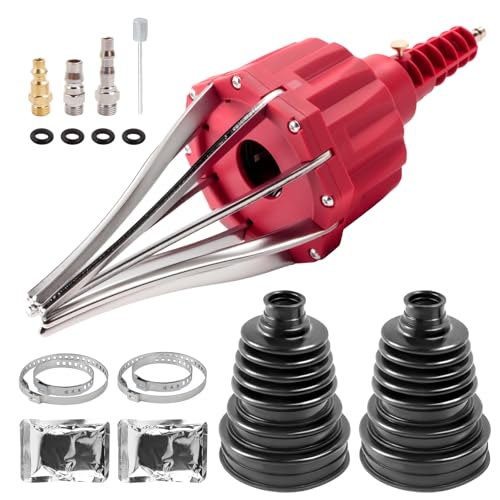 |
Pneumatic CV Joint Boot Installation Tool with CV JointSKCOAUTO | Upgrade pick | Pneumatic Tool · Steel and Rubber · Expander Kit | $65.99
Price as of 21 Oct 2026
|
View |
The right choice depends on collar diameter, not piece count alone. If you want the simplest path for a modern axle, start with a single-ear kit; if the car lives in wet or salty conditions, a 304 stainless banding kit gives better corrosion resistance.
How we chose
Fitment comes first. Clamp diameter range matters most because the band has to close on the boot collar without over-crimping or leaving the seal loose.
Tool needs come next. Some kits include pliers, while others assume you already have a clamp tool or a ratchet-compatible driver.
Corrosion resistance matters more in humid or road-salt use. That is where 304 stainless steel earns its keep, especially on axles and drive shaft boots that stay exposed.
Value here means application fit, not piece count alone. A bigger pack is no better if the sizes do not match the boot or if the kit cannot be installed cleanly in the space available.
What size CV boot clamp kit do you need?
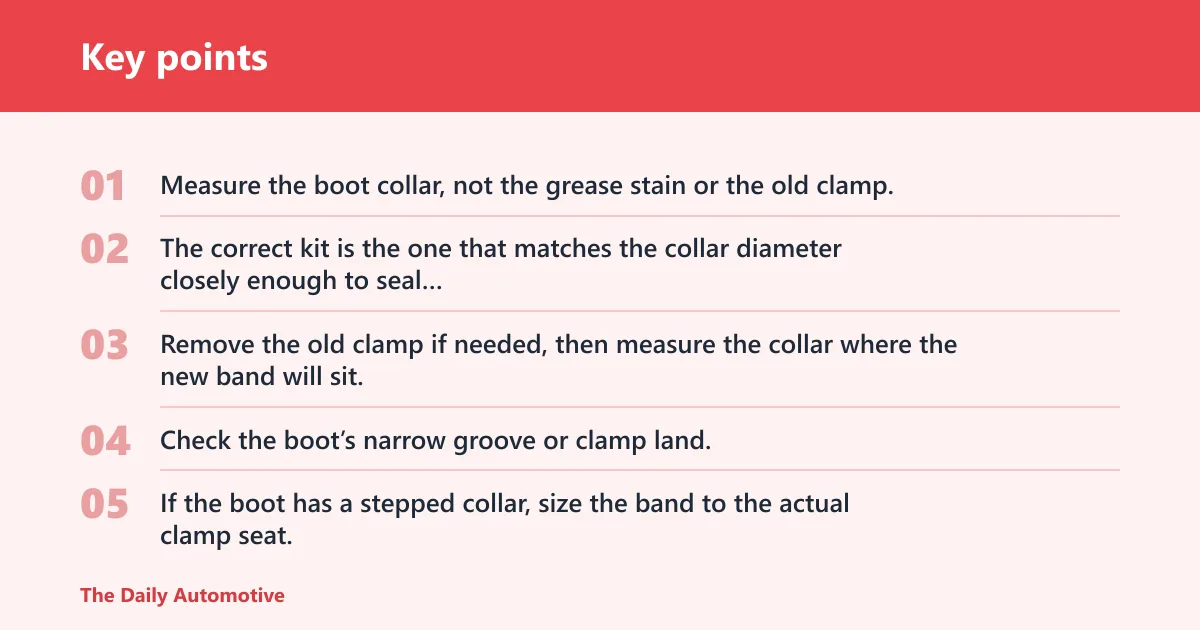
Measure the boot collar, not the grease stain or the old clamp. The correct kit is the one that matches the collar diameter closely enough to seal without crushing the boot lip or leaving the band loose enough to leak grease.
Measure the boot collar, not guesswork
Remove the old clamp if needed, then measure the collar where the new band will sit. Check the boot’s narrow groove or clamp land, because that is the surface the clamp must grip. If the boot has a stepped collar, size the band to the actual clamp seat, not the widest rubber section.
For a universal kit, the published size range has to cover your measurement with a little room for the tool to close the band. The QWORK kit, for example, is listed at 1.8″ to 3.2″, which helps only if your boot collar lands inside that band.
Match small and large ranges to the axle boot
Mixed packs exist for a reason. A 10-piece kit such as Aienxn’s split of small and large clamps can cover one axle job neatly, while a 24-piece pack like Tabazy’s 12 small and 12 large gives more size overlap for multiple repairs.
Small and large assortments help when you do not know whether the boot collar sits at the low end or high end of the range. That helps on passenger cars with tight packaging, where one axle may need a different band size than the other side.
When a universal kit is the wrong size
Universal fit still fails when the boot collar is outside the band range, the groove is damaged, or the clamp land is too narrow for the band width. It also fails when the old boot has stretched, torn, or hardened enough that no clamp can restore the seal.
Say your compact car needs a clamp around a 1.6-inch collar, but the universal kit starts at 1.8 inches. That band will not clamp down properly, and squeezing harder only risks cutting the boot edge.
Single-ear clamp kit: best for modern drivetrains
Single-ear clamps are a strong fit for many newer drivetrains because they crimp down cleanly and hold a consistent seal when installed on the correct collar size. They are common on modern axle boots, and universal kits often include them because the design works across a wide range of OE-style applications.
Why crimp-and-lock clamps suit many newer axles
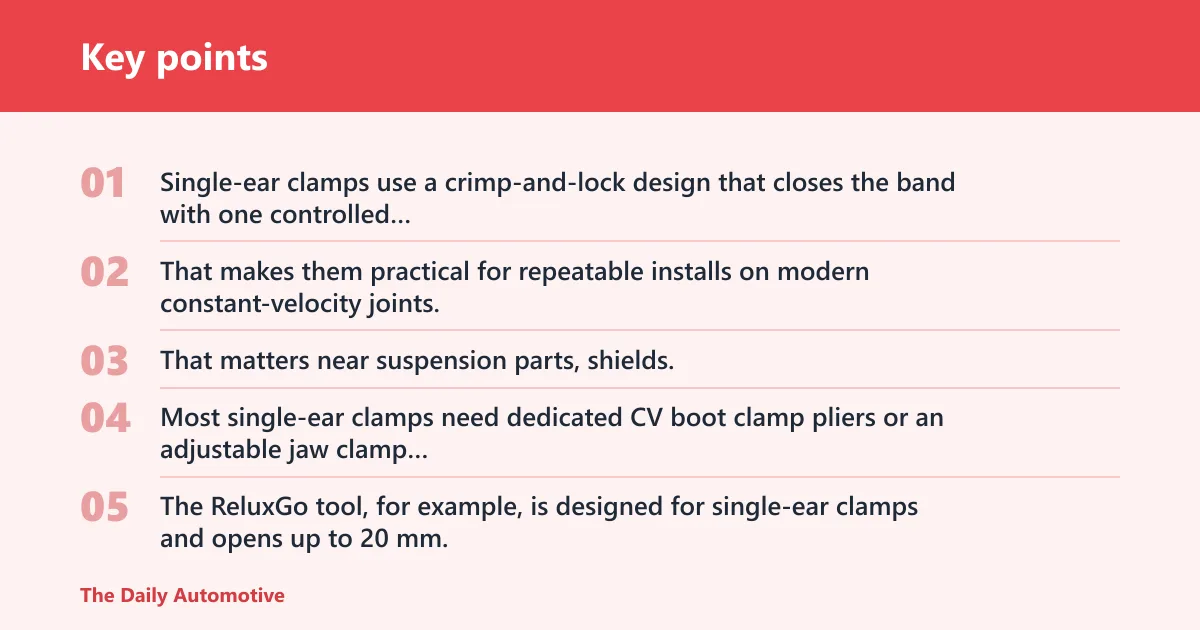
Single-ear clamps use a crimp-and-lock design that closes the band with one controlled deformation. That makes them practical for repeatable installs on modern constant-velocity joints, where the boot groove and collar are designed for this clamp style.
They also keep the clamp profile low. That matters near suspension parts, shields, and subframes where a bulky screw clamp can interfere.
Tool needs and installation difficulty
Most single-ear clamps need dedicated CV boot clamp pliers or an adjustable jaw clamp tool. The ReluxGo tool, for example, is designed for single-ear clamps and opens up to 20 mm, which helps in tight spaces where a regular plier head cannot line up cleanly.
Installation difficulty is moderate, not simple. You need the right band size, a square crimp, and enough access to keep the clamp from twisting while you tighten it.
Where single-ear clamps can fail
Under-tightening leaves a slow leak that often shows up as grease splatter around the joint housing. Over-crimping can cut into the boot lip or deform the band so badly that it bites unevenly.
A common first-timer mistake is letting the clamp twist as it closes. Once the band rotates off-axis, the seal can sit cocked and cut into the rubber during suspension travel.
304 stainless banding kit: best for wet climates
304 stainless steel CV boot clamps are the better call when the vehicle sees humid weather, road salt, slush, or frequent wash exposure. They are commonly used in universal clamp kits because corrosion resistance matters on axle and drive shaft boots that stay exposed under the vehicle.
Corrosion resistance in humid or salty use
304 stainless steel is commonly used for automotive durability and offers better corrosion resistance than plain steel in wet or salty conditions. That does not make it the answer for every repair, but it does help the clamp stay intact where moisture exposure is constant.
On commuter cars in the rust belt, or on vehicles that see winter road treatment, stainless is often the safer material choice for the clamp itself.
Why banding clamps fit axle and drive shaft boots
Banding clamp kits work well on axle and drive shaft boots because they can cinch a broad range of collar sizes and hold a secure seal. Some kits also include band clamp pliers, which helps when you need controlled tightening rather than improvised force.
They are especially useful on oddball fitments or older driveline hardware where the boot collar is not a clean match for a standard ear clamp.
Best use cases and limitations
Banding kits are a strong choice for corrosion-prone environments, but they are not the fastest option in cramped spaces. If the band must be threaded around a tight housing, setup can take longer than a single-ear crimp.
They also depend on careful sizing. A band that is too wide or too long can bunch up, while one that is too short may not close securely enough to keep grease in.
Mixed-size assortment kit: best for mixed jobs
Mixed-size packs make sense when you service more than one vehicle or you do not know the exact clamp size before teardown. Kits like Tabazy’s 24-piece pack with 12 large and 12 small clamps, or Aienxn’s 10-piece set split evenly between sizes, give you coverage across multiple collar diameters.
Why 10-piece and 20-piece packs matter
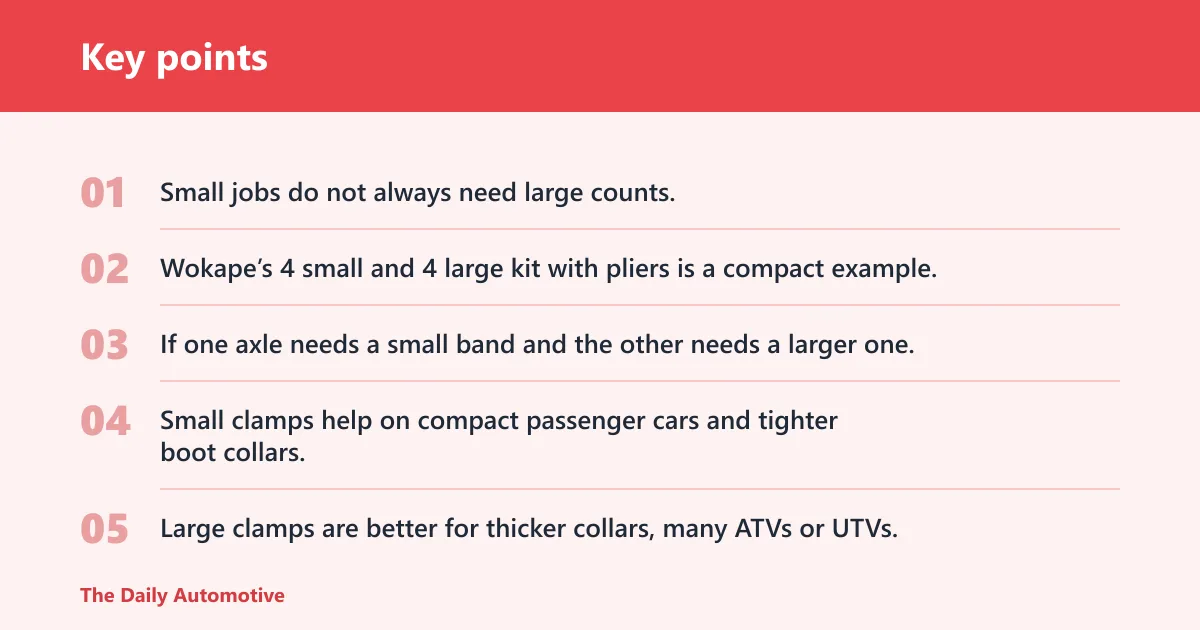
Small jobs do not always need large counts, but mixed packs reduce the odds of stopping mid-repair because the clamp is the wrong size. Wokape’s 4 small and 4 large kit with pliers is a compact example, while Alpha Rider’s 20 crimp bands split into 10 small and 10 large is better suited to repeat service work.
The value comes from coverage, not quantity. If one axle needs a small band and the other needs a larger one, a mixed pack saves a return trip.
How small and large coverage helps
Small clamps help on compact passenger cars and tighter boot collars. Large clamps are better for thicker collars, many ATVs or UTVs, and some older driveline boots that use wider sealing lands.
That split matters because the wrong diameter can cause the clamp to bottom out before it seals, or to tighten so far that it cuts the rubber edge.
When assortments save time and when they waste it
Assortments save time when you have a mixed fleet, a shop bench full of unknown fitments, or a repair where the old clamp is unusable as a size reference. They waste money when you only need one exact size and end up paying for unused bands.
Suppose a UTV boot sees mud, wash water, and vibration, but the clamp groove is still intact. A mixed pack can make sense there because you may need to step up a size after measurement, not before.
Do you need special pliers?
You do not need special pliers for every CV boot clamp, but the right tool makes the job far less awkward. Included pliers are convenient, yet separate CV boot clamp pliers or adjustable jaw tools often offer better control, cleaner crimps, and less hand fatigue in tight spaces.
Included pliers versus buying separate
When pliers come in the kit, they are usually tuned to the clamp style in that package, which helps for first-time repairs. A featured kit that includes 20 stainless steel clamps and pliers for field repairs is a good example of that convenience.
Separate tools can be better if you already service multiple clamp styles. The GEARWRENCH tool, for instance, is compatible with a 1/2″ drive ratchet or torque wrench, which can be useful when you want more controlled tightening.
Adjustable jaw tools and tight-space use
An adjustable jaw clamp tool is worth considering when access is poor. ReluxGo’s adjustable jaw opening up to 20 mm makes it easier to work around suspension parts and shields where straight-line access is limited.
That kind of tool also helps reduce clamp twist because you can line up the jaws before you commit to the crimp.
What makes a pliers set worth paying
Look for ergonomic handles, positive grip at the jaws, and a head shape that matches the clamp style you bought. A tool that slips can distort the band, leave the clamp uneven, or make the install take longer than it should.
For repeated repairs, a dedicated tool is worth more than a cheap all-purpose plier that only grabs the ear halfway.
CV boot clamp decision matrix
| Clamp kit type | Boot diameter range | Tool needed | Install difficulty | Corrosion risk | Best-use scenario |
|---|---|---|---|---|---|
| Single-ear clamp kit | Must match the boot collar closely; common on OE-style boots | Dedicated pliers or adjustable jaw tool | Moderate | Low with stainless steel | Modern passenger-car drivetrains with accessible collars |
| 304 stainless banding kit | Useful for a wider collar range when the band length fits | Band clamp pliers or a kit-specific tool | Moderate to high | Low in humid or salty environments | Axle and drive shaft boots exposed to road spray |
| Mixed-size assortment kit | Small and large coverage for multiple collar sizes | Depends on clamp style included | Low to moderate | Depends on material | Mixed fleet work, unknown fitment, and one-off repairs |
| Included-pliers kit | Depends on the clamp sizes in the pack | Pliers included | Lower for DIY use | Depends on clamp material | First-time installs and roadside or field repairs |
Cv boot clamp kits checklist
- Measure the collar before buying.
- Match the clamp width to the boot’s clamp land.
- Crimp only until the band seats firmly.
- Keep the clamp square so it does not twist.
- Replace the boot if the rubber edge is cut or split.
- Stop and inspect if the groove is damaged or the joint is already noisy.
Choose Tabazy if… / Choose TJ Longda if… / Choose SKCOAUTO if…
Choose Tabazy if you want a mixed-size kit with 12 large and 12 small clamps, and you expect to service more than one axle or one vehicle. It is the better pick when you want broad coverage from a 24-piece pack and prefer stainless steel for everyday corrosion resistance.
Choose TJ Longda if you need a low-profile earless clamp for a cleaner seal on a compatible boot and want a small, straightforward pack. The drawback is capacity: 5 pieces is enough for a targeted repair, not for a busy garage or a full mixed-size inventory.
Choose SKCOAUTO if you need a boot expansion tool rather than a basic clamp-only kit, especially for repair work on cars, trucks, or ATVs with awkward boot installation access. The trade-off is cost and complexity, since a pneumatic tool is not the first purchase for a simple clamp replacement.
For passenger cars, start with the diameter range and clamp style the axle already uses. For ATVs and UTVs, lean toward mixed-size or stainless options because vibration, mud, and wash exposure are harder on the clamp. For older driveline designs, verify the groove and collar width before buying, because oddball fitments are where universal kits fail most often.
Which one should you buy?
If you want the easiest path for a modern passenger car, buy a single-ear kit with the correct diameter range and the right pliers. If your vehicle sees winter salt or damp storage, a 304 stainless banding kit is the safer material choice. If you service several vehicles, a mixed-size pack is the most practical buy.
Budget should follow application. A cheaper clamp kit becomes expensive if it slips, leaks grease, or forces a second repair. If you already own good CV boot clamp pliers, spend more on the right clamp size and less on bundled tools you will not use.
Do not use a universal kit as a shortcut around measurement. If the boot collar is torn, the groove is damaged, or the joint is already seized, a clamp swap is not the fix.
Frequently asked questions
What size CV boot clamp kit do I need for my car?
Measure the boot collar where the clamp sits, then match that diameter to the kit’s stated range. Small and large assortments help when the exact size is not obvious, but the clamp must land on the collar cleanly. If the band is outside the range, choose another kit.
Are stainless steel CV boot clamps better?
304 stainless steel is the better choice in humid, wet, or salty environments because it resists corrosion better than plain steel. It is widely used in universal kits and holds up well for typical automotive durability. For dry, sheltered use, material choice matters less than fit.
Do I need special pliers for CV boot clamps?
Often, yes. Single-ear clamps usually need dedicated pliers or an adjustable jaw tool, while some kits include pliers for convenience. The right tool gives you better control, especially in tight spaces, and helps avoid over-crimping, twist, and uneven sealing.
Can I use a universal CV boot clamp kit on any car?
No. Universal kits can cover many vehicles, but they still need the correct diameter range and clamp style. Some oddball fitments, damaged grooves, and nonstandard collars will not work. Verify the collar diameter and boot width before buying, especially on older driveline hardware.
How many CV boot clamps should I buy?
Buy enough for the repair plus a spare or two. A 10-piece kit can handle one side and leave extras, while a 20-piece or 24-piece kit is better for mixed jobs or a full set of future repairs. Do not buy by count alone; buy by size coverage.
How do I stop a CV boot clamp from leaking grease?
Use the right diameter, seat the clamp on the boot’s clamp land, and crimp only until it is snug and even. Leaks usually come from under-tightening, misalignment, or a twisted band. If the boot edge is cut or the groove is damaged, replace the boot instead of forcing the clamp.
Which CV boot clamp kit is easiest to install?
A kit with included pliers is usually easiest for first-time work, especially on accessible passenger-car axles. Single-ear clamps are straightforward when the diameter is correct. In tight spaces, an adjustable jaw tool can be easier than a bulky clamp head, but the fit still has to be right.
Can CV boot clamps be reused after removal?
Usually not if the clamp was crimped tightly or distorted during removal. Once the band has been deformed, it may not seal evenly a second time. Reuse is less risky only if the clamp is designed for it and still keeps its shape, but replacement is the safer call.
Products related to this article
Sponsored / affiliate links. As an Amazon Associate I earn from qualifying purchases. I may earn additional commission from eligible campaigns.