Eco-Friendly Living With an Automotive Twist Guide
Start with tire pressure, smoother driving, and lighter loads. These three habits usually cut fuel use more than cheap add-ons. Skip them and you burn fuel, add emissions, and pay more for tires, brakes, and routine maintenance. This guide ranks the biggest-payoff habits, low-cost tools, and the mistakes that quietly drain mileage in daily driving.
What eco-friendly driving actually changes in daily use
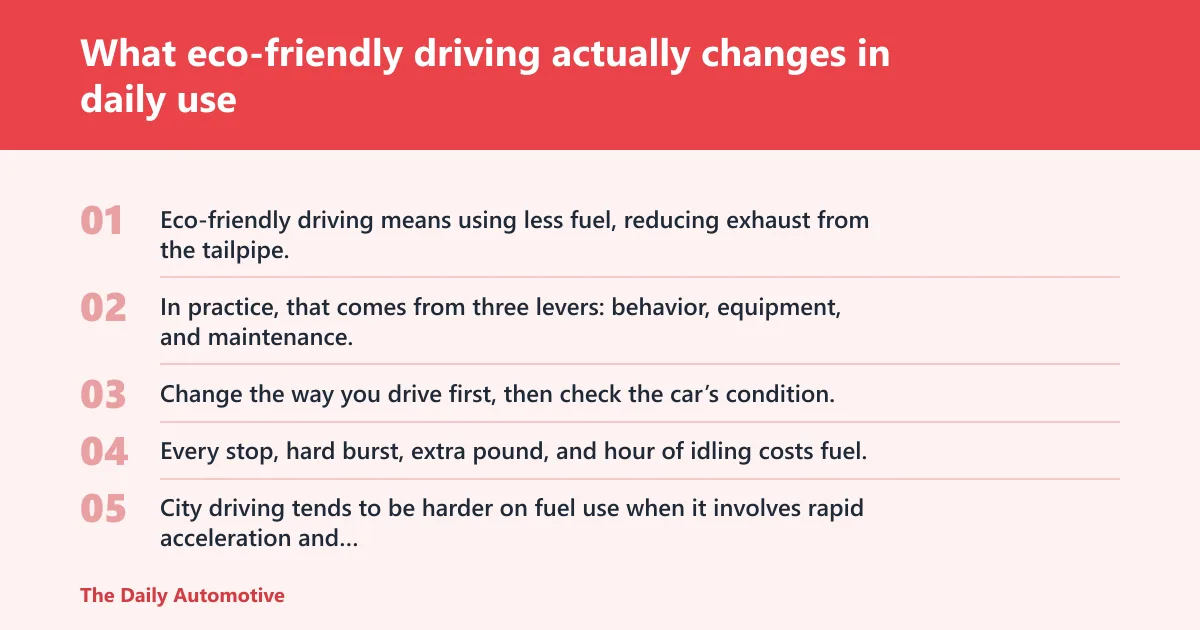


Eco-friendly driving means using less fuel, reducing exhaust from the tailpipe, and helping slow wear on the car you already own. In practice, that comes from three levers: behavior, equipment, and maintenance. Change the way you drive first, then check the car’s condition, then buy accessories only when they solve a real efficiency problem.
How small choices change fuel burn
Every stop, hard burst, extra pound, and hour of idling costs fuel. City driving tends to be harder on fuel use when it involves rapid acceleration and frequent braking. Highway driving tends to be affected by drag, especially from roof-mounted cargo boxes and racks. Tire pressure and engine condition affect both.
Think of eco-friendly living with an automotive twist as a hierarchy. Free habits usually beat paid accessories. Maintenance often beats both, because a car with low tire pressure or a hidden fault can lose efficiency every day.
How to think about impact
The highest-payoff actions cut wasted energy in ordinary use. Avoiding idling is one. Driving at the speed limit is another. Cutting 100 pounds of trunk weight can help reduce fuel use and emissions. A roof box may help with cargo, but it can hurt fuel economy enough to erase other gains.
Which driving habits save the most fuel?
The biggest everyday fuel savers are avoiding idling, driving at the speed limit, smoothing acceleration and braking, combining errands, and removing unnecessary weight. These habits matter because they cut wasted engine work. They also cost nothing, which makes them the first changes to lock in before buying anything.
Avoid idling
Idling burns fuel without moving the car, so it is one of the easiest wastes to cut. That matters most in school pickup lines, drive-throughs, and long curbside waits. If a stop will last more than a brief pause, shutting the engine off is often the cleaner choice, assuming local conditions and safety allow it.
Hold steady speeds and stay near the limit
Driving at the speed limit is a fuel-saving habit, and that matches physics: higher speed increases drag. On the highway, small jumps in speed can add up quickly. In stop-and-go traffic, the best move is not to race to the next brake light.
Brake and accelerate smoothly
Smooth inputs reduce wasted energy. Hard acceleration asks the engine for more fuel right now. Late braking turns that fuel into heat. A steadier pedal pattern often gives the best result in commuting, school runs, and delivery routes with repeated starts and stops.
Cut empty miles by combining errands
Short trips are often inefficient because the engine, cabin, and drivetrain do not get much warm-up time. Combining errands can cut cold starts and reduce miles driven overall. A common first-timer mistake is splitting a grocery run, pharmacy stop, and package pickup into three separate trips across town.
Remove weight you do not need
Trunk weight matters more than many drivers expect. Clearing 100 pounds of trunk weight can help reduce fuel use and emissions. That does not mean every loose item matters equally, but the spare stroller, tool bin, sports gear, and unopened water cases should not live in the trunk all month.
Do cheap accessories help, or add drag?
Some cheap accessories help, but many either do nothing for efficiency or make it worse. A reflective windshield sunshade can reduce AC use. Roof boxes, roof racks, and similar add-ons can hurt mileage. Dash cams improve evidence and safety, but they do not usually improve fuel economy.
Windshield sunshades and cabin heat control
A reflective windshield sunshade is recommended to reduce AC use. That helps most when the car sits in direct sun for hours. Passive heat control also matters: park in shade when possible, crack open airflow before driving, and avoid blasting the cabin colder than needed.
Roof boxes, roof racks, and cargo drag
Roof-mounted cargo boxes can cut highway fuel economy by 6-17%. That is a big penalty for a device that is often left on the car after the trip is over. Roof racks also add drag even when empty. If you only need them a few weekends a year, remove them the rest of the time.
When add-ons do not help efficiency
Dash cams, phone mounts, and in-car chargers are useful for other reasons, but they do not meaningfully improve fuel economy. Some accessories add weight or draw power, which is fine if the benefit is safety or documentation. Just do not count them as eco upgrades.
Ranked driver actions by cost, effort, and payoff

Start with free habits, then move to low-cost tools, then verify maintenance. The table below separates actions into three buckets and shows where each one fits, along with the main failure mode. Use it as a triage list, not a shopping list.
| Bucket | Action | Estimated impact | Best use case | Failure mode |
|---|---|---|---|---|
| Free habit | Avoid idling | Strong in long waits and pickup lines; proven way to cut fuel use and emissions | School drop-off, curbside waits, drive-throughs | Short stops where shutting off and restarting is impractical or unsafe |
| Free habit | Drive at the speed limit | Meaningful on highways and open roads | Commuters with long freeway stretches | Trying to “save fuel” by driving so slowly that traffic flow becomes unsafe |
| Free habit | Combine errands | Medium to strong when it removes multiple short trips | Families and multi-stop weekday routines | Overpacking one trip until it becomes heavy and inefficient |
| Free habit | Reduce unnecessary weight | Clear out 100 pounds of trunk weight for a measurable gain | Any car carrying tools, sports gear, or groceries all week | Removing emergency gear needed for safety |
| Low-cost accessory | Reflective windshield sunshade | Helps reduce AC use after parking in the sun | Hot climates, outdoor parking, summer commutes | Little benefit on cool days or in shaded parking garages |
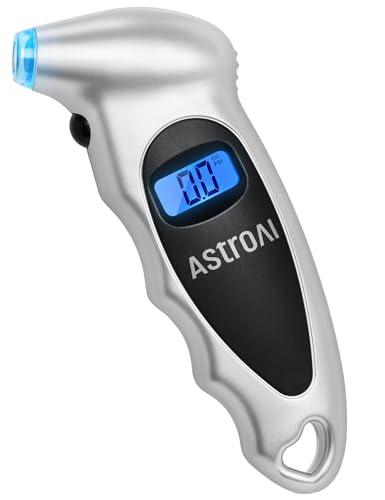
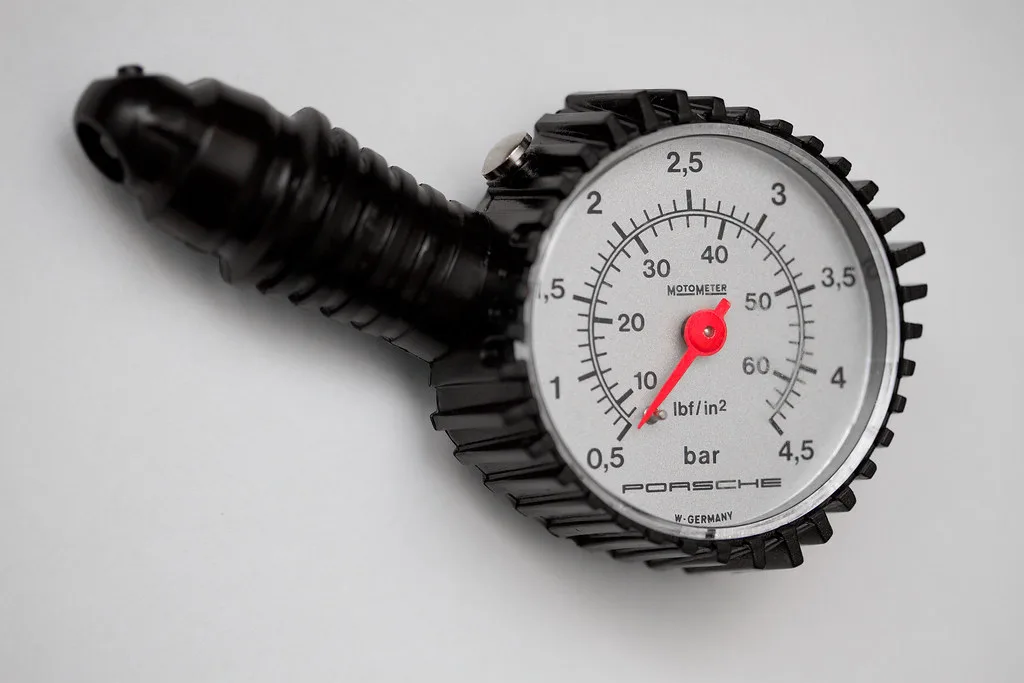
| Low-cost accessory | Tire pressure gauge or inflator | Helps preserve efficiency if tires drift low | Drivers who rarely check pressures | Ignoring load, temperature changes, and the car’s placard spec |
| Maintenance check | Tire pressure | Often one of the quickest fixes for lost efficiency | Every driver, especially before highway trips | Checking only when tires look visibly low |
| Maintenance check | Oil change with the correct viscosity | Supports efficient engine operation when done on schedule | Gas cars and hybrids | Using the wrong viscosity or stretching intervals too far |
| Maintenance check | OBD-II diagnostics | Can reveal faults that quietly waste fuel | Cars with warning lights, rough running, or poor mileage | Ignoring stored codes because the car still “feels fine” |
Use-case examples
Say your weekday route is 18 miles each way with one freeway section and two traffic lights. The best order is simple: tire pressure first, smoother acceleration second, then speed control on the freeway. A roof box would likely hurt more than it helps unless you need the cargo space every day.
Suppose a rideshare driver spends hours in stop-and-go traffic with the engine running between fares. Idling control and cabin heat management matter more than trunk weight. In that case, a sunshade and accurate tire pressure can help, while a roof carrier would be the wrong tradeoff.
What maintenance keeps a car efficient?
Maintenance protects fuel economy by keeping the engine, tires, and drivetrain close to their intended operating condition. Tire pressure and hidden engine faults are the biggest checks to prioritize. Oil changes, tune-ups, and air-filter inspections matter too, but only if they are done correctly and on time.
Tire pressure and tread condition
Underinflated tires hurt efficiency because they increase rolling resistance. Check pressures when tires are cold and compare them with the placard on the car, not the number molded into the sidewall. Tread matters as well, since uneven wear can signal alignment or suspension problems that drag mileage down.
Oil changes and the right viscosity
Proper oil changes help the engine run as designed. The wrong viscosity can raise internal friction, while very overdue oil can contribute to poor performance and hidden wear. Follow the manufacturer’s schedule, especially on cars used for short trips or heavy traffic.
Engine tune-ups and air-filter checks
A dirty air filter, worn spark plugs, or neglected ignition parts can reduce efficiency. Not every modern car needs frequent tune-ups, but a rough idle, sluggish acceleration, or poor cold-start behavior deserves attention. If mileage falls and nothing else changed, this is a good place to look.
OBD-II diagnostics for hidden faults
The ANCEL AD310 is described as a universal OBD II scanner, which is the kind of tool that can help identify stored trouble codes before they turn into bigger waste. A check-engine light is the obvious trigger. Less obvious are pending codes and sensor issues that can quietly hurt fuel use.
- Check tire pressure against the door-jamb placard.
- Remove cargo you do not need this week.
- Scan for OBD-II codes if mileage drops suddenly.
- Confirm oil is current and the correct viscosity.
- Inspect filters, plugs, and visible tire wear.
Are EVs always the greener choice?
Battery-powered EVs use rechargeable batteries and are described as producing zero tailpipe emissions, but they are not automatically the best answer for every driver. The cleanest choice depends on trip length, charging access, and whether the current gas car is still efficient. A hybrid can be the smarter bridge for some households.
Best use cases for EVs
EVs fit best when you have reliable charging at home or work and a commute that falls comfortably within the vehicle’s range. City and suburban driving also suits EVs because regen braking recovers some energy that a gas car would lose as heat. Daily short trips often make strong sense here.
When a hybrid may fit better
Hybrid vehicles combine a gasoline engine with an electric motor, which usually improves fuel efficiency and reduces emissions versus a conventional gas car. If you drive long distances, lack consistent charging, or need one car for varied trip types, a hybrid can be the cleaner, more practical step.
Decision rule for your next car
If you can charge easily and most trips are moderate in length, choose an EV. If you drive mixed routes, need flexibility, or cannot count on charging, choose a hybrid. If your current gas car is already efficient and in good condition, keeping it well maintained may be the lowest-waste option for now.
How should different drivers prioritize changes?
Different drivers should fix different problems first. Commuters usually get the most from speed control and tire pressure. Rideshare drivers should focus on idling and cabin heat. Families need cargo discipline. Highway-heavy drivers should pay close attention to drag from roof gear and to steady cruising speed.
Commuters
For commuters, the best order is tire pressure, smoother acceleration, and staying near the speed limit. If the route is mostly freeway, speed and drag matter more than city habits. If the commute includes long queues, idling control becomes more valuable.
Rideshare drivers
Rideshare drivers rack up engine-on time, so idling and climate control are major issues. A windshield sunshade helps with hot-weather starts. Maintenance matters too, because a high-mileage schedule reveals weak tires, low oil quality, and engine faults faster than casual driving.
Families with cargo needs
Families often carry the most clutter, which makes trunk weight a hidden fuel thief. Keep only the gear that stays useful day to day. Roof boxes make sense for vacations, but not as permanent storage. The best eco move is usually to remove the carrier when the trip ends.
Highway-heavy drivers
Highway drivers should focus on drag, steady speed, and a clean maintenance record. Roof-mounted cargo boxes can cut highway fuel economy by 6-17%, so the penalty is too large to ignore. If the car’s role is mostly freeway miles, accessory choices matter more than they do in city driving.
What can the word eco mean in this context?
Eco in this context points to ecological or environmental effects, and Dictionary.com also notes that eco can mean not harmful to the environment. Wikipedia says eco may refer to ecology or economics. For drivers, the useful meaning is practical: use less energy, waste less fuel, and keep the car working efficiently. (en.wikipedia.org)
Frequently asked questions
How can I live more eco-friendly if I still drive every day?
Start with the car you already own. Check tire pressure, remove extra weight, and avoid idling. Then smooth your throttle use and combine errands so the engine does fewer cold starts. Those changes are usually cheaper and more effective than buying accessories first.
What car habits save the most fuel and emissions?
The strongest habits are avoiding idling, driving at the speed limit, smoothing acceleration and braking, and cutting unnecessary miles. Removing 100 pounds of trunk weight can also help. These changes work because they reduce wasted fuel directly, not just on paper.
Does idling really waste fuel?
Yes. Avoiding idling is presented as a proven way to cut fuel use and emissions. That is why pickup lines, long drive-through waits, and curbside stops are worth watching closely. If the stop is long enough, shutting the engine off usually beats burning fuel for nothing.
How much does roof cargo hurt gas mileage?
Roof-mounted cargo boxes can cut highway fuel economy by 6-17%. The effect is biggest at higher speeds, where aerodynamic drag climbs quickly. If the box stays on after vacation, it can keep costing fuel long after the trip is over.
Are EVs always greener than hybrids?
Not always. EVs have zero tailpipe emissions and rechargeable batteries, but the better choice depends on charging access, trip length, and how efficiently you can use the car. A hybrid may fit better for long-distance drivers or households that cannot charge consistently.
What cheap accessories actually help eco-friendly driving?
A reflective windshield sunshade can help by reducing AC use after parking in the sun. A tire-pressure gauge or inflator also pays off because correct pressure protects efficiency. Beyond that, many cheap add-ons do little for fuel economy, and roof gear often hurts it.
Products related to this article
Sponsored / affiliate links. As an Amazon Associate I earn from qualifying purchases. I may earn additional commission from eligible campaigns.