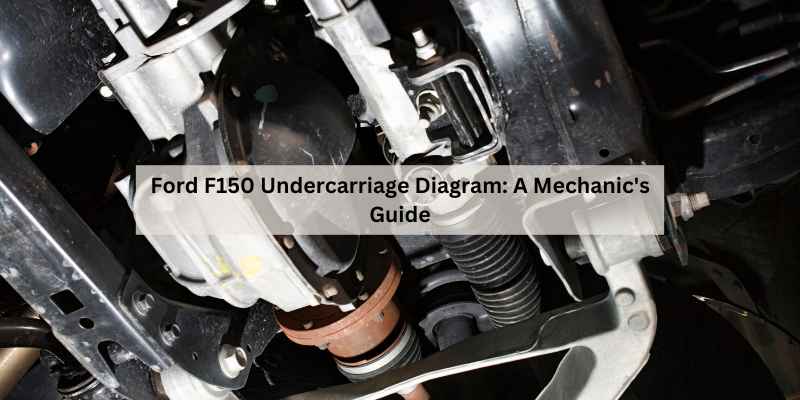
Ford F150 Undercarriage Diagram
You slide under your F-150 to chase an oil leak or knock a stuck brake line loose, and suddenly you’re staring at a maze of metal, hoses, and brackets. The frame rails run the length of the truck, the exhaust snakes around things you can’t quite identify, and somewhere in there is the fuel tank you’re supposed to avoid with a jack. Without a decent ford f150 undercarriage diagram, you’re guessing. Guessing leads to stripped bolts, pinched lines, and the kind of repair that takes three trips to the parts store.
This guide is built around the actual layout of the F-150, not generic truck theory. You’ll learn what each labeled component does, how the layout changes between 2WD and 4WD, where the rust hides, and how the undercarriage shifted across generations from 1997 through 2026. By the time you’re done, you’ll be able to point at any part under your truck and know what it is, why it’s there, and whether it needs attention.

smileracing
for 2015-2020 Ford F150 ML3Z-7222-D Front Engine…
- PART NUMBER: The ML3Z-7222-D Front Engine Splash Shield is a durable F150 underbody shield and skid plate lower cover designed spe…
- COMPATIBILITY: This 2015-2020 Ford F150 front engine splash shield is a direct fit for your model. Not Fit Raptor Model. Not Fit 3…
- DURABLE CONSTRUCTION ENGINE SPLASH SHIELD: This Manganese Steel undercarriage cover provides superior strength and long-lasting pr…
If you’re working under the front end and notice the factory splash shield is cracked or missing, a direct-fit replacement like the smileracing front engine splash shield bolts on without modification. It’s a manganese steel cover for 2026–2026 models that keeps road debris off the engine bay. Worth having on hand before you crawl underneath for the first time.
Why You Need an Accurate F-150 Undercarriage Diagram
A factory service manual diagram is the difference between a two-hour job and a two-day job. The undercarriage is dense. Brake lines run along the frame rails, the wiring harness clips into the crossmembers, and the fuel tank sits between the driveshaft and the spare tire. One wrong move with a pry bar and you’ve got a $400 repair on your hands.
An accurate diagram gives you three things: component identification, fastener locations, and routing paths. Knowing where the parking brake cable routes before you drop the exhaust saves you from yanking on something that doesn’t want to move. Knowing which bolts are actually structural versus cosmetic keeps you from over-torquing a bracket that’s only there to hold a wire loom.
Most diagrams you’ll find online are either forum photos with bad lighting or generic illustrations that don’t match your year. This guide uses the real layout of the 12th and 13th generation trucks (2026–2026) as the baseline, then covers what changed in earlier and later models.
Key Components Labeled in a Standard F-150 Undercarriage Diagram
Here’s the breakdown of what you’ll see when you look at a proper labeled diagram, starting at the front and working back.
Frame and Crossmembers
The F-150 uses a body-on-frame construction. The two main frame rails run from the front bumper to the rear, and they’re tied together by crossmembers. On a 2026–2026 truck, you’ll find six crossmembers: one at the radiator support, one under the engine, one at the transmission, one mid-ship under the cab, one at the rear of the cab, and one at the spare tire area.
The front crossmember is the one that takes the most abuse. It’s where the lower control arm mounts attach, and it’s also where the front skid plate bolts up on 4WD models. If you’re looking at a diagram and trying to locate the transmission crossmember, it’s the wide, flat piece directly under the transmission tailshaft. That’s also where the transmission mount sits, and it’s a common failure point around 100,000 miles.
Suspension and Steering Linkages
Up front, the F-150 uses double-wishbone suspension with coil springs over shock absorbers on most models. The upper and lower control arms attach to the frame at the crossmember points. The steering rack sits behind the front axle, mounted to the rear of the crossmember. Tie rods run from the rack to the steering knuckles.
Out back, it’s a solid axle. The rear differential is mounted to the axle housing, and the axle is located by leaf springs on most models. Some 2026-and-newer trucks with the Max Trailer Tow package use a coil-spring rear setup, but the vast majority of F-150s use leaf springs. The shock absorbers mount behind the axle on the frame side, angled slightly forward.
If you’re tracing a clunk noise, the diagram will show you the sway bar end links. Those are the small links connecting the sway bar to the lower control arm up front, and to the axle housing in the rear. They wear out fast — usually every 40,000 to 60,000 miles — and they’re the cheapest thing to replace in the whole suspension.
Exhaust and Drivetrain Routing
The exhaust system on an F-150 routes from the engine back, but it doesn’t run straight. On a 4WD truck, the exhaust has to clear the front driveshaft, the transfer case, and the rear driveshaft. The catalytic converters sit close to the engine, then the exhaust pipes dip down under the transfer case, then route up and over the rear driveshaft before dropping down to the muffler.
That bend over the driveshaft is the tightest clearance point in the whole system. On 2026–2026 trucks with the 5.0L V8, the exhaust crossover pipe is notoriously close to the front driveshaft. If you hear a metallic rattle at low speed under load, check that clearance first. A worn engine mount can let the exhaust drop just enough to contact the driveshaft.
The fuel tank sits on the driver’s side, just ahead of the rear axle. The fuel filler neck runs from the tank up to the fuel door on the driver’s side rear quarter panel. The fuel lines run along the inside of the left frame rail, from the tank forward to the engine. They’re secured with plastic clips that get brittle with age.
2WD vs. 4WD: Critical Layout Differences
If you’re using a ford f150 undercarriage diagram that doesn’t specify drivetrain, you’re going to get confused. The 2WD and 4WD trucks share the same frame and cab, but the undercarriage is substantially different in the middle section.
| Component | 2WD | 4WD |
|---|---|---|
| Front axle | None (independent front suspension with just steering knuckles) | Solid front differential with half shafts to each wheel |
| Transfer case | Not present | Mounted behind transmission, below the cab floor |
| Front driveshaft | Not present | Runs from transfer case to front differential |
| Rear driveshaft | Single piece, runs from transmission to rear axle | Two-piece design with a center support bearing on some models |
| Skid plates | None from factory (aftermarket available) | Front skid plate under the engine, transfer case skid plate on most trims |
| Ground clearance | About 8.5 inches to the lowest point (rear axle) | About 9.4 inches to the lowest point (transfer case skid) |
The transfer case on 4WD models is the single biggest difference. It hangs below the frame rails, which is why it needs a skid plate. If you’re looking at a diagram and trying to find the transfer case, it’s the aluminum or cast-iron unit bolted to the back of the transmission, with two driveshafts attached to it.
On 2WD trucks, that space is empty. The exhaust takes a slightly different path, and there’s no front differential to clear. That means the front suspension components are simpler, and there’s more room to work on the oil pan and starter.
Generation-Specific Variations (1997–2026)
The F-150 has changed a lot underneath over the years. If you’re working on a 1998 truck and using a diagram from a 2026 truck, you’ll be lost. Here’s what changed.
9th generation (1997–2026): These trucks have the simplest undercarriage. The frame is a ladder design with C-channel crossmembers. The front suspension uses coil springs and a torsion bar setup on 4WD models. The rear is leaf springs. The fuel tank is a steel unit on the driver’s side. These trucks are easy to work on because there’s nothing in the way. No plastic covers, no skid plates unless added, no complex exhaust routing.
10th generation (2026–2026): The frame got stronger, and the front suspension switched to coil-over-shock units on 2WD models. The 4WD models kept the torsion bar front suspension. The exhaust gained a second catalytic converter on V8 models. The fuel tank moved slightly forward, and the spare tire mount relocated from under the bed to under the rear frame, ahead of the rear axle.
11th generation (2026–2026): This is the generation where the undercarriage got significantly more complex. The frame uses hydroformed rails, which means they’re boxed and stronger. The front suspension uses coil springs on all models, with the shock absorber mounted inside the spring. The exhaust routing changed to accommodate the 3.5L EcoBoost, which has a twin-scroll turbo setup that requires more pipe. The fuel tank is now a plastic unit, and there’s a large plastic splash shield under the engine that covers the oil pan.
12th generation (2026–2026): The aluminum body came in, but the frame is still steel. The undercarriage layout is similar to the 11th generation, but with more plastic aero covers. The 2.7L EcoBoost and 3.5L EcoBoost have different exhaust routing than the 5.0L V8. The 3.0L Power Stroke diesel has a completely different undercarriage, including a diesel exhaust fluid (DEF) tank mounted on the passenger side frame rail.
13th generation (2026–2026): The 12th generation’s layout carried over, but with a few tweaks. The 10-speed transmission is standard, and the transfer case on 4WD models is slightly smaller. The rear suspension on trucks with the Max Trailer Tow package switched to coil springs. The spare tire mount moved again, and the underbody aero panels are more extensive.
Common Rust and Corrosion Hotspots to Inspect
Rust is the F-150’s biggest enemy, and the undercarriage diagram will show you exactly where to look. These are the spots that fail first, especially in northern states where road salt is common.
- Rear frame rails near the spare tire: The spare tire cradle traps moisture against the frame. On 2026–2026 trucks, this is a known rot point. Check the area where the spare tire winch mounts.
- Front crossmember behind the bumper: The front crossmember catches all the road spray. The bottom edge is where rust starts. Tap it with a hammer — if it sounds dull, it’s corroded.
- Brake line brackets: The steel brake lines clip to the frame rails with metal brackets. The brackets rust out, and the lines start to rub against the frame. This is a safety issue, not just a cosmetic one.
- Leaf spring mounts: The front eye of the rear leaf springs mounts to a bracket on the frame. That bracket traps mud and salt. On 1997–2026 trucks, this is a common failure point.
- Fuel tank straps: The steel straps that hold the fuel tank rust from the inside out. You can’t see the damage until the strap snaps. On 1997–2026 trucks, replace these if there’s any scaling.
- Transmission crossmember: The transmission mount sits on a crossmember that’s exposed to road spray. The bolts that hold it in place seize up. You’ll find out when you try to drop the transmission.
If you’re buying a used F-150, crawl underneath with a flashlight and check these six spots. Surface rust is fine. Flaking rust or holes are a dealbreaker. The frame on these trucks is strong, but it’s not rust-proof.
How to Use the Diagram for DIY Repairs and Maintenance
You’ve got the diagram on your phone or printed out. Now what? Here’s the practical process for using it on a real job.
- Identify the area you’re working on. Find the component on the diagram first. Don’t start wrenching until you can point to the exact part and the fasteners that hold it.
- Trace the routing of anything nearby. The diagram shows you what’s adjacent. If you’re replacing the starter, check whether the exhaust or a wiring harness runs directly below it. That’ll tell you what you need to move out of the way.
- Check for seized fasteners. The bolts that rust the worst are the ones exposed to road spray: exhaust flange bolts, skid plate bolts, and leaf spring U-bolts. On a ford f150 undercarriage diagram, these are usually marked with a different torque spec or a note about penetrating oil.
- Work from the diagram’s fastener order. If you’re removing a crossmember, the diagram shows you the bolt pattern. Loosen them in the reverse order you’d tighten them, and keep track of which bolt goes where.
- Take your own photos. The diagram is a reference, but your truck has its own quirks. Take a photo of the area before you remove anything. You’ll thank yourself when you’re trying to remember which bracket goes on which side.
One warning: the fasteners on the undercarriage are almost always torqued to spec, and that spec matters. The lower control arm bolts on a 2026–2026 truck need 129 lb-ft. The leaf spring U-bolts need 92 lb-ft. If you’re guessing, you’re either leaving it loose or stripping it. Use a torque wrench.
For more specific diagrams, check out our front axle diagram for 4WD models, or the 1997 F-150 4.6L engine guide if you’re working on that generation.
Frequently Asked Questions About F-150 Undercarriage Parts
What is the lowest point on an F-150 undercarriage?
On a 2WD truck, it’s the rear axle housing, which sits about 8.5 inches off the ground. On a 4WD truck, it’s the transfer case skid plate, which hangs about 9.4 inches down. If you’re off-roading, those are the spots that will hit first. The front differential on 4WD models is also low, but the skid plate protects it.
Do I need to remove the skid plate to change the oil?
On 2026–2026 4WD models, yes. The factory skid plate covers the oil drain plug. It’s held on by four bolts and takes about two minutes to drop. On 2WD models, there’s no skid plate, just a plastic splash shield that you can partially flex out of the way. On 1997–2026 trucks, there’s nothing blocking the oil filter or drain plug.
Why does my F-150 have a vibration at highway speed?
Check the driveshaft first. On 4WD models, the two-piece rear driveshaft has a center support bearing that wears out around 100,000 miles. The diagram will show you where it sits — it’s the rubber-mounted bearing in the middle of the driveshaft. Also check the U-joints at both ends of the driveshaft. A worn U-joint will cause a rhythmic vibration that gets worse with speed.
Where is the fuel filter located on an F-150?
On 1997–2026 trucks, the fuel filter is on the frame rail, driver’s side, just ahead of the fuel tank. On 2026 and newer trucks, the fuel filter is integrated into the fuel pump module inside the tank, so there’s no serviceable external filter. If you have a 2026+ truck and someone tells you to replace the fuel filter, they’re giving you bad advice.
How do I know if my frame is rusted beyond repair?
Use a screwdriver and a hammer. Probe the frame rails in the six hotspots listed earlier. If the screwdriver punches through, the frame is compromised. Surface rust that doesn’t flake is fine. Flaking rust, holes, or a dull sound when you tap the frame means it needs professional evaluation. Ford did a frame rust recall on 1997–2026 trucks in salt-belt states, so check your VIN if you own one of those.
Downloadable and Interactive Diagram Resources
A static image is only useful if you can zoom in and read the labels. The best free resource is the factory service manual, which you can find on forums like F150Forum or through a subscription to Ford’s service information site. The factory diagrams are line drawings with clear labels, and they’re year-specific.
For interactive options, Mitchell 1 and AllData offer paid subscriptions with searchable diagrams. You click on a component and it shows you the part number, torque specs, and removal procedure. That’s overkill for a weekend warrior, but worth it if you’re doing a major job like a transmission swap.
For a quick reference, print out a diagram and keep it in your shop manual. Mark it up with your truck’s specific quirks — like the exhaust hanger that’s been welded twice or the brake line you replaced last year. That personalized diagram is worth more than any generic one you’ll find online.
If you’re dealing with a front-end issue, the lug nut size guide will help with wheel removal, and the bolt pattern reference covers older models.
What to Remember When You’re Under the Truck
- Get a year-specific diagram. A 2026 diagram won’t help you with a 2026 truck.
- The frame rails are the backbone. Everything else bolts to them, so protect them from rust.
- 4WD trucks have a transfer case and front differential. 2WD trucks don’t. The diagrams are not interchangeable.
- The exhaust always routes around the driveshaft. Check that clearance before you lift anything.
- Seized bolts are the norm, not the exception. Penetrating oil and a breaker bar are your friends.
- Rust starts at the spare tire mount, front crossmember, and leaf spring brackets. Inspect those first.
- Torque specs matter. The lower control arm bolts need 129 lb-ft, not “really tight.”
Products related to this article
Sponsored / affiliate links. As an Amazon Associate I earn from qualifying purchases. I may earn additional commission from eligible campaigns.