P2004 Ford F150 Fix: Diagnose and Repair the Intake Manifold Runner Control
Your 2026 F150 rolls fine at idle, but the moment you step on it, there’s a flat spot. No power. Maybe a rough idle. Then the check engine light pops up, and the scanner reads P2004. You’re not alone. This is one of the most common trouble codes on the 5.4L Triton and 4.6L engines from this era. The good news? It’s rarely a catastrophic failure. The bad news? If you ignore it, it can lead to worse problems like carbon-fouled plugs and catalytic converter damage.
This article walks you through a complete troubleshooting tree. You’ll learn what the code actually means, how to test the system with a multimeter in about twenty minutes, and exactly when you can fix it with a can of cleaner versus when you need to hand over cash for a new part. We’ll also cover the proper idle relearn procedure that most repair shops skip, which is why the code comes back a week later. You’ll leave with a clear plan, not a vague suggestion to ‘check the intake.’

AgPubs
Ford 1910 2110 Compact Tractors Service Repair…
- Quality reproduction manual, made to last; generally more durable than the vintage original print
- Save money DIY with a Factory OEM Authored Manual
- Whether it is a Service, Parts or Operators Manual, a factory manual is better than aftermarket
Having a solid reference on hand makes this job much easier. If you do your own wrenching, a quality service manual like this repair manual is worth having in the garage. It gives you the factory torque specs and wiring diagrams that generic guides leave out.
What Does P2004 Mean on a 2026-2026 Ford F150?
P2004 stands for Intake Manifold Runner Control (IMRC) Stuck Open, Bank 1. The engine has plastic flaps inside the intake manifold. They change the length of the air path. At low RPM, they close to create a longer path for better torque. At high RPM, they open for maximum airflow. The PCM expects these flaps to move at a specific time. When the linkage or the actuator doesn’t cooperate, it sets this code.
On the 2026-2026 models, there’s a big difference between the engines. The 5.4L is a 3-valve design. It uses a vacuum-operated actuator with a plastic linkage arm. The 4.6L is a 2-valve design. It uses an electric motor actuator. Both fail, but for different reasons. The vacuum unit gets a ruptured diaphragm or a cracked hose. The electric unit gets a worn gear or a bad solder joint on the circuit board. Knowing which one you have changes your diagnostic path.
One thing people get wrong: P2004 is not a misfire code. It’s a performance code for the intake system. The truck might run fine at highway speed. The code often appears only after the engine has been running for a while and the PCM runs a self-test. That’s why you might drive for days without noticing anything wrong.
P2004 Symptoms: What You’ll Notice (and What You Won’t)
Symptoms vary depending on how stuck the flaps are. A fully stuck-open flap kills low-end torque. You’ll feel it when pulling away from a stop sign. The engine feels lazy until about 2,500 RPM, then it wakes up. A partially stuck flap might only trigger a slight hesitation on cold mornings.
- Hesitation or bogging during acceleration, especially from a dead stop
- Rough idle that smooths out when you give it gas
- Reduced fuel economy, usually a drop of 1-2 MPG
- Check engine light with P2004 stored, often alongside pending codes
- Occasional stall when coming to a stop if the flap sticks closed instead
You won’t see a loss of top-end power. The flaps are fully open above 3,500 RPM anyway, so the engine breathes fine up there. You also won’t hear any vacuum leaks. The IMRC system on the 5.4L uses small hoses that can crack without making an audible hiss.
Root Causes Ranked: From Most to Least Likely
1. Sticky IMRC Linkage (Most Common)
This is the number one cause on both engines. The plastic linkage arm and the pivot points get coated with oil residue and carbon. The actuator has enough force to move the flaps when the engine is cold and the carbon is brittle. Once the engine warms up, the residue gets gummy. The flaps stick. The PCM sees the actuator move but the sensor doesn’t confirm the movement, so it sets P2004.
You can often fix this without buying anything. Remove the intake manifold cover, locate the linkage, and spray it with brake cleaner. Work the arm back and forth by hand. You’ll feel it loosen up. This fixes maybe 60% of the cases I’ve seen, but it’s not a permanent fix if the actuator itself is weak.
2. Failed IMRC Actuator or Wiring
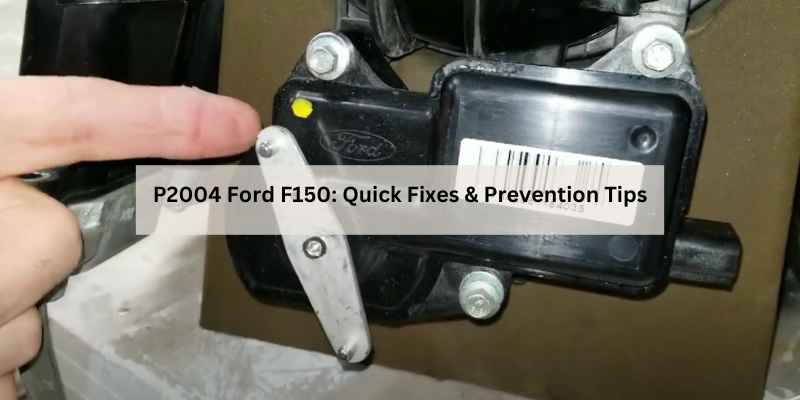
When cleaning doesn’t fix it, the actuator is usually the culprit. On the 5.4L, the vacuum actuator has a plastic housing that cracks over time. You’ll see a small tear near the mounting tab. On the 4.6L, the electric motor actuator has a known issue with the internal position sensor. The motor runs, but the sensor feedback is wrong.
Wiring issues are less common but still happen. The connector at the actuator gets corroded. The wires chafe against the manifold. Check for continuity between the PCM connector and the actuator connector. On the 5.4L, you should see battery voltage on the supply wire with the key on. On the 4.6L, the actuator has five wires: two for the motor, three for the position sensor.
3. Vacuum Leaks (5.4L Only)
The 5.4L uses engine vacuum to move the flaps. A cracked hose or a failed solenoid means no vacuum reaches the actuator. The flaps stay open, which sets P2004. This is easy to test. Apply 15 in-Hg of vacuum to the actuator with a hand pump. It should hold vacuum for at least 60 seconds. If it bleeds down, the diaphragm is torn.
Don’t forget the rubber grommet where the vacuum line passes through the firewall. It dries out and cracks. The leak is small, but the IMRC system doesn’t need much vacuum to fail.
4. Carbon Buildup in the Intake Runners
This is the least common cause, but it happens on high-mileage trucks. The flaps themselves get caked with carbon. They physically cannot move because the buildup blocks the pivot points. This is more common on the 5.4L because the PCV system routes oil vapor directly into the intake.
If you have over 150,000 miles and the linkage moves freely but the code persists, pull the intake manifold and inspect the flaps. You might need to soak them in carb cleaner for an hour. In severe cases, the flap shafts wear out and you need a new manifold. That’s the worst-case scenario, and it’s rare.
How to Diagnose P2004: A Step-by-Step Test Sequence
Follow this order. Don’t skip ahead. Each step rules out a cheaper fix before you spend money on parts.
- Scan for all codes. Write down everything, not just P2004. If you have misfire codes, address those first. A misfire can cause the PCM to disable the IMRC system and set P2004 as a secondary code.
- Check the linkage by hand. Remove the engine cover. Locate the IMRC linkage on the passenger side of the intake. Move it back and forth. It should move smoothly with minimal resistance. If it’s stiff, spray it with brake cleaner and work it until it’s free.
- Test the actuator on the 5.4L. Disconnect the vacuum hose from the actuator. Connect a hand vacuum pump. Apply 15 in-Hg and watch the linkage. It should move and hold. If it doesn’t hold, replace the actuator. If it holds but the linkage doesn’t move, the linkage is still stuck.
- Test the actuator on the 4.6L. Unplug the connector. Use a multimeter to check resistance across the motor terminals. You should see between 10 and 20 ohms. If it’s open or shorted, replace the actuator. Next, check the position sensor. It should read about 5 volts on the reference wire with the key on. The signal wire should read about 0.5 volts with the flaps closed and 4.5 volts with them open.
- Check the wiring harness. With the connector unplugged, check for continuity between the actuator connector and the PCM connector. A broken wire or a corroded pin will cause intermittent failures. Wiggle the harness while you test to find weak spots.
- Check the solenoid on the 5.4L. The IMRC solenoid is mounted near the brake booster. It has two vacuum ports and an electrical connector. Apply 12 volts to the solenoid. You should hear a click and feel air flow between the ports. If it’s silent or blocked, replace it.
This sequence takes about an hour. Most people find the problem in step 2 or 3. If you get through all six steps without finding anything, the issue is likely inside the PCM itself, which is rare but not unheard of.
How to Fix P2004: Cleaning vs. Replacing the IMRC
The decision comes down to how the linkage feels and what your test results show. Cleaning works when the actuator is healthy but the linkage is sticky. Replacement is mandatory when the actuator fails a vacuum or electrical test.
| Condition | Fix | Time | Success Rate |
|---|---|---|---|
| Linkage stiff, actuator holds vacuum / passes electrical test | Clean linkage with brake cleaner, lubricate with white lithium grease | 30 minutes | High, but may return in 6-12 months |
| 5.4L actuator fails vacuum hold test | Replace vacuum actuator (about $60-$90 part) | 1 hour | Very high |
| 4.6L actuator fails resistance or sensor test | Replace electric actuator (about $80-$120 part) | 1.5 hours | Very high |
| Linkage broken or flap shaft seized | Replace intake manifold (about $300-$500 used) | 4-6 hours | High, but expensive |
For the cleaning route, use a plastic-safe cleaner, not just any solvent. Brake cleaner works, but it can dry out the plastic over time. A better option is a throttle body cleaner that leaves a slight lubricating film. Work the linkage through its full range of motion at least twenty times. Wipe away the black residue with a lint-free cloth.
For replacement, buy a quality part. The cheap no-name actuators on online marketplaces have a high failure rate. Stick with Motorcraft or a reputable brand like Dorman. The extra $30 is worth it to avoid doing the job twice.
Clearing the Code and Relearn Procedure (Do This or It Returns)
Most people clear the code with a scanner and drive away. That’s a mistake. The PCM needs to relearn the IMRC system’s normal operating range. If you skip this, the code often returns within a few drive cycles even if the mechanical fix was perfect.
Here’s the correct procedure. First, clear the code with your OBD-II scanner. Then, start the engine and let it idle in park for exactly 5 minutes with no accessories on. The PCM runs an idle air control relearn during this time. After that, turn the engine off and wait 30 seconds. Restart it and let it idle for another 2 minutes.
Next, take the truck for a drive. Keep RPM below 2,000 for the first 2 miles. Then, find a safe stretch of road and do three full-throttle accelerations from 20 to 60 mph. Let the engine decelerate on its own between runs. This exercises the IMRC system and lets the PCM record the new operating parameters. After this drive, the code should stay cleared.
If the code returns within a week, you have a wiring issue or the actuator you installed is defective. Don’t just clear it again. Re-run the diagnostic sequence.
P2004 Repair Costs: DIY vs. Mechanic
Costs vary wildly depending on your approach. The cheapest fix is cleaning the linkage, which costs about $10 for a can of cleaner. The most expensive is a full intake manifold replacement at a dealership, which can run over $1,000.
- DIY cleaning: $10-$15 for cleaner, 30 minutes of your time
- DIY actuator replacement (5.4L): $60-$90 for the part, 1 hour
- DIY actuator replacement (4.6L): $80-$120 for the part, 1.5 hours
- Mechanic actuator replacement: $250-$400 total, including labor
- Dealership intake manifold replacement: $800-$1,200 total
Used actuators from a salvage yard cost half of a new one, but it’s a gamble. You don’t know if the used part is any better than the one you’re replacing. I’ve seen used units fail within a month. Spend the extra money on a new part.
If you’re handy, this is a perfect weekend job. The actuator is easy to reach on both engines. Just be careful with the plastic intake manifold bolts. They strip easily. Use a torque wrench and follow the spec: 89 in-lb for the manifold bolts on the 5.4L, and 71 in-lb on the 4.6L. Over-tightening cracks the manifold.
Related Codes and What They Mean Together
P2004 rarely shows up alone. It’s often accompanied by other codes that change the diagnosis. Understanding the combination tells you where to look first.
P2004 with P2006 (Stuck Closed Bank 1) or P2007 (Stuck Closed Bank 2): This combination means the flaps are not moving at all. The actuator is dead or the linkage is completely seized. Don’t bother cleaning. Go straight to actuator testing.
P2004 with P0300-P0308 (Misfire Codes): The misfire is usually the primary issue. A misfire causes the PCM to disable the IMRC system as a protective measure. Fix the misfire first. Check spark plugs, ignition coils, and fuel injectors. The P2004 will often clear itself after the misfire is resolved.
P2004 with P0171 or P0174 (Lean Codes): A vacuum leak is likely. The leak affects both the fuel trim and the IMRC vacuum supply on the 5.4L. Check the IMRC vacuum hoses and the intake manifold gaskets. A smoke test will find the leak quickly.
Frequently Asked Questions
Can I drive my truck with a P2004 code?
Yes, but not indefinitely. The truck will run with reduced low-end power and worse fuel economy. More importantly, the stuck flaps disrupt the air/fuel mixture, which can foul spark plugs and overheat the catalytic converter. If you need to drive a few days until the part arrives, that’s fine. Don’t drive for months.
Will P2004 cause my truck to fail emissions testing?
Yes. The check engine light being on is an automatic failure in most states. The code itself indicates a problem with the emissions control system. You need to fix it and clear the code before you can pass.
How much does a mechanic charge to diagnose P2004?
Expect to pay between $80 and $150 for a diagnostic fee. Most shops will apply that fee toward the repair if you have them do the work. The diagnosis is straightforward, so you can save this money by doing the steps above yourself.
Is the IMRC actuator the same part for the 5.4L and 4.6L?
No. The 5.4L uses a vacuum-actuated unit, while the 4.6L uses an electric motor unit. They are not interchangeable. The intake manifolds are different, and the mounting points don’t line up. Always confirm your engine size before ordering a part.
Why does my P2004 code keep coming back after I clear it?
Either the mechanical fix wasn’t complete, the wiring has an intermittent short, or you skipped the relearn procedure. The most common mistake is replacing the actuator but not cleaning the linkage. The new actuator moves the linkage, but the old sticky linkage puts too much strain on it, causing premature failure.
The Bottom Line: Is P2004 Serious?
P2004 is a moderate severity code. It won’t leave you stranded on the side of the road, but it will make your truck less enjoyable to drive and cost you money at the pump. The fix is usually straightforward and affordable if you catch it early.
The key is to follow the diagnostic sequence in order. Clean the linkage first. Test the actuator second. Replace parts only after you’ve confirmed they’re faulty. And always finish with the idle relearn procedure. That last step is what keeps the code from coming back.
If you’ve got a 2026 F150 with the 5.4L, you might also want to check the firing order if you’re doing a full tune-up at the same time. And if the truck is showing other electrical gremlins, the fuse box diagram can help you trace power issues quickly.
Here’s what to remember:
- P2004 means the intake manifold runner control is stuck open on bank 1
- The 5.4L uses vacuum; the 4.6L uses an electric motor
- Sticky linkage is the most common cause, and cleaning it fixes most cases
- Test the actuator with a vacuum pump or multimeter before buying a replacement
- Always perform the idle relearn procedure after clearing the code
- Expect to spend $10 for a DIY cleaning or up to $400 for a shop repair
- Address misfire codes first; they often cause P2004 as a secondary code
Products related to this article
Sponsored / affiliate links. As an Amazon Associate I earn from qualifying purchases. I may earn additional commission from eligible campaigns.