Best Fuel Pump for Car (3 Picks Compared)
The best fuel pump is the one that matches your car’s fuel pressure, pump type, and module fitment; for most buyers, that means choosing the OEM-spec assembly or pump-only insert your system was built for. Buy the wrong unit and you can get hard starts, lean running, misfires, or a part that simply will not fit. This guide compares three fuel pump options and shows how to match symptoms, pressure, and fitment before you buy.
Best fuel pumps compared


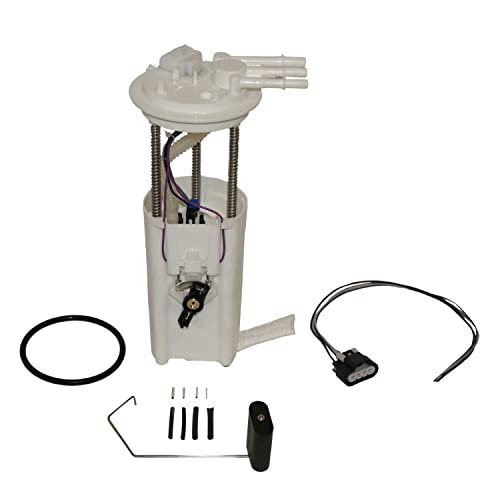
The main trade-off is fitment versus flexibility. Delphi and Bosch are better choices when you need a direct replacement for a specific in-tank application, while Airtex suits buyers who want a lower-cost module and can still verify the exact vehicle match. Carter sits in the pump-only lane for applications that do not need a full module.
| Brand | Best fit | Included parts | Fitment note | Warranty or testing claim |
|---|---|---|---|---|
| Delphi fuel pump module assembly | OE-grade in-tank replacement | Pump, sender, strainer | Vehicle-specific fitment; exact replacement for many in-tank systems | Engineered to Delphi’s original equipment standards; lower amperage draw |
| Bosch original equipment fuel pump module assembly | Original equipment fitment | Pump module, fuel strainer | Application-specific compatibility | Patented turbine pump technology; end-of-line function tested |
| Airtex fuel pump module assembly | Value-priced module replacement | Module assembly with triple barb hose fitting | Vehicle match still matters; check exact application | Reportedly tested throughout manufacturing; limited warranty |
Where Carter electric pumps fit
Carter is the better fit when you need an electric pump rather than a complete module. It uses OEM-quality construction, a patented Clean Screen strainer, and that strainer increases dirt-holding capacity by up to 40%. It is used in passenger cars, fleets, and RVs where a pump-only replacement is the correct repair.
Which fuel pump type fits your car?
The right pump type depends on how your fuel system is built, not on the highest rating in a catalog. A mechanical pump suits older engine-driven systems, an electric pump suits most modern cars, an inline pump mounts outside the tank, and a submersible pump lives inside the tank. If your vehicle came with a module, replace it with a module.
Mechanical vs electric fuel pumps
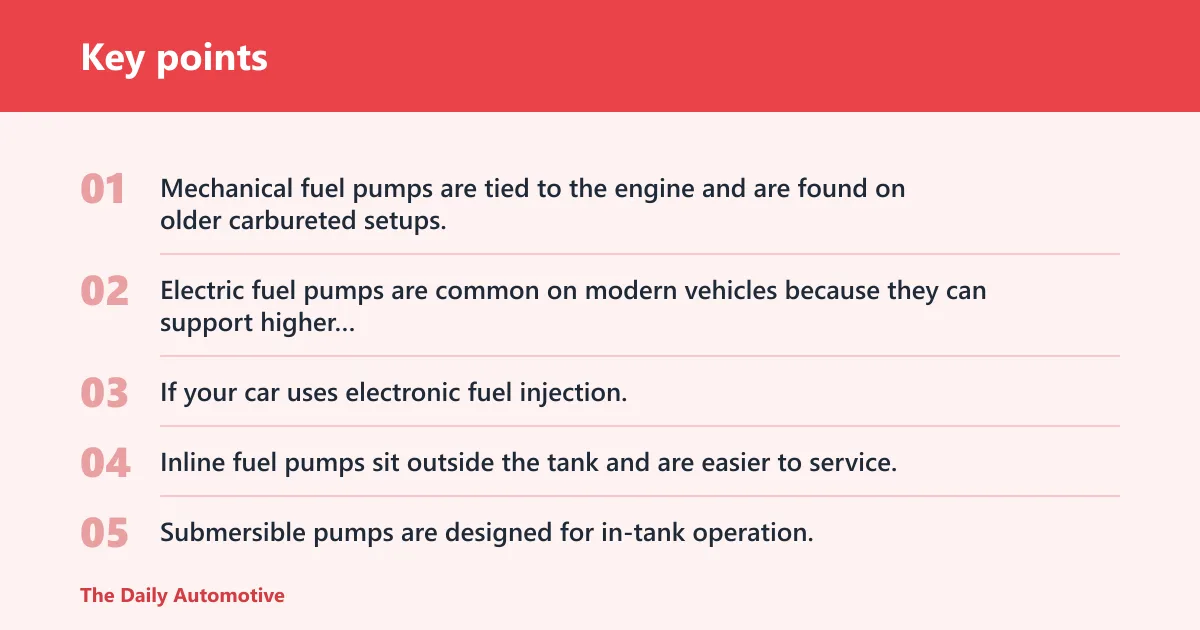
Mechanical fuel pumps are tied to the engine and are found on older carbureted setups. Electric fuel pumps are common on modern vehicles because they can support higher pressure and more consistent delivery. If your car uses electronic fuel injection, an electric pump is usually the starting point, but the exact spec still has to match the vehicle.
Inline vs submersible pumps
Inline fuel pumps sit outside the tank and are easier to service, but they are only correct for vehicles designed that way. Submersible pumps are designed for in-tank operation, where fuel cools the pump and reduces noise. Swapping one for the other without checking the system layout is a common mistake.
When a module assembly is the right replacement
A fuel pump module assembly is the correct choice when the pump, sender unit, strainer, and mounting hardware are designed as one unit. Returnless systems and many late-model cars use this layout. If the sender is also failing, or the tank opening and electrical connector are vehicle-specific, a complete assembly usually saves rework.
Fuel pressure and flow explained
Pressure is not optional. Carbureted engines typically need 2-6 PSI, while fuel-injected vehicles often need 30-60 PSI, depending on the system. The replacement has to match the vehicle specification, not just a generic pressure range from the box.
Carbureted engines and 2-6 PSI targets
For carbureted engines, too much pressure can flood the carburetor and create hard starts or rich running. A pump in the 2-6 PSI range is common guidance, but the carburetor and regulator still matter. A higher-pressure electric pump is usually a bad fit unless a regulator is part of the system design.
EFI pressure requirements and vehicle specifications
Fuel-injected systems need much higher pressure and tighter control. Many EFI systems depend on the correct pump pressure, the right regulator strategy, and the correct return-style or returnless layout. A pump that moves fuel but misses the pressure target can still cause lean codes, misfires, or weak acceleration.
Why flow, amperage draw, and hot-start behavior matter
Flow keeps up with demand at load. Amperage draw affects wiring load and can reveal a pump that is working too hard. Hot-start behavior matters because a weak pump can lose pressure after shutdown and make the engine crank longer when hot. Noise can also point to a strained pump or a tank issue.
What should you replace: pump or module?
Choose the smallest part that fixes the vehicle correctly. If the pump is the only failed piece and the housing, sender, and strainer are sound, a pump-only replacement may be enough. If fitment is vehicle-specific, the sender is inaccurate, or the tank hardware is integrated, a full module is the safer choice.
Pump only versus complete fuel pump module assembly
A pump-only repair can save money up front, but it does not reset a worn sender or a clogged strainer. A module assembly bundles the pump, sender, strainer, and mounting hardware into one installation. That matters on vehicles where the tank access, connector shape, or lock ring pattern is unique.
Return-style and returnless system fitment
Return-style systems send excess fuel back to the tank, while returnless systems control pressure differently and often rely on a matched module. Mixing these up can create pressure complaints that look like pump failure. Check the system layout before buying, especially if the vehicle has been modified.
Fuel pump symptom table
Not every fuel complaint is a bad pump. Relay failure, a blown fuse, wiring loss, a clogged filter, a dirty strainer, or tank contamination can look the same from the driver’s seat. This table maps the symptom to the most likely culprit and the next check.
| Symptom | Likely cause | Confirmatory test | Recommended pump class | Common wrong purchase |
|---|---|---|---|---|
| No start, no pump prime | Relay, fuse, or wiring fault | Check fuse and relay; verify power at connector | Only after electrical supply is confirmed | Buying a pump before checking the circuit |
| Long crank after sitting | Pressure bleed-down or leaking check valve | Fuel pressure test after shutdown | Matched in-tank module or pump | A universal pump with the wrong pressure rating |
| Hesitation under load | Weak pump or clogged filter | Pressure test while driving load; inspect filter | OEM-spec pump with correct flow | Buying by flow claim alone |
| Stall when hot | Pump overheating, wiring loss, or tank contamination | Hot fuel pressure test and connector voltage check | Correct in-tank or submersible pump | External inline pump for an in-tank application |
| Lean code or misfire at highway speed | Insufficient pressure or restricted strainer | Measure running pressure and inspect strainer | Vehicle-specific module with correct pressure | Low-pressure carbureted pump on EFI vehicle |
| Loud whine from tank area | Pump strain, low fuel level, or mounting issue | Check current draw and fuel level; inspect mounting | In-tank module with correct fitment | Universal pump without exact-fit hardware |
| Fuel smell but poor delivery | Leak, cracked hose, or bad strainer seal | Inspect hoses, fittings, and top seal | Module with proper gasket and hardware | Skipping the seal kit or line hardware |
| Intermittent cutout over bumps | Pickup issue, loose connection, or contaminated tank | Shake-test wiring and inspect tank debris | Exact-fit assembly with sender and strainer | Ignoring tank contamination and buying only the pump |
Choose delphi or Bosch if…
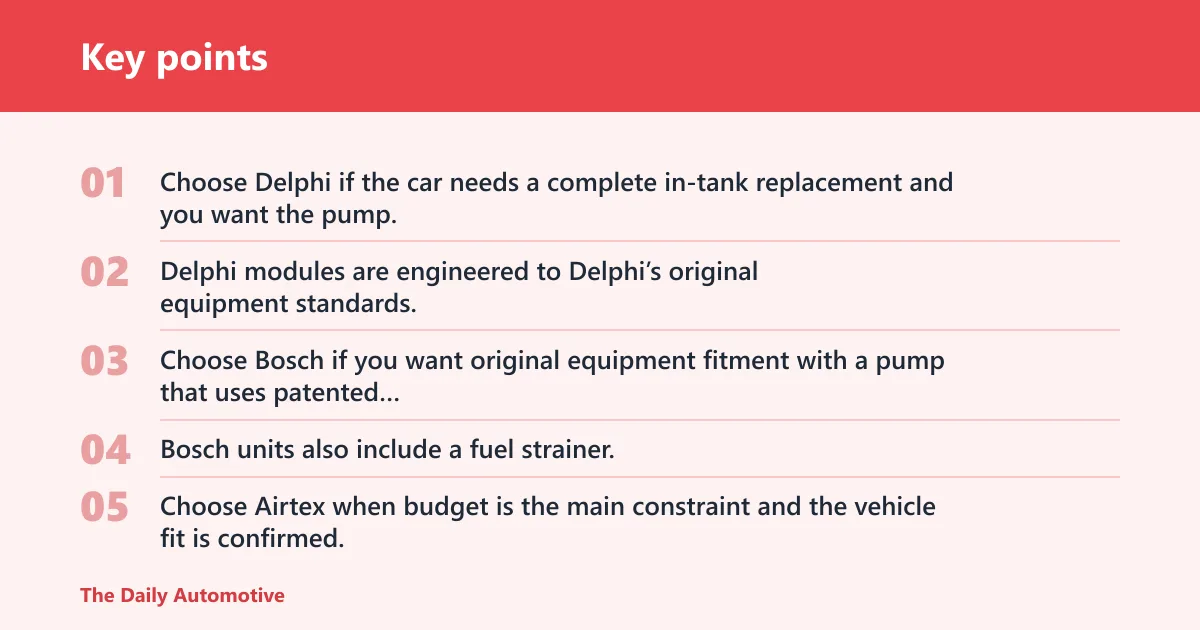
Delphi and Bosch are the stronger choices when your goal is a direct replacement for a vehicle-specific fuel system. Delphi is the better pick for OE-grade in-tank replacement, lower amperage draw, and a complete assembly that includes the pump, sender, and strainer. Bosch fits well when original equipment fitment, turbine pump design, and tested compatibility matter most.
Choose Delphi if you need an OE-grade in-tank assembly
Choose Delphi if the car needs a complete in-tank replacement and you want the pump, sender, and strainer in one assembly. Delphi modules are engineered to Delphi’s original equipment standards, and the vehicle-specific fitment reduces guesswork on late-model applications.
Choose Bosch if compatibility and tested fit matter most
Choose Bosch if you want original equipment fitment with a pump that uses patented turbine pump technology and is end-of-line function tested before shipping. Bosch units also include a fuel strainer, which helps when the old strainer is due for replacement too.
Choose Airtex when price matters more than extras
Choose Airtex when budget is the main constraint and the vehicle fit is confirmed. Airtex module assemblies are tested throughout the manufacturing process, use a triple barb hose fitting, and carry a lifetime limited warranty. That makes them a value option, not a universal fix.
Say your compact sedan cranks for 8 seconds after a hot restart, but pressure holds at the rail only briefly after shutdown. The likely path is a weak check valve, a leaking module, or a restriction, not an automatic need for a higher-rated pump. Start with the pressure test, not the catalog filter.
Suppose a full-size SUV with returnless EFI loses power on a long grade, but the fuse and relay test good. If pressure drops under load and the tank module is original, the best replacement is usually a vehicle-specific module assembly, not a generic inline pump that cannot match the system layout.
Installation and total replacement cost
The box price is only part of the bill. A proper replacement can also require a new strainer, gasket, relay, and line hardware, plus labor for tank access. If the wrong part is ordered, the cost climbs fast because the tank may need to come down twice.
What the box should include
For a module replacement, expect the pump, sender unit, strainer, and mounting hardware when the listing is complete. Delphi modules combine the pump, sender, and strainer into one assembly. Bosch adds a fuel strainer. Airtex includes a triple barb hose fitting. Carter’s pump-only design centers on the Clean Screen strainer.
Labor and hardware that change the final bill
Labor can be the biggest expense on in-tank work. Add the gasket, any damaged line hardware, and a relay if the electrical side is suspect. If the tank is contaminated, cleaning time adds more cost. That is why a correct diagnosis matters before the first part is ordered.
Why fitment mistakes raise cost fast
An exact-fit assembly is often cheaper than a return trip. A pump that misses the pressure spec or does not match the sender connector can leave the vehicle apart while the wrong part is exchanged. Matching vehicle-specific fitment on the front end is the easiest way to avoid repeat labor.
Frequently asked questions
What is the best fuel pump for my car?
The best fuel pump is the one that matches your car’s pressure spec, mounting style, and electrical layout. If the vehicle uses an in-tank module, start with an OE-spec module assembly. If it uses a pump-only setup, match the pump class and pressure exactly, not just the brand name.
Are premium fuel pumps good?
Premium fuel pumps are good when the premium price buys correct fitment, tested construction, and the right included parts. They are not automatically better if the vehicle only needs a simple pump or if the problem is a relay, fuse, or clogged filter. Fitment still decides the value.
Fuel pump vs high pressure fuel pump: what’s the difference?
A standard fuel pump moves fuel from the tank to the engine at the pressure your system requires. A high pressure fuel pump is used on some direct-injection systems to raise fuel pressure further for the injection side. They are not interchangeable, and the wrong one will not solve the problem.
Mechanical fuel pump vs electric fuel pump: which should I choose?
Choose a mechanical fuel pump only for an engine designed for it, usually an older carbureted setup. Choose an electric fuel pump for most modern cars, especially EFI vehicles. Then confirm whether the system needs an inline or in-tank design, plus the correct pressure range.
How much fuel pump do I need for my engine?
Size the pump to the engine’s maximum fuel demand and the system’s pressure spec. A common rule of thumb is 125% of maximum fuel consumption, but that still has to fit the vehicle’s return-style or returnless layout. More pump is not better if pressure control is wrong.
How do I test the fuel pump before replacing it?
Begin with a fuel pressure test, then check the relay, fuse, and wiring before condemning the pump. Inspect the strainer or filter next, because restriction can mimic pump failure. If pressure falls under load or bleeds off quickly after shutdown, the pump or module moves higher on the list.
Products related to this article
Sponsored / affiliate links. As an Amazon Associate I earn from qualifying purchases. I may earn additional commission from eligible campaigns.