Best Car Fuel Pumps for Performance: Top Picks
A common rule of thumb is for a performance fuel pump to flow about 20% to 30% above your engine’s real fuel demand at operating voltage and fuel type; for many mild street builds, a 255 lph pump may be adequate, while higher-boost E85 or big-power cars often need about 340 lph or more, or dual pumps. Buy wrong, and you risk lean-out, misfire, and expensive engine damage. This guide covers sizing by horsepower, voltage drop, ethanol compatibility, and which pumps are worth buying.
Top pick and why it fits most builds
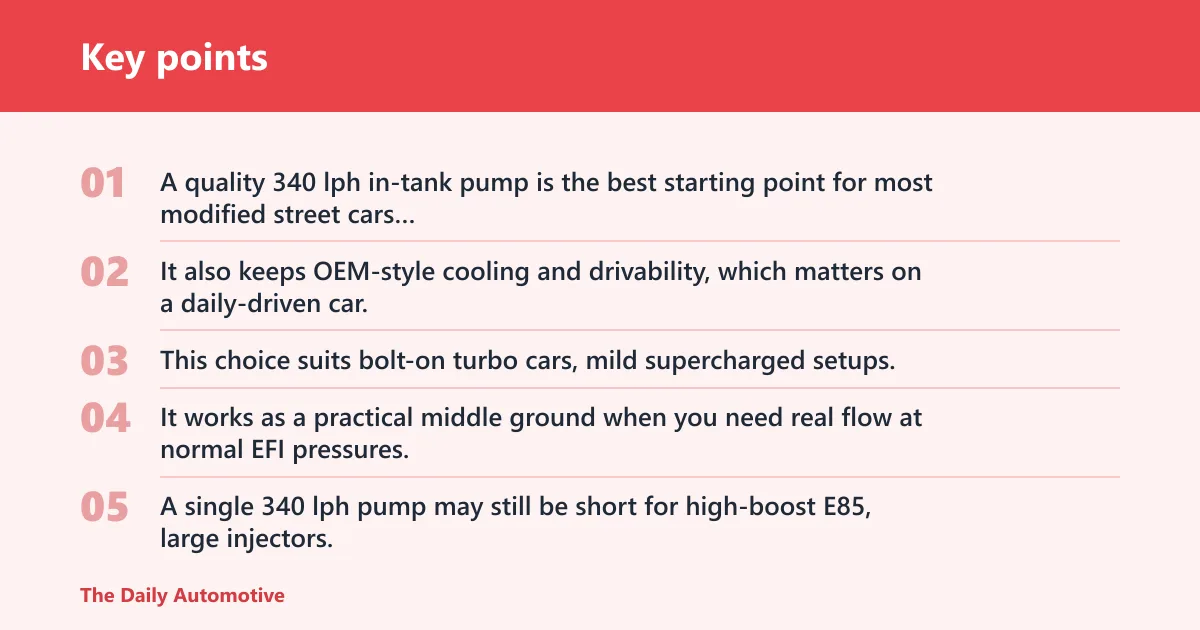

A quality 340 lph in-tank pump is the best starting point for most modified street cars because it gives more headroom than a 255 lph unit without the noise, heat, and packaging problems that often come with external pumps. It also keeps OEM-style cooling and drivability, which matters on a daily-driven car.
Who this pick suits
This choice suits bolt-on turbo cars, mild supercharged setups, and naturally aspirated builds that may move to a modest ethanol blend later. It works as a practical middle ground when you need real flow at normal EFI pressures, not a catalog number measured at free flow.
Where it falls short
A single 340 lph pump may still be short for high-boost E85, large injectors, or track cars that spend long periods at sustained load. Once pressure rises, pump flow drops, so the same pump that looks generous at a base pressure around 43.5 psi can fall behind at roughly 58 to 70 psi under boost.
Quick picks by build
- Bolt-on NA: 255 lph in-tank pump, stock-like noise, stock-style return setup if equipped, usually enough with gasoline and factory pressure.
- Turbo street car: 340 lph in-tank pump, upgraded wiring, boost-referenced regulator on return-style systems, good balance of flow and drivability.
- E85 setup: 340 lph minimum in many street builds, ethanol-safe seals and hose, often 400 lph class or dual pumps for higher output.
- Track car: dual in-tank pumps or a brushless system, relay-fed wiring, larger line size, and a regulator sized for stable pressure at sustained load.
Bolt-on NA
For a naturally aspirated street car with intake, header, and tune changes, a quality 255 lph pump is often enough if pressure stays near factory levels. The key is not the label on the box; it is whether the pump can hold the needed pressure at the voltage the car actually supplies.
Turbo street car
A turbo street car usually needs more than a stock replacement once boost rises. A 340 lph in-tank pump, a healthy relay circuit, and a boost-referenced regulator on return-style systems are the usual baseline.
E85 setup
E85 needs more fuel volume than pump gas for the same power, so the pump choice has to reflect that. Ethanol-safe materials, seal compatibility, and current draw matter here, because a pump that survives gasoline duty can fall short on ethanol volume and electrical load.
Track car
A track car has the hardest job: sustained load, heat soak, and long WOT pulls. Dual pumps or a brushless setup often make more sense than pushing a single pump near its limit, because margin matters more than peak catalog flow.
Which fuel pump do you need?
Choose the pump from the fuel system’s real demand, not from horsepower labels alone. Start with target power, then check base pressure, boost-referenced pressure rise, fuel type, and voltage at the pump; flow falls as pressure rises, and low voltage makes that drop worse.
Match flow to horsepower at real pressure
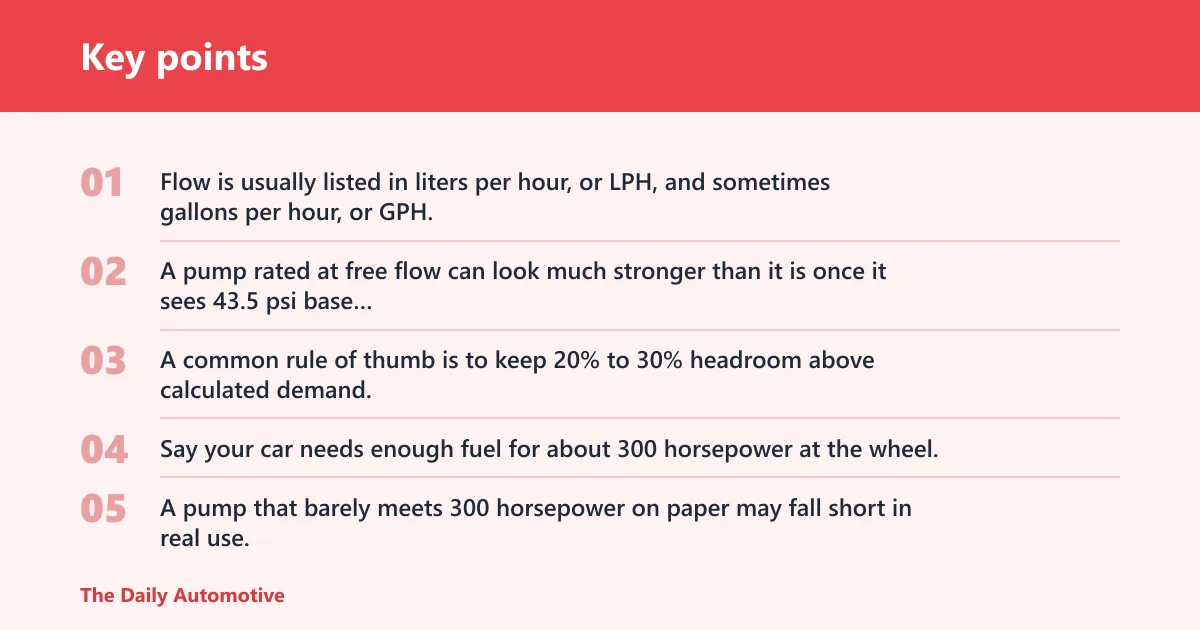
Flow is usually listed in liters per hour, or LPH, and sometimes gallons per hour, or GPH. A pump rated at free flow can look much stronger than it is once it sees 43.5 psi base pressure, then even less as boost pushes rail pressure higher. A common rule of thumb is to keep 20% to 30% headroom above calculated demand.
Say your car needs enough fuel for about 300 horsepower at the wheel, but it runs on E85 and sees 58 psi under boost. A pump that barely meets 300 horsepower on paper may fall short in real use, because ethanol demand and pressure both reduce effective output.
Check base pressure and boost rise
Many EFI systems use a base pressure around 43.5 psi, or 3 bar, though some OEM setups differ. On a boost-referenced regulator, fuel pressure should rise about one pound per square inch for every pound of boost so injector pressure differential stays stable. That is the part many spec sheets skip.
Example: a pump listed at 450 lph free flow may drop sharply at 70 psi rail pressure. If the engine needs that pressure under boost, the pump’s working flow can be far lower than the label suggests.
Factor in voltage and wiring losses
Fuel pumps are voltage-sensitive. Long wire runs, tired grounds, weak relays, and undersized connectors can create voltage drop that lowers pump speed and output. A 13.8-volt reading at the battery may be noticeably lower at the pump once the engine bay and chassis wiring are loaded.
That is why relay-fed power, proper fuse sizing, and heavier-gauge wire matter. A strong pump with poor wiring can act like a weak one.
Best fuel pump comparison table
| Build type | Target horsepower | Fuel type | Base pressure | Wiring upgrade | Regulator type | Pump style |
|---|---|---|---|---|---|---|
| Bolt-on NA | 200 to 325 hp | Pump gas | 43.5 psi / 3 bar | Relay check, stock wiring may suffice if healthy | Stock or return-style if equipped | In-tank 255 lph |
| Turbo street car | 350 to 550 hp | Pump gas or ethanol blend | 43.5 psi / 3 bar | 12 to 10 gauge feed, relay, fuse, good ground | Boost-referenced return regulator | In-tank 340 lph or inline |
| E85 setup | 400 to 650 hp | E85 | 43.5 psi / 3 bar | Heavier-gauge power, low-voltage-loss circuit | Boost-referenced return regulator | 340 to 450 lph, dual if needed |
| Track car | 600 hp and up | Pump gas, E85, or race fuel | Varies by setup | Dedicated relay, fuse, larger feed, monitored voltage | Return regulator or brushless controller system | Dual pumps or brushless |
In-tank vs inline fuel pump
In-tank pumps are usually the better default for street performance because they fit OEM-style modules, stay submerged for cooling, and are quieter. Inline pumps live outside the tank, which can make them easier to service, but they add noise, heat exposure, and mounting demands.
OEM-style module fitment
An in-tank pump works best when you want stock-like drivability and less cabin noise. Many late-model cars also expect a module-style assembly, so replacing just the pump may still require matching the basket, sender, hanger, and connector style.
Cooling, noise, and heat
Submerged pumps run cooler because fuel cools the motor and helps prevent cavitation. Inline pumps are easier to reach, but they can run hotter and are more audible, especially when mounted near the cabin or a hot exhaust path.
Return-style compatibility
Inline pumps often pair well with return-style systems, where fuel is regulated and sent back to the tank. That layout makes pressure control easier, but it also means the regulator, line routing, and pump placement need to be correct for steady pressure under load.
Start with fuel type, then check pressure requirement, line size, electrical capacity, and fitment. The best pump on paper will underperform if the vehicle cannot supply enough voltage, if the connector does not match, or if the pump is wrong for the fuel being used.
Fuel type compatibility
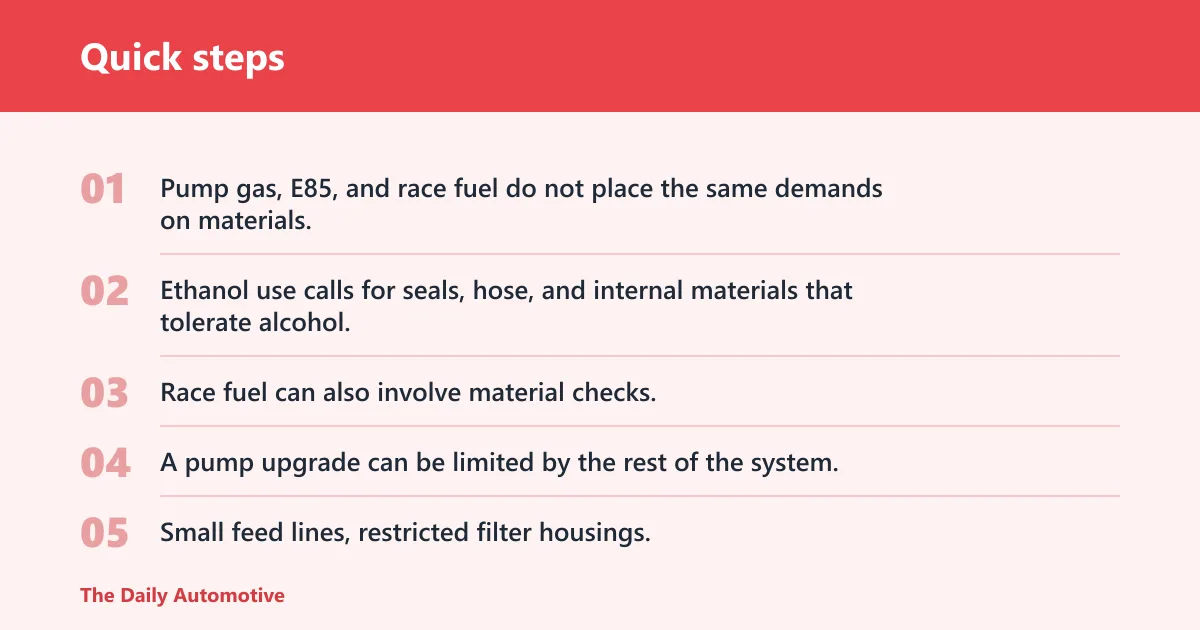
Pump gas, E85, and race fuel do not place the same demands on materials. Ethanol use calls for seals, hose, and internal materials that tolerate alcohol. Race fuel can also involve material checks, especially if the fuel has different solvent properties than pump gas.
Line size and connector checks
A pump upgrade can be limited by the rest of the system. Small feed lines, restricted filter housings, or mismatched connectors can choke performance. Before buying, verify line diameter, connector style, hanger fitment, and whether the module accepts a direct pump swap or a full assembly.
Relay and fuse sizing
High-flow pumps can draw significant current, especially at higher pressure or on ethanol. That is why a relay, proper fuse value, and solid ground are part of the purchase decision. Undersized wiring increases voltage drop and can create lean conditions at the worst time.
When dual or brushless makes sense
Single pumps cover a lot of street builds, but dual-pump or brushless systems start to make sense when one pump would need to run near its ceiling all the time. That is common with high-boost E85, sustained track use, or power goals well beyond a single pump’s efficient range.
Picture a 540 hp turbo car on E85 with 58 psi under boost and an aging 16-gauge feed. A single pump might still idle fine, then pressure falls on a long third-gear pull. That is not a tuning mystery; it is a sizing and voltage problem.
Do you need a fuel pressure regulator?
Yes, if the system is return-style or if the existing regulator cannot hold stable pressure under changing load. A proper regulator keeps idle pressure consistent and raises rail pressure with boost, which preserves injector differential pressure and predictable fueling.
Return-style systems
Return-style systems benefit from a quality boost-referenced regulator because excess fuel is sent back to the tank rather than being trapped at the rail. That setup gives more stable control when the pump flow changes with pressure or voltage.
Boost-referenced behavior
The regulator should rise one psi of fuel pressure for each psi of boost if the system is set up that way. If it does not, the injectors may see less pressure differential than expected, and airflow increases faster than fueling.
Stable idle and WOT pressure control
At idle, the regulator prevents pressure from wandering too high. At wide-open throttle, it keeps pressure from sagging. If the pump is oversized, the regulator becomes even more important because excess flow has to be managed cleanly.
Fuel pump sizing checklist
Use this before you buy. It prevents the most common mistake: choosing a pump by brand reputation instead of by the car’s actual fuel demand and electrical limits.
- Confirm target horsepower and fuel type.
- Identify base pressure in psi or bar.
- Note expected boost so you know final rail pressure.
- Check pump flow at that pressure, not free flow.
- Verify whether the car needs in-tank, inline, dual, or brushless support.
- Inspect line diameter, connector style, and module fitment.
- Plan relay, fuse, and wire-gauge upgrades to limit voltage drop.
- Confirm seal and material compatibility for pump gas, E85, or race fuel.
- Schedule tuning after installation so fuel and injector scaling match the new supply.
A common first-timer mistake is buying a big pump for a stock returnless car, then keeping the factory wiring and pressure control. The result can be heat, noise, or unstable pressure, not more usable fuel.
What fuel pump is best for a performance car?
The best fuel pump is the one that meets your engine’s flow demand at the pressure, voltage, and fuel type it will actually see.
How do I know what fuel pump flow rate I need?
Start with horsepower, then adjust for fuel type and pressure. Flow ratings in LPH or GPH must be read at the operating pressure, not free flow. If your setup needs 43.5 psi base pressure plus boost, choose a pump with 20% to 30% headroom beyond that real requirement.
Will a high-flow fuel pump work with my stock injectors?
Sometimes, yes, but only if pressure control and tuning remain correct. Stock injectors can still be the limit, and an oversized pump can raise return flow and heat if the regulator or module is not matched. Fuel supply and injector capacity need to work as a pair.
What size fuel pump do I need for E85 or boost?
E85 generally needs more pump than gasoline for the same power, and boost raises fuel pressure so flow falls further.
How much horsepower can a Walbro 450 support?
A Walbro 450 is commonly used in high-output street builds and can support a wide range depending on voltage, pressure, fuel type, and injector size. At higher rail pressure or on E85, its usable headroom drops, so the real answer depends on the system, not the model name alone.
What are the signs that my fuel pump is failing?
Common signs include hard starts, hesitation under load, lean running, pressure drop on acceleration, and occasional misfire at high demand. Noise changes, especially a louder whine from an in-tank pump, can also point to wear, cavitation, or a pump that is running hot or starved for voltage.
Can I upgrade just the pump without replacing the whole module?
Sometimes you can, but only if the hanger, basket, sender, connector, and sock are compatible with the higher-flow pump. If the module design is restrictive or the car uses a returnless control strategy, a full module or complete assembly may be the cleaner and safer option.
Products related to this article
Sponsored / affiliate links. As an Amazon Associate I earn from qualifying purchases. I may earn additional commission from eligible campaigns.