We Tested Fuel Injector Cleaner for Car: Top 3 Picks
The best fuel injector cleaner depends on the job: use a high-PEA cleaner for heavy deposits, a maintenance-dose bottle for routine upkeep, and the right fuel-system label for GDI or diesel use. Wrong choices can waste money, leave rough idle or hesitation unresolved, and create compatibility problems. This guide ranks three cleaners by heavy deposits, everyday maintenance, and mixed fuel-system use.
Top fuel injector cleaner picks


| Pick | Best for | Active chemistry | Fuel fit | Typical interval | Skip it when |
|---|---|---|---|---|---|
| BG 44K Fuel System Cleaner | Heavy deposits and symptom cleanup | PEA-based | Gasoline | Use when deposits are suspected, not on a fixed short cycle | You have water in the fuel, a bad injector coil, or severe clogging that needs service |
| Chevron Techron Concentrate Plus | Routine maintenance for gasoline engines | PEA-based | Gasoline only | Every 3,000 to 5,000 miles | You need diesel compatibility or a fix for mechanical injector failure |
| Sea Foam SF-16 Motor Treatment | Mixed fuel-system compatibility and general upkeep | Petroleum-based, not PEA | Gasoline and diesel; also 2-stroke and 4-stroke use cases | Routine maintenance use | You want the strongest deposit-removal chemistry for stubborn injector carbon |
Quick picks:
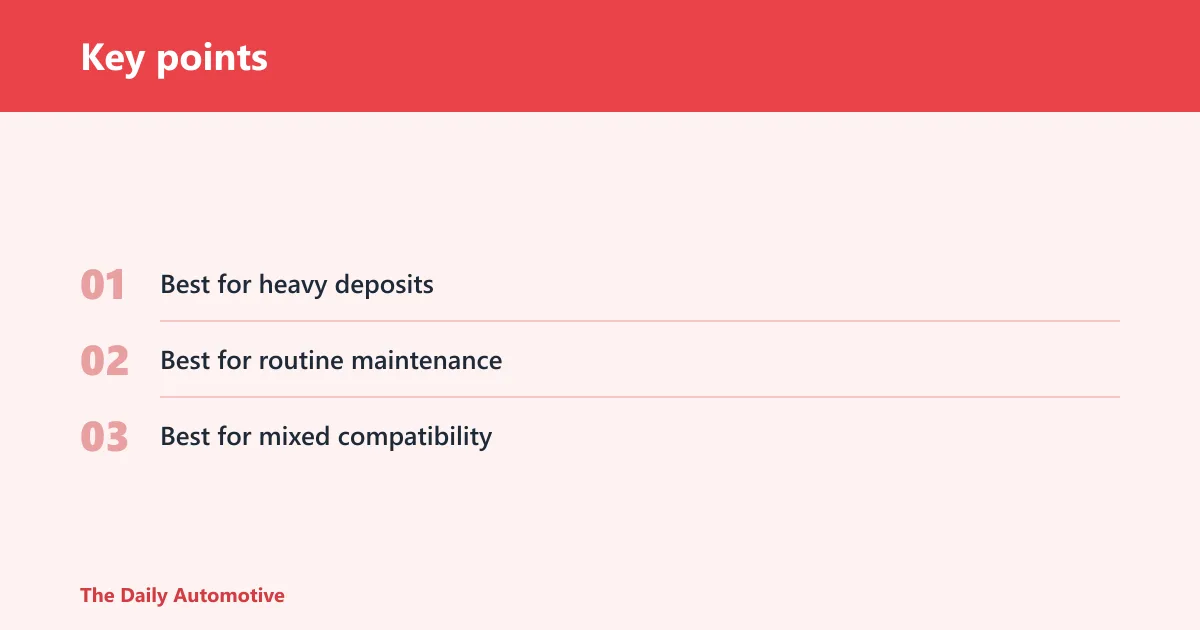
- Best for heavy deposits: BG 44K Fuel System Cleaner.
- Best for routine maintenance: Chevron Techron Concentrate Plus.
- Best for mixed compatibility: Sea Foam SF-16 Motor Treatment.
Fuel injector cleaner decision matrix
If your car has rough idle, hesitation, or a small fuel-economy drop, the right cleaner depends on symptom severity and fuel system type. PEA-based cleaners are the strongest option in this group for deposit removal. Non-PEA products still make sense when you need wider fuel-system compatibility instead of maximum cleaning power.
| Product | Symptom severity | Engine type | Fuel type compatibility | Active chemistry | Treat interval | When to skip the product |
|---|---|---|---|---|---|---|
| BG 44K Fuel System Cleaner | Best fit for rough idle, hesitation, and stronger deposit buildup | Gasoline engines, including harder-cleaning direct-injection cases | Gasoline | PEA-based; positioned as professional-grade; sold through dealer networks | Use when deposits are suspected, not as a fixed short-interval maintenance product | Skip if the issue looks mechanical, fuel is contaminated with water, or the injectors are severely clogged |
| Chevron Techron Concentrate Plus | Best fit for mild-to-moderate maintenance use | Gasoline engines | Gasoline only; full-tank treatment for 12 to 20 gallons | PEA-based | Every 3,000 to 5,000 miles | Skip for diesel vehicles and for fault conditions a cleaner cannot repair |
| Sea Foam SF-16 Motor Treatment | Best fit for routine upkeep where mixed compatibility matters more than maximum cleaning strength | Gasoline and diesel; 2-stroke and 4-stroke engines | Gasoline and diesel | Petroleum-based, not PEA | Routine maintenance use | Skip when the goal is the strongest injector deposit removal, especially on a GDI engine with buildup |
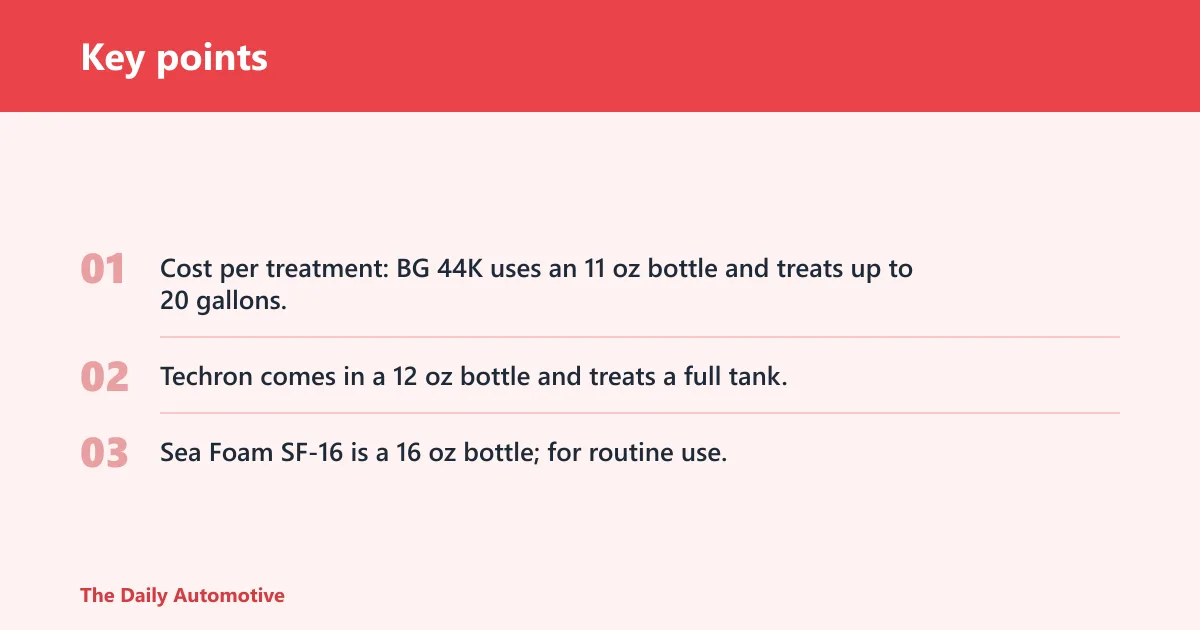
Cost per treatment: BG 44K uses an 11 oz bottle and treats up to 20 gallons, so one bottle covers one full treatment. Techron comes in a 12 oz bottle and treats a full tank, so one bottle is one maintenance service. Sea Foam SF-16 is a 16 oz bottle; for routine use, plan on one bottle per service unless the vehicle label calls for a different dose.
Do fuel injector cleaners actually work?
Yes, fuel injector cleaners can work when the problem is deposit buildup rather than a failed part. PEA-based cleaners are the strongest option here because they are built to remove deposits from injectors, intake valves, and combustion chambers. They will not fix bad wiring, a stuck injector, dirty fuel with water in it, or a severe clog that needs repair.
What PEA cleaners can remove
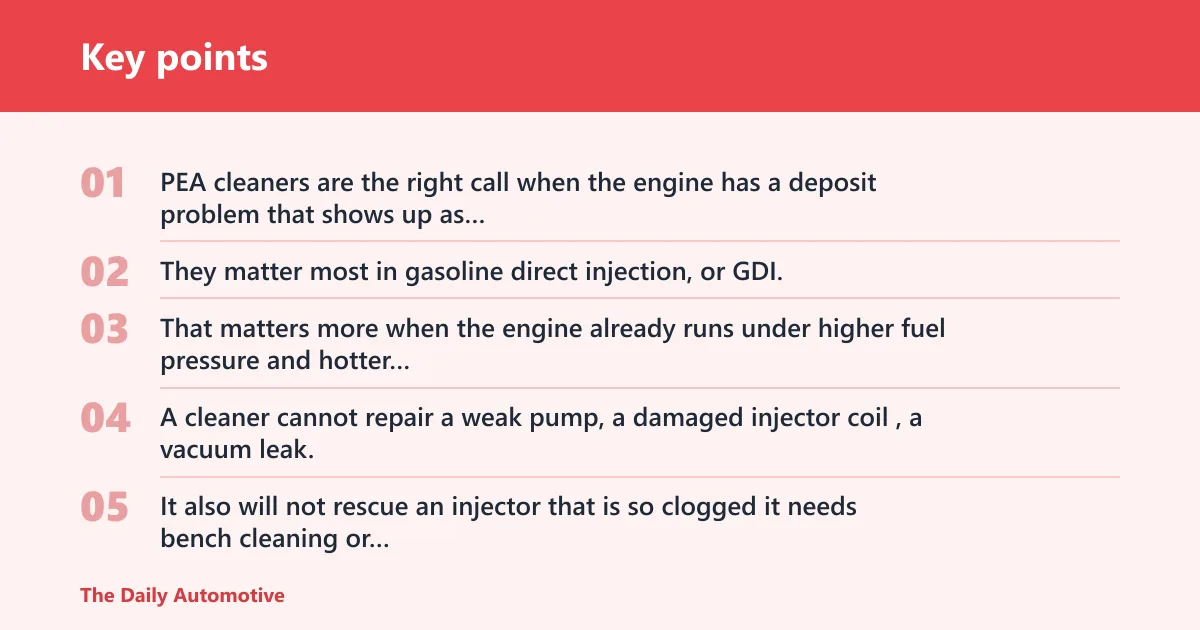
PEA cleaners are the right call when the engine has a deposit problem that shows up as rough idle, light hesitation, or a lazy throttle response. They matter most in gasoline direct injection, or GDI, because modern gasoline direct injection is more prone to carbon buildup than port injection. That matters more when the engine already runs under higher fuel pressure and hotter deposit conditions.
What a bottle cannot fix
A cleaner cannot repair a weak pump, a damaged injector coil, a vacuum leak, or fuel that has been contaminated with water. It also will not rescue an injector that is so clogged it needs bench cleaning or replacement. If the symptom changes with weather, load, or temperature in a way that points to a mechanical fault, start with diagnosis instead of another bottle.
Why GDI engines are the harder case
GDI systems run at much higher pressure than older port-injected setups. VehicleBar cites 2,000 to 2,900 PSI for GDI engines, which is one reason deposits are a more stubborn issue there. Tank additives can still help injectors, but they do not clean intake-valve buildup as directly as a service aimed at the intake side.
Say your sedan starts to idle unevenly after 8,000 miles on the same tank detergent routine. A PEA cleaner can be worth trying before a shop visit. Suppose the same car has a flashing check-engine light and a dead cylinder code. That is no longer an additive problem.
BG 44K for heavy deposits
BG 44K Fuel System Cleaner is the most appropriate pick in this group when the priority is heavier deposit cleanup. It is commonly described as a PEA-based, professional-grade cleaner that is often sold through dealer networks. The 11 oz bottle treats up to 20 gallons, which makes it a straightforward one-bottle treatment for a full tank.
Why the PEA chemistry matters here
PEA is the chemistry most associated with stronger deposit removal in fuel-system cleaners. That matters most on cars that have slipped past routine upkeep and now show rough idle or hesitation. It is also the right kind of cleaner to reach for when a driver wants one product aimed at a more stubborn deposit problem, not just a maintenance dose.
When not to use it
Skip BG 44K if the engine problem points to bad fuel, water contamination, or an injector fault that needs repair. It is also the wrong answer if you need diesel use, because its place in this ranking is heavy gasoline deposit cleanup. If the car is already misfiring hard, diagnose first.
Cost per treatment: 11 oz bottle, up to 20 gallons, so one bottle equals one full-tank treatment.
Chevron Techron for routine maintenance
Chevron Techron Concentrate Plus is the routine-maintenance pick for gasoline engines. It is PEA-based, comes in 12 oz and 20 oz bottle variants, and is recommended every 3,000 to 5,000 miles. For drivers who already buy quality gasoline and want a maintenance cleaner rather than a hard-reset product, this is the cleanest fit.
Everyday use for gasoline engines
Techron fits the driver who wants a regular maintenance interval instead of a one-time cleanup gamble. It is generally used for gasoline engines only, so it should not be selected for diesel use. That narrower compatibility is the tradeoff for a bottle aimed squarely at gasoline-system cleaning.
Bottle size and interval
The 12 oz bottle is commonly said to treat about 12 to 20 gallons in a full tank. Chevron also sells a 20 oz variant for larger tanks or different dose needs. For ordinary maintenance, the 3,000- to 5,000-mile interval is the clearest buying signal in this group.
Cost per treatment: 12 oz bottle, full tank of 12 to 20 gallons, so one bottle covers one service interval on a normal gasoline fill-up.
Sea Foam for mixed compatibility
Sea Foam SF-16 Motor Treatment is the compatibility pick. It is a 16 oz cleaner that is not PEA-based, and it works in gasoline and diesel, including 2-stroke and 4-stroke engines. That broader fit makes it useful when the owner cares more about fuel-system compatibility than maximum detergent strength.
Why it fits maintenance better than heavy cleanup
Because it is petroleum-based and not PEA, Sea Foam is not the top answer for hard carbon cleanup. It makes more sense as a routine maintenance choice, or as a product for mixed-fleet use where one bottle needs to cover gasoline and diesel equipment. It is the practical answer when compatibility is the main question.
Where it can make sense
A common first-timer mistake is to buy the strongest-sounding bottle for a car that actually needs a flexible maintenance treatment. Sea Foam can be the better fit for a household that has both gasoline and diesel equipment, or for a driver who wants one additive that works across more than one engine type. It is the wrong pick when deposit removal is the only goal.
Cost per treatment: 16 oz bottle, routine maintenance use, so one bottle is a service bottle rather than a heavy-cleanup bottle.
How should you choose?
Choose by symptom severity first, then by engine type and fuel. If the car has rough idle, hesitation, or a fuel-economy drop and the symptoms are mild to moderate, a PEA cleaner is the right starting point. If the car is GDI, PEA matters even more. If the vehicle is diesel or mixed-fleet, Sea Foam wins on compatibility, not on raw cleaning strength.
- Match the symptom to the cleaner. Light maintenance calls for Techron. Heavier deposit cleanup points to BG 44K.
- Check fuel compatibility. Techron is gasoline-only. Sea Foam covers gasoline and diesel. BG 44K belongs in gasoline cleanup use.
- Use the interval that fits the job. Techron fits a 3,000- to 5,000-mile cycle. BG 44K is more of a problem-solver than a fixed schedule bottle.
- Rule out failure cases. Water in the fuel, a bad injector, or a severe clog needs diagnosis, not another additive.
- Do not overbuy chemistry. If you already run top-tier detergent gasoline and have no symptoms, a maintenance bottle may be enough.
Picture a high-mileage commuter with a GDI engine, a slight stumble at idle, and no warning lights. That is a PEA use case, not a diesel-compatible one. Suppose a pickup on mixed fuel-system duty needs one additive for gasoline and diesel equipment. Sea Foam fits the compatibility box even though it is not the strongest cleaner in the group.
Frequently asked questions
What is the best fuel injector cleaner for my car?
The best fuel injector cleaner depends on the symptom and the fuel system. BG 44K is the top pick for heavier deposits, Chevron Techron is the routine-maintenance choice for gasoline engines, and Sea Foam fits mixed gasoline and diesel compatibility needs. If the problem is mechanical, none of them will fix it.
Which fuel injector cleaner is best for GDI engines?
For GDI engines, a PEA-based cleaner is the right place to start, and BG 44K is the heavy-cleanup pick here. GDI systems run at much higher pressure and are more prone to carbon buildup than port injection, so a maintenance bottle is not always enough when symptoms are already present.
How often should I use fuel injector cleaner?
For routine maintenance, Chevron Techron is the clearest interval-based option here at every 3,000 to 5,000 miles. Heavy-cleanup bottles like BG 44K are better used when symptoms show up, not on a fixed short schedule. If the car already runs clean on good fuel, less frequent use may be enough.
Is PEA better than Sea Foam for injectors?
Yes, if the main goal is deposit removal. PEA is the cleaner chemistry associated with stronger injector, valve, and combustion-chamber cleaning. Sea Foam makes more sense when mixed fuel compatibility matters, including gasoline, diesel, 2-stroke, and 4-stroke use cases. It is the broader-use product, not the stronger cleaner.
Are fuel injector cleaners safe for catalytic converters?
When used as directed, these cleaners are generally intended to be safe for catalytic converters and oxygen sensors. The larger risk comes from the wrong product for the engine or from a mechanical fault that a cleaner cannot solve. If the vehicle is already misfiring heavily, diagnose first rather than relying on an additive.
Products related to this article
Sponsored / affiliate links. As an Amazon Associate I earn from qualifying purchases. I may earn additional commission from eligible campaigns.