Best AC Condenser Fans for Hot-Weather Driving: We Compared
Best AC condenser fans for hot-weather driving are the ones that move the most air at idle and fit the condenser and shroud correctly; if idle AC is weak, verify the fan before replacing the compressor. Ignoring a weak condenser fan means higher cabin temps, rising underhood heat, and wasted money on parts that won’t fix traffic-light heat soak. This guide shows how to tell fan trouble from blend-door, refrigerant, or wiring faults and how to choose the right fan.
Best for most hot-weather idle cooling is the SPAL 12″ puller fan, because its listing gives 1226 CFM and a sealed Weather Pack connector, which makes it the strongest all-around match here when you have room for a 12-inch puller setup. If your vehicle needs an exact OEM-style replacement instead, the Mobile Climate Control pusher assembly is the safer fit for the listed MCC applications.
Quick comparison
| Product | Badge | Best for | Price | ||
|---|---|---|---|---|---|
 |
8 Inch Reversible Radiator Cool Fan, Upgraded Push & Pullcaqeg | Our pick | 8-inch · 12V 80W · reversible slim fan | $39.98
Price as of 29 Oct 2026
|
View |
 |
SPAL 30101529 12" 12V High-Performance Puller Fan – 1226Spal | Upgrade pick | 12-inch · 1226 CFM · puller fan | $136.20
Price as of 29 Oct 2026
|
View |
 |
12V Pusher Condenser Fan Motor Assembly – Mobile ClimateMobile Climate Control | Also great | 11-inch · pusher · 12V motor assembly | $129.94
Price as of 29 Oct 2026
|
View |
 |
Flex-A-Lite Trimline Reversible Electric Fan, Pusher-PullerFlex-a-lite | Also great | 16-inch · 2215 CFM · reversible fan | $124.99
Price as of 29 Oct 2026
|
View |
 |
Mishimoto MMFAN-6 Slim Electric Radiator Fan, 6 in, 12Mishimoto | Pair with it | 6-inch · 415 CFM · slim fan | $64.95
Price as of 29 Oct 2026
|
View |
Two things matter first: the fan has to move condenser air at idle, and it has to fit the vehicle without forcing the wrong rotation, plug, or thickness. Use the comparison to sort exact-fit replacements from universal fans before you buy.
How we chose
We compared the listings for fitment detail, airflow claims, connector style, mounting approach, and whether each fan is a direct replacement or a universal install. We also weighed the manufacturer details against the buyer-feedback themes that usually matter in hot-climate use: idle cooling, noise, and wiring complexity.
SPAL 12-inch puller fan: best for high-airflow universal replacement
This is the best pick if you want a strong universal fan for a hot climate and you have room for a 12-inch puller layout. The listing gives 1226 CFM, curved blades, and a sealed Weather Pack connector, so it is aimed at airflow and installation flexibility rather than exact OEM match.
The main drawback is fitment effort. Universal models require measuring, wiring, and custom mounting, and you still need to confirm rotation, depth, and plug match before buying.
If your weak AC shows up at traffic lights or in slow crawl, this is the kind of fan that can help when the condenser needs more air at idle. It still will not fix low refrigerant, a clogged condenser, damaged wiring, a failed relay, or a tired compressor.
Mobile Climate Control pusher assembly: best for exact OEM-style fit
Choose this if your vehicle matches the listed Mobile Climate Control CM-2 or CM-3 applications and you want a direct OEM-spec replacement. The listing identifies a 12V pusher motor assembly with an 11-inch blade, which makes it the most exact-fit choice in this group for the specified fleet HVAC use.
Its advantage is fit confidence. Direct bolt-on replacements usually save time, and a matched assembly cuts guesswork about blade depth, mount points, and airflow direction.
The drawback is obvious: it is not a broad passenger-car universal part. If your vehicle is not in the compatibility list, do not treat it as a substitute.
Caqeg 8-inch reversible fan: best for tight spaces
This is the pick for cramped bays where a slim universal fan and flexible push-pull setup matter more than top-end airflow claims. The listing calls it an 8-inch, 12V, 80W reversible slim fan, so it fits the “small auxiliary cooling” end of the market rather than a full-size condenser replacement.
Its strength is packaging. A slim reversible design can be useful when shroud clearance is limited or when a larger fan would sit too close to nearby parts.
The drawback is that an 8-inch fan may not be enough for a primary condenser-cooling job on a heavy or heat-soaked vehicle. Measure first, and verify the airflow path across the condenser before you rely on it.
Flex-a-lite Trimline 16-inch fan: best for large universal coverage
This is the right choice when you need a large reversible fan and have the space to fit a 16-inch unit. The listing gives 2215 CFM and a pusher-puller design, which makes it the biggest airflow option in this group on paper.
Its main advantage is coverage. A larger fan can move more air across a bigger condenser area, which matters when idle cooling drops in traffic or parking-lot heat soak.
The drawback is fitment risk. A 16-inch fan needs more room, more careful mounting, and more attention to shroud clearance than a smaller unit.
Mishimoto 6-inch slim fan: best for auxiliary cooling
This is the compact option for tight spaces where you need a small auxiliary fan rather than a main condenser fan. The listing gives a 6-inch size, 12 volts, and 415 CFM, so it is aimed at small-volume cooling support rather than broad condenser coverage.
Its strength is size. A compact fan can fit where larger universal units will not, and that matters when thickness and nearby hardware are the limiting factors.
The drawback is that 6 inches is small for many condenser applications. If your weak AC shows up only at idle in summer traffic, confirm that a fan this size can actually cover the condenser area that needs airflow.
Is your weak idle AC really the condenser fan?
When AC cools at speed but goes warm at traffic lights, parking lots, or slow crawl, the condenser fan moves to the top of the list. That pattern points to lost airflow at idle, not automatically to a compressor or blend-door fault, but the fan still has to be verified before you buy.
Idle-only warm air versus highway cooling
If the air turns warm mainly when road speed drops, the condenser loses natural airflow and depends more on the fan. A matched fan keeps air moving across the condenser when road speed falls, so weak idle cooling often shows up first in summer congestion.
If cooling is poor at speed too, the fan is less likely to be the only problem. A new fan will not fix low refrigerant, a clogged condenser, damaged wiring, a failed relay, or a tired compressor.
Traffic, parking lots, and slow crawl symptoms
F1 matters here: weak AC often shows up at traffic lights, parking lots, or slow crawl through summer congestion. That is the classic condenser-airflow complaint. It is also where a bad radiator fan can confuse the picture, because both fans may run near the same part of the front end.
A common first-timer mistake is replacing the first fan that looks weak without checking which fan actually serves the condenser. Trace the airflow path, not just the noise.
When airflow is the issue, and when it is not
Say your AC blows cold on the highway but turns lukewarm at a long red light. That pattern fits a condenser-airflow problem much better than a compressor that fails all the time.
Suppose the fan is spinning but the AC still fades in traffic. Then look at rotation, voltage supply, relay health, and connector condition before you blame the fan motor alone.
Fitment and diagnosis matrix
This matrix helps you separate fan failure from the wider AC system before you order parts. It focuses on symptom pattern, likely fan-related cause, and the one or two checks that matter most before buying.
| Symptom pattern | Likely fan-related cause | What to verify before buying |
|---|---|---|
| Idle-only warm air | Condenser airflow drops when road speed falls | Confirm the fan reaches the condenser at idle and matches airflow direction |
| Fast-speed cooling that fails in traffic | Fan or control issue shows up when natural airflow disappears | Check make/model/year fit, plug design, and whether the fan is the condenser unit |
| Noisy fan startup | Motor wear, blade contact, or mounting stress | Verify thickness, shroud clearance, and bracket fit before ordering |
| Repeated blown fuses | Startup current is too high for the circuit or the motor is failing | Check startup current, relay condition, grounds, and fuse rating in the manual |
| Fan that spins backward | Wrong rotation or reversed wiring | Confirm rotation direction and connector pinout before installation |
Checklist before you buy
- Connector type: match the plug design to the vehicle or adapter you have.
- Thickness: a fan that is slightly too thick can interfere with nearby components.
- Shroud clearance: confirm the blade depth and surrounding space.
- Mounting points: compare bracket locations and hole spacing with the old unit.
- Voltage: confirm the fan is the correct system voltage for the vehicle.
Direct-fit replacement: best for OEM-style fit
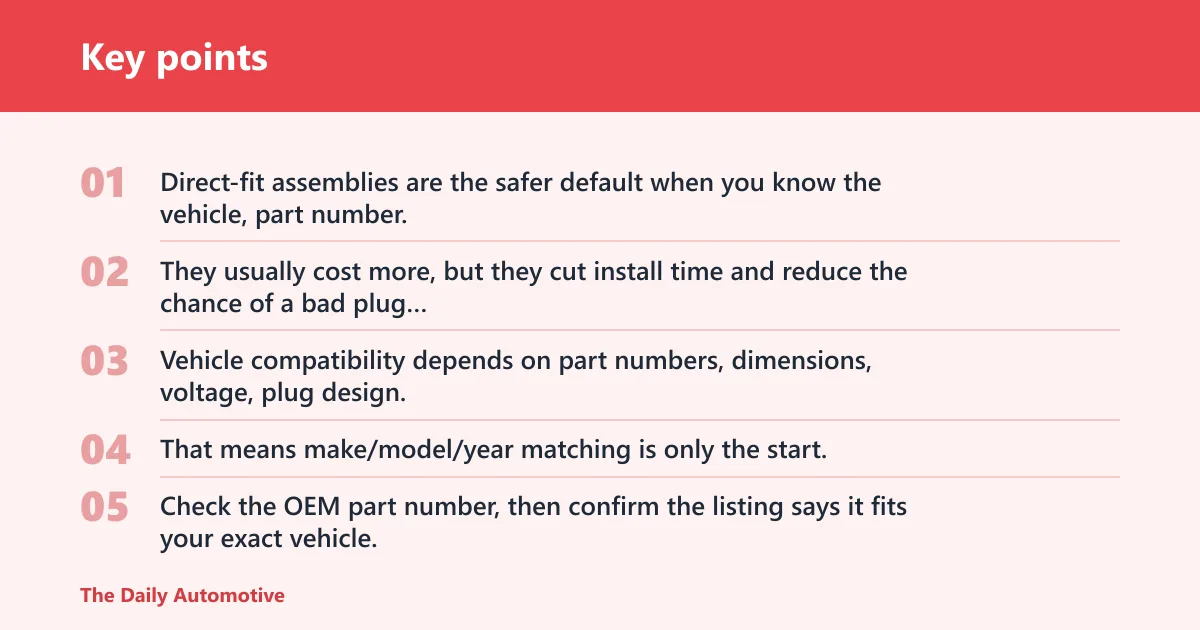
Direct-fit assemblies are the safer default when you know the vehicle, part number, and mounting layout. They usually cost more, but they cut install time and reduce the chance of a bad plug match, wrong depth, or poor shroud fit.
Make/model/year matching and OEM part numbers
Vehicle compatibility depends on part numbers, dimensions, voltage, plug design, and airflow direction. That means make/model/year matching is only the start. Check the OEM part number, then confirm the listing says it fits your exact vehicle, not just a broad family.
The Mobile Climate Control assembly is the only listed part here that is clearly framed as a direct OEM-spec replacement for named applications. If your vehicle is not one of those applications, do not force the match.
Bracket inclusion, shroud fit, and receiver drier clearance
A direct bolt-on fan is only “direct” if the brackets and clearance work in the vehicle. Check whether the listing includes brackets or assumes reuse of the old hardware, then confirm there is room around the shroud and nearby components.
If the fan sits near the receiver drier or other condenser hardware, a few millimeters can matter. A fan that is slightly too thick can interfere with nearby components.
Why direct bolt-on is the safer default when space is known
If the factory layout is known and the vehicle is listed, direct-fit usually removes guesswork. It is a better choice when you want the closest match to the original mounting, plug style, and airflow path.
It is also the better choice for drivers who do not want custom wiring or custom brackets. In that case, the higher price often buys less frustration.
Universal slim fan: best for tight packaging
Universal slim fans make sense when the bay is tight and the factory part is unavailable or too bulky. They can work well, but only if you confirm size, rotation, wiring, and the mounting method before you order.
12-inch and 14-inch size checks
The listed universal options here include a 12-inch SPAL fan and smaller slim fans such as the 8-inch and 6-inch units. The correct size depends on the condenser area, surrounding space, and how much of the core the fan can actually cover.
If a fan does not cover the part of the condenser that needs airflow, airflow efficiency drops fast. Check the condenser face, not just the available gap in front of it.
Push/pull orientation and blade direction
A fan in the wrong rotation can move air in the opposite direction. That matters because condenser fans must push or pull air the right way across the core, not just spin freely.
Before you buy, confirm whether the installation needs push or pull operation, then check the blade depth and orientation in the listing. Do not assume reversible means any direction will work without setup.
Custom mounting, wire fitment, and CFM claims
Universal models require measuring, wiring, and custom mounting. That is where the job gets harder, because the physical fit and the electrical fit both have to work.
CFM claims can help, but they are not enough on their own. If the plug style, mount points, or thickness do not fit, the number on the box will not help in the vehicle.
What makes a condenser fan noisy or unreliable?
Noise usually points to blade contact, bearing wear, bad mounting, or a motor that is struggling under heat. Cheap motors may whine, vibrate, or develop bearing noise after repeated heat cycles, so build quality and fit matter as much as airflow claims.
Motor direction, blade depth, and shroud contact
Wrong rotation, wrong depth, or a poor shroud match can create noise fast. A blade that sits too close to nearby hardware can rub or disturb airflow, and that adds vibration.
Check the fan’s depth against the available space before buying. If the unit is slightly too thick, it can interfere with nearby components.
Startup current, relay stress, and fuse sizing
The fan circuit must handle startup current without overheating wires, blowing fuses, or damaging a relay. That is why a replacement fan that draws more than the circuit can handle may create a new problem right away.
Do not guess here. Check the vehicle manual for the relay and fuse requirements, and match the replacement to the circuit’s limits.
Corroded connectors, weak grounds, and slow spin
The guide recommends inspecting corroded connectors and weak grounds before installation. A fan can look fine on the bench and still run slowly in the vehicle if voltage is lost through bad contacts or a weak ground path.
If the new fan is slow, do not assume the motor is bad. Check the circuit first, then inspect the connector pins and ground point for heat damage or corrosion.
Which one should you buy?
Pick the fan that matches the vehicle first, then the one that fits the space and electrical circuit without compromise. If you want the safest OEM-style choice, use the Mobile Climate Control assembly for the listed CM-2 and CM-3 applications. If you need the strongest universal airflow and have the room, the SPAL 12-inch puller is the top universal option here.
Choose direct-fit when mounting, plug design, and clearance must match the factory layout. Choose universal only when you can verify rotation, thickness, connector style, voltage, and mounting points before you order.
For a tight bay, the caqeg 8-inch reversible fan or Mishimoto 6-inch slim fan can make sense as auxiliary options. For larger universal cooling coverage, the Flex-a-Lite 16-inch fan offers the biggest listed footprint here, but it also demands the most room.
Frequently asked questions
What is the best condenser fan for a car in hot weather?
The best choice is the fan that matches your vehicle and moves enough air across the condenser at idle. For the listings here, the SPAL 12-inch puller is the strongest universal airflow option, while the Mobile Climate Control assembly is the best exact-fit choice for its listed applications.
How do I know if my AC condenser fan is failing?
A failing condenser fan often shows up as weak AC at traffic lights, parking lots, or slow crawl, then improves as road speed rises. Noise on startup, slow spin, blown fuses, or airflow in the wrong direction are also strong clues that the fan or its circuit needs attention.
Will a new condenser fan fix weak AC at idle?
Only if the old fan was the real problem. A new fan will not fix low refrigerant, a clogged condenser, damaged wiring, a failed relay, or a tired compressor, so verify the fan, the circuit, and the airflow path before you buy.
What should I check before buying a replacement condenser fan?
Check the part number, dimensions, voltage, plug design, airflow direction, thickness, mounting points, and shroud clearance. Also confirm whether you need a direct-fit assembly or a universal slim fan, because the wrong choice can create fit or wiring problems.
Are universal condenser fans worth it or should I buy direct-fit?
Universal fans are worth it when space is tight and you can measure carefully, wire it correctly, and mount it solidly. Direct-fit is the better default when you want less installation work and a more certain match to the factory layout.
Can poor wiring or relays make a new condenser fan run slowly?
Yes. The fan circuit must handle startup current, and bad grounds, corroded connectors, weak relays, or damaged wiring can all reduce speed. If a new fan runs slowly, check the circuit before assuming the motor itself is weak.
Products related to this article
Sponsored / affiliate links. As an Amazon Associate I earn from qualifying purchases. I may earn additional commission from eligible campaigns.