Off-Road Tires for Cars: Tread and Sizing Basics
Pick an off-road tire for a car only if its load index meets or exceeds the OEM tire, its overall diameter stays within about 3% of stock, and the tread is mild enough for daily pavement use. Get that wrong and you can lose ride comfort, speedometer accuracy, braking grip, and sometimes wheel-arch clearance. This guide explains tread types, size markings, and the fitment checks that matter before you buy.
Off-road tire basics


Off-road tires are built for cars, trucks, or SUVs leaving the trail, but they still need strong grip on wet and dry roads. They also need puncture resistance and load-rating consideration. That mix makes fitment matter as much as tread choice.
What makes the tread different
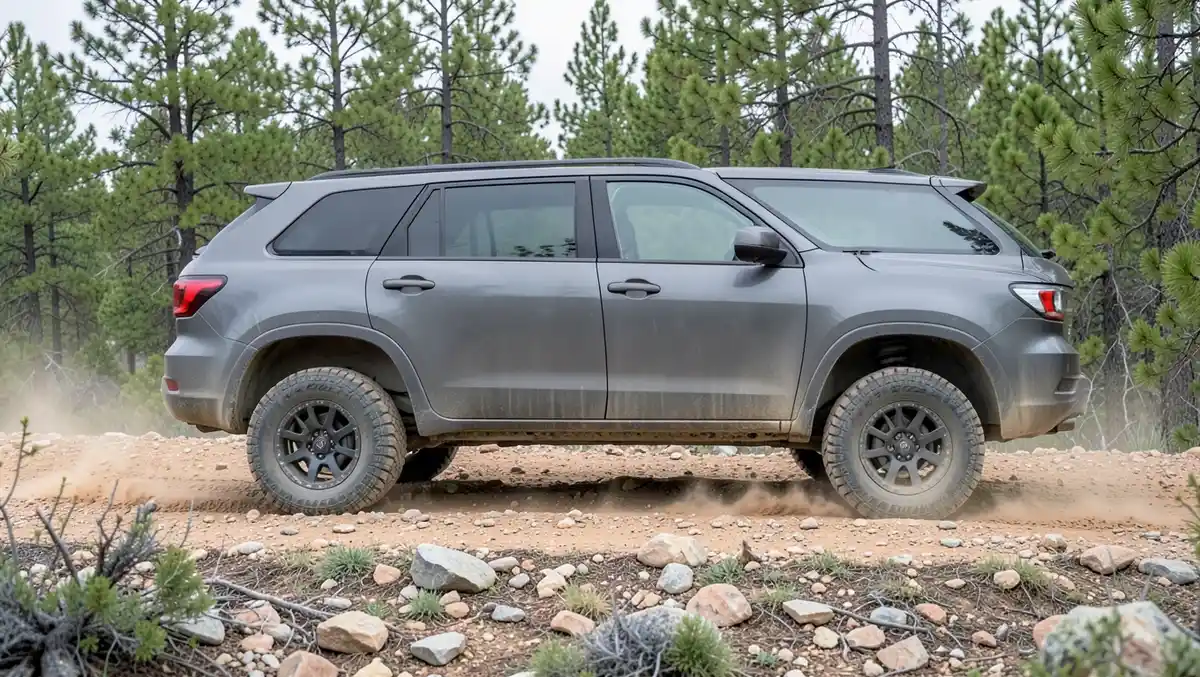
The main visual cue is the tread pattern. Off-road tires use broader grooves between tread blocks and specially shaped tread blocks that can bite into loose surfaces. Those same features reduce the road contact patch compared with summer tires, so you gain loose-surface traction at the cost of some pavement grip.
That tradeoff is the core sizing problem. A more aggressive tread can help in dirt, sand, mud, or snow, but it also changes how the tire sits on the road and how much room it needs inside the wheel well.
Where these tires fit best
These tires can handle rocks, boulders, sand, dirt, snow, and mud. For a car or crossover that spends most of its time on pavement, a mild all-terrain pattern usually makes more sense than a mud-terrain-style tread. The more aggressive the tread, the more noise, wear, and fitment compromises you should expect.
Street use versus mixed use
On a daily route that is mostly urban or suburban, off-road tires can work, but they are rarely the best street-performance choice. Summer tires remain the street benchmark for grip and road feel. Off-road tires are a multi-surface compromise, and the buyer should treat them that way.
Tread patterns and contact patch
More aggressive tread means more void area, more block movement, and less rubber touching the road at once. Compared with summer tires, that reduced contact patch area is why off-road tires usually feel less planted on pavement and sound louder. They can also reduce fuel efficiency.
Grip tradeoffs on pavement
The same tread that helps in loose ground can make the tire less precise on dry tarmac. The blocks flex more, especially during cornering and braking, so the road contact is less continuous. On wet roads, that matters even more because the tire still has to clear water while keeping stable contact.
A common first-timer mistake is choosing an aggressive tread because it looks capable, then expecting summer-tire response on the commute. Suppose a crossover moves from a 225/50R18 street tire to a much blockier all-terrain tire in the same size. The new tire may fit the wheel, yet still feel noisier and less sharp on highway ramps.
Noise and rolling resistance
Broader grooves and taller tread blocks create more pattern noise as the tire rotates. The block edges also increase rolling resistance, which helps explain the fuel-economy hit. On urban or suburban roads, off-road tires provide less grip and more noise than summer tires, and that penalty grows as the tread gets more aggressive.
How do I read off-road tire sizes and sidewall markings?
Read the full size string as three fitment clues in one line: width, aspect ratio, and wheel diameter. Then confirm the load index and speed rating. If you skip any of those pieces, you may buy a tire that bolts on but fails the vehicle’s load needs, clearance limits, or legal speed requirement.
Width, aspect ratio, and wheel diameter
In a size such as 225/55R17, 225 is the tire width in millimeters, 55 is the aspect ratio, and 17 is the wheel diameter in inches. The width affects inner and outer clearance. The aspect ratio affects sidewall height. The wheel diameter should match the wheel exactly.
The full string matters because one number changes the others. A wider tire may need more suspension or fender clearance. A taller sidewall can increase the overall diameter, which can alter speedometer accuracy and raise rubbing risk.
Load index and speed rating
The load index tells you how much weight the tire is rated to carry, and the speed rating tells you the maximum speed category. For off-road tires, load rating is not optional paperwork. It must be considered along with grip and puncture resistance.
A replacement tire generally should not have a lower load index than the OEM tire unless the vehicle maker explicitly allows it. The sidewall may look tougher, but toughness does not replace the correct load rating.
What size off-road tire fits my car or SUV?
Start with the door-jamb placard and the OEM size, then compare the replacement to the wheel width and the space around the tire. A fit that looks fine on paper can still rub at full steering lock, under compression, or with a more aggressive tread. Keep overall diameter close to stock and confirm the load index first.
OEM size and placard first
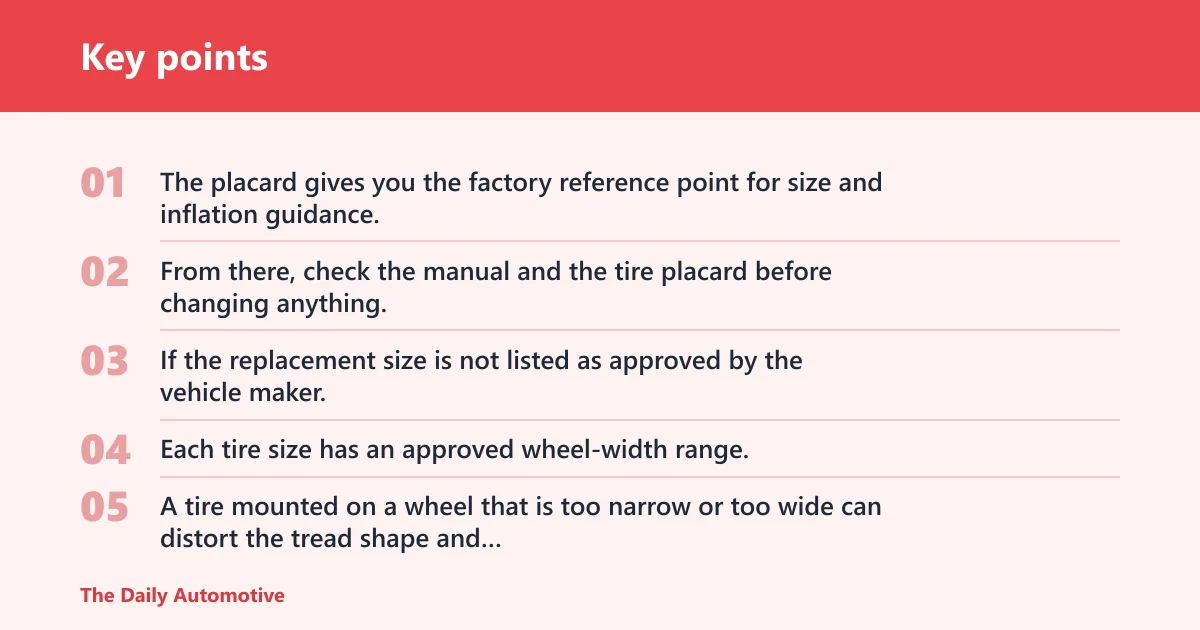
The placard gives you the factory reference point for size and inflation guidance. From there, check the manual and the tire placard before changing anything. If the replacement size is not listed as approved by the vehicle maker, treat it as a modification that needs careful verification.
Approved replacement width range
Each tire size has an approved wheel-width range, and the wheel you already own may narrow your choices. A tire mounted on a wheel that is too narrow or too wide can distort the tread shape and worsen road manners. That matters more with aggressive tread patterns because the blocks already move more on pavement.
Clearance, speedometer error, and rubbing risk
Keeping the overall diameter within about 3% of stock is a common rule of thumb to help limit speedometer error and maintain predictable clearance. Bigger diameter raises the chance of rubbing at the liner, strut, or fender lip. Wider section width can do the same even if diameter stays close.
Picture a hatchback that runs 205/55R16 from the factory and wants a more aggressive 215/60R16 all-terrain tire. The new tire is taller and slightly wider, so it may clear static measurements yet rub on full lock or over a driveway ramp. That is why diameter and width both matter.
Off-road tire sizing checklist

Use this as a buy-or-pass sheet before you order. If one line fails, fix that problem before moving on. The table assumes the vehicle maker has not published a different approved replacement size.
| Check | Decision rule | Pass/fail line |
|---|---|---|
| OEM size | Use the door-jamb placard and current OE size as the baseline | Pass if the proposed tire is measured against the listed OEM size; fail if you are guessing the stock size |
| Approved replacement width range | Match the tire to the wheel’s approved width range | Pass if the wheel width falls within the tire maker’s approved range; fail if it does not |
| Wheel diameter | Must match the wheel diameter exactly | Pass if the tire and wheel both read the same diameter; fail if they differ |
| Load index | Meet or exceed the OEM tire’s load index | Pass if the replacement load index is equal to or higher than OEM; fail if lower |
| Speed rating | Meet the vehicle maker’s minimum speed requirement | Pass if the rating meets the manual or placard requirement; fail if below it |
| Expected noise increase | Mild tread: slight increase; aggressive tread: noticeable increase | Pass if the added noise fits your commute; fail if you expect near-summer-tire quiet |
| Rubbing-risk flags | Check steering lock, suspension travel, inner liner, and fender lip | Pass if there is no contact at full lock and compression; fail if any rubbing appears |
- Read the OEM tire size from the door-jamb placard.
- Check the manual for any approved replacement sizes.
- Verify wheel diameter before looking at tread style.
- Confirm the tire’s load index meets or exceeds OEM.
- Confirm the speed rating meets the vehicle requirement.
- Compare the tire’s approved wheel-width range to your wheel.
- Check overall diameter and keep it within about 3% of stock.
- Look for rubbing-risk points at full lock and full suspension travel.
Do you need reinforced sidewalls?
Reinforced sidewalls matter when the tire will see rocks, boulders, or uneven surfaces that can pinch or cut the casing. Off-road tires use reinforced sidewalls to resist punctures, but that extra strength does not override the need to match the vehicle’s load rating. Both checks matter.
Puncture resistance on rough ground
The sidewall is often the first part to suffer on sharp terrain. Stronger construction helps the tire survive impacts that would damage a softer street tire. If your route includes washboard roads, construction debris, or rocky access roads, reinforced sidewalls are worth serious attention.
Load ratings still come first
A tougher sidewall is not a substitute for the correct load index. The tire must still carry the vehicle safely at the stated weight. That is especially important on cars and crossovers, where buyers sometimes focus on tread appearance and forget load rating entirely.
When extra sidewall strength is worth it
If the vehicle only sees paved streets and a little gravel, a milder all-terrain tire is usually the smarter fit. If the daily route includes rough shoulders, potholes, or dirt access roads, extra sidewall strength can pay off. The point is to buy the least aggressive tire that still matches the route.
Tread life, noise, and fuel use
Off-road tires usually wear faster than regular street tires because their blocks move more, their compounds are often softer, and their tread pattern trades road contact for loose-surface grip. Their average tread life is said to be no lower than 40,000 miles, and some models can be rated for up to 70,000 miles. Real-world life varies with driving conditions, weather, and driving habits.
What shortens tread life fastest
Hard cornering, underinflation, frequent stop-and-go commuting, and mixed weather all work against tread life. Consumer Reports notes that tread life varies by driving conditions and weather, and also ties tread life to driving habits and road and weather conditions. Aggressive tread on mostly pavement can also wear faster than a milder pattern.
Why road noise and fuel use rise
The broader grooves and blockier tread that help off-road traction also create more cabin noise. The reduced contact patch area and higher rolling resistance can lower fuel efficiency. Those effects are most noticeable on smooth pavement, where the tire has little to gain from its open tread.
So a daily driver should not buy based on trail looks alone. If the route is mostly pavement with occasional dirt or snow, mild all-terrain tread is usually the more balanced choice. If the route regularly includes rocks or mud, the more aggressive tread may be worth the compromises.
Frequently asked questions
What tread pattern is best for off-road tires on a car?
For a car-driven daily route, a mild all-terrain pattern is usually the best compromise. It gives you broader grooves and tougher tread blocks without the harsh road manners of a mud-terrain-style design. If most miles are pavement, choose the least aggressive tread that still matches your actual dirt or snow use.
Can off-road tires be used on the street every day?
Yes, but only if the tire is appropriate for daily pavement use and the size meets the vehicle’s limits. Expect more noise, less grip than summer tires, and often lower fuel efficiency. A milder all-terrain tire usually fits street use better than a more aggressive off-road tread.
How much tread life do off-road tires usually have?
Many models are said to last no lower than 40,000 miles, and some can be rated for up to 70,000 miles. Actual life depends on the road mix, weather, inflation, and driving habits. Aggressive tread on mostly pavement usually wears faster than a milder pattern used in mixed driving.
Do off-road tires need reinforced sidewalls?
Often yes, especially if the tire will see rocks, boulders, or uneven ground that can damage the casing. Reinforced sidewalls help resist punctures, but they do not replace the need to match the vehicle’s load rating. Think of sidewall strength as protection, not a shortcut around fitment rules.
What should I check before buying off-road tires?
Check the OEM size, the door-jamb placard, the wheel diameter, the approved replacement width range, the load index, the speed rating, and rubbing risk at full lock and full suspension travel. Keep overall diameter close to stock, and remember that more aggressive tread usually means more noise and less on-road grip.
Follow the vehicle and product manual. Never work under a vehicle supported only by a jack; use jack stands on level ground.
Products related to this article
Sponsored / affiliate links. As an Amazon Associate I earn from qualifying purchases. I may earn additional commission from eligible campaigns.