Should You Start a Stored Car Every Few Weeks in Winter?
For a stored car in winter, do not start it every few weeks unless you can drive it long enough to fully recharge the battery and bring the engine, oil, exhaust, and transmission up to temperature. Short idle sessions can leave moisture and fuel dilution behind, which raises the odds of battery failure, corrosion, and rough running. This guide gives the rule of thumb, when a maintainer is the better choice, and the rare cases where a full drive is the only useful warm-up.
Should you start it in winter?
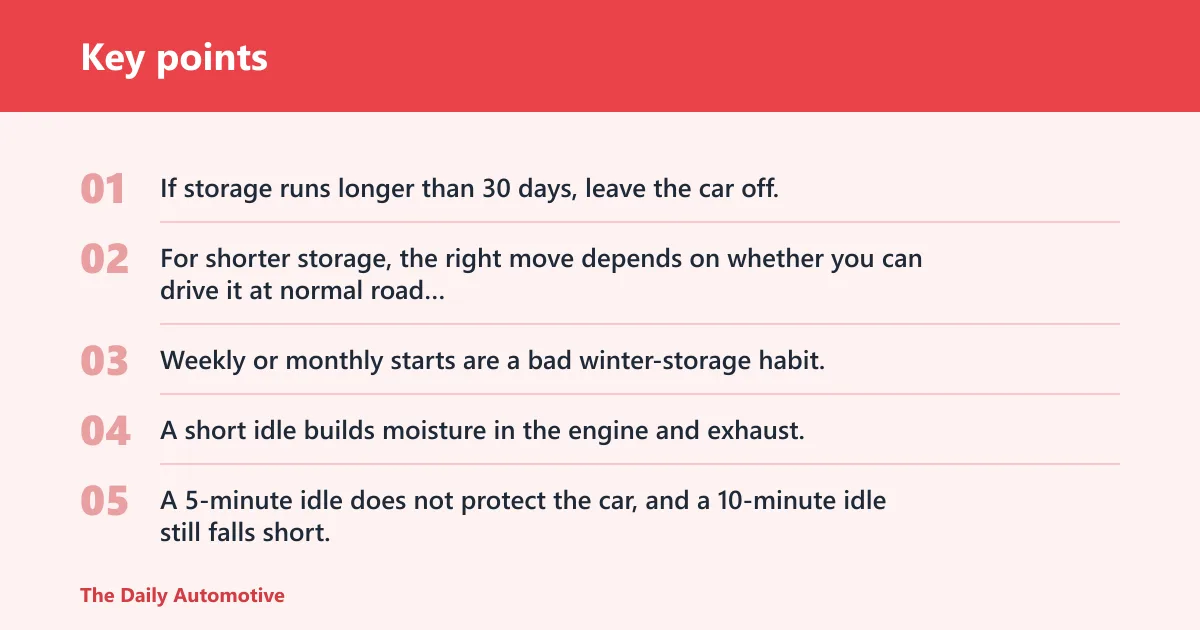



For most stored cars, the answer is no. If storage runs longer than 30 days, leave the car off. For shorter storage, the right move depends on whether you can drive it at normal road speeds long enough to heat the whole vehicle, not just the coolant gauge.
The short answer for stored cars
Weekly or monthly starts are a bad winter-storage habit. A short idle builds moisture in the engine and exhaust, and it drains the battery more than it restores. A 5-minute idle does not protect the car, and a 10-minute idle still falls short.
Why brief starts fail the job
The alternator charges while the engine runs, but it needs time and higher engine speed to work well. Idle speed often means low output, so the battery may not recover from the starting load. If the engine never reaches full operating temperature, the exhaust stays wet and the oil can collect water.
When a full drive changes the answer
If you must wake the car up, a normal road-speed drive is the only useful warm-up. The guide recommends a 15-minute drive at normal road speeds if you start it, and about 30 minutes or more is needed to heat the exhaust enough to clear water. A driveway idle does not replace that.
Stored car winter table
This decision table separates storage by length. Use the storage window first, then decide whether to leave the car alone, connect a battery tender, or plan a real drive.
| Storage length | Recommended action | Start the car? | Use a battery tender? | Main risk to avoid |
|---|---|---|---|---|
| Under 2 weeks | Park it, prepare it, and leave it alone unless there is a problem. | No routine starting. | Usually not needed if the battery is healthy and the car is parked in a dry place. | Unnecessary short-idle moisture and battery drain. |
| 2 to 4 weeks | Use proper storage prep and plan for battery support if the car will sit outside or has a weak battery. | Only if you can drive it long enough to fully warm it. | Yes, if a full drive is impractical. | Starting load without a full recharge. |
| Over 30 days | Prepare the car for storage and leave it off. | No. | Yes, the article recommends a battery tender as the standard for winter car storage. | Moisture buildup, battery discharge, fuel and tire problems. |
Battery and alternator
Storage slowly lowers a battery’s state of charge, even when the car sits still. A healthy battery matters because cold weather cuts cranking reserve, and repeated short starts can drain it faster than the car can recover it. That is why a tender is usually the smarter choice when a full drive is not realistic.
What storage does to battery state of charge
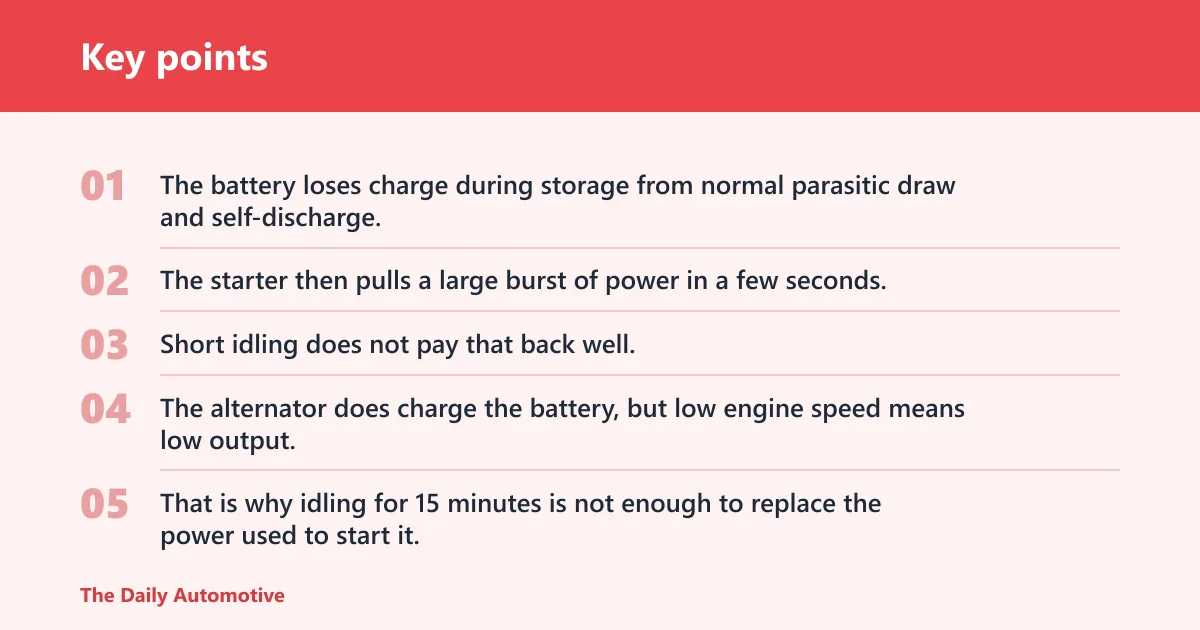
The battery loses charge during storage from normal parasitic draw and self-discharge. The starter then pulls a large burst of power in a few seconds. Short idling does not pay that back well, especially if the car never gets off fast idle and the alternator never reaches strong output.
Why idle charging can fall short
The alternator does charge the battery, but low engine speed means low output. That is why idling for 15 minutes is not enough to replace the power used to start it. If the battery starts weak, each brief run can leave it worse off than before, not better.
Suppose a sedan sits in an attached garage for three weeks. The owner starts it in place for 10 minutes on a cold morning, then shuts it off. The battery may have taken a start hit, the exhaust stays damp, and the next cold crank is harder. A tender avoids that cycle.
When a battery tender is the better choice
The guide recommends a battery tender as the standard for winter car storage because it keeps charge without overcharging. Use it when the car will sit for weeks, when indoor access is easy, or when a real drive would require moving snow, ice, or other barriers first. That keeps the battery ready without repeated cold starts.
What short idles do
A short idle warms the engine unevenly. Cool metal, cold exhaust parts, and low load make condensation more likely, not less. Repeating that pattern can leave water in the exhaust and crankcase, which may increase rust risk inside the tailpipe, muffler, and piping.
Engine condensation and exhaust moisture
Moisture forms during short warm-ups because combustion makes water vapor and the metal stays too cool to evaporate it. That moisture mixes with the air inside the engine and exhaust. A short idle can build up damaging moisture in both places, then trap it when the car shuts back down.
Oil contamination and lubrication loss
Repeated cold starts can put water into the oil, especially when the engine never stays hot long enough to boil it off. The result may be milky or sludgy oil, weaker lubrication, and more corrosion risk inside the engine. That matters more in winter, when the engine is already slower to warm.
Why rust risk rises inside the exhaust
The exhaust system needs full operating temperature to dry out internal moisture. Condensation buildup leaves water behind in low spots and mufflers, where rust can start from the inside. Driving at road speed heats the system far more evenly than a driveway idle.
A common first-timer mistake is thinking the engine sounds “warmed up” after a few minutes in the driveway. The sound changes first. The oil, catalytic converter, muffler, and transmission fluid may still be cold long after the idle smooths out.
Do you need to let it idle?
No. For stored cars, driveway idling is the wrong goal. If the car needs attention, the useful target is a full operating-temperature drive. If storage is under two weeks and the car is otherwise healthy, you may not need to start it at all.
Why driveway idling is the wrong goal
Idling is too slow to make up for the start. It also keeps engine speed low, which limits alternator output. That combination leaves the battery undercharged and the exhaust wet. A short idle does more harm than good because it creates start-up wear and the moisture problem without the payoff of a real drive.
How long a drive must run instead?
If you must run the car, the better choice is a normal road-speed drive long enough to heat the entire car. The guide recommends 15 minutes at normal road speeds if you start it, and about 30 minutes or more to heat the exhaust enough to clear water. Shorter than that leaves the job unfinished.
Cases where starting at all is unnecessary
For under-2-week storage, the car can usually stay parked with proper prep. For over 30 days, the guide says leave the car off. That is especially true if the battery is on a maintainer and the car is stored indoors, where temperature swings and moisture are lower than outdoors.
Winter storage prep
Proper prep matters more than periodic starts. The article says the best practice is to properly prepare the car for storage and leave it off. That means you deal with battery state, fuel, tires, and pests before the first snow, not after the battery is already weak.
Battery, fuel, and tires
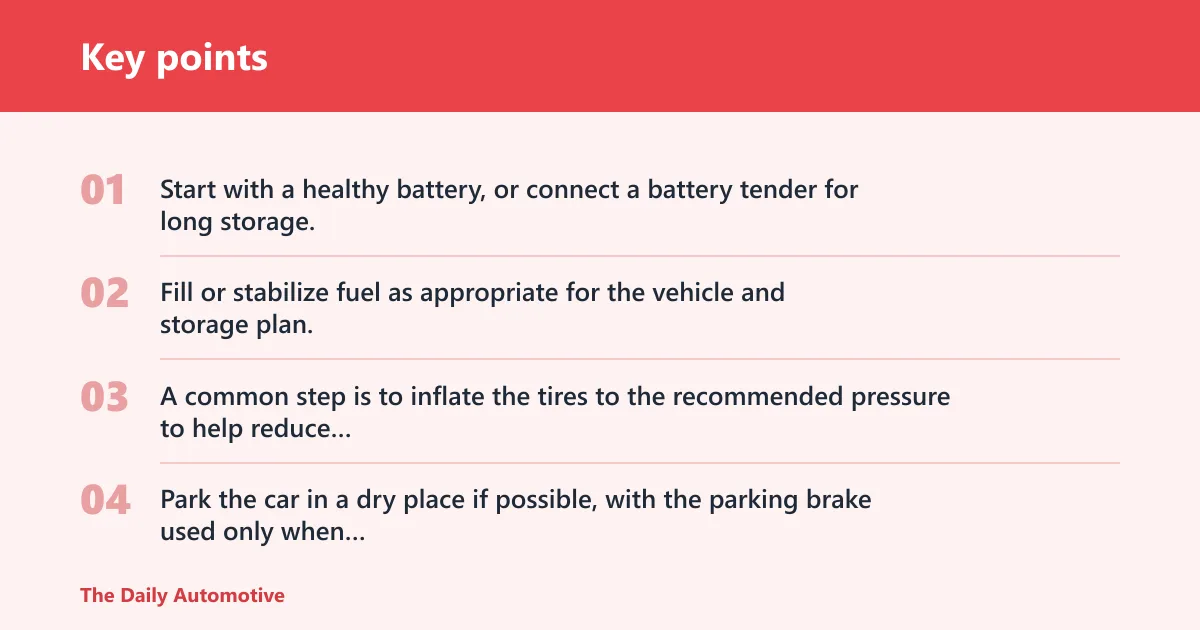
- Start with a healthy battery, or connect a battery tender for long storage.
- Fill or stabilize fuel as appropriate for the vehicle and storage plan.
- A common step is to inflate the tires to the recommended pressure to help reduce flat-spotting.
- Park the car in a dry place if possible, with the parking brake used only when appropriate for the vehicle.
Rodent and insect protection
Storage creates more than battery risk. Mice and insects can enter through small openings, nest in insulation, and chew wiring. That can cause starting faults, warning lights, and damaged harnesses when spring returns. Close up food sources, check for gaps, and keep the storage area clean.
Indoor storage versus outdoor storage
Indoor storage usually lowers moisture and temperature swings, which helps the battery and bodywork. Outdoor storage adds snow, ice, and wider temperature changes, so battery support and rodent protection matter more. Either way, a stored car still needs fuel, tire, and pest prep before it sits.
Other failure cases to plan
Stored cars can also run into fuel-system issues from stale fuel, brake corrosion from sitting with damp hardware, and tire flat-spotting from long static loads. Starting the engine for a few minutes does little to prevent any of those problems. Proper storage prep does far more.
If you must start it
Only start the car if you can drive it long enough to warm it fully. If the plan is a brief driveway idle, skip it. That is the simplest rule. A short run can create moisture, drain the battery, and leave the car less ready than before.
What to do before the key turns
Check that the battery is charged or on a tender. Clear snow, ice, and blocked exhaust openings. Make sure you have a route that lets the car reach normal road speeds, not just a lap around the driveway. If the weather or road conditions block that, leave the car off.
What not to do after it starts
Do not let it sit and idle for a few minutes while you hope the fluids are protected. Do not count on a 5-minute or 10-minute idle to dry the exhaust or recharge the battery. Do not shut it off again before the engine, oil, and exhaust are fully hot.
Stop rules for a harmful short run
If the car cannot be driven, shut it down rather than letting it idle aimlessly. If the battery is weak, do not keep retrying starts. If the exhaust is still cold and the windows fog quickly, the car has not warmed enough to justify the fuel burn and moisture load.
Frequently asked questions
Should you start a stored car every few weeks in winter?
No, not as a default rule. For storage longer than 30 days, leave the car off. For shorter storage, only start it if you can drive long enough to warm the vehicle fully. Otherwise, use a battery tender and leave the car off.
Is it bad to start a car that has been sitting in winter?
It can be. A short idle can drain the battery more than it charges, and it can build moisture in the engine and exhaust. If the run will stay short, the car may be worse off afterward. A real drive is the better option when starting is truly needed.
How often should you start a car in storage?
There is no useful weekly or monthly default. The better question is how long it will sit. Under 2 weeks usually needs no routine start. Two to 4 weeks may justify battery support. Over 30 days calls for proper storage prep, a tender, and leaving the car off.
Do you need to let a stored car idle in winter?
No. Idle time is the wrong target because it rarely heats the whole car enough. A short idle can leave condensation in the engine and exhaust, and it may not replace the battery power used to start the engine. If you start it, drive it at road speed instead.
What happens if you start a stored car and let it idle?
You can end up with a weaker battery, damp exhaust parts, and water mixed into the oil. That combination raises corrosion risk and can leave the car harder to start next time. A 15-minute driveway idle still does not equal a proper warm-up or recharge.
How do you keep a stored car battery charged in winter?
Use a battery tender. The guide recommends it as the standard for winter car storage because it maintains charge without overcharging. That is the best fit for long storage or for cases where a full drive is impractical. It protects the battery without the side effects of repeated cold starts.
Should you drive a stored car instead of idling it?
Yes. If the car is going to run, a normal road-speed drive is the only useful warm-up. The guide recommends 15 minutes at road speeds if you start it, and about 30 minutes or more to heat the exhaust enough to clear water. Idle alone does not do that.
How do you prepare a car for winter storage?
Clean it, fill or stabilize fuel as appropriate, inflate the tires, protect against rodents, and support the battery. Then leave it off if storage will run longer than 30 days. Good prep prevents more problems than routine startup ever will.
Products related to this article
Sponsored / affiliate links. As an Amazon Associate I earn from qualifying purchases. I may earn additional commission from eligible campaigns.