How Many Front Oxygen Sensors Are There Explained
Sometimes, figuring out car parts can feel tricky, especially when you’re new to it. You might wonder, How Many Front Oxygen Sensors Are There? This question pops up because different cars have different setups. It can seem confusing at first glance.
But don’t worry, it’s actually pretty simple once you know what to look for. We’ll break it all down step-by-step so you can find the answer for your specific vehicle with ease.
Understanding Your Vehicle’s Oxygen Sensors
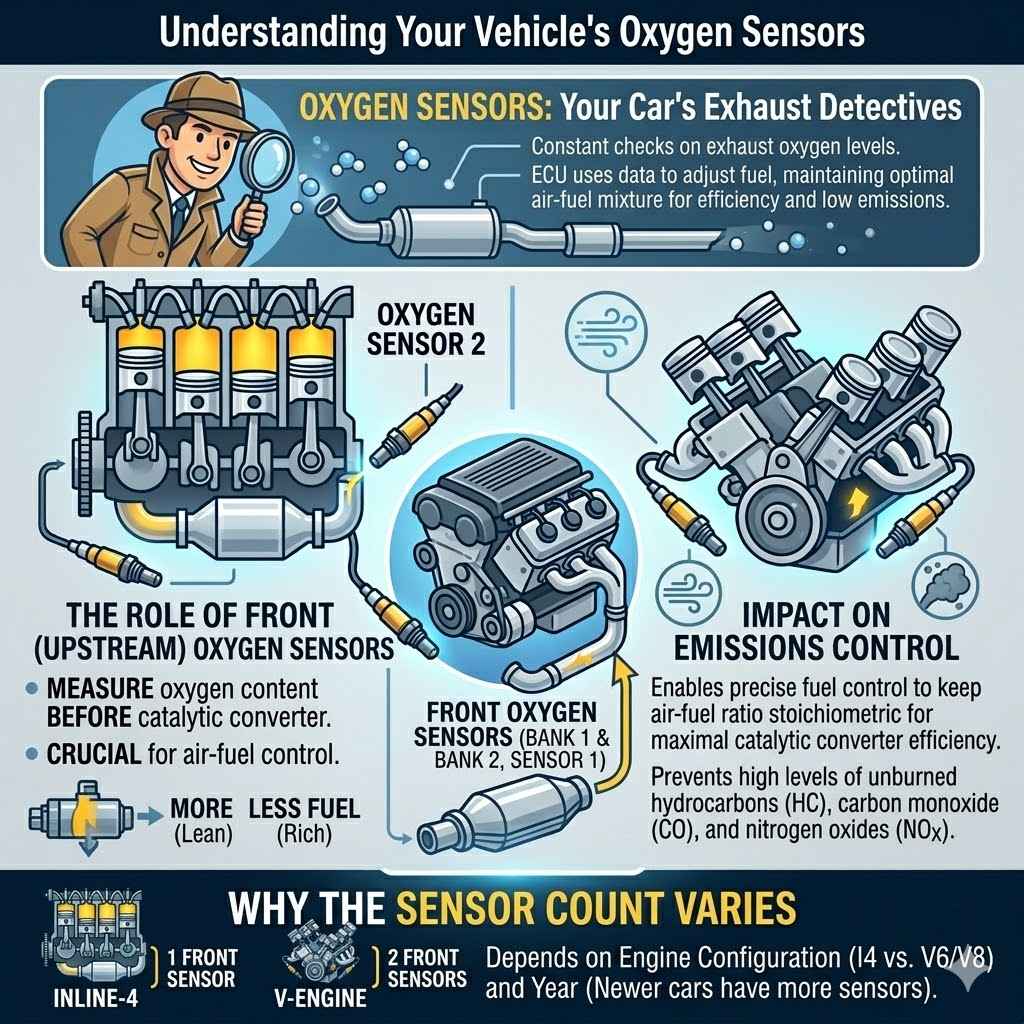
Your car’s oxygen sensors, often called O2 sensors, are vital parts of its exhaust system. They help your engine run efficiently and reduce pollution. Think of them as tiny detectives that constantly check the amount of oxygen in your exhaust gases. Based on this information, your car’s computer, called the Engine Control Unit or ECU, adjusts how much fuel is injected into the engine. This keeps the air-fuel mixture just right for optimal performance and lower emissions.
The Role of Front Oxygen Sensors
The oxygen sensors located before the catalytic converter are known as “front” or “upstream” O2 sensors. These are the most important ones for controlling the air-fuel mixture. They provide real-time data to the ECU, allowing for immediate adjustments. If these sensors aren’t working correctly, your car might experience poor fuel economy, rough idling, or even trigger a check engine light. Proper function of these sensors is key to keeping your car running smoothly and cleanly.
Initial Detection and Fuel Adjustment
The primary role of front oxygen sensors is to measure the oxygen content in the exhaust gases exiting the engine cylinders before they reach the catalytic converter. This measurement is crucial because it tells the engine control unit (ECU) whether the air-fuel mixture is too rich (too much fuel, not enough air) or too lean (too much air, not enough fuel). The ECU then uses this data to make instant adjustments to the amount of fuel it injects into the engine.
For example, if the sensor detects a lot of unburned oxygen (lean mixture), the ECU will increase the fuel flow. Conversely, if it detects very little oxygen (rich mixture), the ECU will reduce the fuel flow. This constant feedback loop ensures the engine operates at its most efficient point, typically aiming for a stoichiometric air-fuel ratio, which is the ideal balance for complete combustion and minimal emissions.
Catalytic Converter Efficiency Monitoring
While the front O2 sensors are primarily for fuel control, the data they provide indirectly helps in monitoring the catalytic converter’s performance. The catalytic converter’s job is to convert harmful pollutants into less harmful ones. Its efficiency is significantly impacted by the air-fuel mixture entering it. By ensuring the correct air-fuel ratio is maintained by the ECU based on the front O2 sensor readings, the catalytic converter can operate at its peak performance.
Some systems may also have rear (downstream) O2 sensors that directly monitor the catalytic converter’s efficiency by comparing its output to the front sensors. However, the front sensors lay the groundwork for the converter to function properly in the first place.
Impact on Emissions Control
The precise control of the air-fuel mixture, dictated by the front oxygen sensors, has a direct and significant impact on emissions. An engine that runs too rich will burn excess fuel, leading to higher levels of unburned hydrocarbons (HC) and carbon monoxide (CO) being released. An engine that runs too lean can lead to higher combustion temperatures, which can increase the formation of nitrogen oxides (NOx).
By constantly refining the air-fuel ratio, the front O2 sensors enable the engine to burn fuel more completely and allow the catalytic converter to effectively neutralize the remaining pollutants. This optimization is essential for meeting strict environmental regulations and ensuring your vehicle has a lower carbon footprint.
Why the Question Arises
The question “How Many Front Oxygen Sensors Are There?” often comes up for a few reasons. First, not all cars are built the same. Some cars have a simple exhaust system with just one bank of cylinders, while others have V-shaped engines with two banks. This difference directly affects the number of O2 sensors. Second, newer cars are often equipped with more sensors than older models, which can add to the confusion. Many beginners also find themselves asking this when their check engine light comes on, and they want to understand what parts might need attention.
How Many Front Oxygen Sensors Are There By Engine Type
The number of front oxygen sensors your vehicle has depends primarily on its engine configuration. Engines are generally categorized by the arrangement of their cylinders. This arrangement dictates how many exhaust manifolds or pipes are present, and each manifold or pipe typically has its own upstream oxygen sensor. Understanding your engine type is the most straightforward way to determine the number of front O2 sensors.
Inline Engines (I-4, I-6)
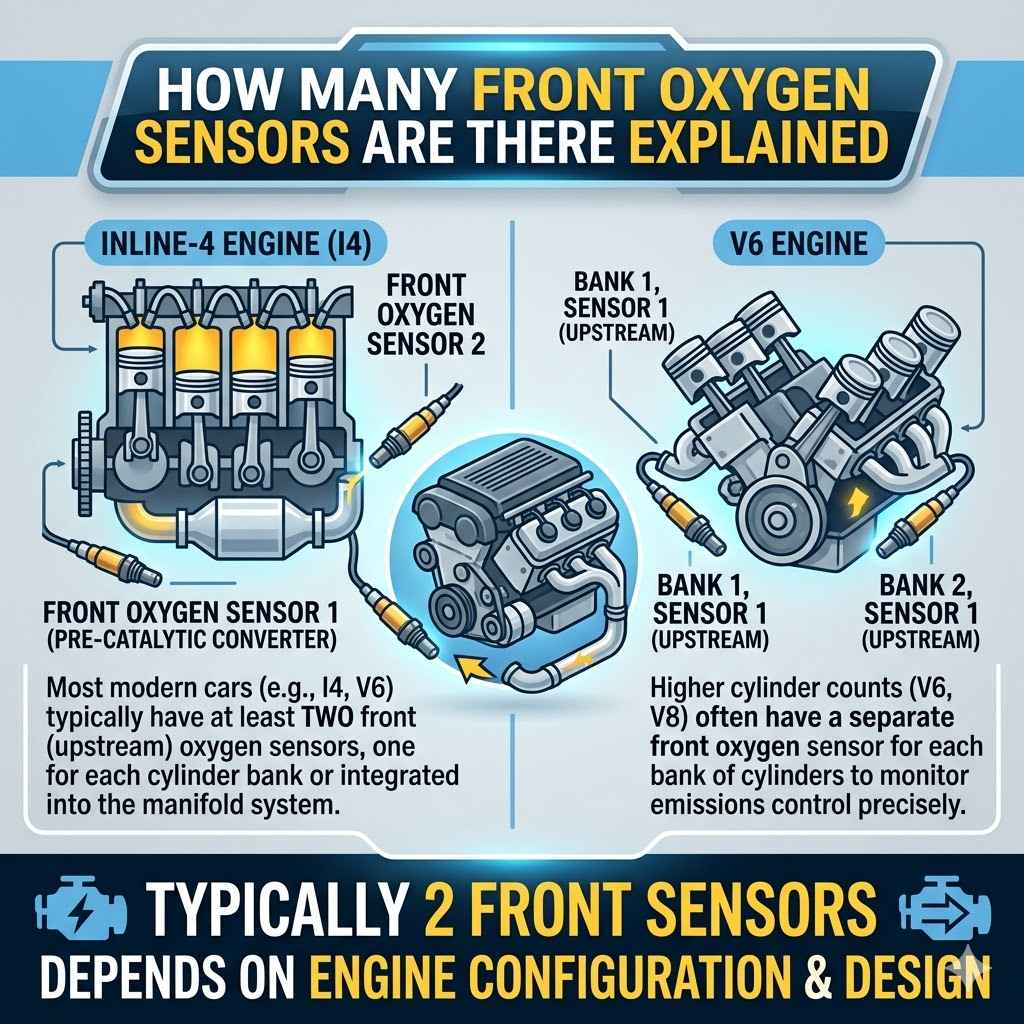
Inline engines, also known as straight engines, have all their cylinders in a single straight row. The most common types are the inline-four (I-4) and inline-six (I-6). These engines typically have a single exhaust manifold that collects gases from all cylinders. Because there’s only one exhaust stream leaving the engine before the catalytic converter, these vehicles usually have just one front oxygen sensor. This sensor is positioned in the exhaust pipe leading from this single manifold to the catalytic converter.
Single Exhaust Manifold Design
An inline engine features cylinders arranged in a straight line, such as the common four-cylinder or six-cylinder configurations found in many sedans and smaller SUVs. This linear arrangement typically results in a single exhaust manifold that consolidates exhaust gases from all cylinders into one pipe. This unified exhaust flow simplifies the sensor placement.
Only one upstream sensor is needed to monitor the oxygen content of this single exhaust stream. This sensor is usually located in the exhaust pipe shortly after it leaves the exhaust manifold and before it connects to the catalytic converter. This setup is generally more straightforward and cost-effective for manufacturers.
Simplified ECU Calculations
With only one front oxygen sensor providing data for an inline engine, the Engine Control Unit (ECU) has a less complex task in calculating the optimal air-fuel ratio. The ECU receives a single oxygen reading and applies its adjustments universally across all cylinders. This doesn’t mean performance is compromised; rather, the system is designed to be efficient for its specific configuration.
Manufacturers design the fuel injection and ignition timing to work harmoniously with this single sensor’s feedback. Diagnostic procedures for these systems are often less intricate due to the fewer variables involved compared to V-engines.
Common Vehicle Applications
Inline engines are incredibly popular due to their balance of efficiency, cost-effectiveness, and packaging flexibility. You’ll find inline-four engines powering the vast majority of compact cars, mid-size sedans, and smaller crossover SUVs. Inline-six engines, while less common in smaller vehicles, are often found in larger sedans, some trucks, and performance-oriented cars where their smoother operation is valued.
Examples include many Honda Civic, Toyota Camry (four-cylinder models), BMW 3-Series (older models), and Ford F-150 trucks (some configurations). In all these inline engine setups, expect to find one upstream oxygen sensor.
V-Engines (V6, V8)
V-engines arrange cylinders in two separate banks, forming a “V” shape. Common examples include V6 and V8 engines. Because there are two distinct banks of cylinders, each bank usually has its own exhaust manifold. Consequently, vehicles with V-engines typically have two front oxygen sensors – one for each bank. Each sensor monitors the exhaust gases from its respective cylinder bank.
Dual Exhaust Manifold Structure
V-shaped engines, such as V6 and V8 configurations, are characterized by their cylinders being arranged in two separate banks that meet at a common crankshaft. This design inherently leads to two distinct exhaust manifolds, one for each bank of cylinders. Each exhaust manifold collects gases from its set of cylinders and directs them into a separate exhaust pipe. To accurately monitor and control the air-fuel mixture for each bank independently, two front oxygen sensors are required.
Each sensor is installed in the exhaust pipe originating from its respective manifold, upstream of the catalytic converter. This dual-sensor setup allows for more precise management of combustion across the entire engine.
Independent Fuel Control per Bank
Having two front oxygen sensors allows the ECU to manage the air-fuel mixture for each cylinder bank separately. This is crucial because exhaust conditions can sometimes vary slightly between the two banks due to minor differences in combustion, temperature, or airflow. By having dedicated sensors, the ECU can fine-tune fuel delivery to each bank independently, optimizing performance and emissions for both.
This independent control ensures that neither bank runs excessively rich or lean, contributing to overall engine stability and efficiency. This sophisticated control is a hallmark of more complex engine designs.
Impact on Diagnostic Complexity
The presence of two front oxygen sensors in V-engines can make diagnostics slightly more involved compared to inline engines. If a check engine light related to an oxygen sensor comes on, technicians need to identify which bank the issue is occurring on. This often involves using diagnostic tools to read specific sensor data (e.g., Bank 1 Sensor 1, Bank 2 Sensor 1).
Understanding which sensor corresponds to which bank is essential. For instance, on many vehicles, Bank 1 is typically the side with cylinder 1. However, this convention can vary, so consulting a service manual for the specific vehicle is always recommended.
Boxer Engines (Subaru)
Boxer engines, famously used by Subaru, have cylinders arranged horizontally opposite each other, like a boxer punching. This configuration also results in two distinct exhaust streams leaving the engine. Therefore, vehicles with boxer engines typically have two front oxygen sensors, similar to V-engines, with one sensor for each bank of cylinders.
Horizontally Opposed Cylinder Layout
Boxer engines, also known as flat engines, have cylinders positioned on opposite sides of the crankshaft and laid out horizontally. This arrangement is famous for its low center of gravity, which contributes to excellent vehicle handling. Each pair of opposing cylinders has its own exhaust port, leading to separate exhaust downpipes. Because there are two distinct exhaust streams exiting the engine directly, two front oxygen sensors are installed. Each sensor is placed in its respective downpipe, upstream of the catalytic converter, to monitor oxygen levels from its associated cylinder pair.
Symmetrical Exhaust Flow
The symmetrical nature of the boxer engine’s exhaust system means that the two banks of cylinders are generally balanced in terms of exhaust flow and temperature. The two front oxygen sensors monitor these respective flows. The ECU then uses the data from both sensors to maintain an optimal air-fuel ratio across the entire engine. This setup ensures that the engine’s combustion is consistent and efficient, contributing to the smooth running characteristic often associated with boxer engines. The twin-sensor approach mirrors the dual-bank nature of the engine.
Specific Sensor Identification
In boxer engines, just like V-engines, it’s important to identify which sensor belongs to which bank. Typically, on Subaru vehicles, “Bank 1” refers to the bank on the passenger’s side of the vehicle, and “Bank 2” refers to the bank on the driver’s side. The sensors are often labeled as “Bank 1 Sensor 1” and “Bank 2 Sensor 1” in diagnostic trouble codes. This distinction is vital for accurate diagnosis and repair. If one sensor fails, it will affect the performance and emissions of its specific bank, and potentially trigger a check engine light.
Identifying Your Vehicle’s Front Oxygen Sensors
Pinpointing the exact number and location of your front oxygen sensors can seem daunting, but a few reliable methods exist. The most definitive way is to consult your vehicle’s service manual. However, if that’s not readily available, you can also visually inspect your exhaust system or use online resources. Each method has its advantages in helping you understand your car’s specific setup.
Consulting Your Vehicle’s Service Manual
The most accurate and detailed information regarding your vehicle’s oxygen sensors can be found in its official service manual. These manuals are written by the manufacturer and provide comprehensive diagrams, specifications, and diagnostic procedures. They will clearly indicate the number of upstream (front) and downstream (rear) oxygen sensors, their precise locations, and part numbers. This is the gold standard for information.
Comprehensive Schematics and Diagrams
Service manuals provide detailed visual aids, including exploded views of the exhaust system and engine bay. These diagrams clearly label all components, including the oxygen sensors. You can easily spot the upstream sensors based on their position before the catalytic converter. The manual will also illustrate the exhaust manifolds and piping for each cylinder bank, making it obvious whether you have one or two front sensors. This visual guidance is invaluable for anyone unfamiliar with their car’s undercarriage.
Part Numbers and Specifications
Beyond just showing you where the sensors are, service manuals list the exact part numbers for each oxygen sensor. This is crucial if you plan to replace a sensor yourself or purchase one from an auto parts store. The manual also often includes specifications related to sensor resistance, voltage, and response times, which can be helpful for diagnostic purposes or for ensuring you purchase a compatible replacement part. This level of detail ensures you get the correct component for your vehicle.
Diagnostic Trouble Code (DTC) Reference
Service manuals are also invaluable for understanding diagnostic trouble codes (DTCs) that may appear when your check engine light illuminates. They will explain what each code signifies, including those related to oxygen sensors (e.g., P0130 for O2 sensor circuit malfunction, Bank 1). For V-engines or boxer engines, the manual will clarify the specific bank and sensor number associated with the code, guiding you to the correct component needing attention. This context is essential for accurate troubleshooting.
Visual Inspection of the Exhaust System
If you can safely get under your car, a visual inspection can often reveal the number of front oxygen sensors. The front oxygen sensors are typically located on the exhaust pipe relatively close to the engine, before the catalytic converter. The catalytic converter is usually a bulge in the exhaust pipe system, often located further down the exhaust path.
Locating the Catalytic Converter
The first step in a visual inspection is to identify the catalytic converter. It’s usually a metal canister, often oval or rectangular, situated in the exhaust system. It’s typically found after the exhaust manifolds but before the muffler. Its presence signals the point where upstream sensors should be located before it. Cars might have one or two catalytic converters, depending on the exhaust configuration.
Identifying Upstream Sensors
Once the catalytic converter is located, look for sensors screwed into the exhaust pipe just before it. These are your upstream or front oxygen sensors. If you see one sensor on a single exhaust pipe leading to the converter, you have one front O2 sensor. If you see two separate exhaust pipes leading to one or two catalytic converters, and each pipe has a sensor before the converter, you have two front O2 sensors. These sensors have wires connected to them, usually a black, heat-resistant cable.
Distinguishing from Downstream Sensors
It’s important not to confuse front sensors with rear or downstream sensors. Downstream sensors are located after the catalytic converter and are primarily used to monitor the converter’s efficiency. They are usually found on a separate section of pipe after the converter. Front sensors are always positioned upstream, before the converter’s main body. The wiring color or connector type can sometimes differ between upstream and downstream sensors, but their location is the most reliable indicator.
Using Online Resources and VIN Decoders
Numerous online automotive databases and VIN (Vehicle Identification Number) decoders can provide detailed information about your car’s specifications, including its exhaust system components. Entering your VIN can often bring up a complete breakdown of your vehicle’s factory configuration.
VIN Decoder Accuracy
A Vehicle Identification Number (VIN) is a unique 17-character code assigned to every motor vehicle. By entering your VIN into a reliable online decoder, you can access a wealth of information about your car’s original specifications, including engine type, transmission, and exhaust system details. Many VIN decoders will explicitly state the engine configuration (e.g., V6, I-4) and may even list the number of oxygen sensors. This is a quick way to get factory specs without physically inspecting the car.
Automotive Forums and Communities
Online car forums and communities dedicated to specific makes and models are excellent resources. You can post your question about how many front oxygen sensors your vehicle has, along with your car’s year, make, and model, and receive advice from experienced owners and mechanics. Often, members will share detailed photos and instructions for common repairs and diagnostics, including O2 sensor locations. These communities are built on shared knowledge.
Parts Retailer Websites
Many online auto parts retailers allow you to enter your vehicle’s year, make, and model to find compatible parts. When searching for oxygen sensors, they usually list whether a part is for Bank 1 Sensor 1, Bank 2 Sensor 1, or a single sensor. This can indirectly tell you how many front sensors your car requires. If the search results show options for both Bank 1 and Bank 2 upstream sensors, you know your car has two.
When Oxygen Sensors Need Replacement
Oxygen sensors don’t last forever. Like any component that experiences extreme heat and harsh exhaust conditions, they eventually wear out. A failing oxygen sensor can lead to a variety of performance issues and ultimately impact your car’s emissions and fuel economy. Knowing the signs of a failing sensor can save you money and prevent further damage.
Common Signs of Failing Oxygen Sensors
Several symptoms can indicate that one or more of your front oxygen sensors are not functioning correctly. Recognizing these signs early can help you address the problem before it becomes more severe.
Illuminated Check Engine Light
The most common sign of a faulty oxygen sensor is the illumination of the check engine light on your dashboard. The car’s computer constantly monitors the sensor data, and if it detects readings outside of expected parameters for too long, it will trigger this warning light. The specific diagnostic trouble code (DTC) stored in the ECU will often point to an issue with an oxygen sensor circuit, specifying which sensor or bank is affected. This is the computer’s way of telling you something is wrong.
Poor Fuel Economy
Oxygen sensors play a critical role in maintaining the optimal air-fuel ratio for efficient combustion. When a front O2 sensor fails, it can send incorrect information to the ECU, causing it to incorrectly adjust the fuel mixture. If the sensor erroneously signals a lean condition, the ECU might inject too much fuel, leading to a noticeably worse fuel economy. You’ll find yourself visiting the gas station more frequently than usual. This is a direct financial consequence of a malfunctioning sensor.
Rough Idling or Engine Misfires
An incorrect air-fuel mixture caused by a faulty oxygen sensor can lead to unstable engine operation. This might manifest as a rough idle, where the engine shakes or stutters when stopped, or even engine misfires, where combustion in one or more cylinders fails to occur properly. These issues arise because the engine is not receiving the correct amount of fuel and air for smooth, consistent power delivery. The engine control module is struggling to maintain stability.
Emissions Test Failures
If your vehicle fails an emissions test, a faulty oxygen sensor is a very common culprit. The sensors are directly responsible for ensuring your car runs cleanly. If they are not providing accurate data, the engine’s combustion will be inefficient, leading to higher levels of pollutants like unburned hydrocarbons and carbon monoxide. This will result in your vehicle not meeting the legal emissions standards required for registration.
How to Test Oxygen Sensors
Testing oxygen sensors involves checking their electrical signals and responsiveness. This can be done using a diagnostic scan tool to monitor live data or by performing voltage tests.
Using a Diagnostic Scan Tool
A diagnostic scan tool is the most common and effective way to test oxygen sensors. It connects to your car’s OBD-II port and allows you to view real-time data from various sensors, including the O2 sensors. You can observe the voltage output of the sensors as the engine warms up and runs. A healthy front oxygen sensor will typically cycle its voltage rapidly between approximately 0.1 volts (lean) and 0.9 volts (rich). If a sensor’s voltage is stuck high or low, or doesn’t fluctuate, it’s likely failing.
Voltage Testing with a Multimeter
For a more hands-on approach, you can use a multimeter to test the sensor’s output voltage. With the engine running, you would carefully connect the multimeter probes to the appropriate wires of the oxygen sensor connector. Observing the voltage fluctuations will provide similar insights to using a scan tool. However, this method requires more technical knowledge and caution to avoid electrical shorts or damaging the sensor or wiring. It’s also important to know the specific expected voltage range for your vehicle.
Response Time Testing
Beyond just voltage, a key indicator of a healthy oxygen sensor is its response time. A good sensor should react quickly to changes in the air-fuel mixture. When using a scan tool, you can sometimes observe the sensor’s response time to air changes. If the sensor is slow to respond or doesn’t change its output voltage quickly, it indicates degradation. This sluggishness means the ECU isn’t getting timely information, impacting its ability to make precise adjustments.
How Many Front Oxygen Sensors Are There Summary
In conclusion, determining How Many Front Oxygen Sensors Are There is straightforward once you understand your vehicle’s engine type. Inline engines typically have one, while V-engines and boxer engines usually have two. Consulting your service manual or performing a visual inspection are excellent ways to confirm the number for your specific car. Knowing this helps in diagnosing issues and ensuring your vehicle runs efficiently and cleanly.

Frequently Asked Questions
Question: How many front oxygen sensors does a 2005 Honda Civic have?
Answer: A 2005 Honda Civic, typically equipped with an inline-four engine, generally has one front oxygen sensor.
Question: Do all V8 engines have two front oxygen sensors?
Answer: Yes, V8 engines have two banks of cylinders, and each bank typically has its own exhaust manifold, requiring two front oxygen sensors for proper air-fuel mixture control.
Question: What is the difference between a front and rear oxygen sensor?
Answer: Front (upstream) oxygen sensors are located before the catalytic converter and are crucial for fuel mixture control. Rear (downstream) sensors are located after the catalytic converter and monitor its efficiency.
Question: Can I drive my car with a bad front oxygen sensor?
Answer: You can usually drive with a bad front oxygen sensor, but it will lead to poor fuel economy, increased emissions, and potentially trigger a check engine light. It’s best to replace it soon.
Question: Where is the O2 sensor located on a car?
Answer: Oxygen sensors are screwed into the exhaust system. Front sensors are located in the exhaust pipe before the catalytic converter, and rear sensors are located after it.
Wrap Up
You’ve learned that How Many Front Oxygen Sensors Are There really depends on your car’s engine. Inline engines usually have one, while V and boxer engines typically have two. Identifying them involves checking your engine type or inspecting the exhaust system before the catalytic converter. Knowing this helps you keep your car running smoothly.