How Many Oxygen Sensors A 2004 Ford Focus SVT Has
Figuring out car parts can sometimes feel a little tricky, especially for folks just starting out with vehicle maintenance. You might wonder, How Many Oxygen Sensors Are in a 2004 Ford Focus SVT? It’s a question many ask because oxygen sensors play a big role in how your car runs smoothly and efficiently. Don’t worry, though!
We’ll break it down super simply so you know exactly what’s going on. Get ready to find out the easy answer and what you need to know.
Understanding Oxygen Sensors In Your 2004 Ford Focus SVT
Oxygen sensors, often called O2 sensors, are small but mighty parts of your car’s exhaust system. They help your engine computer know how much oxygen is in the exhaust. This information is super important for making sure your engine burns fuel the best way possible.
When the O2 sensors are working right, your car runs cleaner and gets better gas mileage. If they aren’t, you might notice your car isn’t running as well, or you could see that check engine light come on.
For a 2004 Ford Focus SVT, knowing the number of oxygen sensors helps when you’re doing checks or thinking about repairs. It’s good to have this basic knowledge. This section will explain what these sensors do and why they are vital for your SVT’s performance.
What Do Oxygen Sensors Do
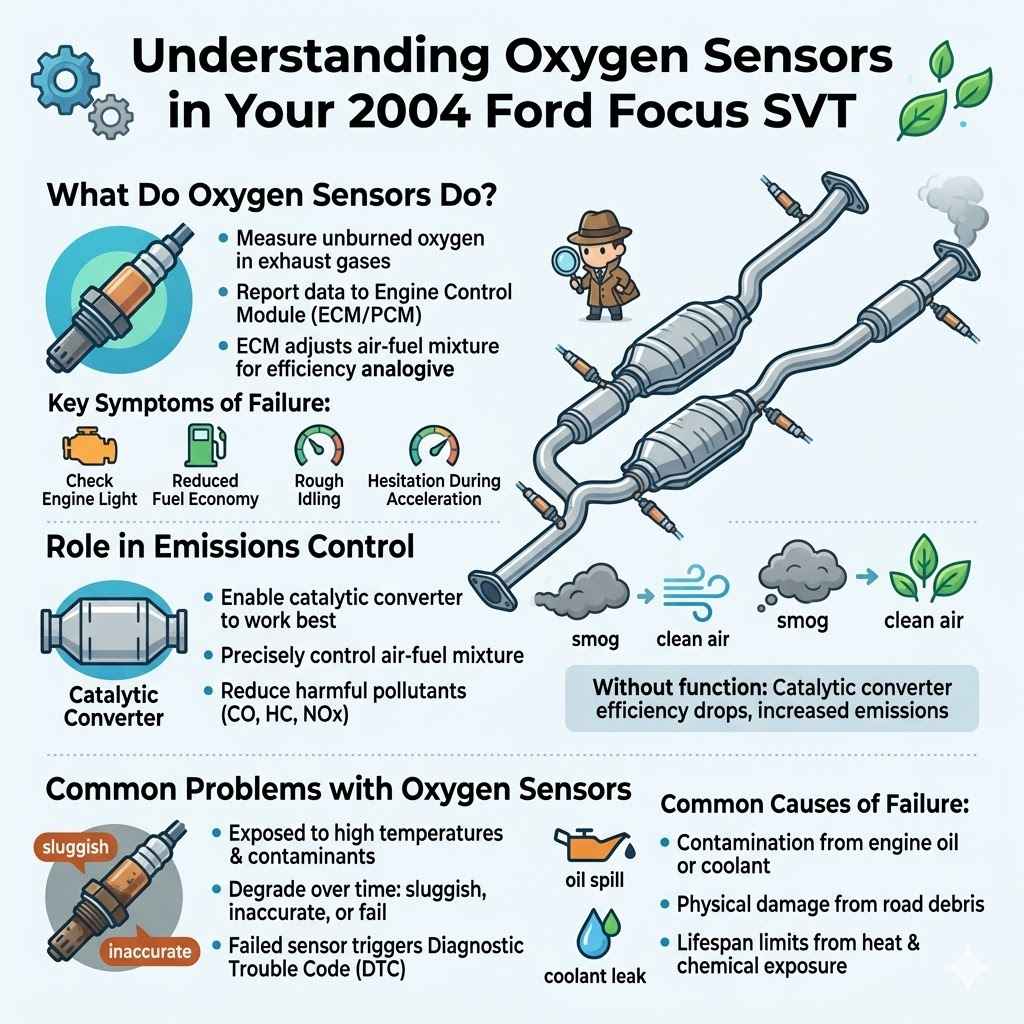
Oxygen sensors measure the amount of unburned oxygen in the exhaust gases leaving your engine. This reading tells your car’s computer, known as the Engine Control Module (ECM) or Powertrain Control Module (PCM), about the air-fuel mixture. If there’s too much oxygen, it means the engine is running lean (too much air, not enough fuel).
If there’s not enough oxygen, the engine is running rich (too much fuel, not enough air).
The ECM uses this data to adjust the amount of fuel injected into the engine in real-time. This constant adjustment ensures that the air-fuel ratio is as close to the ideal stoichiometric ratio as possible. This is crucial for efficient combustion, which leads to better fuel economy, lower emissions, and optimal engine performance.
Think of them as tiny detectives reporting back to the engine’s brain.
When an oxygen sensor starts to fail, it can send incorrect information to the ECM. This can cause the engine to run with an improper air-fuel mixture. Symptoms might include poor fuel economy, rough idling, hesitation during acceleration, or the illumination of the check engine light.
The Role of Oxygen Sensors in Emissions Control
Oxygen sensors are key players in helping your car meet emission standards. By ensuring the engine burns fuel as efficiently as possible, they reduce the amount of harmful pollutants released into the atmosphere. This includes carbon monoxide (CO), hydrocarbons (HC), and nitrogen oxides (NOx).
These are all bad for the air we breathe and can contribute to smog and other environmental problems.
Modern cars, like your 2004 Ford Focus SVT, have catalytic converters that further clean up exhaust gases. However, the catalytic converter works best when the air-fuel mixture is precisely controlled. The oxygen sensors provide the crucial data that allows the ECM to maintain this optimal mixture, allowing the catalytic converter to do its job effectively.
Without properly functioning oxygen sensors, the catalytic converter’s efficiency can drop significantly. This can lead to increased tailpipe emissions and, in many places, your car failing an emissions test. So, these sensors are not just about performance; they’re also about environmental responsibility.
Common Problems With Oxygen Sensors
Oxygen sensors don’t last forever. They are exposed to harsh exhaust gases, high temperatures, and contaminants in fuel and oil. Over time, their performance can degrade.
Common issues include a sensor becoming sluggish, inaccurate, or completely failing.
A sluggish sensor might respond slowly to changes in the exhaust gas composition, leading to delayed adjustments by the ECM. An inaccurate sensor might consistently report incorrect oxygen levels. A completely failed sensor will stop sending any useful data, often triggering a diagnostic trouble code (DTC) and the check engine light.
Some common causes of failure include contamination from engine oil or coolant, physical damage from road debris, or simply reaching the end of their lifespan due to heat and chemical exposure. Regular maintenance and addressing any engine oil or coolant leaks promptly can help extend the life of your oxygen sensors.
How Many Oxygen Sensors Are in a 2004 Ford Focus SVT
Now let’s get to the main question: How Many Oxygen Sensors Are in a 2004 Ford Focus SVT? This specific model, especially with its performance-oriented SVT trim, typically comes equipped with a specific number of these sensors to manage its engine and emissions effectively. Understanding this number is the first step in troubleshooting or planning for maintenance.
The number of oxygen sensors can vary depending on the engine configuration and emissions equipment installed by the manufacturer. For the 2004 Ford Focus SVT, this means we need to consider its unique design. We’ll break down where these sensors are typically located and why the SVT might have this particular setup.
Oxygen Sensor Locations on the 2004 Ford Focus SVT
The 2004 Ford Focus SVT generally has two oxygen sensors. One sensor is located upstream, before the catalytic converter, and the other is located downstream, after the catalytic converter. This setup is standard for many vehicles designed to meet emissions regulations.
The upstream oxygen sensor (often referred to as Sensor 1) is critical for monitoring the air-fuel ratio entering the catalytic converter. It provides the primary data for the ECM to control fuel injection. The downstream oxygen sensor (often referred to as Sensor 2) primarily monitors the efficiency of the catalytic converter itself.
It checks if the converter is effectively cleaning the exhaust gases after they pass through.
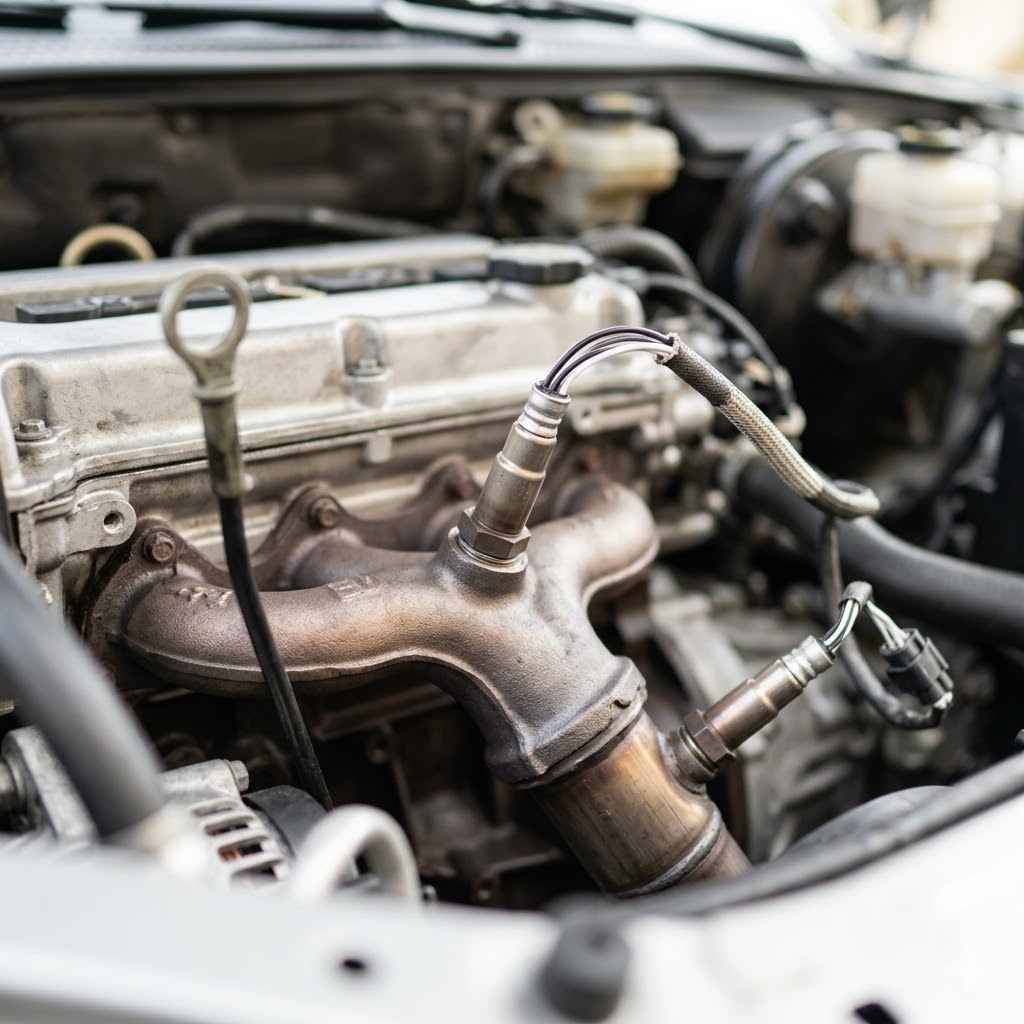
Identifying these sensors is usually straightforward once you are under the vehicle. The upstream sensor is closer to the engine, typically on the exhaust manifold or the exhaust pipe just after it. The downstream sensor is further back on the exhaust system, typically after the catalytic converter.
They are usually connected by a wire harness that leads back to the engine bay.
Upstream vs. Downstream Sensor Functions
The two oxygen sensors have distinct roles. The upstream sensor is the “performance” sensor. It constantly tells the engine computer how the combustion is going and allows for immediate adjustments to the fuel mixture.
This is vital for optimal engine power and fuel efficiency during all driving conditions.
The downstream sensor acts as a “monitor” for the catalytic converter. After the exhaust passes through the converter, the downstream sensor checks the oxygen content again. If the catalytic converter is working correctly, the downstream sensor should show a much more stable reading compared to the upstream sensor.
A fluctuating reading from the downstream sensor can indicate that the catalytic converter is not functioning as it should.
This dual-sensor system allows the car’s computer to not only fine-tune engine performance but also to diagnose potential issues with the emissions control system. If the readings from both sensors don’t match up in the way they should, the ECM will likely trigger a check engine light.
Why Two Sensors Are Common
Having two oxygen sensors is a common configuration for vehicles that use a catalytic converter to reduce emissions. The first sensor upstream provides the real-time data needed for the engine’s primary function: efficient fuel combustion. The second sensor downstream is essential for monitoring the effectiveness of the catalytic converter, ensuring that the vehicle is meeting its emission control requirements.
This system provides a comprehensive view of the exhaust system’s health and performance. The ECM can compare the readings from both sensors to get a clear picture. For instance, if the upstream sensor shows a rich condition and the downstream sensor also shows a rich condition, it points to a problem with the catalytic converter’s ability to process those gases.
This two-sensor setup allows for more sophisticated diagnostics and better overall emissions control. It helps the car run cleaner and more efficiently for longer periods. It’s a smart design that benefits both the driver and the environment.
Replacing Oxygen Sensors
Replacing oxygen sensors is a common maintenance task that many car owners can tackle themselves with the right tools and knowledge. While it might seem technical, understanding the process can save you money and give you a sense of accomplishment. This section will guide you through the basics of why and how to replace these vital parts.
When an oxygen sensor fails, it’s important to replace it promptly. A faulty sensor can lead to reduced fuel economy, increased emissions, and potential damage to other engine components. We’ll cover the signs that indicate a need for replacement and the general steps involved in the process.
Signs Your Oxygen Sensors Need Replacement
Several common symptoms can indicate that one or more of your oxygen sensors need to be replaced. The most obvious sign is the illumination of the check engine light on your dashboard. Auto parts stores can scan your car’s computer to identify specific diagnostic trouble codes (DTCs) related to oxygen sensors, such as P0130 through P0167 ranges.
Beyond the check engine light, you might notice a decrease in your vehicle’s fuel economy. This happens because a faulty sensor can cause the engine to run too rich or too lean, consuming more fuel than necessary. You may also experience a rough idle, engine hesitation or stalling, and a noticeable decrease in engine performance, such as reduced acceleration.
A failed oxygen sensor can also cause your car to fail an emissions test. In some cases, you might even be able to smell raw fuel or a “rotten egg” smell from the exhaust, which can indicate an overly rich fuel mixture or a failing catalytic converter, often related to bad O2 sensors.
Tools and Materials Needed
To replace oxygen sensors on your 2004 Ford Focus SVT, you’ll generally need a few specific tools. A dedicated oxygen sensor socket wrench is highly recommended. These sockets have a slot to allow the sensor’s wire to pass through, making removal and installation much easier.
They come in various sizes, so ensure you have the correct one for your sensors.
You’ll also need a ratchet or breaker bar to attach to the oxygen sensor socket. Penetrating oil, like WD-40 or a similar product, can be very helpful to spray on the old sensor and let it soak for a while to loosen any rust or carbon buildup. This makes removal much easier and reduces the risk of damaging the exhaust pipe.
Of course, you’ll need the
Step-by-Step Replacement Process
First, ensure your engine is cool to avoid burns. Safely lift your vehicle using jack stands or ramps so you can access the exhaust system. Locate the oxygen sensors; the upstream one is before the catalytic converter, and the downstream one is after.
Spray penetrating oil on the old sensor’s threads and let it sit for about 15-30 minutes. Then, attach the oxygen sensor socket to your ratchet or breaker bar and carefully work the old sensor loose. Once removed, clean the threads on the exhaust pipe if necessary.
Apply a small amount of anti-seize lubricant to the threads of the new oxygen sensor (if not pre-applied). Screw the new sensor into the exhaust pipe by hand to avoid cross-threading. Tighten it with the oxygen sensor socket and ratchet.
Connect the wiring harness. Lower the vehicle, start the engine, and check for any leaks or unusual noises. It’s also a good idea to clear any DTCs with a scanner and drive the car to allow the computer to re-learn the settings.
Post-Replacement Checks and Driving
After replacing an oxygen sensor, the next crucial step is to clear any diagnostic trouble codes (DTCs) that may have been stored in the car’s computer. This can be done using an OBD-II scanner. If you don’t have one, many auto parts stores offer this service for free.
Once the codes are cleared, you need to drive your vehicle to allow the Engine Control Module (ECM) to run through its diagnostic tests and relearn the sensor readings. This driving cycle typically involves a mix of city and highway driving. For example, you might drive at highway speeds for 15-20 minutes, then drive in city conditions for another 15-20 minutes.
During this driving cycle, the ECM will monitor the performance of the new oxygen sensor. If the sensor is functioning correctly and the original problem is resolved, the check engine light should remain off. If the check engine light comes back on, it might indicate an issue with the other oxygen sensor, a different problem entirely, or a faulty new sensor, requiring further diagnosis.
Diagnosing Oxygen Sensor Issues
When your check engine light comes on, it can be unsettling, but it’s often a signal that a simple component needs attention. Oxygen sensors are frequent culprits. Diagnosing these issues involves a systematic approach to pinpoint the exact sensor that’s causing trouble and to ensure no other problems are masked.
This section will explore the methods used to confirm if an oxygen sensor is indeed the problem. We’ll cover how to read diagnostic codes and what those codes tell us, as well as some advanced techniques to verify sensor performance. Understanding the diagnostic process empowers you to work effectively with your mechanic or even perform some checks yourself.
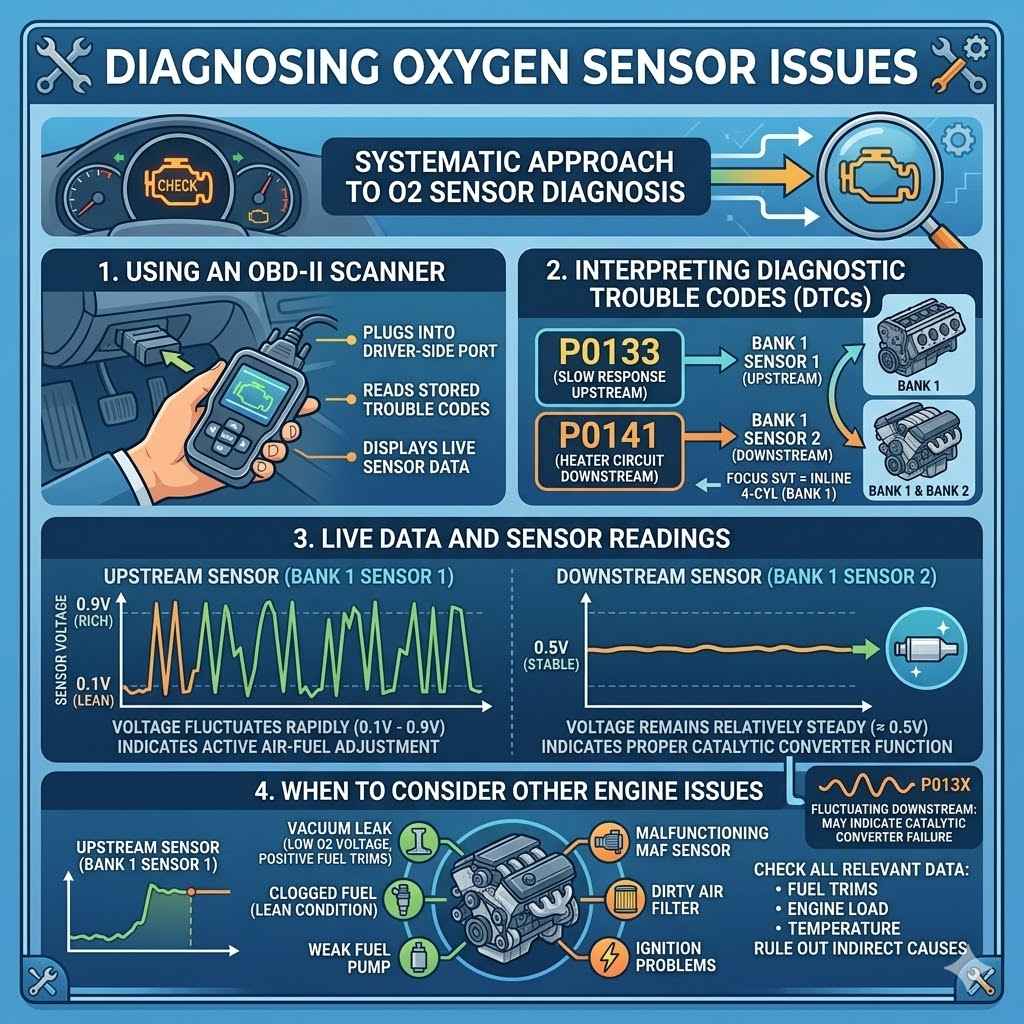
Using an OBD-II Scanner
The most common and effective way to diagnose oxygen sensor issues is by using an On-Board Diagnostics (OBD-II) scanner. When the check engine light illuminates, the car’s computer stores one or more trouble codes that indicate the nature of the problem. An OBD-II scanner plugs into a port usually located under the dashboard on the driver’s side of the vehicle.
Once connected, the scanner can read these codes, which are typically alphanumeric (e.g., P0135, P0141). These codes provide a starting point for diagnosis. For oxygen sensors, you’ll often see codes related to “Oxygen Sensor Circuit Malfunction” or “Oxygen Sensor Performance.” For example, a P0135 code might point to an issue with the heater circuit of an upstream oxygen sensor.
Many scanners can also display live data from the vehicle’s sensors, including the real-time readings from the oxygen sensors. This live data is invaluable for diagnosing intermittent issues or confirming the functionality of each sensor. You can observe how the sensor readings fluctuate with changes in engine load and RPM.
Interpreting Diagnostic Trouble Codes (DTCs)
Diagnostic Trouble Codes (DTCs) are your car’s way of communicating specific problems. For oxygen sensors on a 2004 Ford Focus SVT, you’ll encounter codes within certain ranges. Codes starting with ‘P0130’ through ‘P0139’ typically relate to Bank 1 oxygen sensors, while ‘P0140’ through ‘P0149’ are also for Bank 1, often concerning the downstream sensor.
Codes like P0131, P0132, P0133, and P0134 usually refer to Bank 1 Sensor 1 (upstream). P0136, P0137, P0138, and P0139 might relate to Bank 1 Sensor 2 (downstream). If your vehicle has a V6 or V8 engine, there would be two banks (Bank 1 and Bank 2), but the 2004 Focus SVT typically has an inline 4-cylinder engine, so you’ll primarily deal with Bank 1.
For example, P0133 “Oxygen Sensor Circuit Slow Response Bank 1 Sensor 1” suggests the upstream sensor is not reacting quickly enough to changes in the exhaust. P0141 “Oxygen Sensor Heater Circuit Malfunction Bank 1 Sensor 2” indicates a problem with the heating element of the downstream sensor, which helps it reach optimal operating temperature faster.
Live Data and Sensor Readings
Beyond just reading DTCs, using an OBD-II scanner to view live data can provide deeper insights. When you monitor the upstream oxygen sensor (Bank 1 Sensor 1), you should see its voltage fluctuate rapidly between approximately 0.1 volts and 0.9 volts. This rapid switching signifies that the engine computer is actively adjusting the air-fuel mixture.
The downstream oxygen sensor (Bank 1 Sensor 2) should display a more stable voltage reading. Ideally, it should remain relatively steady, often around 0.5 volts, indicating that the catalytic converter is functioning properly and reducing exhaust emissions. If the downstream sensor’s voltage fluctuates as rapidly as the upstream sensor, it could mean the catalytic converter is no longer effective.
Observing these live data streams allows a mechanic or DIYer to differentiate between a faulty sensor and a problem with another engine system. For instance, if the upstream sensor is always reading lean (low voltage) and the fuel trims are also high, it might be a vacuum leak rather than a bad sensor. However, if the upstream sensor is stuck at a specific voltage and the fuel trims are normal, the sensor is likely the issue.
When to Consider Other Engine Issues
While oxygen sensors are common, it’s essential to remember they can sometimes be symptoms of other problems. For example, if the upstream O2 sensor consistently reports a lean condition (low voltage), and the ECM is compensating by injecting more fuel (indicated by positive fuel trims), there might be an underlying issue like a vacuum leak, a clogged fuel injector, or a weak fuel pump.
Similarly, if the downstream O2 sensor shows activity similar to the upstream sensor, it might not necessarily mean the downstream sensor is bad. It could indicate that the catalytic converter is failing and is no longer able to “clean” the exhaust gases effectively, leading to similar oxygen readings before and after it. In this case, replacing the O2 sensor might not solve the problem; the catalytic converter would need to be addressed.
Other engine issues like a malfunctioning Mass Air Flow (MAF) sensor, a dirty air filter, or ignition problems can also indirectly affect the air-fuel mixture and, consequently, the readings of the oxygen sensors. Therefore, a thorough diagnosis involves looking at all relevant data, including fuel trims, engine temperature, and engine load, to rule out other potential causes before solely replacing the oxygen sensor.
Frequently Asked Questions
Question: How many oxygen sensors does a 2004 Ford Focus SVT have?
Answer: A 2004 Ford Focus SVT typically has two oxygen sensors. One is located before the catalytic converter (upstream) and the other is after the catalytic converter (downstream).
Question: Where are the oxygen sensors on a 2004 Ford Focus SVT located?
Answer: The upstream oxygen sensor is found on the exhaust system before the catalytic converter, usually near the exhaust manifold. The downstream oxygen sensor is located on the exhaust system after the catalytic converter.
Question: What are the symptoms of a bad oxygen sensor on my 2004 Ford Focus SVT?
Answer: Common symptoms include a check engine light, decreased fuel economy, rough idling, poor engine performance, and a potential failure of emissions tests.
Question: Can I replace the oxygen sensors on my 2004 Ford Focus SVT myself?
Answer: Yes, many car owners can
Question: What happens if I don’t replace a faulty oxygen sensor on my 2004 Ford Focus SVT?
Answer: If you don’t replace a faulty oxygen sensor, you can experience significantly reduced fuel economy, increased harmful emissions, poor engine performance, and potential damage to your catalytic converter, which is a more expensive part to replace.
Conclusion
The 2004 Ford Focus SVT is equipped with two oxygen sensors. One is upstream of the catalytic converter, and the other is downstream. These sensors are vital for optimal engine performance, fuel efficiency, and emissions control.
If you suspect an issue, diagnosing with an OBD-II scanner is your best first step.