How Many Pesos Is A Car In Mexico: Essential Guide
A car in Mexico can cost anywhere from around 150,000 pesos for a basic used sedan to over 1,000,000 pesos for a new SUV or luxury model. The exact price depends heavily on whether it’s new or used, its make, model, year, condition, and features.
Ever found yourself wondering about the price tag on a car in Mexico? You’re not alone! It’s a question many people ask, whether they’re planning a move, looking for a new ride, or just curious about the market. The cost of a car can feel a bit like a moving target, with so many things affecting the final number. But don’t worry, by the end of this guide, you’ll have a clear picture of what to expect and how to navigate the car buying process in Mexico. We’ll break down all the factors that go into pricing a car, from the shiny new models to reliable used options. Let’s get started!
Understanding Car Prices in Mexico: A General Overview
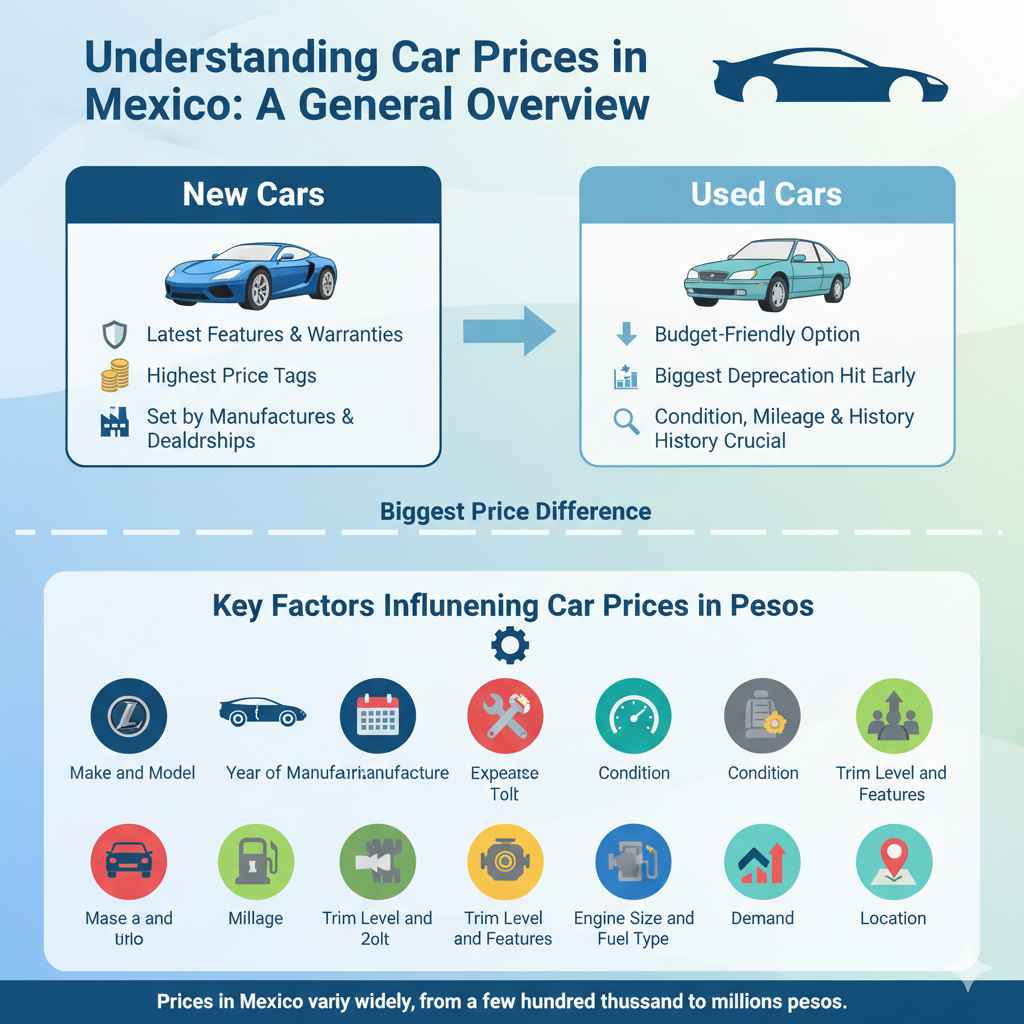
When we talk about “how many pesos is a car in Mexico,” it’s important to understand that there’s no single answer. Just like anywhere else, car prices here vary widely. Think of it like asking “how much does a house cost?” – it depends on size, location, and condition! In Mexico, a small, economical used car might start at a few hundred thousand pesos, while a brand-new, top-of-the-line SUV could easily run into the millions. This guide aims to give you a realistic understanding of these price ranges.
New Cars vs. Used Cars: The Biggest Price Difference
The most significant factor influencing the price of a car is whether it’s new or used. This is a universal truth in the automotive world, and Mexico is no exception.
New Cars
New cars come with the latest features, warranties, and that satisfying new-car smell. However, they also come with the highest price tags. You’re paying for the latest technology, the manufacturer’s warranty, and of course, that pristine condition. Prices for new cars are generally set by manufacturers and dealerships, with some room for negotiation, especially at the end of the model year.
Used Cars
Used cars, on the other hand, offer a more budget-friendly option. The biggest hit in depreciation happens in the first few years of a car’s life. This means you can often find a car that’s only a few years old for a significantly lower price than its original sticker. However, with used cars, condition, mileage, and maintenance history become crucial factors in determining the price. A well-maintained used car can be a fantastic value.
Key Factors Influencing Car Prices in Pesos
Beyond new vs. used, several other elements play a big role in determining how many pesos a car will cost you in Mexico:
- Make and Model: Luxury brands like BMW or Mercedes-Benz will always be more expensive than mass-market brands like Nissan or Volkswagen.
- Year of Manufacture: Newer models are generally more costly than older ones, even within the same make and model.
- Condition: A car in excellent mechanical and cosmetic condition will command a higher price than one with dents, rust, or mechanical issues.
- Mileage: Lower mileage usually means a car has been used less and is likely to have more life left in it, thus fetching a higher price.
- Trim Level and Features: Higher trim levels with premium features (leather seats, advanced infotainment systems, sunroofs, safety assists) will increase the price.
- Engine Size and Fuel Type: Cars with larger engines or those that are specifically electric or hybrid can sometimes carry a premium.
- Demand: Popular models or those that are scarce in the market can see higher prices due to demand.
- Location: While less of a factor than in some other countries, prices can sometimes vary slightly between different states or cities in Mexico.
Estimated Car Prices in Mexico: By Category
To give you a more concrete idea, let’s break down potential price ranges for different types of vehicles. These are approximate figures and can fluctuate based on the factors mentioned above.
Economy/Compact Cars
These are typically the most affordable options. They are great for city driving, fuel-efficient, and easier to park. Think models like the Nissan Versa, Chevrolet Aveo, Volkswagen Virtus, or similar.
- New: Expect to pay anywhere from approximately 250,000 to 400,000 pesos for a new compact car.
- Used (2-5 years old): These can range from about 150,000 to 280,000 pesos, depending on mileage and condition.
- Older Used (5+ years old): You might find these for 100,000 to 180,000 pesos, but be sure to check the maintenance history carefully!
Sedans (Mid-Size)
These offer more space and comfort than compact cars, making them ideal for families or longer commutes. Examples include the Toyota Corolla, Honda Civic, Mazda3, Nissan Sentra.
- New: Prices for new mid-size sedans generally start around 350,000 pesos and can go up to 550,000 pesos or more for higher trims.
- Used (2-5 years old): A good used mid-size sedan could be in the range of 250,000 to 400,000 pesos.
- Older Used (5+ years old): These might be priced between 180,000 and 270,000 pesos.
SUVs/Crossovers
These are very popular in Mexico for their versatility, higher driving position, and often more cargo space. This category includes a wide range, from small crossovers to larger, more robust SUVs.
- New: Smaller crossovers can start around 400,000 pesos, while mid-size or larger new SUVs can easily range from 550,000 to over 1,000,000 pesos.
- Used (2-5 years old): Expect to find used SUVs in the range of 350,000 to 700,000 pesos, with luxury or larger models costing more.
- Older Used (5+ years old): Older, well-maintained models might be found from 250,000 pesos upwards.
Trucks (Pickups)
Pickup trucks are workhorses in Mexico, used for everything from business to recreation. Popular models include the Ford F-150, Chevrolet Silverado, Ram 1500, and Toyota Hilux.
- New: New pickup trucks can start around 500,000 pesos for basic versions and quickly climb to 800,000 to over 1,200,000 pesos for higher trims and larger engines.
- Used (2-5 years old): Used pickups often hold their value well. You might see prices from 400,000 to 800,000 pesos.
- Older Used (5+ years old): Older models could be anywhere from 300,000 pesos and up, depending on their heavy-duty use and condition.
Luxury and Performance Cars
For those looking for premium features, higher performance, or prestigious brands like Audi, BMW, Mercedes-Benz, Porsche, etc.
- New: Prices for new luxury cars start well above 700,000 pesos and can easily surpass 2,000,000 pesos for high-end models.
- Used (2-5 years old): Even a few years old, these cars retain a significant value. Expect prices from 500,000 pesos to over 1,500,000 pesos.
- Older Used (5+ years old): Pre-owned luxury vehicles can offer better value, but still cost from 350,000 pesos upwards, with maintenance costs being a key consideration.
Navigating the Mexican Car Market: Where to Look
Finding a car in Mexico involves a few different avenues. Knowing where to search can save you time and potentially money.
Dealerships
For new cars, dealerships are your primary source. They also often have certified pre-owned (CPO) vehicles. These are typically more expensive but come with inspections and extended warranties. Dealerships are a good option for those who prioritize peace of mind and the convenience of a one-stop shop.
Online Marketplaces
Websites like Mercado Libre (the Latin American equivalent of eBay, with a huge automotive section) and dedicated car sales sites are incredibly popular. You’ll find thousands of listings from private sellers and dealerships alike. Be thorough in your searches and always arrange to see the car in person.
Private Sellers
Buying directly from a private owner can sometimes lead to better prices, as there’s no dealership markup. However, this route requires you to be more vigilant. You’ll be responsible for understanding the car’s history, condition, and handling all paperwork yourself.
Car Auctions
Auctions can be a place to find deals, but they are generally not recommended for beginners. Cars are often sold “as-is,” and you might not have much time for inspection. It’s best to have a mechanic with you if you go this route.
Essential Costs Beyond The Sticker Price
It’s crucial to remember that the price you agree on for the car is not the final cost. You need to factor in other expenses that are part of car ownership in Mexico.
Taxes and Fees
When buying new, there are various taxes and registration fees to consider. These can add a significant percentage to the sticker price. For used cars, there are also transfer of ownership fees and annual plate fees (tenencia). It’s wise to ask dealerships or check official government sources for current rates.
Insurance
Car insurance is a must-have. The cost varies greatly based on the car’s value, your driving record, and the type of coverage you choose. Comprehensive coverage is recommended, especially if you’re in a high-traffic area or driving a newer vehicle.
Maintenance and Repairs
Factor in the ongoing costs of regular maintenance like oil changes, tire rotations, and scheduled servicing. For used cars, be prepared for the possibility of needing repairs sooner rather than later. Researching the reliability of specific makes and models can help you anticipate these costs.
Fuel
Gasoline prices in Mexico can fluctuate. Consider the fuel efficiency of the car you’re looking at relative to your expected driving habits and budget.
Tips For Buying A Car In Mexico
Buying a car can be exciting, but it’s also a big decision. Here are some tips to make the process smoother and more secure:
- Set a Budget: Know exactly how much you can spend, including all associated fees, insurance, and initial maintenance.
- Research: Identify the makes and models that fit your needs and budget. Read reviews and check reliability ratings. For a good starting point on vehicle reliability, you can often find ratings from automotive organizations.
- Inspect Thoroughly: If buying used, take your time. Check for rust, uneven panel gaps, tire wear, and interior condition.
- Test Drive: Pay attention to how the car accelerates, brakes, shifts gears, and handles. Listen for any unusual noises.
- Get a Pre-Purchase Inspection (PPI): For used cars, it’s highly recommended to have an independent mechanic you trust inspect the vehicle before you buy it. This small cost can save you from major headaches and expenses down the road. You can find certified mechanics through local recommendations or automotive clubs.
- Verify Documentation: Ensure all paperwork is in order, including the vehicle registration (tarjeta de circulación), invoice (factura), and any history of paid taxes. For used cars, verify the seller’s ownership with their ID.
- Negotiate Wisely: Be prepared to negotiate, especially with private sellers and sometimes at dealerships. Know the fair market value of the car you’re interested in.
- Understand the Payment Process: Be clear on how payment will be made and when ownership officially transfers. For private sales, consider using escrow services for significant purchases if available and trusted.
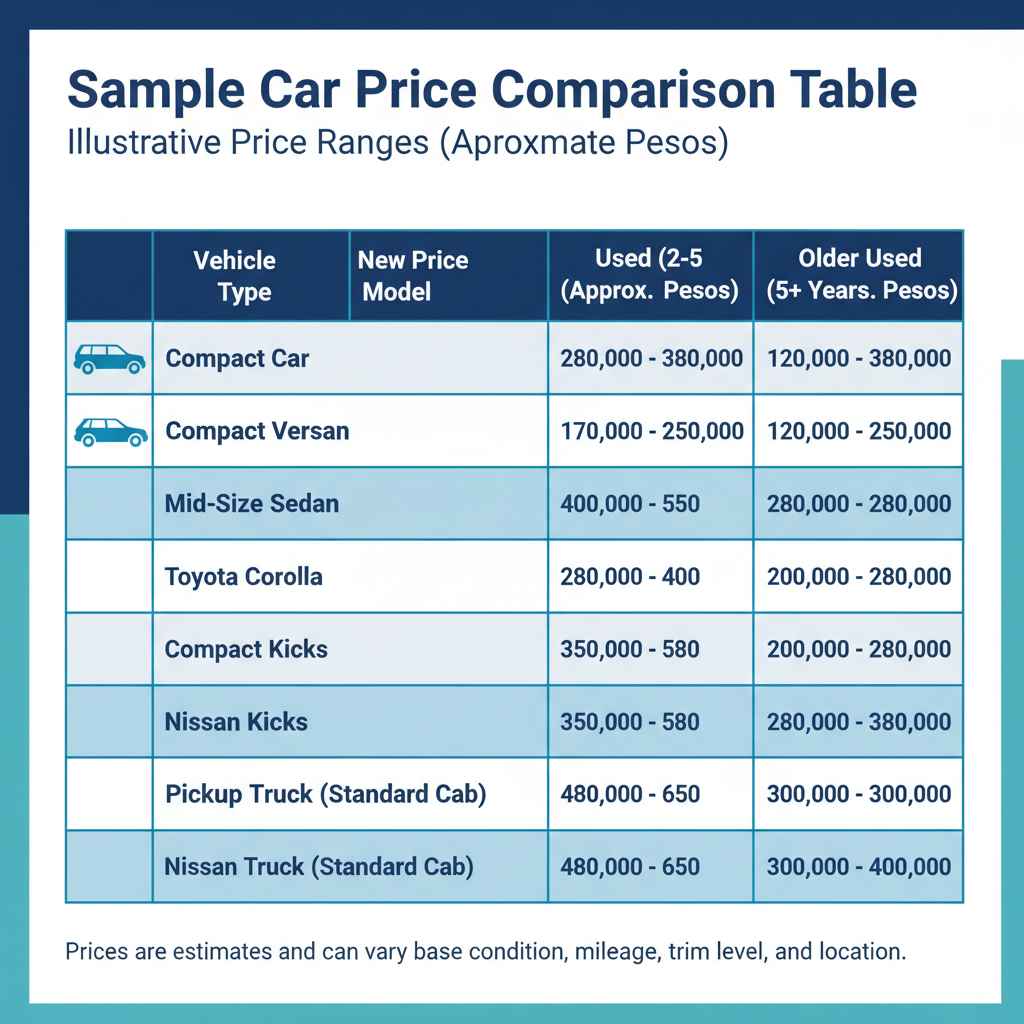
A Sample Car Price Comparison Table
To illustrate the price differences, here’s a simplified table comparing potential costs for similar vehicles in different conditions:
| Vehicle Type | Example Model | New Price (Approx. Pesos) | Used (2-5 Years Old, Approx. Pesos) | Older Used (5+ Years Old, Approx. Pesos) |
|---|---|---|---|---|
| Compact Car | Nissan Versa | 280,000 – 380,000 | 170,000 – 250,000 | 120,000 – 180,000 |
| Mid-Size Sedan | Toyota Corolla | 400,000 – 550,000 | 280,000 – 400,000 | 200,000 – 280,000 |
| Compact SUV | Nissan Kicks | 450,000 – 580,000 | 350,000 – 480,000 | 280,000 – 380,000 |
| Pickup Truck (Standard Cab) | Nissan NP300 | 480,000 – 650,000 | 380,000 – 520,000 | 300,000 – 400,000 |
Frequently Asked Questions (FAQ)
Q1: What is the cheapest type of car I can buy in Mexico?
The cheapest cars are typically older, smaller, used compact cars or subcompacts. You might find some well-used vehicles for under 100,000 pesos, but their condition may require significant investment in repairs.
Q2: Are car prices in Mexico higher or lower than in the US?
Generally, new car prices in Mexico can be comparable to or slightly higher than in the US due to import taxes and local manufacturing costs. However, used car prices can vary widely. In some cases, well-maintained used cars might offer better value in Mexico, while in others, particularly for specific models, the US market might have more competitive pricing.
Q3: What are “chocolate cars” and should I avoid them?
“Chocolate cars” (or “autos chocolates”) refer to vehicles illegally imported into Mexico, often from the United States, without proper customs clearance and registration. These vehicles may have tampered VINs and lack legal documentation. Owning one can lead to confiscation by authorities, fines, and legal trouble. It is strongly advised to avoid purchasing these vehicles. The Mexican government has specific programs to legalize certain older imported cars, but these have strict criteria and processes.
Q4: How much should I budget for annual car ownership costs in Mexico?
Beyond the initial purchase, budget for insurance, annual plate tax (tenencia, if applicable), regular maintenance, fuel, and potential repairs. For a mid-range car, you might budget anywhere from 10,000 to 30,000 pesos or more annually, depending heavily on your driving habits and the car’s age and condition.
Q5: Is it easy to get financing for a car purchase in Mexico?
Financing is available through dealerships and Mexican banks (like Banamex, BBVA, Santander). However, qualification often depends on your credit history in Mexico, Mexican identification (like an INE card), and proof of income. For those new to the country, securing financing might be more challenging initially.
Q6: Can I buy a car in Mexico if I am a foreigner?
Yes, foreigners can buy cars in Mexico. For new cars, you’ll typically need a valid passport, proof of address in Mexico, and sometimes a local bank account. For used cars, the process is similar, but the seller will need to provide all the correct ownership documents. Importing a car from another country into Mexico involves specific customs procedures and taxes.
Conclusion
Navigating the world of car prices in Mexico can seem complex at first, but by understanding the key factors – new vs. used, make and model, condition, and additional costs – you can approach your car search with confidence.