
How Much Does It Cost to Rent a Car for a Week?
A 7-day car rental often costs about $250 to $900 before optional insurance, and the total can be higher for SUVs or airport pickups. A weak budget can turn a “cheap” weekly rental into a bill hundreds of dollars higher at checkout. This guide breaks down base rate, taxes, airport and location fees, insurance, deposits, and which car class fits common trip types.
How much does a week-long rental cost?
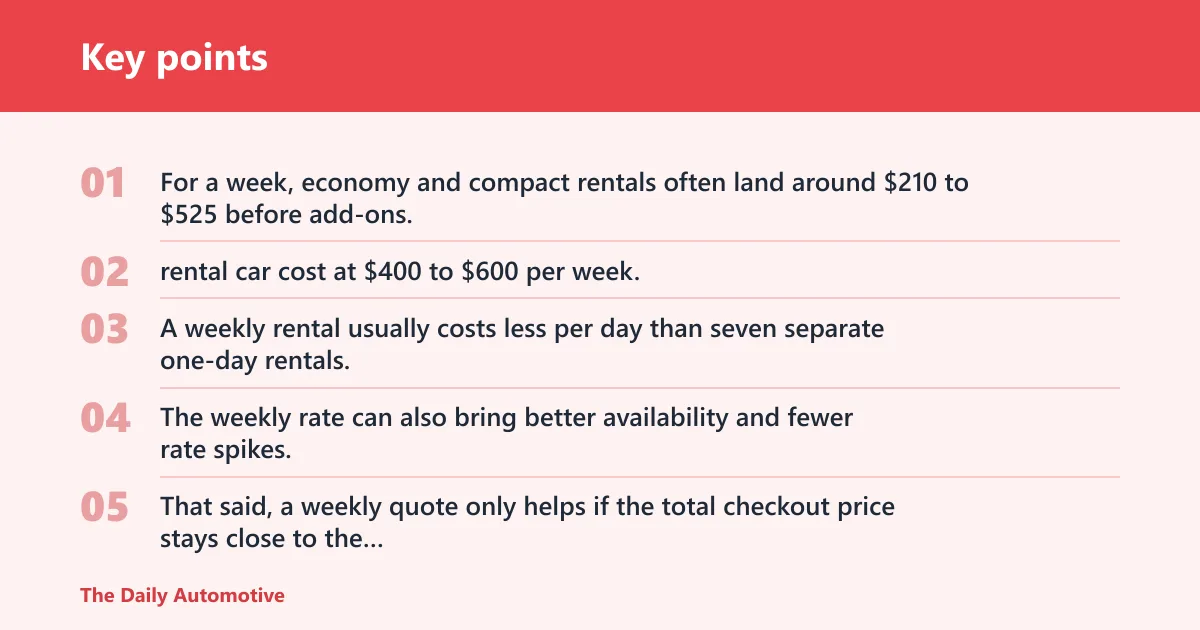


For a week, economy and compact rentals often land around $210 to $525 before add-ons, which works out to roughly $30 to $70 a day. Fidelity puts the average U.S. rental car cost at $400 to $600 per week, so a “normal” checkout total often sits above the lowest headline rate once fees are added.
Daily equivalent vs 7-day pricing
A weekly rental usually costs less per day than seven separate one-day rentals. The weekly rate can also bring better availability and fewer rate spikes, especially when the trip spans a weekend or a busy travel period. That said, a weekly quote only helps if the total checkout price stays close to the headline rate.
Why the quoted rate changes by market
Rental car prices shift with location, timing, vehicle type, and availability. A city-center branch in a slower market may quote much less than an airport location during a holiday week. Brand rules matter too. Many rental companies say pricing depends on location, availability, car type, rental length, and add-ons, and some also note insurance and drop-off changes as cost factors.
Weekly rental cost worksheet
Use this as a checkout checklist, not a promise of a final bill. The base rate is only the starting point. Taxes, fees, coverage, and a hold on your card can all change what actually comes due at pickup.
| Line item | What it covers | Typical amount or rule |
|---|---|---|
| Base rate | Weekly price for the car itself | Economy and compact: $210 to $525 per week |
| Taxes and fees | Local taxes, airport charges, facility fees, and similar line items | Often add 15% to 40% |
| Optional coverage and add-ons | Insurance, GPS, fuel plans, extra driver charges | Varies by trip and policy; can raise the total quickly |
| Deposit or authorization hold | Card hold or deposit at pickup | Some brands use a hold rather than a true deposit; Avis says the card charge can include the rental plus a $250 minimum hold |
A simple way to estimate the checkout price is to start with the base weekly rate, then add the likely fee band, then add any coverage you actually want. Suppose a compact quote starts at $299 for the week. If taxes and fees add 15% to 40%, the checkout total before extras could move into a much wider range than the headline number suggests.
Is airport pickup more expensive?
Usually, yes. Airport locations are often about 20% more expensive than downtown or off-airport branches because of concession fees, facility charges, and local tax treatment. Off-airport pickup is often the lower-cost choice when you can reach the branch without paying for an expensive transfer or extra ride.
Why downtown pickup can cost less
Downtown and other off-airport branches usually avoid some airport-specific charges, so the quote can look cleaner. That does not mean every city works that way. Some off-airport locations run low on inventory or charge more on busy dates, so the lower base rate still needs a full checkout check.
When airport pickup still makes sense
Airport pickup can still be the better fit if you land late, need a one-way start to a road trip, or want the simplest handoff after a flight. Picture a family arriving after midnight with luggage and child seats. The airport counter may cost more, but the convenience can beat a long shuttle ride to an off-airport branch.
Which car class fits your budget?

Car class is one of the fastest ways to move a weekly quote up or down. Economy and compact cars sit at the bottom of the price ladder, midsize is the next step up, SUVs and minivans cost more, and luxury sits at the top. Match the car to passengers, bags, and road conditions before you pay for size you will not use.
Economy and compact
Economy and compact rentals are the budget anchor for most 7-day trips. A typical compact fits two to four passengers, with luggage space for about one to two carry-ons and sometimes a small checked bag depending on the model. These classes work best for solo travel, couples, and short city trips where cargo space matters less than price.
Midsize
Midsize cars usually cost more than economy or compact, but they can be a better value if four adults need more legroom or if you want a calmer highway ride. If you are balancing cost against comfort, midsize is often the middle ground for family visits and regional trips.
SUV and minivan
SUVs and minivans usually cost more because they carry more people and more luggage. They make sense for larger families, group travel, or trips with gear. The extra space can also reduce the need for a second car, which matters when the goal is one vehicle for a full week rather than a low headline rate.
Luxury
Luxury rentals are the highest-cost class in this list. They can be useful for business travel, special events, or premium comfort, but they are rarely the cheapest way to solve a transportation problem. If the trip only needs a clean, reliable weeklong car, luxury usually adds cost without adding useful function.
| Class | Typical weekly base price | Airport vs off-airport note | Best fit |
|---|---|---|---|
| Economy | $210 to $525 | Airport pickup often pushes the total higher | Solo travelers, couples, light luggage |
| Compact | $210 to $525 | Off-airport pickup often keeps fees lower | City trips, short road trips, small groups |
| Midsize | Above economy and compact | Airport premium still matters | More room for passengers and bags |
| SUV | Higher than midsize | Airport fees can compound the higher base rate | Families, gear, rougher routes |
| Minivan | Higher than SUVs in many markets | Often one of the priciest non-luxury options | Large families or groups |
| Luxury | Top end of the price stack | Fees and deposits can be steeper | Premium travel and special occasions |
What adds to the total bill?
The base rate is only part of the answer. Insurance, GPS, fuel plans, additional drivers, age surcharges, mileage limits, and card holds can all move the total. If you want a realistic budget, you need to price the extras you will actually use and ignore the ones you do not need.
Insurance and protection plans
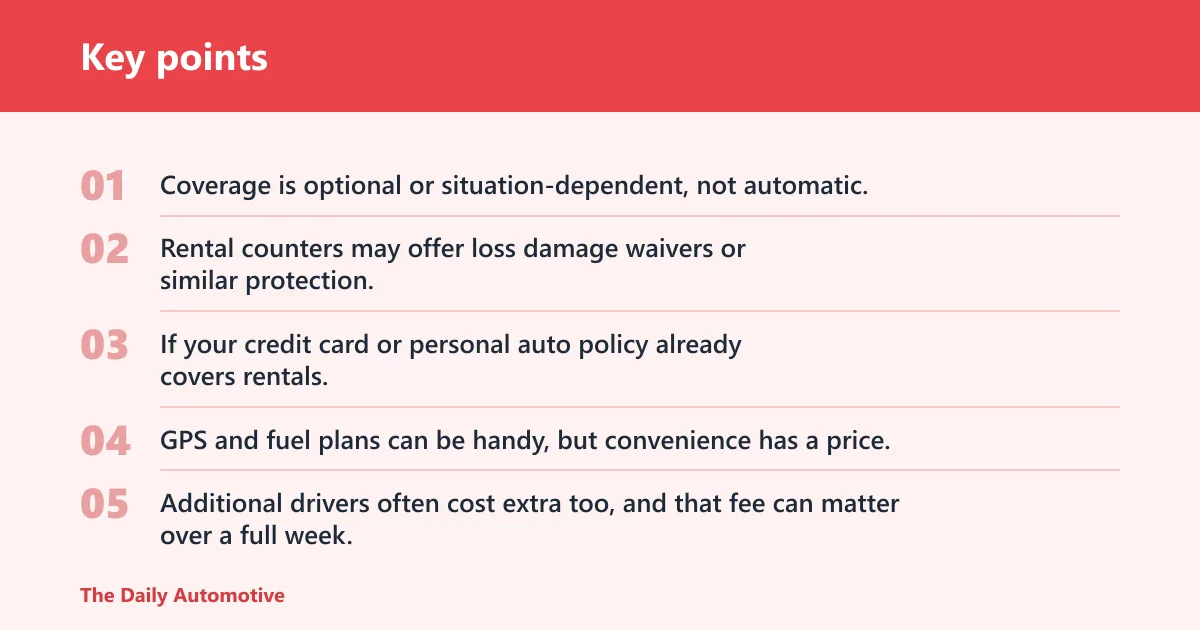
Coverage is optional or situation-dependent, not automatic. Rental counters may offer loss damage waivers or similar protection, and that choice can add a meaningful amount to a weekly bill. If your credit card or personal auto policy already covers rentals, the rental-company option may be unnecessary.
GPS, fuel plans, and extra drivers
GPS and fuel plans can be handy, but convenience has a price. Additional drivers often cost extra too, and that fee can matter over a full week. Enterprise lists add-ons as a cost factor, which is why the checkout screen should be checked line by line before you confirm.
Under-25 surcharges
Driver age can change the price fast. The same source says under-25 renters can expect a surcharge of $25 per day and up. Company policy varies, and the fee may differ by location, vehicle class, and age band. A 7-day rental with that surcharge can climb quickly, even before coverage is added.
Mileage limits and unlimited miles
Do not assume unlimited miles are included. Some weekly rentals do offer unlimited mileage, but others cap use or price mileage separately. If you are planning a road trip, unlimited miles can be worth paying for because overage charges can turn a good weekly quote into a poor total. That needs confirmation on the booking page, not a guess.
Say your trip starts with a compact car at a downtown branch, then you add one extra driver and a fuel plan. The base price may still look low, but the total bill rises because each add-on has its own line item. The checkout total, not the banner rate, is what matters.
How much do brands and markets vary?
Brands do not publish one universal weekly price. Quotes often depend on branch, date, car class, length, and add-ons, so a live quote check for the exact pickup point and travel week is the most direct comparison. Location matters too. Florida, California, and UK pricing can all look different from a generic U.S. average.
Enterprise and Hertz quote checks
For Enterprise or Hertz, compare the same car class, the same rental length, and the same pickup location before deciding which is cheaper. A downtown branch can beat an airport branch, and a slightly different class can hide a large price jump. A fair comparison starts with the checkout total, not the first number on the results page.
Florida, California, and UK pricing context
Florida and California often show strong market variation because airport demand, tourism, and seasonality can all move rates. The UK adds another layer, since local taxes, currency differences, and branch rules affect the final number. For a weeklong trip, the same class can price very differently in each market, so use the local quote rather than a generic average.
Peak season and last-minute pricing
Peak season usually pushes weekly rates higher, especially at airports and in tourist markets. Last-minute bookings can also cost more when inventory is tight. Advance booking often gives you more choice in class and pickup time, and it may keep the rate closer to the lower end of the range. If your dates are fixed, book early and recheck later if the company allows changes.
Frequently asked questions
How much does it cost to rent a car for a week on average?
For a broad U.S. average, Fidelity says weekly rental car cost ranges from $400 to $600. Economy and compact cars can come in lower, at roughly $210 to $525 per week before add-ons. The final total depends on location, vehicle class, timing, and whether airport or off-airport pickup is used.
How much does it cost to rent a car for a week from Enterprise?
Enterprise does not publish one fixed weekly price because cost depends on length, car class, location, insurance, add-ons, and drop-off changes. The right way to price it is to quote the exact branch and dates, then compare the checkout total against other brands for the same class.
How much does it cost to rent a car for a week from Hertz?
Hertz pricing varies by market, vehicle type, and travel dates, so there is no single weeklong number that fits every rental. Compare the same class, pickup point, and mileage terms across the same dates. The quote with the lowest headline rate is not always the cheapest checkout total.
How much does it cost to rent a car for a week with unlimited miles?
Unlimited miles can be included, but it is not guaranteed. The price depends on class, branch, and trip length. For a road trip, unlimited mileage is worth checking first because a lower headline rate with mileage caps can end up costing more once overage charges are added.
How much does it cost to rent a car for a week in Florida?
Florida weekly prices change by city, airport, and season, so there is no single statewide number. Tourist-heavy markets can price higher during busy periods, especially near airports. Compare downtown and airport branches for the same car class and travel week before you book.
How much is the deposit on a weekly rental car?
Deposit rules vary by company and payment method. Avis says there is no deposit, but there may be an authorization hold, and the card charge can include the rental plus a $250 minimum hold. Debit cards can face tighter rules than credit cards, so check the payment policy before pickup.
Products related to this article
Sponsored / affiliate links. As an Amazon Associate I earn from qualifying purchases. I may earn additional commission from eligible campaigns.