
How Much Do Auto Tech Teachers Make? Pay by School Type
Auto tech teachers often make somewhere around $50,000 to $80,000 a year, and community-college or unionized public-school roles may pay more than short-term program jobs. If you ignore setting, credentials, and location, you can overstate earnings by tens of thousands or miss benefits that change the real value. This guide breaks down pay by school type, license stack, and region so you can judge the career path accurately.
Factors That Shift Auto Tech Pay From Entry to Director
In many full-time, year-round roles, hourly pay may land around the high $20s to low $30s, which works out to an annual salary in roughly the same general range. Entry-level jobs usually start lower, while seasoned instructors and program directors can move above that band when the school, credentials, and schedule support it.
Annual pay versus hourly pay
Annual salaries matter more than hourly pay in this field because many roles include prep time, lab setup, and student supervision that a simple hourly comparison misses. A year-round $60,000 salary works out to roughly $29 an hour on a 40-hour basis. A school-year role with summers off changes the math again.
Entry-level versus experienced pay
Entry-level positions typically offer a starting salary, especially in high school or smaller post-secondary programs. Pay climbs with years in the trade, and experienced instructors may command the highest salaries when they bring documented shop experience, ASE credentials, and a record of strong enrollment and placement results.
When program director roles change the ceiling
Higher pay is available for program directors or instructors with advanced manufacturer certifications. That pay bump reflects budget control, curriculum oversight, safety management, and employer demand for someone who can recruit students and maintain lab equipment as well as teach diagnostics.
📊 Auto tech teachers typically earn between $58,000 and $67,000 per year. Source: How Much Do Auto Tech Teachers Make?.
What does an automotive technology instructor do?
An automotive technology instructor teaches repair theory, supervises shop labs, and prepares students for certifications and entry-level jobs. The role also includes safety oversight, tool control, grading, and keeping lessons aligned with current vehicle systems, which now include scan tools, electrical diagnosis, and computerized drivability work.
Classroom instruction and lab supervision
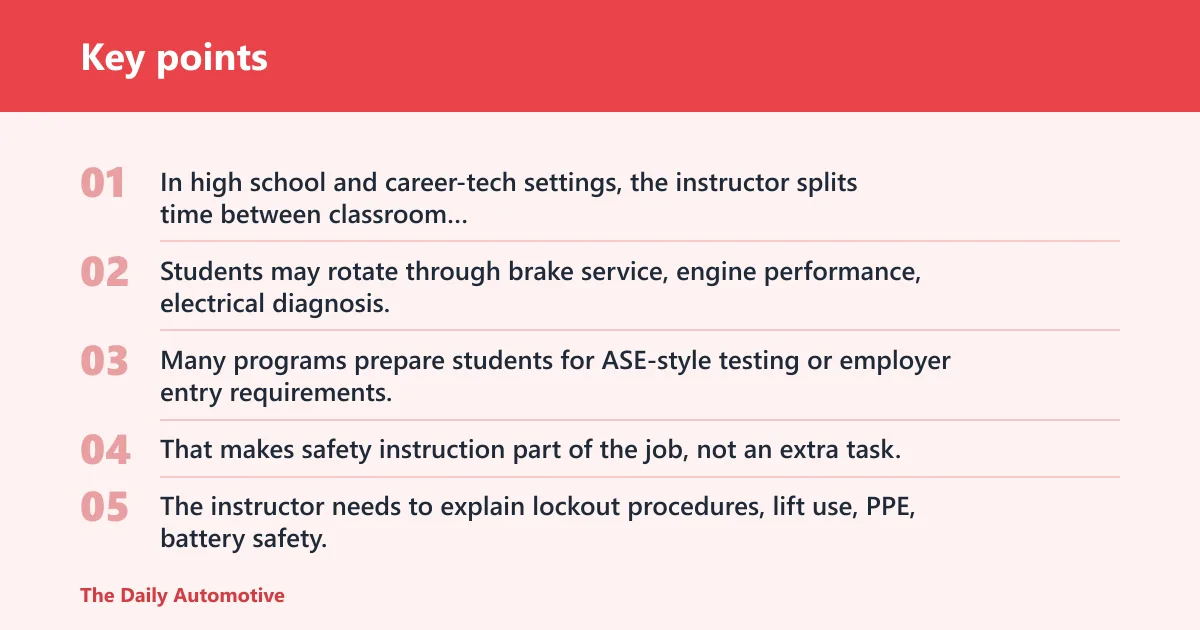
In high school and career-tech settings, the instructor splits time between classroom instruction and hands-on bay work. Students may rotate through brake service, engine performance, electrical diagnosis, and basic preventive maintenance while the teacher watches workflow, keeps the lab organized, and stops unsafe tool use before it becomes a problem.
Student credential prep and shop safety
Many programs prepare students for ASE-style testing or employer entry requirements. That makes safety instruction part of the job, not an extra task. The instructor needs to explain lockout procedures, lift use, PPE, battery safety, and airbag precautions in a way students can follow under pressure.
Industry experience and day-to-day responsibilities
Most employers want industry experience because the job is part teaching role, part shop leadership. A common mistake is assuming an auto tech teacher only works school hours and never spends extra time supervising shop projects or updating equipment. In practice, it often includes inventory control, bay cleanup, equipment requests, student coaching, and employer outreach.
How do school setting and employer type affect pay?
Pay changes a lot by employer type. High school programs often pay less than post-secondary roles, while community colleges, career-tech centers, and manufacturer-affiliated training jobs can sit higher on the scale because they expect deeper technical knowledge, broader responsibility, or more direct industry alignment.
Salary stack by setting, credentials, and pay drivers
| Setting | Likely pay drivers | Credential requirements | Where it tends to sit on the pay scale |
|---|---|---|---|
| High school | Teacher certification, school-district pay bands, coaching or extra-duty assignments | Minimum high school diploma or GED plus state teaching credential rules | Usually lower to middle of the range |
| Community college | Post-secondary teaching load, lab oversight, student outcomes, employer partnerships | Industry experience, post-secondary hiring standards, often ASE and related training | Middle to upper-middle of the range |
| Career-tech center | Program size, lab complexity, regional labor demand, certification prep duties | High school diploma or GED, industry background, often ASE or equivalent proof of skill | Middle of the range, sometimes higher with demand |
| Manufacturer-affiliated training | OEM curriculum depth, brand certification, technical specialization | Manufacturer certifications, strong diagnostic background, current repair knowledge | Often higher than standard school-based roles |
High school auto shop programs
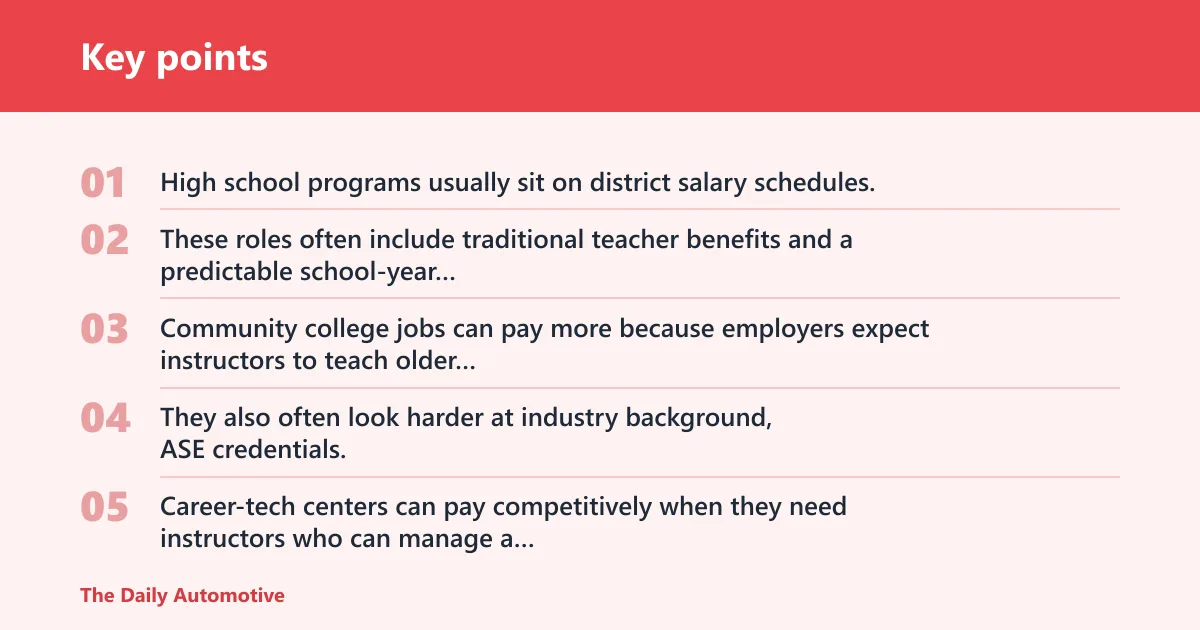
High school programs usually sit on district salary schedules, so pay can be steady but not flashy. These roles often include traditional teacher benefits and a predictable school-year calendar, yet they may trail the top shop-floor technician pay that experienced technicians can reach.
Community college and post-secondary programs
Community college jobs can pay more because employers expect instructors to teach older students, maintain advanced equipment, and support completion or placement metrics. They also often look harder at industry background, ASE credentials, and the ability to teach diagnosis rather than only routine maintenance.
Career-tech centers and manufacturer-affiliated training
Career-tech centers can pay competitively when they need instructors who can manage a full lab and keep enrollment healthy. Manufacturer-affiliated training can pay even more when the employer wants brand-specific expertise, especially if the instructor knows dealer workflows, new-model systems, and OEM service information.
What do Texas and Austin auto tech teacher salaries look like?

Texas auto tech teacher salary data points to an average of $58,656, which sits close to the typical national range. Austin, Texas salary averages $55,807 to $66,937, and the city’s stronger labor demand and cost of living can push offers upward in some schools while smaller programs stay below that band.
Texas auto tech teacher salary range
Statewide pay in Texas depends on whether the job sits in a district, a community college, or a workforce-training program. Texas also has wide local variation, so an instructor in a fast-growing metro may earn more than a peer in a smaller town even when the job title looks identical.
Austin, Texas salary band and local demand
Austin’s range of $55,807 to $66,937 reflects local demand and the competition for technical talent. Schools with strong enrollment, active employer partnerships, or hard-to-fill evening sections may pay toward the top end, especially when they need someone who can teach advanced diagnostics and keep students job-ready.
How listings and cost of living shape pay
Listings often reveal more than broad averages. A full-time opening that requires ASE credentials, night classes, and prior shop experience may pay more than a basic daytime role, but the local rent burden matters too. A salary that looks fine in one city may feel thin in another once housing and commuting costs are counted.
Say your local career-tech center advertises one opening and the job asks for ASE brakes and electrical credentials, plus evening instruction one night a week. That combination usually signals a stronger pay offer than a standard classroom-only role, because the school needs a working instructor and not just a subject-matter teacher.
Which credentials can move auto tech teacher pay?
Credentials matter because they signal current repair knowledge and the ability to teach modern vehicle systems. ASE certification may help with hiring and pay, and manufacturer certifications can be especially useful when the program is tied to a brand-focused curriculum or dealer pipeline.
ASE certification and specialty areas
ASE certification in specific areas such as brakes, engine repair, and electrical systems can demonstrate expertise. Employers often like that proof because it is easy to verify and maps well to what students need to learn. In many listings, ASE is not just preferred; it is used as a screening tool.
Ford and General Motors certifications
Manufacturer certifications, including Ford certification and General Motors certification, can raise earning power when the employer teaches brand-specific service methods or works closely with dealer networks. That premium is usually strongest in post-secondary or manufacturer-affiliated roles, where OEM content matters more than in a general high school shop.
Education requirements and industry experience
Auto tech teachers typically need a minimum of a high school diploma or GED, though many employers expect more than the floor. Strong candidates usually combine formal training with years in the trade, and that mix becomes more valuable when the job includes curriculum planning, student assessment, and shop supervision.
- Check whether the opening is high school, post-secondary, career-tech, or manufacturer training.
- Match your current credentials against the listing, especially ASE or OEM requirements.
- Compare the salary to local housing and commute costs, not just the headline number.
- Look at whether the job is full-time, school-year only, or part-time with limited hours.
- Ask about benefits, prep time, and lab responsibilities before judging the offer.
Are benefits and schedule part of the real value?
Yes. Health insurance, retirement plans, and continuing education can materially change the worth of an auto tech teacher job. Stable hours also matter, because many instructors trade the unpredictability of shop work for a school calendar, even if the salary trails top technician earnings.
Health insurance and retirement plans
Public-school and college roles often include health insurance and retirement plans, which can narrow the gap between the posted salary and the real compensation value. Those benefits are worth comparing carefully, especially when one employer offers a slightly lower wage but a stronger retirement match.
Continuing education and tuition support
Continuing education support can be a real advantage in a field that changes quickly. Schools may pay for certification renewals, diagnostics training, or curriculum updates. That support can save money and help an instructor stay current enough to teach hybrid systems, scan-tool use, and evolving electrical work.
Stable hours, summers off, and part-time tradeoffs
The role offers more stable hours, but not every job is full-time or year-round. Some programs run part time, and some school-year jobs come with summers off instead of summer pay. Low-enrollment programs can also limit overtime, section count, and advancement, which cuts annual earnings even when the posted salary looks solid.
Suppose a district offers an auto shop teaching job with a solid salary and benefits, but only one section enrolls enough students to run the lab full time. The instructor may have lighter days, fewer stipend opportunities, and less room for extra pay than a larger program with two full classes and evening sections.
Frequently asked questions
How much do auto tech teachers make?
Auto tech teachers typically earn between $58,000 and $67,000 per year, though local pay schedules can move the number up or down. Entry-level openings sit closer to the bottom of the range, while experienced instructors, especially those with advanced certifications, can move higher.
How much do automotive techs make?
Shop-floor automotive tech pay varies far more than teacher pay because flag hours, brand specialization, and customer volume all matter. Teaching pay often trails top shop-floor technician pay, but the classroom role usually offers more stable hours and, in many districts, better benefits.
How much does an auto technician make?
An auto technician’s income depends on whether the role is flat-rate, hourly, or salary based, plus the type of repairs handled. Heavy diagnostics, dealership work, and brand certification can raise earnings, while slower independent shops or entry-level positions usually pay less.
How much can an automotive technician make?
Experienced automotive technicians can earn substantially more than entry-level workers, especially in dealership or specialty settings. Income rises with advanced diagnostics skill, manufacturer training, and work volume, while pay can flatten if the shop has limited customer flow or weak labor rates.
How much money do automotive technicians make?
Automotive technicians can make a modest starting wage or a strong upper-end income, depending on experience and specialization. The spread is wide, so it helps to compare hourly rate, efficiency bonuses, and benefits instead of focusing on one advertised number.
How to become an auto technician salary?
Start by earning basic automotive training, then look for entry-level shop work, ASE testing, and manufacturer-specific certification. Salary usually rises with proven diagnosis ability, repeatable repair quality, and specialization in systems that are harder to master, such as electrical and drivability work.
Is being an automotive technician worth it?
It can be worth it if you want hands-on work and can handle the physical pace and constant learning. The tradeoff is clear: strong technicians can earn well, but the job can be demanding, and income often depends on the shop model, not just skill.
Products related to this article
Sponsored / affiliate links. As an Amazon Associate I earn from qualifying purchases. I may earn additional commission from eligible campaigns.