How Much Do Car Rotors Cost? A Simple Guide for Everyone
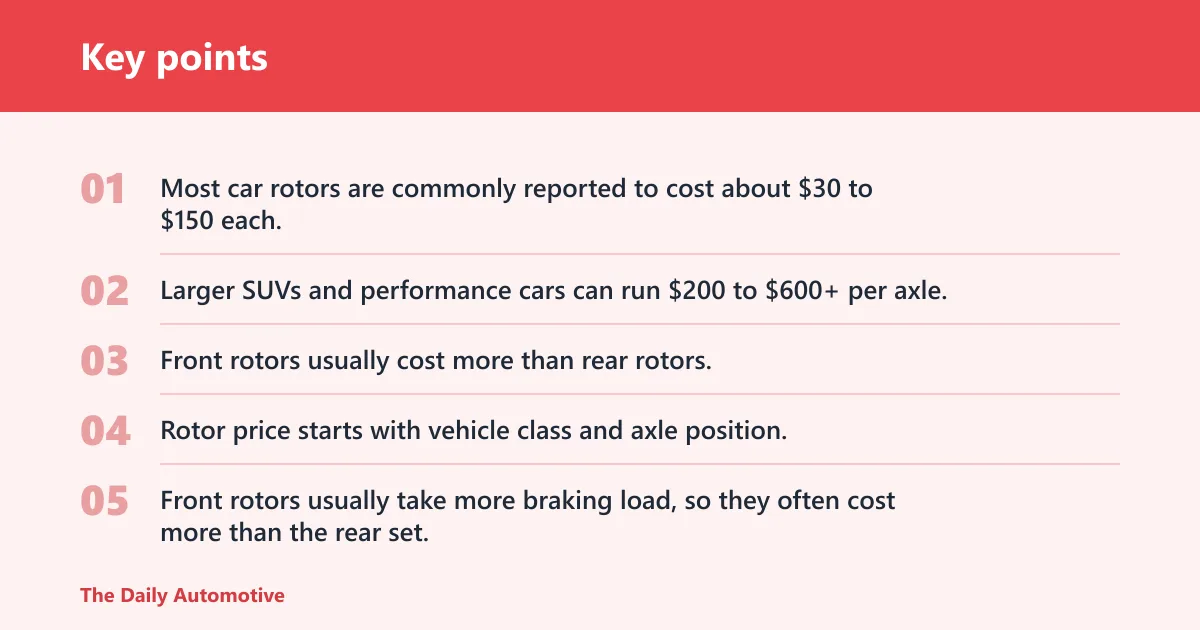
Most car rotors are commonly reported to cost about $30 to $150 each, or roughly $60 to $300 per axle in parts. Larger SUVs and performance cars can run $200 to $600+ per axle. Front rotors usually cost more than rear rotors, and a quote for one rotor can hide the fact that shops often replace both rotors on the same axle.
Rotor prices by vehicle and axle


Rotor-only pricing by axle
Rotor price starts with vehicle class and axle position. Front rotors usually take more braking load, so they often cost more than the rear set. Standard replacement rotors are usually the lowest-priced option, while slotted and drilled versions push the bill higher because of the extra machining and the niche use case.
| Vehicle class | Front axle rotors | Rear axle rotors | Full-job rotor parts range | Common add-ons and warning signs |
|---|---|---|---|---|
| Compact sedan | $60 to $140 | $50 to $120 | $110 to $260 | Pads, hardware, labor, and rust cleanup can add $150 to $350. Grooves, thickness variation, or a seized caliper bracket often push the job away from a quick rotor swap. |
| Midsize sedan | $80 to $180 | $60 to $150 | $140 to $330 | Pads and labor commonly add $180 to $400. Warping symptoms, heavy rust on the hub face, or worn guide pins can turn a simple quote into a longer brake service. |
| SUV or truck | $120 to $300 | $100 to $240 | $220 to $540 | Larger calipers, heavier rotors, and corrosion cleanup raise the bill. Hardware, pads, and labor can add $220 to $500, especially if fasteners seize. |
| Performance car | $150 to $450 | $120 to $350 | $270 to $800+ | Specialized rotors, pad wear, and tighter brake packages increase cost. Slotted or drilled options can add more, and dealer labor often lands higher than an independent shop. |
When a single rotor quote is misleading
A quote for one rotor can look low until the shop adds the second rotor, pads, hardware, and labor. Brake work is usually priced by axle because braking stays even only when both sides match closely. If one rotor is badly worn, the other side is often close behind.
Say your compact sedan needs a right-front rotor because it is grooved and noisy. The parts price may look small, but the final bill rises once the shop replaces the left-front rotor, installs pads, and clears rust from the hub face so the new rotor sits flat.
What makes rotor prices change
Rotor prices change because the parts themselves are different and the labor around them is different. OEM rotors usually cost more than standard aftermarket parts, while slotted and drilled rotors cost more still. Dealerships will charge more than independent stores, and seized hardware or corrosion can add time.
Parts type: OEM, aftermarket, slotted, or drilled
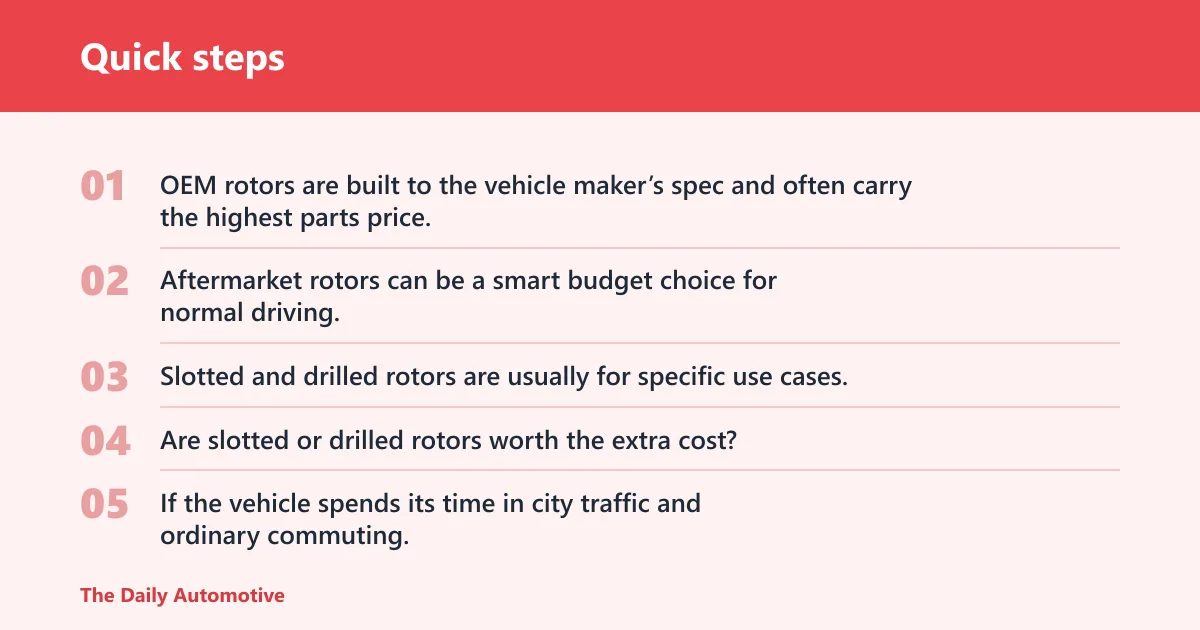
OEM rotors are built to the vehicle maker’s spec and often carry the highest parts price. Aftermarket rotors can be a smart budget choice for normal driving. Slotted and drilled rotors are usually for specific use cases, such as repeated heat loads, and they rarely make sense just because they look sportier.
Are slotted or drilled rotors worth the extra cost? For most daily drivers, usually not. If the vehicle spends its time in city traffic and ordinary commuting, a standard rotor is the more practical buy. The extra cost makes more sense when repeated hard braking and heat management matter more than price.
Labor rates and shop type
Labor rate matters because brake work is billed by time, and location changes that time charge. Independent shops usually come in lower than dealerships. Some brake jobs are simple and fast, but others need more time because the caliper bracket, guide pins, or pad hardware are rusted or seized.
Rust, seized hardware, and extra cleanup
Rust on the hub face can make a fresh rotor sit unevenly, which leads to vibration or a steering wheel shake. Seized slide pins, frozen brackets, and corroded bolts add labor. In salt-belt areas, a rotor job can turn into cleanup work before the new parts even go on.
Should you resurface or replace rotors?
Rotor resurfacing means machining the disc on a brake lathe to remove grooves and restore a flat surface. It can save money when the rotor still has enough thickness left. It stops making sense when machining would leave the rotor too thin, or when the labor cost is close to the price of a new rotor.
When machining can still work
Resurfacing can work when the rotor is only lightly grooved, has no deep heat damage, and remains within thickness limits after cutting. Rotors often need complete replacement or resurfacing on a brake lathe, but new rotors in contemporary cars are usually about the same price as machining fees.
That price match is why many shops steer drivers toward replacement during major brake service. Mechanically, a fresh rotor is often the cleaner call when the old disc already needs pad replacement, rust cleanup, and labor.
Warning signs that call for replacement
Replacement is the better call when rotors show deep grooves, heavy rust pitting, thickness variation, heat cracks, or repeated warping symptoms. If the rotor has already been machined once or twice, another cut may leave too little material for safe use.
Suppose a midsize sedan has a pulsating pedal, a rusty hub face, and rotors that measure near the service limit. In that case, resurfacing can look cheaper on paper but cost more in repeat labor and reduced rotor life. Replacement is the safer budget choice there.
How much does it cost to replace rotors and brake pads together?
Rotors and pads are usually replaced together because worn pads shorten rotor life, and fresh pads can damage worn rotors if they are installed alone. Ceramic pads are expensive but provide longer life, less noise, and cleaner wheels. Semi-metallic choices offer good performance at reasonable costs.
Pad material choices and price impact
Pad material changes both cost and wear behavior. Organic pads tend to be quieter and softer, but they may wear faster. Semi-metallic pads balance cost and stopping performance. Ceramic pads usually cost more, yet they often last longer and keep wheels cleaner.
High-quality brake pads usually last between 30,000 and 70,000 miles. Premium brake pads can last over 70,000 miles. Some brake pads may need replacement as early as 25,000 miles. A pad set that wears early can take rotors with it if the backing material starts contacting the disc.
Pairing pads with axle replacement
When pads and rotors are changed together on one axle, the total bill often includes both sets of parts, new wear hardware, and labor. For many compact and midsize cars, that means a parts-and-labor total that is much higher than rotor-only pricing. Larger vehicles move higher because the parts are larger and more expensive.
Brake pad replacement on a Toyota RAV4 is listed at $110 to $270 per axle. That figure helps show how pad labor and parts can stack on top of rotor work, especially on vehicles with larger brake packages.
Rotor wear, lifespan, and maintenance
Rotor life depends on driving style, road conditions, and how often the brakes are inspected. Stop-and-go traffic, steep mountain routes, aggressive braking, and road salt all speed up wear and corrosion. Brake fluid flushes are advised every two years, and regular brake inspections help catch problems before they become expensive.
Typical wear signs to watch
Common rotor problems include brake pedal pulsation, squealing, grinding, vibration, visible grooves, and uneven pad contact. If the steering wheel shakes under braking, the front rotors are often the first place to check. Rear rotors can still wear badly, but the symptoms may feel different.
How driving habits change rotor life
Heavy traffic and mountain driving make rotors work harder because the brakes are used more often and with more heat. Aggressive braking adds even more heat. Road salt attacks the metal surface and can leave rust that speeds up pad wear and makes rotor replacement more likely.
- Have the pads, rotors, calipers, and hardware inspected at every major brake service.
- Replace rotors in pairs on the same axle when the wear pattern is uneven or the surface is damaged.
- Compare repair quotes before you authorize work, especially if the shop recommends pads, rotors, and hardware together.
- Follow the brake fluid flush interval every two years so moisture does not add to brake-system wear.
Simple maintenance that helps control costs
Routine inspections catch thin pads before they chew into rotors. They also catch torn boots, sticking calipers, and rusted hardware before those parts turn a routine brake job into a large repair. Mechanics often recommend fixing rotors during every major brake service because waiting usually raises the total later.
Frequently asked questions
How much do car rotors cost?
Larger SUVs and performance models often cost more, and front rotors usually land higher than rear rotors because they carry more braking load.
Are rotors cheaper to replace or resurface?
Resurfacing can be cheaper when the rotor still has usable thickness and only light damage, but that gap has shrunk. New rotors in contemporary cars are usually about the same price as machining fees, so replacement often makes more sense when labor is already in play.
How long do brake rotors usually last?
Rotor life depends on the pads, the road, and the driver’s braking habits. There is no single mileage that fits every car, but frequent stop-and-go use, mountain driving, and rust can shorten life. Pads often wear out first, then the rotors follow.
Why are rotors more expensive on SUVs and performance cars?
SUVs, trucks, and performance cars use larger, heavier brake parts and sometimes more specialized rotor designs. Bigger rotors cost more to make, and the brake hardware around them takes more time to service. That combination pushes both parts and labor higher.
Can I replace just one rotor, or should I replace both on an axle?
Rotors are usually replaced in pairs on the same axle so braking stays even from side to side. A single rotor replacement can leave the axle with uneven friction or wear, which may cause pull, vibration, or different stopping behavior.
What makes rotor replacement cost more at a dealership?
Dealership pricing is often higher because labor rates are higher and the shop may use OEM parts by default. Dealerships will charge more than independent stores, especially when the job needs rust cleanup, seized hardware removal, or extra brake-system inspection.
Are slotted or drilled rotors worth the extra cost?
They can be worth it for drivers who repeatedly brake hard or need more heat control, but they are not a default upgrade. For most daily driving, a standard rotor is the better value because it costs less and usually lasts well under normal use.
How much does podcasting cost?
That question does not fit brake service, but the answer on a budgeting page would be similar: costs depend on the setup, the labor, and the gear quality. For rotors, the useful takeaway is the same, get a real quote for your exact vehicle, then compare parts, labor, and add-ons before approving the work.
Products related to this article
Sponsored / affiliate links. As an Amazon Associate I earn from qualifying purchases. I may earn additional commission from eligible campaigns.