How Much Does Tire Rotation Cost?
Tire rotation usually costs about $20 to $60, though many shops may include it free with another service or a prepaid maintenance plan. Wait too long, and you can pay more for uneven tread wear, extra noise, and shorter tire life. This guide breaks down what rotation alone should cost, when alignment or balance work changes the bill, and how chain-store offers compare.
This guide is part of our Car ownership essentials series.
Typical cost range
A basic tire rotation is usually a labor charge, not a parts-heavy repair. The typical retail range is $20 to $80 for a set of tires, with the final number shaped by labor rates, vehicle layout, and local market pricing.
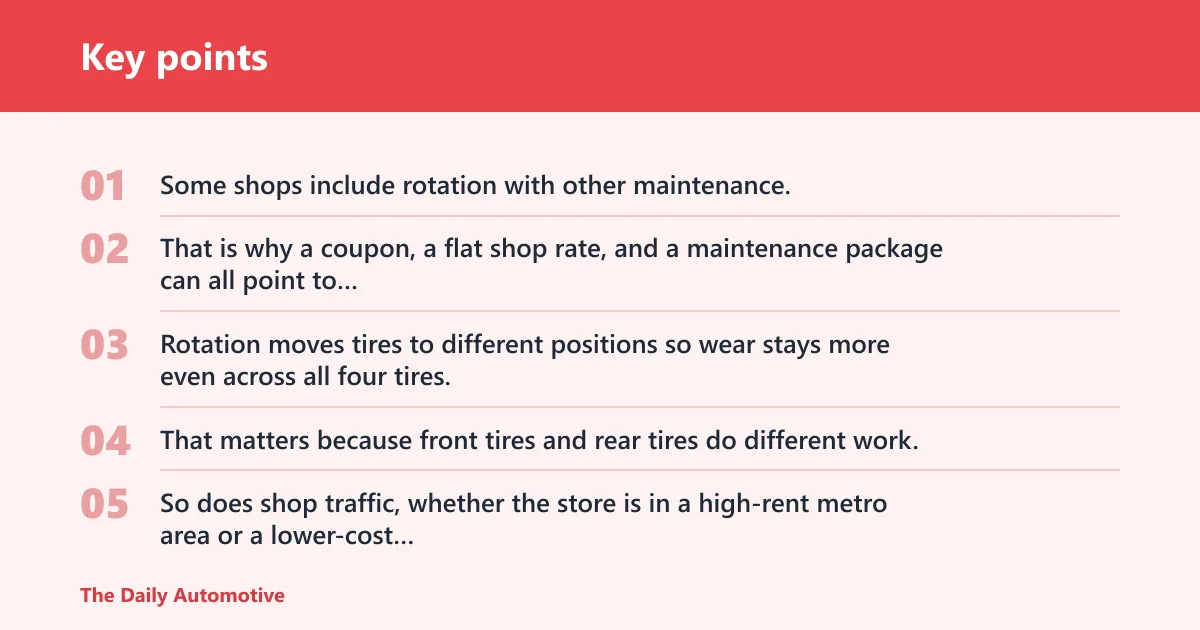
Rotation-only pricing is the base case. Bundle pricing is different. Some shops include rotation with other maintenance, and some tire retailers include it free when you buy the tires there. That is why a coupon, a flat shop rate, and a maintenance package can all point to different numbers for the same service.
Rotation moves tires to different positions so wear stays more even across all four tires. That matters because front tires and rear tires do different work, and the wear pattern changes with drive type, weight balance, and alignment condition.
Why prices vary by region
Local labor rates matter. So does shop traffic, whether the store is in a high-rent metro area or a lower-cost market, and whether the location is selling the rotation as a loss leader to bring you in for other service.
That is why one location can advertise a coupon for far less than its standard rate, while another shop charges the full menu price with no promotion at all.
Rotation-only versus bundled service
A rotation-only visit covers moving the tires and, at many shops, a quick visual check. Bundled visits can add balance, road-force balancing, alignment inspection, brake checks, or a full maintenance package. Once those extras are added, the bill climbs for labor more than for parts.
Chain-store price examples
National chains are useful as examples, but not as universal pricing. Location, promotion, and the service package change the bill. The same brand may quote a coupon price at one store and a standard flat rate at another.
Firestone, jiffy Lube, discount tire, midas, and yourMechanic
Firestone’s coupon price for a rotation can be $9.99, while its regular flat rate is about $25. That gap shows how much coupon-driven pricing can differ from standard pricing.
Jiffy Lube’s usual tire-rotation cost is about $40. In practice, that number often sits in a service-bundle context, where the visit may be paired with routine maintenance rather than sold as a bare-bones add-on.
Discount Tire charges about $15 per tire for rotation. It may also include rotation and balance free with tire purchase, which is a very different offer from paying retail for a stand-alone visit.
Midas rotation starts at about $20, but package pricing can raise the total if the visit includes inspection or other maintenance items. YourMechanic tire rotation usually starts at $79, which reflects the mobile service model and on-site labor.
How much is rotation with add-ons?
Once you add balance or alignment, you are no longer buying the same service. Rotation alone moves the tires. Balance corrects wheel-and-tire weight distribution. Alignment adjusts suspension angles. Each one can be useful, but they solve different problems.
Rotation and balance pricing
Rotation and balance usually costs more than rotation alone because balancing typically takes extra labor and often extra equipment use. This bundle makes sense if you feel vibration, if weights have been lost, or if the shop finds balance-related wear during inspection.
Rotation and alignment pricing
Rotation and alignment is usually a larger bill than rotation and balance. Alignment changes steering geometry, so the work belongs on its own line item unless the shop is already correcting pull, steering wheel off-center position, or abnormal edge wear.
Say your compact sedan needs only a routine rotation at 6,000 miles. That is usually a straight rotation visit. Suppose the steering wheel also sits off-center after a pothole hit; then alignment becomes a separate line item, and the total rises for a real repair reason, not just because tires were moved.
Price decision table
| Vehicle type | Tire setup | Service add-ons | Likely price range | Recommended or modified |
|---|---|---|---|---|
| FWD | Standard four-tire set | Rotation only | $20 to $60 | Recommended with a forward cross pattern |
| RWD | Standard four-tire set | Rotation only | $20 to $60 | Recommended with a rearward cross pattern |
| AWD | Standard four-tire set | Rotation only, plus inspection | $20 to $80 | Recommended, but follow the manual closely |
| EVs | High-torque, often heavier vehicle | Rotation only, sometimes inspection | $20 to $80 | Recommended, often on the shorter interval end |
| Staggered tires | Different front and rear sizes | May need side-to-side only or no rotation | $20 to $80 if rotation is possible | Modified; some setups cannot be rotated normally |
| Directional tires | One-way tread design | Rotation must respect direction | $20 to $80 | Modified with limited pattern choices |
Which rotation pattern fits your car?
The right pattern depends on drive layout and tire design. Rearward cross is used for four-wheel and rear-wheel drive vehicles. Forward cross is used for front-wheel drive vehicles. X-pattern can be applied to any type of vehicle, but it still has to fit the tire and wheel setup.
Rearward cross
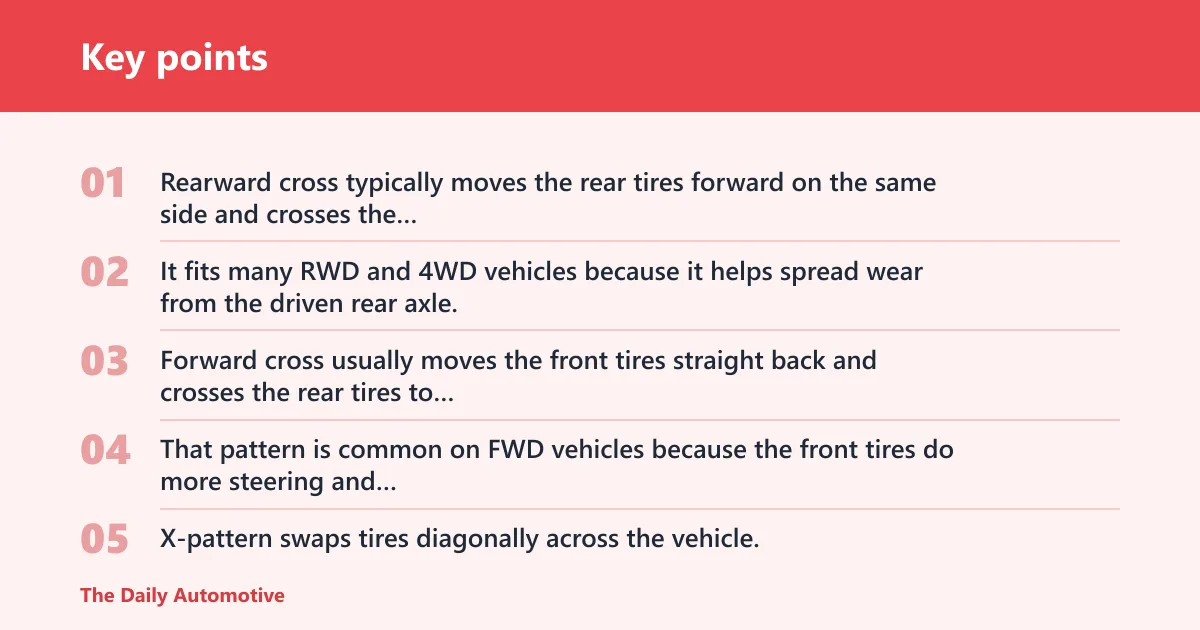
Rearward cross typically moves the rear tires forward on the same side and crosses the front tires to the rear. It fits many RWD and 4WD vehicles because it helps spread wear from the driven rear axle.
Forward cross
Forward cross usually moves the front tires straight back and crosses the rear tires to the front. That pattern is common on FWD vehicles because the front tires do more steering and driving work.
X-pattern
X-pattern swaps tires diagonally across the vehicle. It can be used on many vehicles, but it is not always the best choice for directional tires or certain wheel and axle setups.
A common first-timer mistake is asking for “a rotation” without checking the tread direction. A directional tire mounted the wrong way can lose one of its main design advantages, so the pattern has to match the tire, not just the vehicle.
How often should you rotate tires?
Most drivers should plan on rotation every 5,000 to 8,000 miles, or sooner if the owner’s manual says so. That interval helps even out wear before one axle starts falling behind the other, especially on vehicles that work the front tires harder.
Owner’s manual exceptions
The owner’s manual controls if it lists a tighter schedule, a special pattern, or a tire-size limit. Some vehicles with staggered fitments, directional tires, or AWD requirements need a modified plan rather than a standard rotation cycle.
Signs you should move the visit up
If one pair of tires is wearing faster, if road noise changes, or if the tread depth looks uneven from one axle to the other, do not wait for the full mileage interval. A rotation paired with inspection may stop the wear pattern before it becomes expensive.
When is a rotation not standard?
Some vehicles need rotation, but not the usual kind. AWD systems can require specific intervals and patterns. EVs often need attention because of weight and torque delivery. Staggered and directional tires can limit what the shop can legally and safely do.
AWD systems
AWD vehicles are often more sensitive to tire diameter differences. That means all four tires should stay close in wear, and rotation is important, but the shop should follow the manufacturer’s pattern and interval rather than using a one-size-fits-all approach.
EVs
EVs can put extra load on tires because of vehicle weight and instant torque. Rotation is usually a smart maintenance step, and it may be worth checking tread more often than you would on a similar gas vehicle.
Staggered fitments
Staggered setups use different tire sizes front and rear, so a standard front-to-rear rotation may not be possible. In those cases, the visit may be modified, skipped, or limited to inspection and pressure checks.
Directional tires
Directional tires are built to roll one way. That limits the pattern choice and can force the shop to keep tires on the same side or use a different rotation plan. If the shop cannot preserve direction, the pattern should change or the rotation should be skipped.
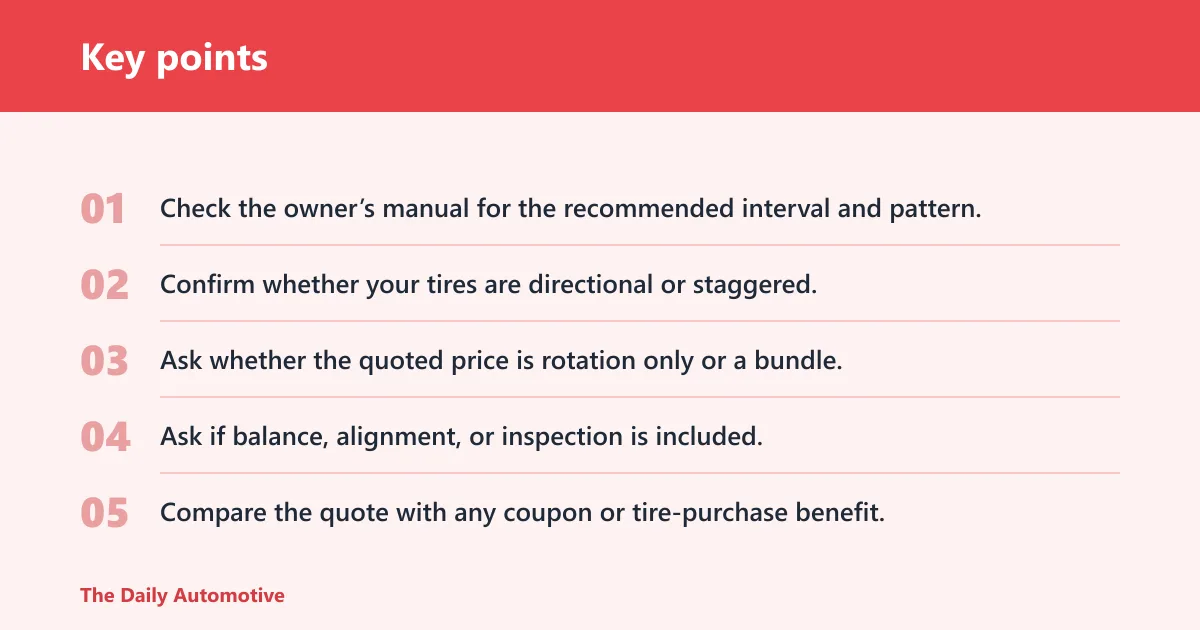
- Check the owner’s manual for the recommended interval and pattern.
- Confirm whether your tires are directional or staggered.
- Ask whether the quoted price is rotation only or a bundle.
- Ask if balance, alignment, or inspection is included.
- Compare the quote with any coupon or tire-purchase benefit.
- Book the visit before wear gets uneven.
Frequently asked questions
How much does tire rotation cost at Discount Tire?
Discount Tire charges about $15 per tire for rotation, and it may include rotation and balance free with tire purchase. That makes the final bill highly dependent on whether you bought the tires there and whether the store is using a promotion or standard pricing.
How much does tire rotation cost at Firestone?
Firestone’s coupon price can be $9.99, while its regular flat rate is about $25. The price you actually pay depends on the location, the offer running that day, and whether the visit is sold as a coupon service or standard maintenance.
How much does tire rotation cost at Jiffy Lube?
Jiffy Lube’s usual tire-rotation cost is about $40. The total can shift if the shop packages the rotation with another maintenance item or if the local store prices its service menu differently from the national average.
How much does tire rotation cost at a Toyota dealership?
A Toyota dealership often charges more than a basic independent shop because labor rates and inspection packages are usually higher. Exact pricing varies by dealer and market, so ask whether the quote covers rotation only or includes a multi-point check.
How much does tire rotation and balance cost?
Rotation and balance costs more than rotation alone because balancing adds labor and equipment time. The extra charge is worth it when you have vibration, missing wheel weights, or a shop inspection that points to balance-related wear.
How much does tire rotation cost for Tesla Model Y?
For a Tesla Model Y, the price is usually shaped by EV-specific labor and by whether the shop follows Tesla’s rotation guidance. Some owners will see standard shop pricing, while others may pay more at a dealer or mobile service provider.
Products related to this article
Sponsored / affiliate links. As an Amazon Associate I earn from qualifying purchases. I may earn additional commission from eligible campaigns.