How Much to Replace Rotors on a Car? $120-$400
Rotor replacement usually costs $120 to $400 per axle, depending on rotor type, labor rate, and whether pads are replaced too. Bad quotes can hide extra labor, unnecessary parts, or a warped-rotor diagnosis that does not match the measurements. This guide shows what a rotor-replacement bill should include, which thickness and runout numbers justify replacement, and which add-ons are legitimate versus optional.
Rotor replacement cost by axle


A fair rotor quote is easier to judge by axle than by wheel. Front axle pricing, rear axle pricing, and both-axles pricing should be broken out clearly, because labor, pad wear, and hardware needs often differ from one end of the car to the other.
As a broad planning number, brake replacement can run from $120 to $1,200+, and rotor work often sits inside that span. CarCostHub lists rotors at $120-$420 as part of a front-axle pads-and-rotors estimate, while All About Vehicles says rotor replacement typically costs between $300 and $800 per axle at a shop.
Front axle vs rear axle pricing
Front rotors usually cost more to service than rear rotors because front brakes do more of the stopping on many cars, and they often wear faster. Rear rotors can be cheaper on simpler cars, but the difference shrinks when the rear setup uses electronic parking brakes, integrated sensors, or more labor to retract the calipers.
Single-axle service is often the cleaner quote to compare. If the front is noisy and the rear still measures within spec, replacing only the front axle can be the right call. If both axles are worn, a full brake job can land anywhere from $600 to $1,500, according to All About Vehicles.
Why the same car can get two very different quotes
Two shops can quote the same vehicle differently and still be fair. One may list only rotors and labor, while another includes pads, hardware, brake fluid service, and a road test. Labor rates also differ: All About Vehicles says independent shops typically charge $60 to $100 per hour, while dealerships may charge $100 to $150 per hour.
The same source says labor time can be 1-4 labor hours, which makes quote comparisons tricky. A quote with fewer hours is not automatically better if it omits corrosion cleanup, caliper slide service, or hardware that should be replaced with the rotors.
What a fair rotor quote includes
A fair estimate should name the axle, the part type, the labor hours, and any extra work that is condition-based. It should also say whether the shop is using OEM or aftermarket rotors, because parts quality changes both the line total and the warranty terms.
Parts, labor, and shop supplies
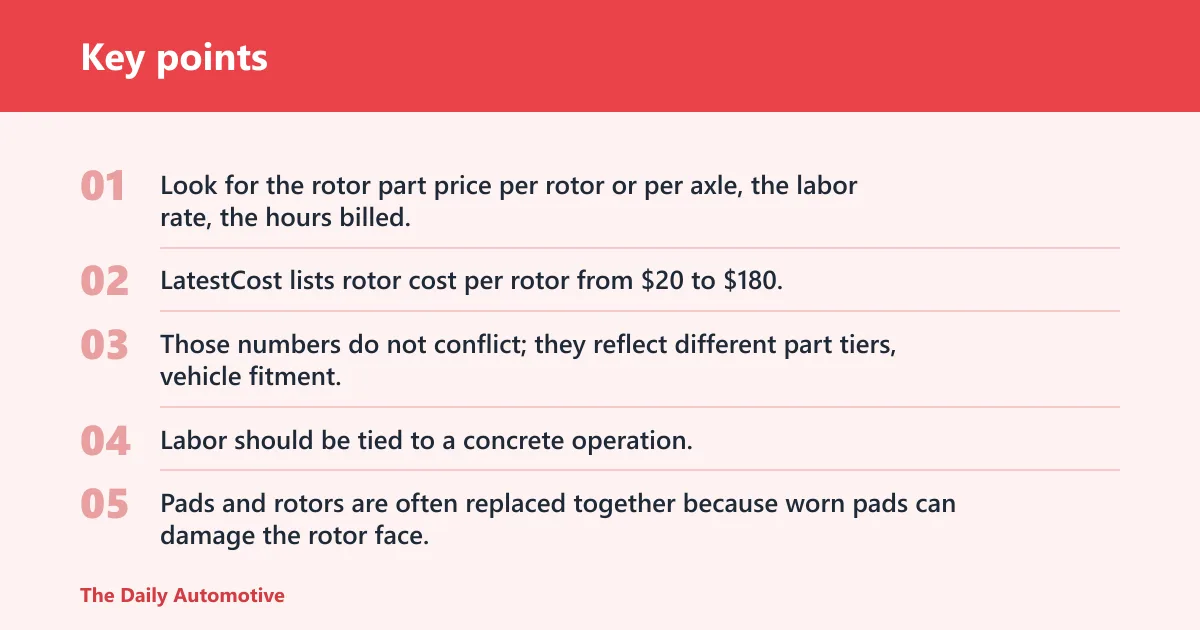
Look for the rotor part price per rotor or per axle, the labor rate, the hours billed, and any shop supply charge. LatestCost lists rotor cost per rotor from $20 to $180, while All About Vehicles says a single rotor costs $150 to $400 in parts. Those numbers do not conflict; they reflect different part tiers, vehicle fitment, and labor packages.
Labor should be tied to a concrete operation, not a vague line like “brake service.” If the shop says the job needs 2.0 hours, ask what is included in that time: wheel removal, caliper removal, rotor swap, hardware transfer, pad bedding, and test drive.
Pads, hardware, and fluid line items
Pads and rotors are often replaced together because worn pads can damage the rotor face. The cost table from CarCostHub lists brake pad replacement at $120-$520 and pads and rotors at $300-$900.
Hardware is often legitimate on a quote if the clips, shims, or abutment hardware are corroded or missing. Brake fluid service can also be valid if the fluid is old, contaminated, or the shop must open the hydraulic system for caliper work. It is not automatic with every rotor job.
OEM and aftermarket parts on the same estimate
A quote may list OEM rotors, aftermarket rotors, or both as options. That is normal. What matters is whether the estimate identifies the part grade clearly enough for you to compare apples to apples. A premium rotor with better corrosion protection may cost more up front but can be a fair buy on a vehicle that sees salt, heat, or heavy towing.
Ask the shop to separate parts and labor so you can see what changes if you choose a different rotor brand. If the quote bundles everything into one total without listing parts numbers, you cannot tell whether the price gap is from the rotor itself or from labor markup.
How do you know rotors actually need replacement?
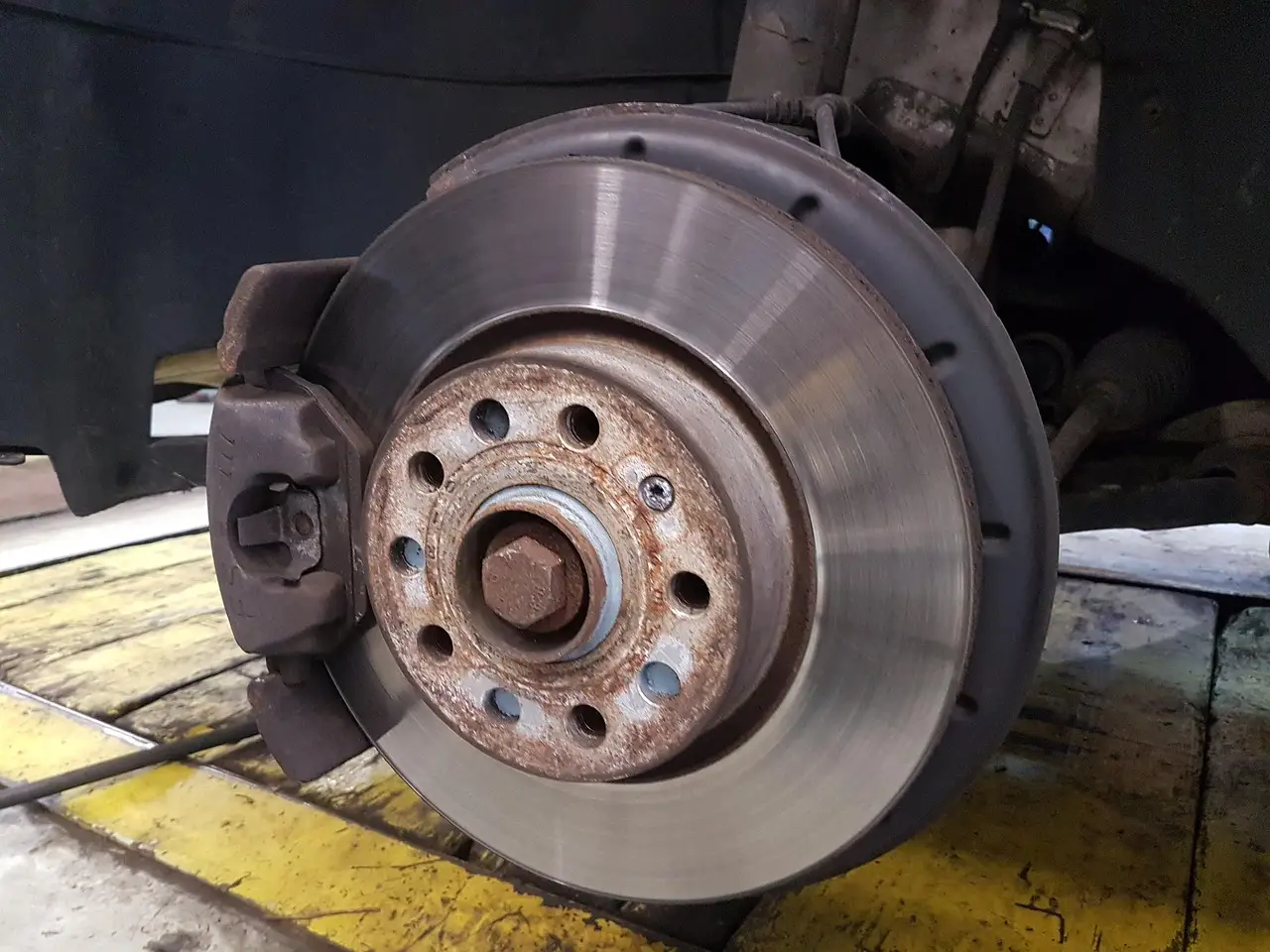
Rotors need replacement when they are below minimum thickness, cracked, heavily scored, or damaged by heat. A complaint about pulsation or noise is not enough by itself. The estimate should show a micrometer thickness reading, the minimum specification, and any visible damage that supports the diagnosis.
Minimum thickness and micrometer readings
The key number is the rotor’s measured thickness compared with the minimum thickness spec stamped or listed by the manufacturer. A micrometer reading matters because “looks thin” is not proof. If the rotor is at or below minimum, replacement is justified. If it is above spec, resurfacing may still be possible if the surface condition is acceptable.
Ask for the exact reading in millimeters or inches, plus the minimum spec. That lets you verify the claim instead of taking a vague “needs rotors” note at face value.
Scoring, heat damage, and warping complaints
Deep scoring means the pad material or backing plate has cut into the rotor face. Heat spots, blue discoloration, and cracking point to overheating. A “warped rotor” complaint often refers to pedal pulsation or steering wheel shake, but the shop should still measure runout and thickness before recommending replacement.
Say your midsize sedan shudders only under light braking from 55 mph, and the shop writes “warped rotors” without a measurement. That is not enough detail. You want the actual thickness reading, the runout number, and the cause of the heat or wear before authorizing new parts.
Resurfacing versus replacing
Rotors may be resurfaced if they are still above minimum thickness and not damaged by cracking or severe heat. Resurfacing removes a thin layer of metal to restore a smoother surface. Replacement is the correct call when the rotor is already too thin, too uneven, or too damaged to machine safely.
A common first-timer mistake is approving replacement when resurfacing would have been enough. The reverse is also risky: resurfacing a rotor that is already near minimum thickness can leave too little material for safe service life.
Do you need pads and rotors together?
Not always. Pads and rotors should be replaced together when the pads are worn down enough to damage the rotor surface, or when rotor condition is already outside spec. If the pads still have healthy friction material and the rotors measure within spec, pads-only service can be the correct quote.
How pad wear damages rotors
When pads get too thin, the backing plate can contact the rotor and score it. Even before that point, worn pads can overheat the rotor or create uneven transfer layers that cause noise and vibration. That is why a pad change should trigger a rotor inspection, not an automatic rotor sale.
Picture a compact car that needs front pads and has one rotor with heavy grooves from metal-to-metal contact. The correct estimate may be pads plus front rotors, not a full four-wheel rotor set. The diagnosis should match the damage at each axle.
Pads-only pricing versus bundled pricing
Pads-only pricing should be lower than a pads-and-rotors package, and the quote should make that difference obvious. The bundle is legitimate when both parts truly need service.
If a quote for pads-only comes close to the bundled total, ask why. The extra amount may be legitimate if the shop is adding hardware, fluid service, or seized-caliper work. It is not legitimate if the line items are left vague.
Why the price changes by vehicle
Vehicle type changes rotor cost because part size, brake design, and labor complexity are not the same across the fleet. Standard cars are usually cheaper. Trucks, SUVs, performance cars, and luxury vehicles often need pricier parts or more labor, and some rear brake designs are slower to service.
Standard cars versus trucks and SUVs
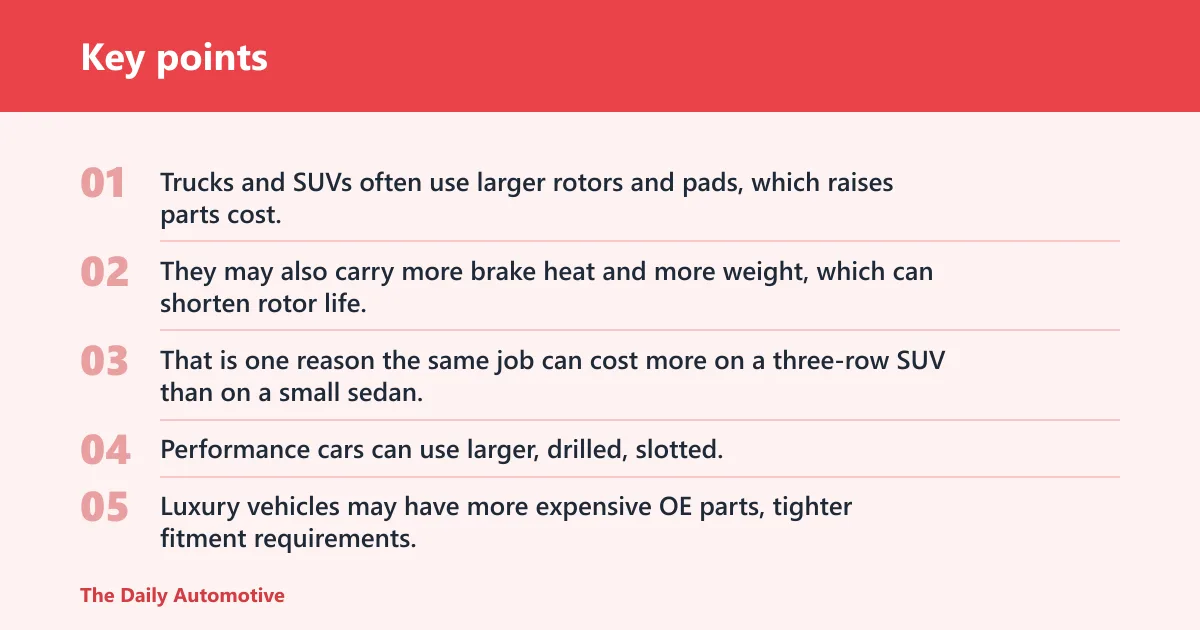
Trucks and SUVs often use larger rotors and pads, which raises parts cost. They may also carry more brake heat and more weight, which can shorten rotor life. That is one reason the same job can cost more on a three-row SUV than on a small sedan.
Performance and luxury brake parts
Performance cars can use larger, drilled, slotted, or high-carbon rotors that cost more than basic replacements. Luxury vehicles may have more expensive OE parts, tighter fitment requirements, and higher labor time. Those factors can push the estimate well above a basic commuter-car quote.
All About Vehicles notes that a complete front and rear brake job can land anywhere from $600 to $1,500, which is a useful reminder that vehicle class matters. The same shop can quote a commuter car and a luxury sedan very differently without either quote being inflated.
Rear brake designs, sensors, and electronic parking brakes
Rear brakes can be more complex when they integrate parking brake motors, wear sensors, or ABS-related procedures. Some cars need a scan tool or service mode to retract the rear calipers. Those steps are legitimate if the vehicle requires them; they should not be hidden under a generic labor line.
Rotor quote checklist
Use this table to compare quotes line by line. If the shop cannot answer the “must-have proof” column, the estimate is not complete enough to approve.
| Quote line | Normal range | Must-have proof | Red-flag wording |
|---|---|---|---|
| Rotor thickness measurement | Measured in mm or inches, with minimum spec listed | Micrometer reading and factory minimum thickness | “Thin rotors” or “looks worn” |
| Axle scope | Front axle, rear axle, or both axles named clearly | Which wheels need service and why | “Brake job” with no axle detail |
| Pad condition | Pads-only or pads-and-rotors stated separately | Pad thickness or wear note | Automatic pad replacement without inspection |
| Hardware | Included only if clips, shims, or pins need replacement | Corrosion, missing clips, or broken hardware noted | “Required by policy” |
| Calipers | Only if seized, leaking, or not retracting properly | Leak, drag, or piston problem documented | “While we’re in there” |
| Brake fluid service | Condition-based, not automatic | Fluid condition test or contamination note | Bundled into every rotor quote |
| Labor hours | CarCostHub says 1-4 labor hours | Hours per axle and task list | One vague flat fee |
| Warranty | Parts and labor terms listed separately | Written coverage period and exclusions | “Lifetime” with no details |
Why shop quotes vary so much
Rotor quotes vary because labor rates, part sourcing, and shop structure are different. An independent shop may price the same axle job lower than a dealership, but a dealership may include brand-specific parts or procedures that an independent shop prices separately. National chains often use package pricing that can look cheaper at first glance.
Independent shop versus dealership labor rates
That gap alone can change the estimate by a meaningful amount when the labor time is 1-4 hours. Higher labor does not always mean overcharging; sometimes it reflects more complete brake system work.
National chain pricing and package quotes
National chains may quote a low brake special, then add hardware, fluid, or sensor charges if the vehicle needs them. That is not automatically unfair, but the estimate should spell out the trigger for each add-on. If the package price is only valid with a pile of exclusions, ask for the total with all required parts included.
Regional labor variation and parts markup
Location matters. Higher overhead, higher rent, and regional wage differences can move both labor and markup. Two shops in different cities can quote the same axle job differently and both be reasonable. What matters is whether the estimate separates the parts, the hours, and the condition-based extras.
Frequently asked questions
How much does it cost to replace rotors on a car?
A practical planning range is $120 to $400 per axle for rotor replacement, with the total moving based on rotor type, labor rate, and whether pads are replaced too. Parts-only costs can be lower, but once labor and any necessary hardware are added, the bill climbs quickly.
Do I need to replace rotors when I replace brake pads?
No, not always. Replace rotors when they are below minimum thickness, deeply scored, heat-damaged, or otherwise outside spec. If they still measure within spec and the surface is acceptable, pads-only service can be the right choice, which is why a proper inspection matters.
How much is rotor replacement per axle?
The same source says rotor replacement typically costs between $300 and $800 per axle at a shop. That range fits many common vehicles, but the number can move higher for luxury, performance, or heavy-duty applications, and lower if the job is simple and local labor rates are modest.
What makes rotor replacement more expensive on SUVs and luxury cars?
Larger parts, heavier vehicles, and more complex rear brake systems raise the price. Luxury vehicles may also use pricier OE rotors, more involved service procedures, or higher labor rates. Trucks and SUVs often need larger rotors and can wear pads and rotors faster under load.
Can rotors be resurfaced instead of replaced?
Yes, if they are still above minimum thickness and do not have cracks, severe heat damage, or other defects. Resurfacing can save money when the rotor is still structurally sound. If the rotor is already too thin, replacement is the safer option.
What should a rotor replacement estimate include?
It should list the axle, rotor part price, labor hours, labor rate, pad condition, hardware, any fluid or sensor work, and warranty terms. The estimate should also show the measurement or symptom that justifies replacement. If the quote is vague, ask for a written breakdown before approving the job.
Products related to this article
Sponsored / affiliate links. As an Amazon Associate I earn from qualifying purchases. I may earn additional commission from eligible campaigns.