How Much Does Gap Insurance Cost on a Car?
Gap insurance on a car usually costs about $20 to $40 a year through an auto insurer, but dealer or lender add-ons can run $400 to $700 as a one-time charge rolled into the loan. Without it, after a total loss, you can still owe more than the car is worth. This guide breaks down the real cost by purchase channel and gives a simple rule for buying, keeping, or dropping coverage.
What gap insurance covers
Gap insurance pays the difference between your car loan or lease payoff and the insurer’s actual cash value settlement after a total loss or theft. It matters only when the vehicle is stolen or totaled, and the loan balance is still higher than the payout. Collision and comprehensive coverage still have to be in place.
ACV versus loan payoff
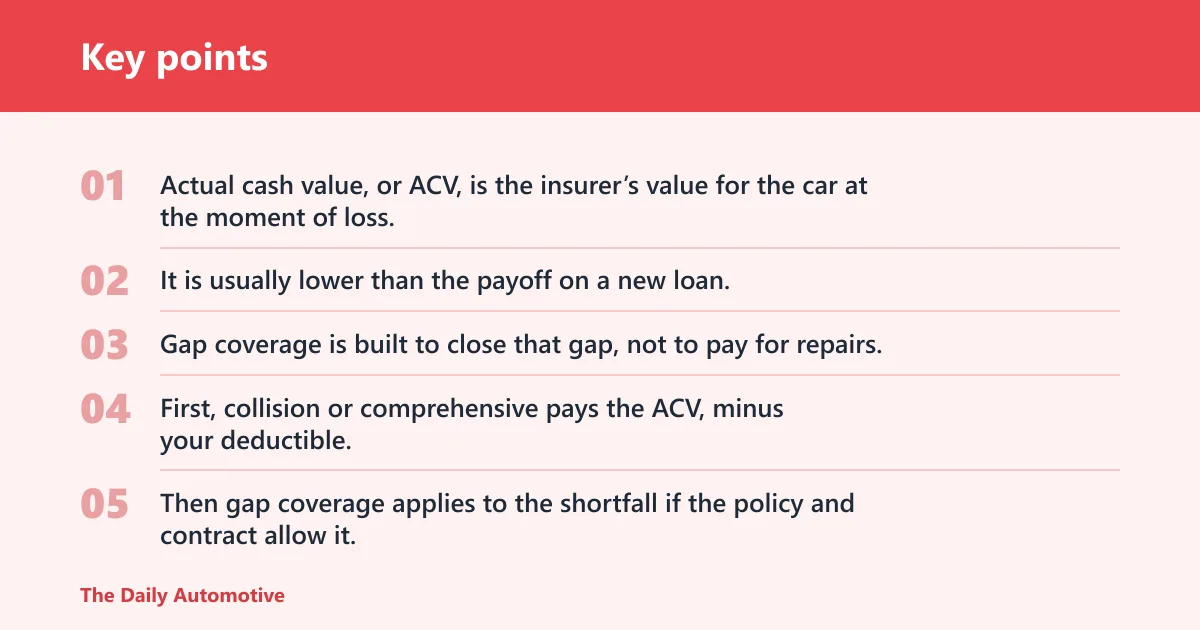
Actual cash value, or ACV, is the insurer’s value for the car at the moment of loss. It is usually lower than the payoff on a new loan, because depreciation starts fast and loan balances fall slowly at first. Gap coverage is built to close that gap, not to pay for repairs.
Here is the basic claim sequence. First, collision or comprehensive pays the ACV, minus your deductible. Then gap coverage applies to the shortfall if the policy and contract allow it. Any amount tied to past-due payments, extended warranty charges, or rolled-in negative equity may still be excluded depending on the contract.
When a total loss creates a shortfall
Say you owe $28,000 on a car that is totaled and the insurer values it at $23,000. If your deductible is $500, the insurer may pay $22,500, leaving a $5,500 gap before fees or exclusions. Gap coverage is meant for that difference, not for repairs or routine claims.
That is why small down payments and long loan terms matter. They keep the balance above the car’s value for longer. New cars are exposed early on, but used cars can be upside down too.
How much gap insurance costs
How much gap insurance costs depends on where you buy it. Through an insurer, it is usually the cheapest option. Through a dealer, it is usually the most expensive. Lenders and credit unions often sit in the middle, with pricing that may be bundled at closing.
Insurer add-on price range
Gap insurance usually costs between $20 and $40 per year when added to a car insurance policy. Some sources place insurer add-ons at $20 to $100 per year, and one common pattern is a small bump to comprehensive and collision premiums. Insuranceopedia puts one current-insurer example at around $40 per year.
Dealer add-on price range
Dealer gap insurance can cost around $400 to $700 in total. Some dealership quotes run higher, with reports of $400 to $900 as a one-time fee. That price can look manageable until it is financed inside the auto loan, where interest raises the real cost.
Lender or credit union pricing
Some banks and credit unions offer gap insurance for $200 to $700 upfront. The same source lists a lender or manufacturer fee of $200 to $300, which is lower than many dealer quotes. The exact figure depends on the contract, the lender, and whether the coverage is a separate line item or part of the loan package.
Gap insurance decision table
This table compares the common purchase paths using the figures above. For financed dealer or lender pricing, the interest estimate assumes the gap charge is rolled into a 60-month loan at 8% APR. That produces about $87 of interest on a $400 charge and about $152 on a $700 charge.
| Purchase path | Upfront price | Estimated interest if financed | 3-year total cost | 5-year total cost | Keep or drop rule |
|---|---|---|---|---|---|
| Insurer add-on | $20 to $40 per year | Usually none if billed with the policy | $60 to $120 | $100 to $200 | Keep if your loan balance still sits above ACV; drop once you have positive equity. |
| Dealer add-on | $400 to $700 one time | About $87 to $152 if financed at 8% over 60 months | $487 to $852 | $487 to $852 | Keep if the loan is still upside down, especially on a small down payment or long term. |
| Lender or credit union add-on | $200 to $700 upfront | About $43 to $152 if financed at 8% over 60 months | $243 to $852 | $243 to $852 | Keep for lease contracts or when loan payoff still exceeds ACV; drop after equity turns positive. |
For lease deals, the answer can be different. A lease agreement may require gap coverage, or it may include it in the contract already. If the lease already has payoff protection, buying a second copy wastes money.
Why dealer gap usually costs more
Dealer gap usually costs more because it is often sold as a bundled add-on at finance signing, then rolled into the loan. That turns a one-time fee into a financed balance that also accrues interest. The sticker price is not the full price.
Rolled-in loan cost
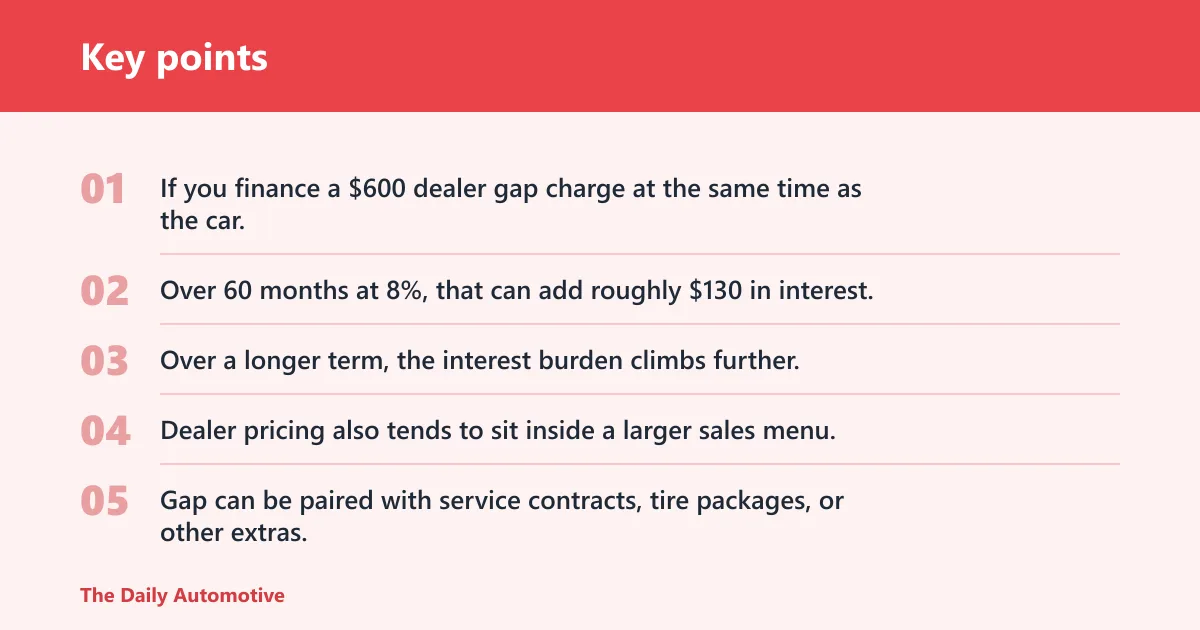
If you finance a $600 dealer gap charge at the same time as the car, you pay interest on that $600 just like the rest of the loan. Over 60 months at 8%, that can add roughly $130 in interest. Over a longer term, the interest burden climbs further.
Markup and add-on packaging
Dealer pricing also tends to sit inside a larger sales menu. Gap can be paired with service contracts, tire packages, or other extras. That does not make the coverage better. It just makes the quote harder to compare against an insurer quote for the same loan balance and deductible assumptions.
Insurer pricing is usually lower because the add-on is tied to an existing policy instead of a finance contract. That simpler structure is why a policy add-on often lands in the $20 to $40 annual range, while dealer quotes often start several hundred dollars higher.
Do you need gap on a new car?
New cars are the most common place to buy gap insurance because depreciation is steep in the first years and loan balances can stay high. A small down payment, a 72-month loan, or both can keep you upside down for longer. That makes gap more useful early in the loan.
Depreciation in the first years
Vehicle depreciation is fastest right after purchase. If the car is totaled in that window, ACV can lag far behind the payoff. Gap helps only if you still owe more than the insurer will settle for after a theft or total loss.
Small down payments and long terms
A down payment of less than 20% is a warning sign, especially on a new car. The smaller the down payment, the more likely the loan starts underwater. Long terms stretch that risk over more months, which can make a gap policy worth the small annual cost.
Suppose you put $1,500 down on a $35,000 sedan and choose a long loan term. The value can fall faster than the balance in the first two years, so a total loss could leave a real shortfall. In that case, gap makes sense until the payoff catches up to the car’s value.
Do you need gap on a used car?
Used cars can still need gap coverage if the loan balance is higher than the vehicle’s value. That happens with low down payments, stretched terms, or when the buyer rolls in a trade-in deficit from a previous car. A used car is cheaper, but that does not guarantee positive equity.
When used-car loans stay upside down
If the car is a few years old but the loan is long and the down payment is thin, the vehicle can still depreciate faster than the balance drops. In that case, gap coverage can still protect against a total-loss shortfall. The age of the car matters less than the equity position.
When a larger down payment changes the answer
A larger down payment can shrink the gap need fast. If you owe less than the car is worth after the first months of ownership, gap stops making sense. That is why used-car buyers with strong equity often skip it after checking the loan payoff against ACV.
A common first-timer mistake is assuming a used car is always safe from gap risk. Picture a $22,000 used SUV bought with $1,000 down and a long term. If the car is totaled before the balance falls, the payout can still miss the payoff by thousands.
When to cancel gap coverage
Cancel gap coverage once your loan balance drops below the car’s actual cash value, or once the lease no longer needs it. The clean rule is simple: if a total loss today would leave you with positive equity after the insurer settlement, you can usually drop it. If not, keep it.
Positive equity threshold
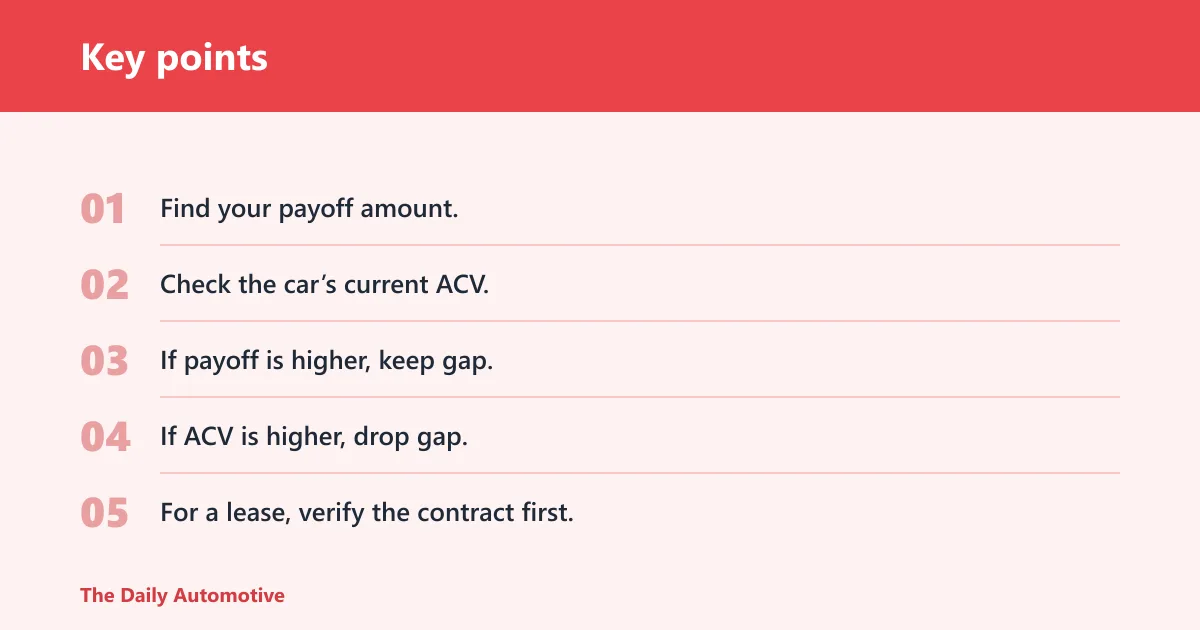
Check the payoff amount against the car’s current ACV. If the payoff is lower, gap has little value because the standard insurer payout should cover the loan. If the payoff is higher, gap still has a job to do.
Lease payoff check
Leases can be different because the contract may require gap coverage or include it already. Before canceling, read the lease payoff section and make sure there is no separate requirement. If the lease is close to ending, the coverage may no longer be useful.
Do not confuse gap with collision or comprehensive coverage. Those policies pay for the car’s value, not the loan balance. If you drop them, gap cannot step in and replace them. It only works after a covered total loss or theft claim creates a shortfall.
- Find your payoff amount.
- Check the car’s current ACV.
- If payoff is higher, keep gap.
- If ACV is higher, drop gap.
- For a lease, verify the contract first.
Frequently asked questions
How much does gap insurance cost on a car loan?
The right comparison is the sticker price plus interest if the charge is rolled into the loan.
How much does gap insurance cost on a new car?
The difference is need, not price. New cars lose value quickly, so the coverage is more likely to pay off early in the loan.
Is gap insurance cheaper through an insurer or dealer?
It is usually cheaper through an insurer. If the dealer charge is rolled into the loan, the true cost rises again because you also pay interest on that amount.
Does gap insurance matter if I already have full coverage?
Yes. Full coverage means collision and comprehensive coverage, which pay the car’s value after a covered loss. They do not pay off the loan balance. Gap insurance matters when the insurer settlement falls short of what you owe, which can happen after depreciation or a long loan term.
When should I cancel gap insurance?
Cancel gap insurance when your loan balance drops below the car’s actual cash value, or when a lease no longer requires it. Before you cancel, compare the payoff to the current ACV. If a total loss today would leave no shortfall, the coverage is no longer doing useful work.
Do I need gap insurance on a used car?
You may need it on a used car if you are financing a large amount, putting little down, or rolling in old negative equity. If you have a strong down payment and the payoff drops below ACV quickly, you can usually skip it. The deciding factor is equity, not model year.
Products related to this article
Sponsored / affiliate links. As an Amazon Associate I earn from qualifying purchases. I may earn additional commission from eligible campaigns.