How Much Does Liability Car Insurance Cost?
Liability car insurance often costs about $40 to $100 per month, and the practical question is whether those limits could cover a serious crash without leaving a large gap to pay yourself. A cheap premium can hide a thin policy that turns one wreck into years of debt. This guide explains what liability-only coverage costs, what minimum limits actually buy, and when higher limits are worth the extra premium.
What liability car insurance covers
Liability car insurance pays for injury claims and property damage you cause to other people. It does not pay to repair your own vehicle. The policy usually has two parts: bodily injury liability and property damage liability, and each part has its own limit.
Bodily injury liability
Bodily injury liability pays medical bills, rehab costs, and lost wages for other people when you are at fault. Limits are often written as a per-person number and a per-accident number, such as 25/50 or 50/100. The first number caps payment for one injured person; the second caps payment for everyone injured in one crash.
Property damage liability
Property damage liability pays for damage to other vehicles and property, such as a parked car, a fence, or a storefront window. State minimum limits vary, and the property damage number can be low in some minimum policies. That is where a cheap quote can look better than it is.
What liability does not pay
Liability coverage does not fix your own car after a crash, theft, hail, or vandalism. It also does not pay your own medical bills. If you want help with your vehicle, you need collision coverage or comprehensive coverage, which changes the price picture fast.
How much does liability car insurance cost?
Liability car insurance costs $68 per month on average, or $814 per year. Some sources put a clean-driver, good-credit quote closer to $45 a month, while others show a typical national figure around $61 a month. The spread is normal because limits, state rules, age, credit, and driving history change the quote.
Why two drivers can see very different quotes
One driver may be pricing a bare-bones state minimum policy, while another is buying 50/100/50 or higher. Those are not the same product. Location matters too: Wyoming is the cheapest state at $26 per month, while Delaware is the most expensive at $110 per month.
Picture two drivers with the same car. One buys the state minimum and gets a low monthly bill. The other adds stronger bodily injury and property damage limits because one serious injury claim could exceed the cheap policy in a single afternoon.
What a quote usually includes
A liability quote usually reflects the limits you choose, the state where the car is garaged, and the insurer’s view of your risk. Age, driving record, credit score where allowed, and ZIP code all feed into the price. A quote can be cheap for a low-limit driver and too thin for someone with real financial exposure.
Liability cost reality check
The table below shows how the same product can look cheap, normal, or expensive depending on the profile behind it. The question is not only what you pay each month. It is what that premium buys if you cause a claim that exceeds your limits.
| Driver profile | Likely premium band | Underwriting reason |
|---|---|---|
| Clean driver with good credit | About $45 to $68 per month | Lower claim history and lower expected loss; this is usually cheap for a standard liability package. |
| Teen driver | About $100 per month or more | Young drivers are rated as higher risk; this is often expensive, even before limits rise. |
| Poor credit | Often materially higher than a good-credit quote | In states that allow credit-based pricing, poor credit can add $1,039 per year compared with good credit; that can exceed some driving violations. |
| DUI history | About $121 per month on average | A DUI signals a much higher future-loss risk, so the premium rises sharply. |
| High-limit buyer | Above the minimum-rate band | Higher bodily injury and property damage limits usually cost more because the insurer takes on more exposure. |
| California minimum-coverage buyer | About $64 per month | State rules and minimum limits keep the premium moderate, but that does not mean the protection is enough for a serious crash. |
Use the premium band as a budget check, not as a value score. A low quote can be a poor deal if the limit is too small for your assets, commute, or family income. A higher quote can be sensible if it closes a big injury gap.
Why limits change the price

Policy limits matter because insurers price the amount of loss they might have to pay. A 25/50/10 policy is generally less protective than a 50/100/50 policy because it typically carries lower coverage limits. Higher limits usually increase premium, but they also reduce the chance that one crash drains your finances.
Split-limit examples
WalletHub explains a 50/100/50 policy as split limits for bodily injury and property damage. In plain terms, 50/100/50 means up to $50,000 for one person’s injuries, $100,000 total for all injuries in one crash, and $50,000 for property damage. A 25/50/10 policy is much thinner, especially for injury claims.
A common first-timer mistake is choosing the cheapest liability-only quote without checking the injury limits. A rear-end crash that sends one person to the emergency room can exceed a low per-person limit quickly, and a second injured passenger can exhaust the per-accident cap just as fast.
Why the cheapest quote may leave you exposed
The cheapest quote often means the lowest legal limit, not the best value. If you have savings, wages, or future earnings to protect, the extra premium for higher bodily injury liability can be worth it. The cost difference is often smaller than the damage from one serious claim.
What makes liability rates rise?
Insurers usually rate liability coverage using age, driving record, credit score where allowed, state, and ZIP code. Some of these factors are broad age bands; others are specific events on your record. Not every state lets insurers use credit, so the pricing impact depends on where you live.
Age and driver stage
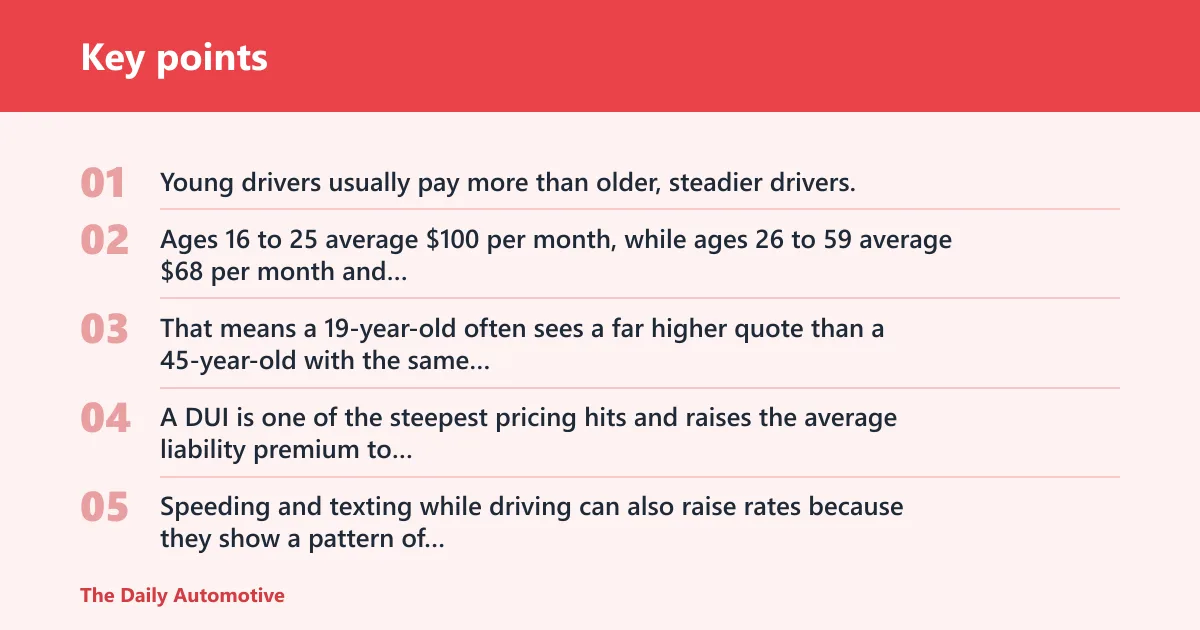
Young drivers usually pay more than older, steadier drivers. Ages 16 to 25 average $100 per month, while ages 26 to 59 average $68 per month and drivers 60+ average $58 per month. That means a 19-year-old often sees a far higher quote than a 45-year-old with the same car and similar limits.
Driving record and recent violations
A DUI is one of the steepest pricing hits and raises the average liability premium to $121 per month. Speeding and texting while driving can also raise rates because they show a pattern of risk. An at-fault accident usually increases price too, while a not-at-fault accident is often treated differently depending on state and insurer rules.
Credit score where allowed
Poor credit can raise liability rates by $1,039 per year compared with good credit in states that allow credit-based pricing. That increase can be larger than the impact from some moving violations. If your state restricts credit use, this factor may not apply at all.
State and ZIP code
Where the car is garaged matters because claim severity, traffic density, theft, weather, and repair costs vary by location. A driver in one ZIP code can pay much more than a similar driver across town. State minimum laws also shape the price because a state that requires more protection tends to push premiums higher.
How much does minimum liability cost by state?
Minimum liability cost depends on state law, and the legal minimum is not the same thing as a safe limit. Some states require bodily injury and property damage minimums; some require other coverages; and a few have no bodily injury minimum but still require property damage or another specific form of coverage. That is why a low quote can mean very different protection from one state to another.
California minimum coverage
California’s listed liability average is $64 per month, which sits near the national range. That does not mean California minimum coverage is generous. It only means the state’s minimum-price market is around that level, while the legal minimum may still leave you short if you cause a serious injury claim.
States with no bodily injury minimum
Some states do not require a bodily injury minimum, but they still may require property damage liability or another insurance obligation tied to driving legally. In those states, a cheap liability policy can be especially thin if you are only meeting the minimum and not buying meaningful injury protection.
State minimums are a floor, not a recommendation. If your net worth, paycheck, or future earning power is larger than the policy limit, the gap can land on you after a crash.
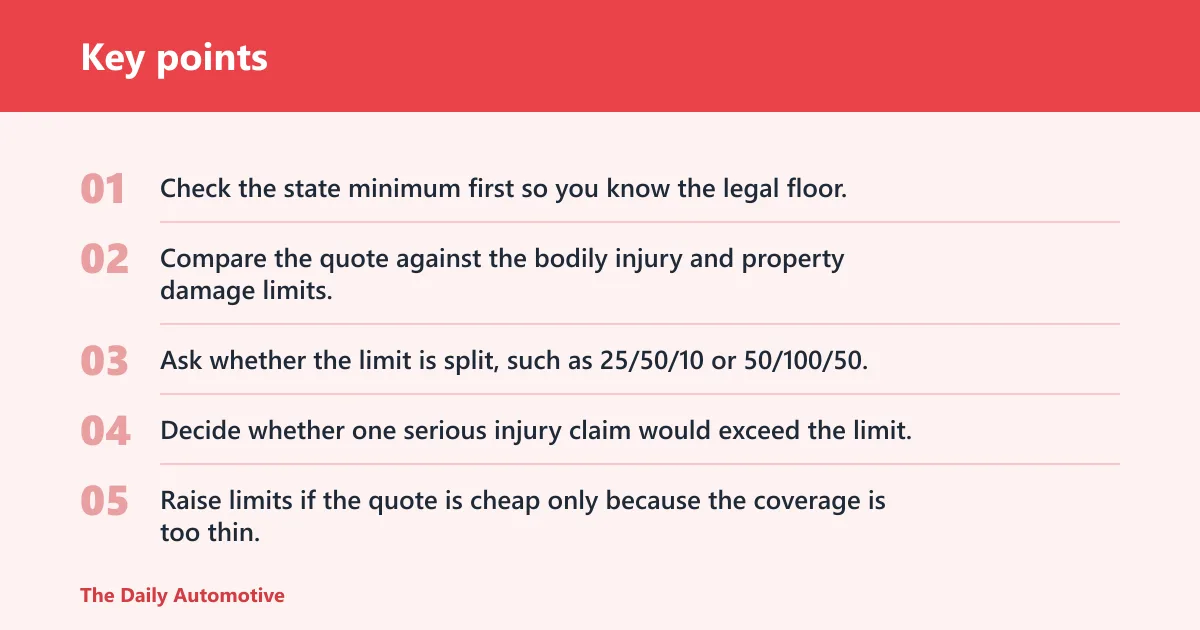
- Check the state minimum first so you know the legal floor.
- Compare the quote against the bodily injury and property damage limits, not only the monthly bill.
- Ask whether the limit is split, such as 25/50/10 or 50/100/50.
- Decide whether one serious injury claim would exceed the limit.
- Raise limits if the quote is cheap only because the coverage is too thin.
How much does liability car insurance cost for a 16 year old?
A 16-year-old usually pays much more than an adult because young drivers are priced as higher risk. The average for drivers ages 16 to 25 is $100 per month, and a teen’s quote can climb faster if the policy is written on a separate vehicle or if the state charges more for inexperience. The lowest quote is not usually the right benchmark.
How a parent policy changes the cost picture
Adding a teen to a parent’s policy is often cheaper than buying a separate standalone policy, though the total bill still rises. The key comparison is not only price. It is whether the liability limits are high enough for a new driver who is still building driving history.
What to compare before you buy
Compare the same limits across quotes, not just the same monthly payment. Also compare whether the policy is minimum-only or carries higher bodily injury and property damage limits. A cheap teen policy with low limits may be much less useful than a slightly higher policy with real protection.
Frequently asked questions
How much does liability car insurance cost per month?
Liability car insurance often costs about $40 to $100 per month, with a national average of $68 per month. Clean drivers with good credit can see quotes near $45 a month, while teens, drivers with DUIs, or shoppers in expensive states can pay more.
How much does liability car insurance cost in California?
California’s listed liability average is $64 per month. That can look moderate, but the real question is whether the policy limit is enough for your risk. A minimum-limit quote may be affordable and still be too thin after a serious crash.
How much should liability car insurance cost?
It should cost enough to buy meaningful bodily injury liability and property damage liability, not only the legal minimum. If the quote is much lower than the market average, check whether the limits are too small. A low price is only useful if it still protects you from a large claim.
How much does minimum liability car insurance cost?
Minimum liability car insurance can be fairly cheap, but the price varies by state and by the limits your state requires. California’s listed liability average is $64 per month, while Wyoming is $26 per month and Delaware is $110 per month. The cheapest minimum policy is not always the safest choice.
How much does liability insurance cost for a rental car?
Rental car liability is usually priced differently from a personal auto policy, because short-term coverage is tied to the rental agreement and any coverage you already carry. Before you buy the rental counter option, check whether your personal auto policy extends to rentals and what limits it brings along.
How much will car insurance cost me?
Your cost depends on age, driving record, credit score where allowed, state, ZIP code, and the limits you choose. A clean adult driver can land near the national average, while a teen, a driver with poor credit, or a DUI history can be far above it. Compare the same liability limits across quotes before deciding.
Products related to this article
Sponsored / affiliate links. As an Amazon Associate I earn from qualifying purchases. I may earn additional commission from eligible campaigns.