
How Much Does Collision Coverage Cost?
Collision coverage often costs several hundred dollars a year, and the right choice depends on whether the annual premium plus your deductible is reasonable next to your car’s actual cash value. Drop it too early, and you may pay for repairs or replacement yourself after a crash. This guide shows how to compare price, deductible, and vehicle value before you buy, keep, or drop collision coverage.
What collision coverage pays
Collision coverage pays for damage to your own car after a crash or impact. That includes a collision with another vehicle or an object, and it can also apply if your car rolls over. The Hartford says a parked car hit by someone else can still be covered.
It usually does not cover theft or vandalism. Collision coverage usually does not cover fire, weather damage, or animal hits; those are often handled under comprehensive coverage.
The deductible still matters because you pay that amount before insurance starts paying a covered claim. A lower deductible usually means a higher premium. A higher deductible usually lowers the premium.
How much does collision coverage cost?
The price is not fixed. It moves with the car, the driver, and the local market, so any “average” only gives you a rough starting point. Many insurance explanations point to factors such as vehicle value, make, model, year, location, and driving record.
That means two drivers can buy the same policy form and still see very different monthly or annual costs. A newer sedan in a busy metro area can cost more than an older compact in a lower-cost area, even before you change the deductible.
If you want a useful estimate, ask insurers for quotes at the deductible you would actually choose. Then compare the premium against the car’s value and the amount you would realistically be able to absorb after a crash.
What changes the price
Collision pricing starts with the vehicle itself. Cost varies with the car’s value, and it also varies with the vehicle’s year, make, and model. A newer or more expensive car often costs more to insure because repair parts and labor can be pricier, and the insurer’s exposure is larger.
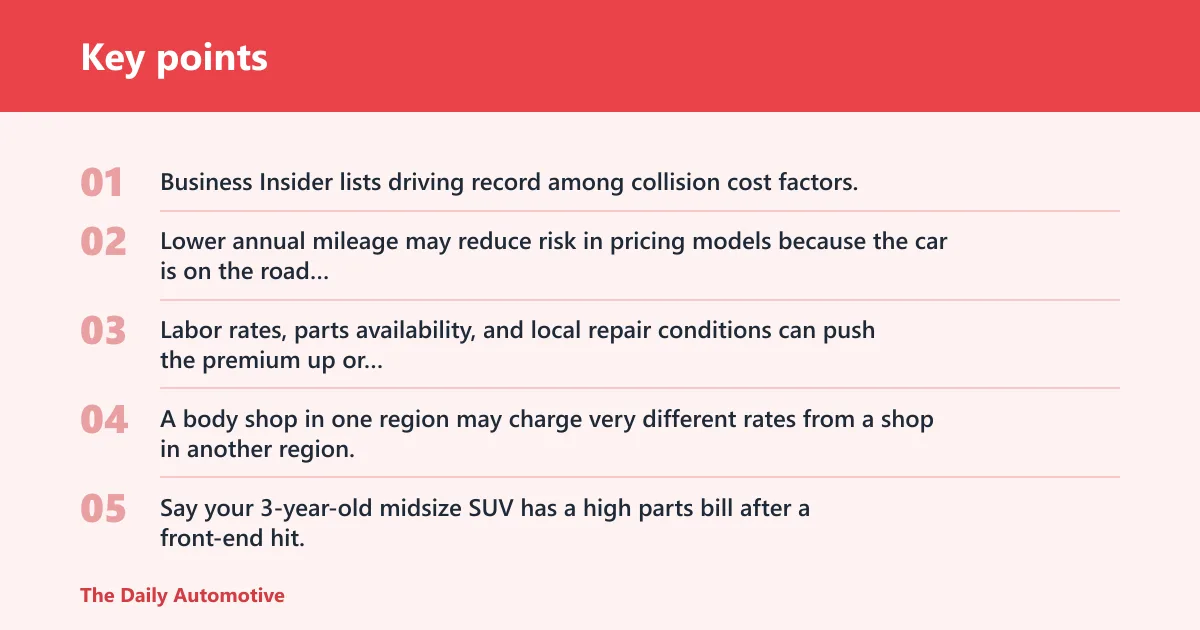
Driving record matters too. Business Insider lists driving record among collision cost factors, and age and gender can also affect pricing in some models. Lower annual mileage may reduce risk in pricing models because the car is on the road less often.
Location changes cost as well. Labor rates, parts availability, and local repair conditions can push the premium up or down. A body shop in one region may charge very different rates from a shop in another region, and insurers price that into the policy.
Say your 3-year-old midsize SUV has a high parts bill after a front-end hit. The premium can run higher than for an older sedan with cheaper panels, even if both drivers have clean records. The insurer is pricing the likely repair cost, not just the badge on the trunk.
How deductibles change your premium
Collision deductibles commonly range from $500 to $2,000. The deductible is the amount you pay out of pocket before the insurer pays the rest of a covered loss. The Hartford says lower deductibles usually mean higher premiums.
That tradeoff is simple: a lower deductible raises the monthly or annual charge, while a higher deductible lowers it. If the car is worth less and you can handle more risk yourself, a higher deductible may make sense. If cash flow is tight, the lower deductible can be easier to live with after a crash.
A $500 deductible may cost more up front, but it reduces the amount you would owe on a claim. A $1,000 or $2,000 deductible may cut the premium, but it also raises the amount you must pay before coverage helps.
How much does collision coverage cost per month?
Monthly cost is just the annual premium spread over 12 months, so the number you see depends on the same factors that drive the yearly price. A policy that looks affordable per month can still be a poor value if the deductible is high and the car’s actual cash value is low.
For many drivers, the monthly charge feels small enough to keep paying without a second look. That can be a mistake if the car is old, the repair risk is limited, or the policy has a large deductible that leaves little real protection.
Is collision coverage worth it?
Collision coverage is worth more on cars with meaningful actual cash value, and less on cars whose payout ceiling is already low. Actual cash value, or ACV, means the vehicle’s depreciated value at the time of loss rather than the original purchase price. If the car is totaled, the insurer’s payment is limited by that depreciated value.
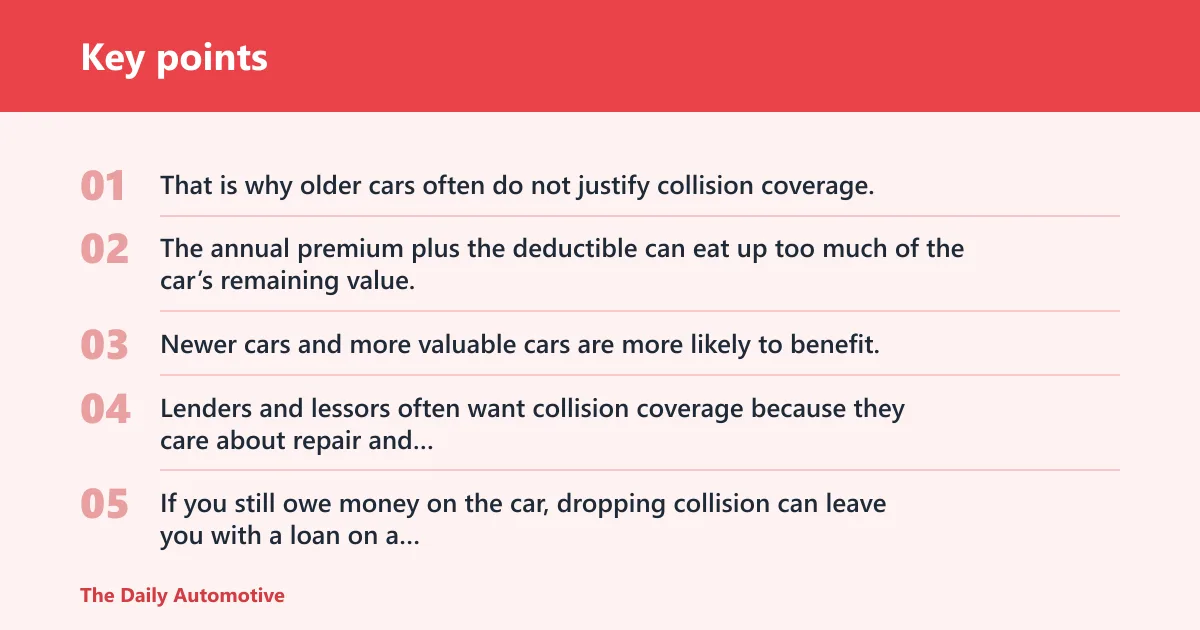
That is why older cars often do not justify collision coverage. The annual premium plus the deductible can eat up too much of the car’s remaining value. Newer cars and more valuable cars are more likely to benefit, especially if repairs would be expensive after a crash.
Financed and leased vehicles are different. Lenders and lessors often want collision coverage because they care about repair and total-loss protection while the vehicle still carries a balance or a residual obligation. If you still owe money on the car, dropping collision can leave you with a loan on a wrecked vehicle and no insurance payment large enough to clean it up.
A common example uses a 10-year-old car worth about $4,500 and a $1,000 deductible. If the annual premium is several hundred dollars, the combined cost can quickly approach a large share of the car’s value. In that case, the coverage may still be available, but it is often a weak buy.
Collision coverage cost worksheet
Use this worksheet to decide whether collision still pays for itself. Fill in real quote numbers, then compare the cost to what you could tolerate if the car were damaged or totaled.
| Vehicle ACV | Annual collision premium | Deductible | Likely repair exposure |
|---|---|---|---|
| $18,000 | $420 | $500 | Moderate front-end repair or total loss can still exceed your comfort zone |
| $9,000 | $380 | $1,000 | One major crash claim could consume a large share of the car’s value |
| $4,500 | $310 | $1,500 | Repair bills may rival the vehicle’s remaining value |
| $3,000 | $260 | $2,000 | Loss exposure is high relative to what the car is worth |
Keep-or-drop rule: if the annual collision premium plus your deductible is close to, or greater than, the car’s realistic loss tolerance, the coverage is probably too expensive for the risk left on the vehicle. If the car’s ACV is low and you could replace or repair it yourself without strain, dropping collision becomes easier to justify.
This rule is especially useful for high-deductible policies. A policy with a low premium can still be a poor deal if the deductible is so large that you would absorb most of the damage yourself anyway.
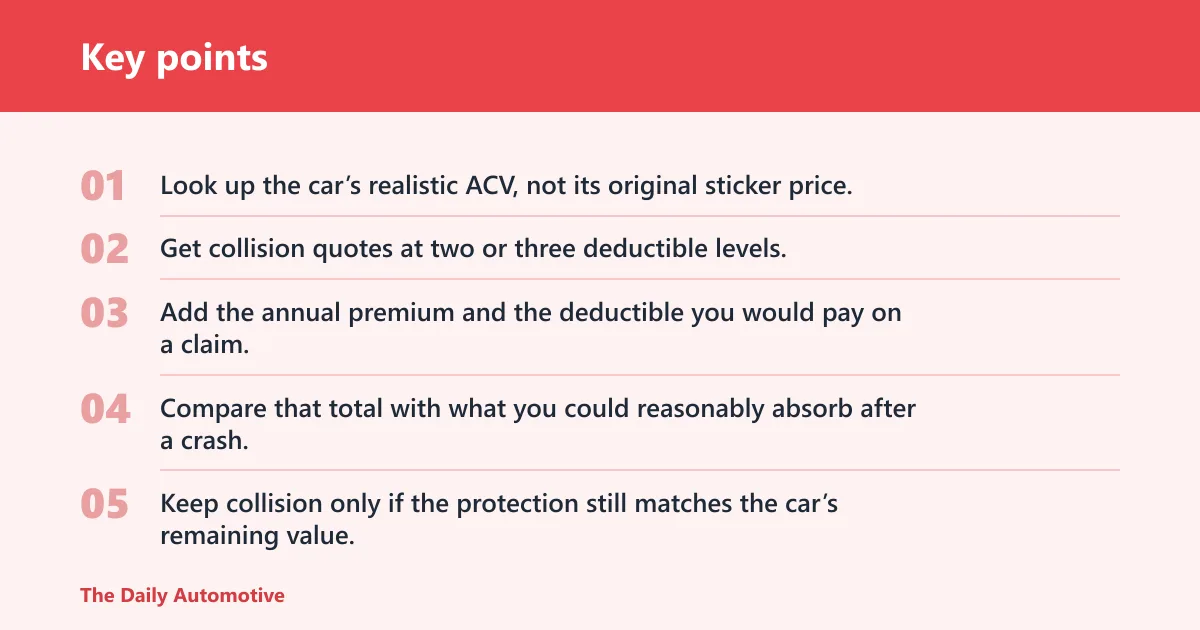
- Look up the car’s realistic ACV, not its original sticker price.
- Get collision quotes at two or three deductible levels.
- Add the annual premium and the deductible you would pay on a claim.
- Compare that total with what you could reasonably absorb after a crash.
- Keep collision only if the protection still matches the car’s remaining value.
Collision vs comprehensive coverage
Collision coverage pays for crash damage to your car after a collision with another vehicle or object, and it can also apply to a rollover. Comprehensive coverage is separate; in many policy explanations it handles theft, vandalism, fire, weather, and animal hits.
Drivers often confuse the two because both help with damage to their own vehicle. The split matters. If a tree branch falls on the car, that is usually a comprehensive claim. If you back into a pole in a parking lot, that is usually collision.
Many policies pair both coverages on newer or financed cars. That does not mean every car needs both forever. It means you should compare the cost of each coverage against the risk each one actually addresses.
How much does collision insurance cost?
Collision insurance cost varies with the vehicle’s value, year, make, and model, plus the driver’s record, mileage, and location. That is why one driver may pay a few hundred dollars a year while another pays much more for the same type of protection.
The useful question is not whether collision has one fixed price. It is whether the premium, plus the deductible, makes sense next to the car’s actual cash value and the repair risk you are carrying.
How much does collision insurance cost per month?
Monthly cost depends on the annual premium divided by 12, so there is no universal figure. If the deductible is low, the monthly charge usually rises. If the deductible is high, the monthly charge usually falls, but you take on more out-of-pocket risk.
To estimate your monthly cost, quote the same car with the same coverage at two or three deductible levels. That gives you a better picture than a broad average and shows whether the payment fits the car’s remaining value.
Frequently asked questions
How much should collision coverage cost?
It should cost less than the value of the protection you would actually use. If the premium plus deductible is too close to the car’s ACV, the coverage starts to look weak. Older cars often fail that test, while newer or financed cars usually pass it more easily.
How much does it cost to add collision insurance?
Adding collision depends on the car, deductible, and risk profile. The cleanest way to price it is to ask for the incremental charge on the same policy. That shows the real added cost instead of a blended number that includes other coverages.
How much more does collision insurance cost with a lower deductible?
A lower deductible usually raises the premium, sometimes noticeably. The exact increase depends on the vehicle and insurer, but the tradeoff is constant: you pay more up front for less out-of-pocket pain after a claim. Compare both deductible levels before you choose.
Does full coverage have collision coverage?
Usually yes, in common insurance shorthand, “full coverage” often means liability plus collision and comprehensive. But the phrase is not a policy form, so you should check the declarations page. The details matter more than the label.
How much does comprehensive and collision coverage cost?
The combined cost depends on the car, where it is garaged, and the deductibles you choose for each coverage. A newer or more valuable car can push the total up. Compare the combined premium against the car’s ACV and the total amount you could absorb after a loss.
How much does collision repair cost without insurance?
It can vary widely because the bill depends on parts, labor, damage location, and vehicle type. A bumper cover on one car may be manageable, while frame, sensor, or airbag work can jump sharply. Local labor rates and parts availability can change the total a lot.
Products related to this article
Sponsored / affiliate links. As an Amazon Associate I earn from qualifying purchases. I may earn additional commission from eligible campaigns.