Best Auto Insurance for Minimum Coverage Buyers
The best auto insurance for minimum coverage buyers is the carrier quoting your state minimum at the lowest annual premium, but the cheapest choice still shifts by ZIP code, driving record, and age. I have seen a low bill turn into a bad deal after one crash, because repairs, medical bills, and rate hikes land on the driver. This guide ranks minimum-coverage insurers by price, claims usability, and how much protection you still have when something goes wrong.
What minimum coverage auto insurance actually includes
Minimum coverage auto insurance is the state-required liability policy a driver must carry to stay legal. It usually includes bodily injury liability and property damage liability, which pay for injuries and property damage you cause to other people, not your own car. The limits vary by state.
State minimum liability requirements
State minimums are the floor, not a comfort zone. Some states ask for very low limits; others require more. That difference changes both the premium and the risk you carry after a crash.
Bodily injury liability and property damage liability
Bodily injury liability helps pay medical claims for people hurt in a crash you cause. Property damage liability pays for the other person’s vehicle, fence, mailbox, or building. When people say “minimum coverage,” they usually mean these two parts together.
Why minimum coverage varies by state
Minimums vary because state laws vary. A policy that is legal in one state can be too thin in another. That matters for buyers chasing the lowest bill, because the cheapest quoted premium may reflect lighter required limits, not a better policy.
According to Best Car Insurance Companies for 2026 — Travelers’ average monthly minimum coverage rate is $50.
Which insurer is best for minimum coverage buyers?
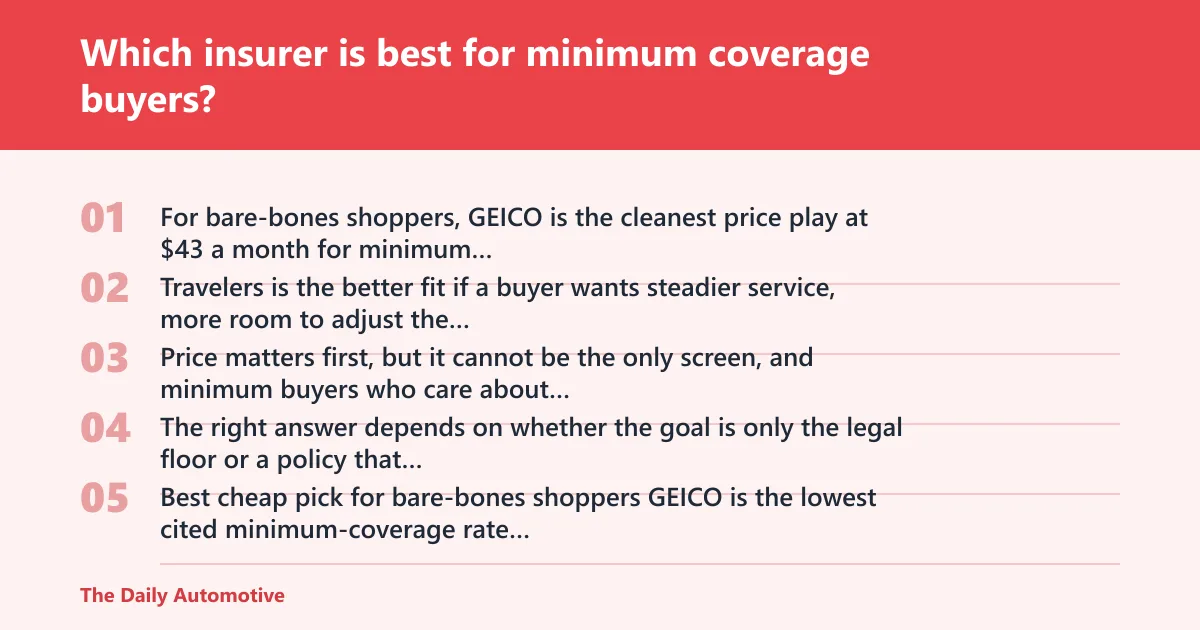
For bare-bones shoppers, GEICO is the cleanest price play at $43 a month for minimum coverage in the cited comparison. Travelers is the better fit if a buyer wants steadier service, more room to adjust the policy later, and stronger add-on choices. Price matters first, but it cannot be the only screen, and minimum buyers who care about steadier service should compare at least one more carrier. The right answer depends on whether the goal is only the legal floor or a policy that can grow.
Best cheap pick for bare-bones shoppers
GEICO is the lowest cited minimum-coverage rate at $43 a month, and it is the right starting point when price is the only priority. The tradeoff is a thinner add-on menu, so it fits drivers who want the state minimum and do not expect to add much else.
Best pick if you want steadier service
Travelers is the stronger all-around pick for minimum buyers who care about the policy working well after a claim, not only on the day they buy it. It is rated top overall in the cited analysis, with a minimum rate of $50 a month.
Best pick if you may add extra protection later
Travelers is also the better choice if the driver may add small extras later. It offers accident forgiveness, rideshare coverage, and new car replacement. GEICO can still fit some buyers, but its add-on menu is thinner.
How we judge minimum-coverage insurers

Price matters first, but it cannot be the only screen. A minimum policy still has to work when a claim happens, and it should leave room for a driver who later wants a small amount of extra protection. The four checks below separate the low-bill bargain from the policy that is actually livable.
Premium score
The premium score asks one question: who is cheapest for the same legal minimum in the same driver profile? In the cited comparison, GEICO lands at $43 a month and Travelers at $50 a month for minimum coverage.
Claims and service tolerance
Some buyers can live with a bare-bones service experience if the price is low enough. Others need an insurer that is easier to reach, easier to work with, or less likely to become a headache after a loss. That difference matters even on minimum coverage.
Add-on availability
Add-ons matter when a driver wants a policy that can move past the legal floor without starting over. Accident forgiveness, rideshare coverage, new car replacement, and mechanical breakdown insurance are the usual pressure points.
Who should avoid each carrier
A cheap quote is not a good quote if the driver has special needs. A commuter for rideshare work, a driver with a new financed car, or someone who wants broader repair help may outgrow the cheapest minimum-policy option fast.
Minimum coverage decision matrix
Use this matrix as a quick buyer-by-buyer filter. It ranks the major tradeoffs minimum shoppers actually face: the bill, claims/service tolerance, add-on flexibility, and the kind of driver who should pass.
| Insurer | Premium | Claims/service tolerance | Add-on availability | Who should avoid it | One-line recommendation |
|---|---|---|---|---|---|
| GEICO | $43/month minimum coverage | Good if the buyer wants simple, low-cost coverage and can live with a stripped-down policy | Limited; mechanical breakdown insurance is the standout option | Drivers who want accident forgiveness, rideshare coverage, or a broader policy menu | Choose GEICO when the legal minimum and the lowest bill are the only goals. |
| Travelers | $50/month minimum coverage | Better fit for buyers who want steadier service and a more flexible policy relationship | Stronger; accident forgiveness, rideshare coverage, and new car replacement | Pure price hunters who will not use extra features | Choose Travelers when you want a low minimum rate and room to grow the policy later. |
| Other carriers by profile | Varies by state minimum and driver profile | Can be worth a quote if claims handling is a priority | Varies widely | Drivers who only compare one quote | Compare at least one more carrier when your state minimum is high or your record is not clean. |
How much does minimum car insurance cost?
In the cited comparison, minimum coverage runs from $43 a month with GEICO to $50 a month with Travelers. That gap is small in absolute dollars, which is why service, add-ons, and claim tolerance matter so much once a driver has already decided to stay at the legal floor.
Cited monthly price examples
GEICO is priced at $43 a month for minimum coverage, which is the cheapest cited rate. Travelers is $50 a month and is second nationally in the cited comparison. Those prices are only a benchmark, not a promise.
Why your state and record change the quote
Premiums often move with state minimums, age, ZIP code, credit profile, and claim history. A clean-record driver with good credit will usually see very different pricing from a driver with accidents or a DUI. Minimum coverage is cheap only when the profile is friendly.
Clean record versus DUI pricing
Driver profile matters a lot. Travelers’ cost example after a DUI is $161 a month, which shows how quickly a minimum policy can stop feeling cheap when the record changes. A quoted minimum rate for a clean driver tells you little about a high-risk shopper.
Is minimum coverage enough for your car?
Minimum coverage can be enough for an older paid-off car and a driver who can absorb a loss. It fails fast if the car is totaled, the vehicle is financed, or the repair bill would hit the household budget too hard. Legal minimum is not the same as safe financial coverage.
When minimum coverage is a fair fit
A bare-minimum policy makes sense when the car has low value, the driver has cash set aside, and the downside of a total loss is tolerable. It also fits people who truly only want the legal floor and are willing to self-insure the rest.
When it fails after a crash
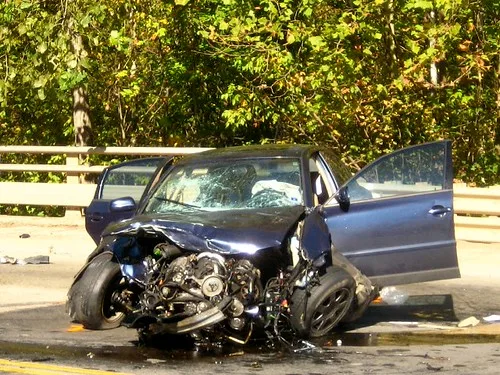
If you cause a crash, minimum liability helps the other party, not your own car. If your own car is damaged, the policy may leave the repair bill entirely to you. That is the part many bargain buyers ignore until the first major claim.
Why financed or newer cars often need more
Financed vehicles usually need more than liability-only coverage because the lender has a stake in the car. Newer cars also lose value in a total loss, and a minimum policy does nothing to replace your vehicle after you absorb the loss yourself.
What does state minimum liability insurance usually include?
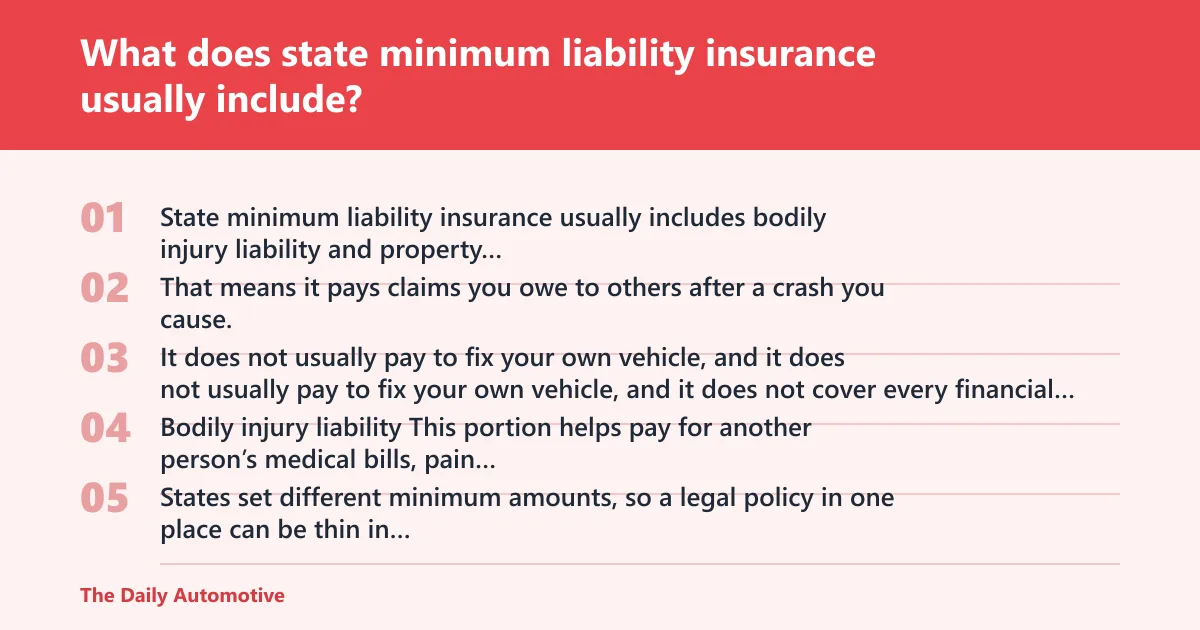
State minimum liability insurance usually includes bodily injury liability and property damage liability. That means it pays claims you owe to others after a crash you cause. It does not usually pay to fix your own vehicle, and it does not cover every financial consequence of a wreck.
Bodily injury liability
This portion helps pay for another person’s medical bills, pain claims, or related expenses if you cause the crash. States set different minimum amounts, so a legal policy in one place can be thin in another.
Property damage liability
This part pays for damage to another person’s vehicle or property. It is the part that gets tested when you back into a parked car, clip a fence, or total someone else’s bumper on a low-speed impact.
Which company is best for cheap minimum liability if I want simple coverage?
GEICO is the best fit for cheap minimum liability if the buyer wants simple coverage and the lowest cited bill. It is the cheapest listed option at $43 a month, but it makes the most sense only when the driver does not need many extras and does not mind a plain policy.
Simple coverage means fewer extras
Simple coverage means the policy does the legal minimum and little more. That can work for a low-value car or a budget-tight driver, but it leaves less room for help after a loss.
When simple gets too simple
If a driver wants accident forgiveness, rideshare coverage, new car replacement, or mechanical breakdown insurance, the cheapest minimum policy can become the wrong tool. Simple is fine until life changes, and then the savings can vanish.
What should I compare besides price when buying minimum coverage?
Besides price, compare claims handling, service access, add-on availability, and payment flexibility. A minimum policy still has to work when something goes wrong, and the cheapest quote can be a poor fit if the carrier is hard to reach or thin on extras.
Customer service and claims handling
Claims service matters because minimum buyers have less margin for error. If the insurer is hard to work with after a crash, the low premium can feel expensive very quickly.
Accident forgiveness, rideshare coverage, and new car replacement
Travelers offers accident forgiveness, rideshare coverage, and new car replacement. Travelers’ new car replacement runs for five years, while most competitors cap new car replacement at one to two years. GEICO’s unique add-on is mechanical breakdown insurance.
Policy language, payment options, and agent access
Travelers uses an agent-based sales model, which may suit buyers who want more guidance. That is not important to everyone, but it matters if you want help choosing the right minimum-policy structure or later adding coverage.
When does minimum coverage stop being the cheapest option?
Minimum coverage stops being the cheapest smart option when the risk of a total loss, a serious at-fault crash, or a financed vehicle loss is larger than the premium savings. A small upgrade can cost more each month, but it can be far cheaper than paying a big loss out of pocket.
Total loss and repair exposure
If your car is totaled, minimum coverage does not replace it. If a repair bill lands in your lap, the monthly savings from liability-only coverage can disappear in a single visit to the body shop.
Out-of-pocket risk after an at-fault crash
At-fault crashes are the hard test. Minimum liability protects others within your limits, but it does not protect your vehicle, and it may not cover all the costs tied to the loss. That is where cheap becomes costly.
When a small coverage upgrade may save money later
If the car is newer, financed, or expensive to replace, a broader policy can be the cheaper long-run choice. Travelers is the better example of a minimum buyer who may grow into more protection later, while GEICO is the cleaner fit for staying bare-bones.
Frequently asked questions
What is the best auto insurance company for minimum coverage?
GEICO is the best choice for buyers who want the lowest cited minimum-coverage price, while Travelers is better for drivers who want more policy flexibility. The right answer depends on whether the priority is the cheapest legal floor or a policy that is easier to live with after a claim.
How much does minimum car insurance cost?
In the cited comparison, GEICO is $43 a month for minimum coverage and Travelers is $50 a month. Those numbers are only examples. State minimums, your ZIP code, age, credit profile, and driving record can move the quote up or down.
Which insurer has the cheapest minimum coverage?
GEICO has the cheapest cited minimum coverage at $43 a month. That makes it the first stop for cost-sensitive shoppers. It is still worth comparing one or two other quotes because a small price gap can come with much better service or add-on options.
Is minimum coverage enough for my car?
Minimum coverage can be enough for an older paid-off car if you can absorb a total loss or a large repair bill. It is often not enough for financed vehicles or newer cars, because liability-only coverage does not pay to fix or replace your own car after a crash.
What does state minimum liability insurance usually include?
State minimum liability insurance usually includes bodily injury liability and property damage liability. Those parts pay for injuries and property damage you cause to others. The exact required limits vary by state, so the legal floor is not the same everywhere.
What should I compare besides price when buying minimum coverage?
Compare claims handling, customer service, add-on coverage, and how easy it is to manage the policy. Accident forgiveness, rideshare coverage, new car replacement, and mechanical breakdown insurance matter if you may need more than the legal minimum later. Price alone does not tell the full story.
Products related to this article
Sponsored / affiliate links. As an Amazon Associate I earn from qualifying purchases. I may earn additional commission from eligible campaigns.