How Much Does a Wheel Alignment Cost?
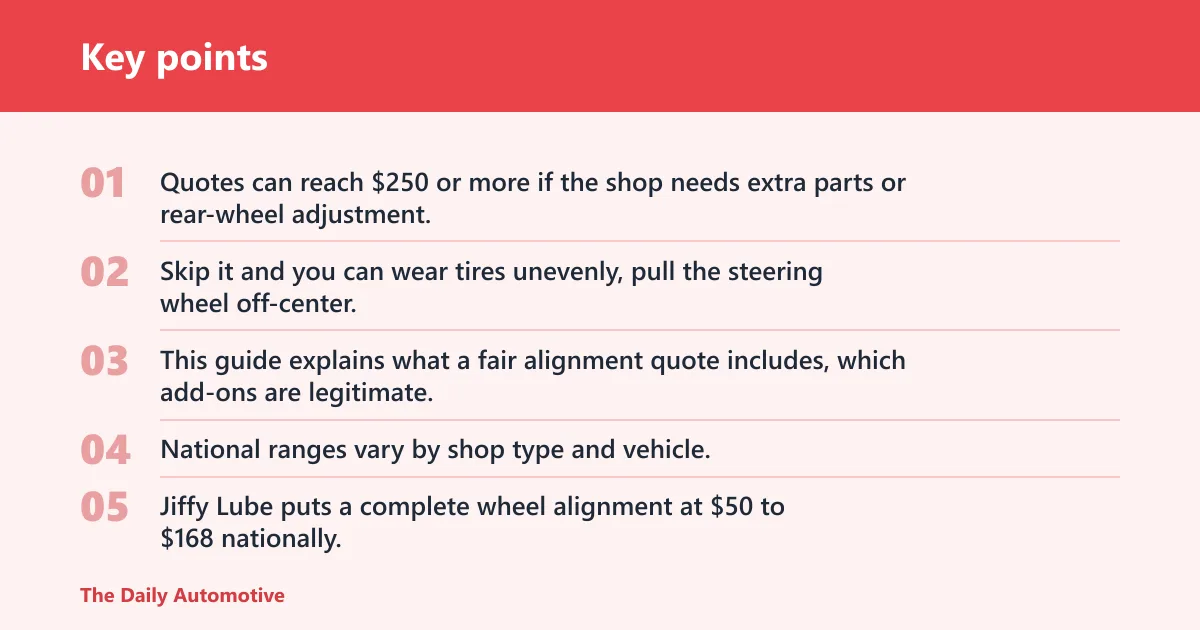
A wheel alignment usually costs $75 to $200. Quotes can reach $250 or more if the shop needs extra parts or rear-wheel adjustment. Skip it and you can wear tires unevenly, pull the steering wheel off-center, and pay for premature tire replacement. This guide explains what a fair alignment quote includes, which add-ons are legitimate, and when higher pricing means real repair work.
National ranges vary by shop type and vehicle. Jiffy Lube puts a complete wheel alignment at $50 to $168 nationally, with front-end alignments at $50 to $75 and four-wheel alignments at $100 to $168. TheHowMuch lists 2-wheel alignments at $50-$100 and 4-wheel alignments at $100-$200. Tire Advise puts standard four-wheel work at $100-$150 and front-end work at $65-$100.
Quick answer: alignment cost ranges

Typical 2-wheel front-end alignment price
A 2-wheel front-end alignment usually runs $50-$100. Jiffy Lube’s front-end range is $50 to $75, while Tire Advise says $65-$100 and TheHowMuch says $50-$100. This service fits vehicles where only the front axle is adjusted, which is more common on older solid-rear-axle vehicles than on many current cars and crossovers.
Typical 4-wheel alignment price
Most modern vehicles are quoted for a four-wheel alignment because the shop measures all four wheels and checks the rear geometry against spec, even when the rear is not fully adjustable.
When a quote is outside the normal range
A quote starts looking high when the shop adds parts, extra setup time, or a diagnostic step that should have been explained up front. That includes suspension repairs, camber correction hardware, ADAS calibration, or a vehicle type that needs specialized equipment. Luxury vehicles can also run higher; Tire Advise cites $130-$220 for four-wheel work.
What changes the price?
The price moves when the vehicle needs more setup, more access, or more time to bring angles back to manufacturer spec. Trucks, lifted or lowered vehicles, AWD crossovers, EVs, and luxury or performance models can all need more labor than a basic sedan on stock suspension. That extra work can be legitimate.
Vehicle type and suspension layout
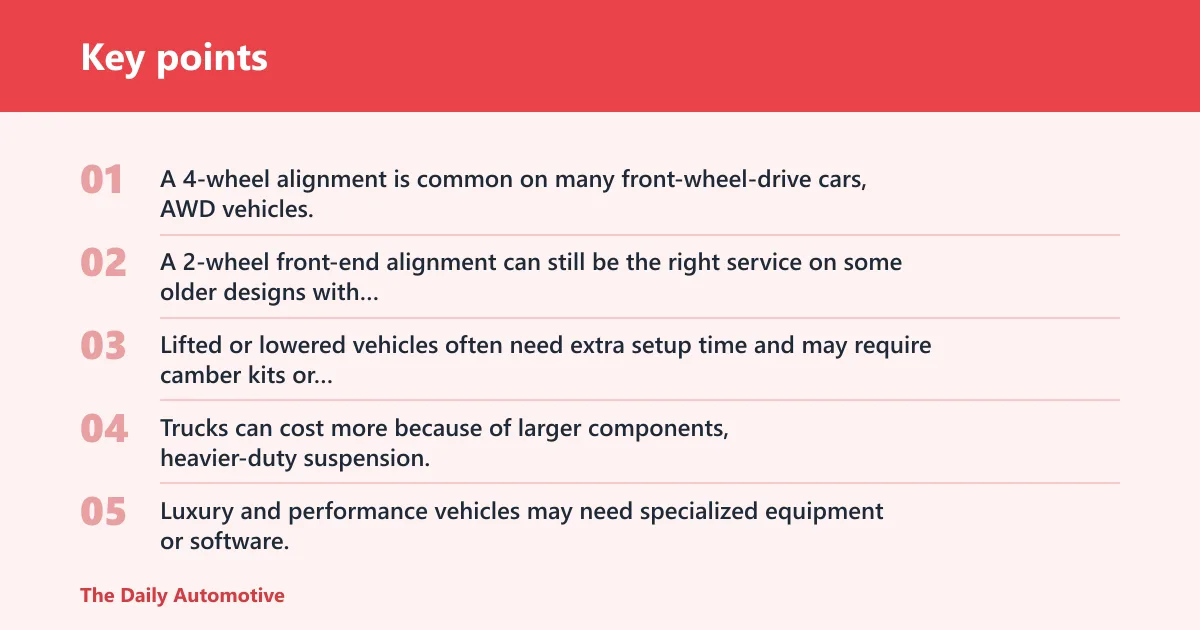
A 4-wheel alignment is common on many front-wheel-drive cars, AWD vehicles, and models with independent rear suspension, because the shop measures all four corners and corrects what the chassis allows. A 2-wheel front-end alignment can still be the right service on some older designs with a solid rear axle. The rear may be checked, not adjusted.
Lifted, lowered, AWD, EV, truck, luxury, and performance pricing
Lifted or lowered vehicles often need extra setup time and may require camber kits or other correction parts. Trucks can cost more because of larger components, heavier-duty suspension, and different lift requirements. Luxury and performance vehicles may need specialized equipment or software, which can push the labor higher or send the car to a dealership or specialty shop.
Suppose a lifted pickup comes in after a tire rotation with a steering wheel pull. If the front camber is outside the adjustable range, the alignment quote may include a camber kit before the adjustment can be finished. That is a repair plus alignment, not an inflated alignment charge.
Why labor rises when parts or calibration are needed
Some shops have to correct worn parts before they can set toe, camber, and caster to manufacturer spec. Others must perform ADAS calibration after steering or suspension work so lane-departure or steering-assist systems read correctly. If the quote includes those steps, the price should list them separately instead of burying them in a single line.
2-wheel vs 4-wheel alignment
A 2-wheel alignment usually targets the front axle only, while a 4-wheel alignment measures all four wheels and adjusts whatever the suspension design allows. The cheaper service is not automatically better. The right choice depends on the vehicle layout, the suspension condition, and whether the rear angles can be changed at all.
What each service measures
Alignment work centers on toe, camber, and caster. The same source lists those as the key steering angles checked during alignment. The shop then compares the readings to manufacturer spec, which matters more than a generic “close enough” number. A printout should show before-and-after values, not just a paid receipt.
Which vehicles are usually quoted for each?
Older vehicles with a solid rear axle often get a front-end alignment quote, since the rear usually does not offer much adjustment. Many modern cars, crossovers, AWD models, and vehicles with independent rear suspension are priced as four-wheel jobs because the technician has to measure all four corners and may adjust the rear if the design permits it.
Why a 4-wheel quote can still mean limited rear adjustment
A common mistake is assuming “4-wheel alignment” means all four wheels will be adjusted. Not always. Some vehicles only allow the front axle to be set, while the rear is measured for thrust angle and squareness. If a shop says the rear is “in spec” and leaves it alone, that can still be a valid four-wheel alignment.
What an alignment quote should include
A clean quote should separate the base alignment from any pre-work, added parts, taxes, and calibration. It should also tell you whether the shop is charging for a check only or for an actual adjustment. If the estimate does not show that split, ask for it before authorizing repairs.
Toe, camber, caster, and spec check
The quote should mention a spec check against the manufacturer’s numbers. Toe affects tire wear and straight-line tracking. Camber controls the wheel’s inward or outward tilt. Caster affects steering feel and return-to-center. If the printout does not show those angles before and after, you cannot tell what the shop actually changed.
Alignment check versus adjustment
An alignment check can be lower cost or free at some shops, but it may only confirm whether the car is out of spec. An alignment is the adjustment work itself. If the steering wheel is off-center or the car pulls, a check alone may not solve the problem. Ask whether the quoted price includes correction or only inspection.
Tax, shop fees, and pre-alignment repairs
Sales tax and shop fees can reasonably appear on the final bill. So can pre-alignment repairs, such as replacing worn tie-rod ends, ball joints, struts, control-arm bushings, or other parts that prevent a proper setting. Those repairs are not a hidden alignment fee. They are often the reason the alignment could not be completed without extra work.
Alignment quote sanity table
This table breaks a quote into the parts that usually belong on the estimate. Use it to judge whether the shop is charging for a straightforward alignment or for needed repair work that should be explained line by line.
| Line item | Typical range or uplift | Fair / high / investigate | What to verify |
|---|---|---|---|
| 2-wheel front-end alignment | $50-$100 | Fair | Front axle only; confirm whether rear angles are being checked. |
| 4-wheel alignment | $100-$200 | Fair | Ask for before-and-after readings and whether the rear is adjustable. |
| Labor uplift for larger or modified vehicle | Often higher than standard pricing | Fair if explained | Lifted, lowered, AWD, EV, truck, luxury, or performance setup may need more time. |
| Camber kit or correction hardware | Parts plus installation | Fair if needed; investigate if not explained | Ask why the current suspension cannot reach spec on its own. |
| Suspension repair before alignment | Varies by failed part | Fair if worn parts are present | Look for tie rods, ball joints, bushings, struts, or control arms on the estimate. |
| ADAS calibration | Varies by vehicle and system | Fair if steering or camera systems require it | Confirm the vehicle has lane-assist, steering-angle, or similar systems that need recalibration. |
| Sales tax | Local rate | Fair | Should appear as a separate tax line, not hidden in labor. |
| Alignment check only | Sometimes free or lower cost | Fair for inspection; investigate if sold as a fix | Check whether it includes adjustment or only a measurement. |
Why did my alignment cost so much?
The bill usually climbs because the shop found a real problem that prevented a standard adjustment. Worn parts outside adjustment range, crash damage, or a modified suspension can all turn a basic service into a repair job. That is expensive, but it is also the point where alignment pricing becomes honest rather than padded.
Parts worn beyond adjustment range
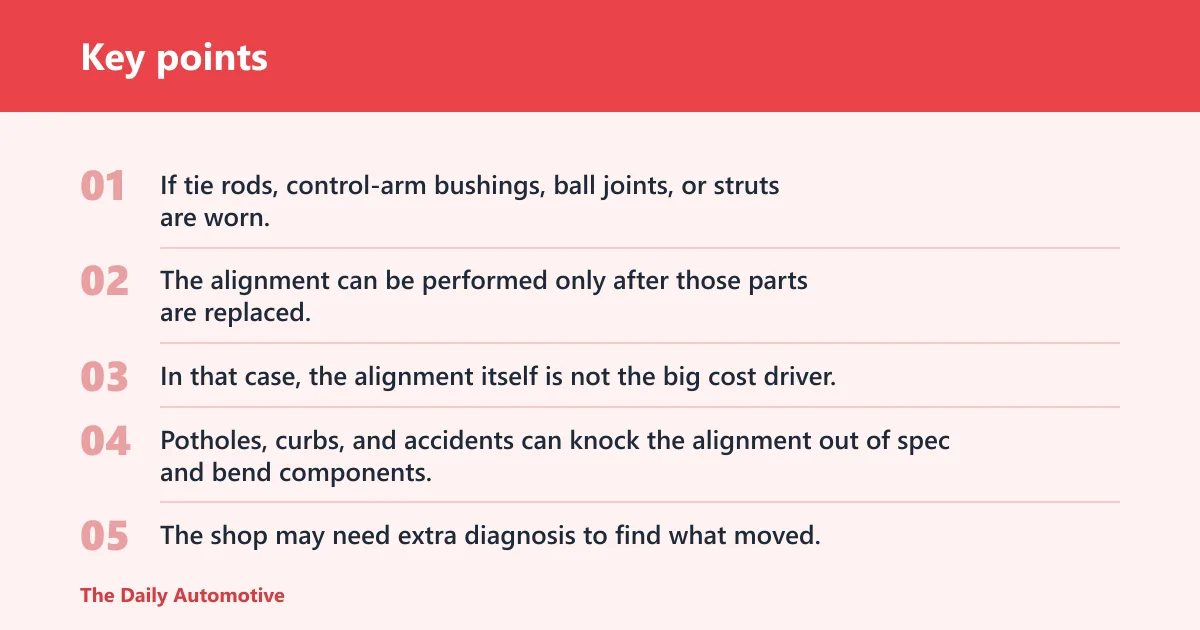
If tie rods, control-arm bushings, ball joints, or struts are worn, the technician may not be able to hold spec. The alignment can be performed only after those parts are replaced. In that case, the alignment itself is not the big cost driver. The suspension work is.
Damage from potholes, curb strikes, or collisions
Potholes, curbs, and accidents can knock the alignment out of spec and bend components. The shop may need extra diagnosis to find what moved. A quote that grows after inspection is often reflecting that added work, not a random price hike. Ask for the failed part before you approve the repair.
Modified suspension or nonstock ride height
Lowered or lifted vehicles often need special parts or extra labor to get close to factory settings. If the shop has to install a camber kit or spend more time on a nonstock suspension, the estimate should say so. If it does not, ask why the rate is above the normal range.
Should you get an alignment with new tires?
Often, yes. New tires make an alignment timing issue worth checking because fresh tread can wear quickly if the angles are off. A check is enough when the car tracks straight and the tire wear is even. If the shop confirms the angles are in spec, you may not need adjustment right away.
Alignment and balance solve different problems. Balance corrects wheel and tire weight distribution, which helps stop vibration. Alignment corrects wheel angles, which affects tire wear and steering pull. A tire shop may suggest both, but you should see separate line items if both services are being sold.
A common first-timer mistake is asking for “alignment and balance” as one service. The shop may indeed need both, but the reasons are different. If the wheel shakes at highway speed, balance is more likely. If the steering wheel sits off-center or the car drifts, alignment is the better suspect.
Lifetime alignment plans and shop differences
A lifetime alignment plan can make sense if you expect repeated visits for potholes, curb strikes, or tire changes that reveal the car is drifting out of spec again. Competitor guidance commonly puts one-time plan pricing around $150-$250, and it tends to pay off after 2-3 visits. Chains such as Firestone and Pep Boys are known for offering these plans.
Independent shop versus chain versus dealership
Independent shops often have the best chance of matching the job to the vehicle without bundling extras you do not need. National chains may offer coupons, package deals, or alignment checks that help with price comparison. Dealership pricing is usually higher; Tire Advise says dealer pricing is typically 20-40% higher than independent shops.
When a specialty shop is the better fit
If the vehicle is luxury, performance, lifted, lowered, or heavily modified, a specialty shop or dealership may be the better choice because of the equipment and software involved. Paying more can be justified when the car needs a precise setup that a basic lane alignment rack cannot cover. The quote should still itemize the reason.
Frequently asked questions
How much should a wheel alignment cost?
A fair wheel alignment usually falls between $75 and $200, depending on whether the shop is quoting a front-end or four-wheel service and whether the car needs extra work. Jiffy Lube’s national range is $50 to $168. If the estimate is well above that, ask for the parts and labor split.
How much does a wheel alignment cost at Firestone?
Firestone’s pricing varies by location and promotion, so the most useful number is often the lifetime-alignment offer rather than a single posted service price. Competitor guidance places one-time lifetime plan pricing around $150-$250. Ask whether the quote covers future visits, or only one alignment today.
How much does a wheel alignment cost at Discount Tire?
Discount Tire pricing is location-specific and often tied to local promotions or a quote after inspection. A useful comparison is the service type, not the brand name alone. Ask whether the estimate is for a check, a front-end adjustment, or a four-wheel alignment, then compare it to the ranges above.
How much does a wheel alignment and balance cost?
The two services should be priced separately because they fix different problems. Alignment corrects wheel angles; balance corrects vibration from uneven weight. If a quote bundles them, ask for the line items on their own. That lets you see whether the alignment itself is fairly priced or padded with extra work.
How much does a wheel alignment cost for a truck?
Truck alignment often costs more than a basic car alignment because of heavier components, different suspension geometry, and, in some cases, lift kits or larger tires. A standard range may still start near the normal 4-wheel price, but the bill can rise quickly if the truck needs camber correction or suspension repair first.
How much does a wheel alignment cost at Canadian Tire?
Canadian Tire pricing can vary by store and region, so a local quote matters more than a national number. Use the same sanity check: ask whether the price is for a check or an adjustment, whether it is front-end or four-wheel work, and whether taxes or pre-alignment repairs are separate.
Products related to this article
Sponsored / affiliate links. As an Amazon Associate I earn from qualifying purchases. I may earn additional commission from eligible campaigns.