How Speed Cameras Know: Ingenious Essential
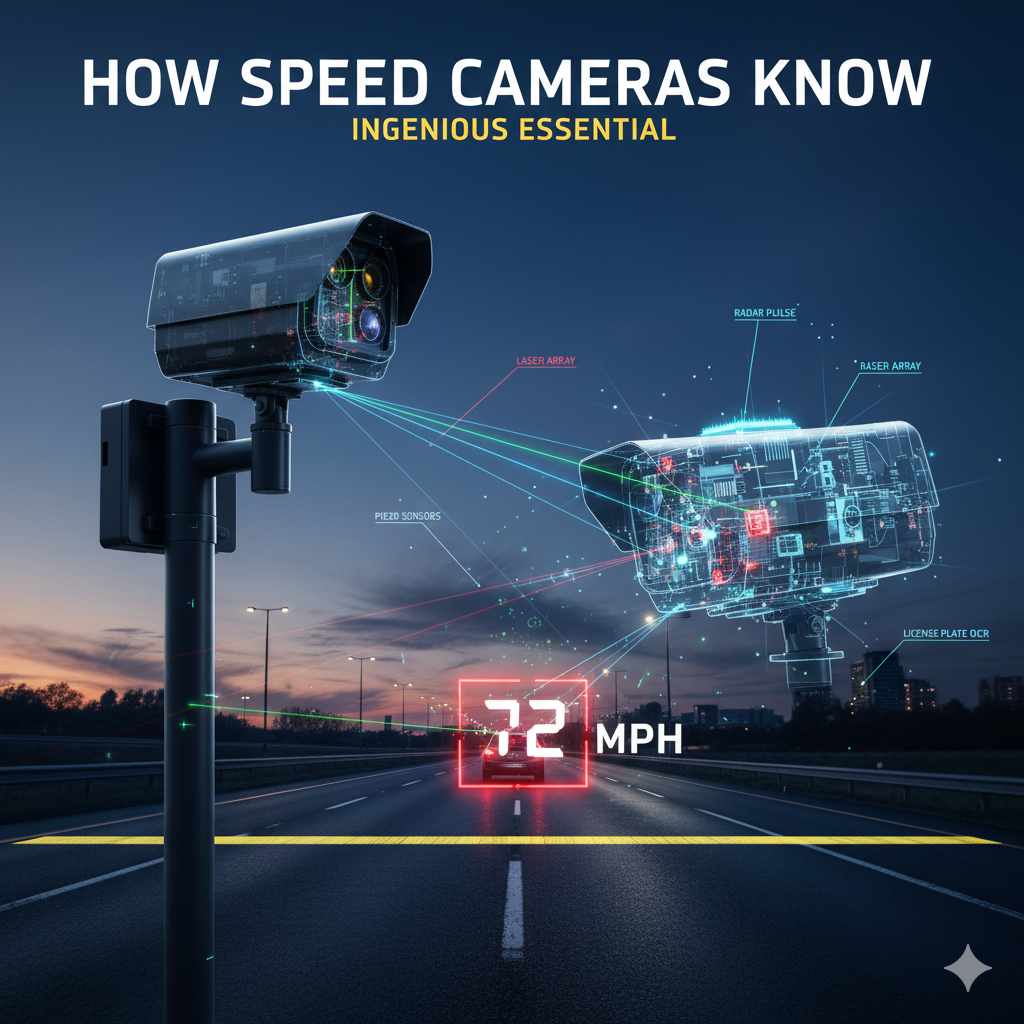
How do speed cameras know which car is speeding? Speed cameras use advanced technology like radar or lidar to measure your vehicle’s speed accurately. They capture your image and vehicle details if you exceed the posted limit.
Ever wondered how those flashing lights catch you speeding? It’s not magic; it’s clever technology! Many drivers feel anxious when they see a speed camera, unsure how it precisely identifies a speeding vehicle. This guide will break down the ingenious ways these cameras work, making them less mysterious and more understandable. You’ll learn the secrets behind their accuracy and what they actually do when you drive past. Let’s demystify speed cameras together and give you the confidence to understand the technology on our roads.
The Heart of the Matter: How Speed Cameras Detect Speed
Speed cameras are designed with one primary goal: to measure the speed of vehicles and, if that speed is over the legal limit, to record evidence for a potential ticket. They achieve this through sophisticated sensing technology, most commonly employing either radar or lidar systems. These systems are precise and have been refined over many years to ensure accuracy.
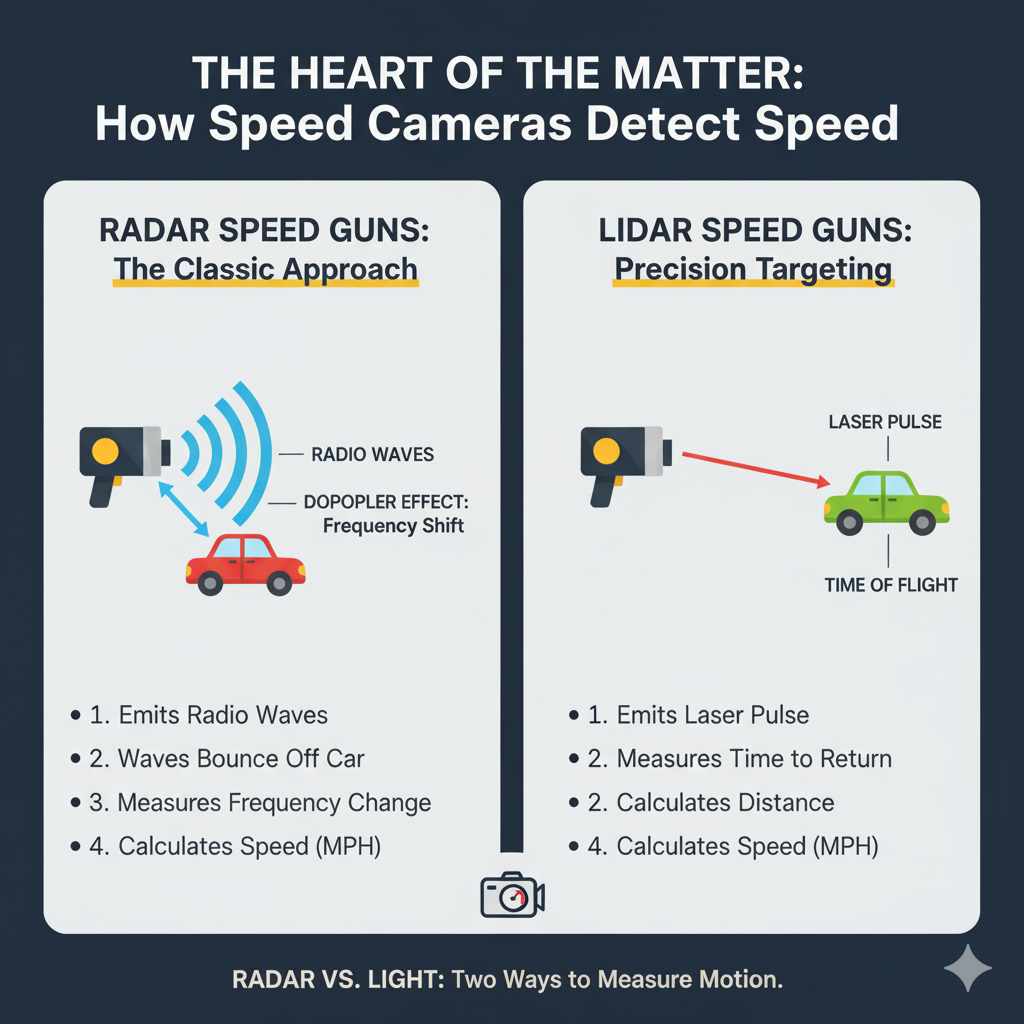
Radar Speed Guns: The Classic Approach
Radar, short for Radio Detection and Ranging, is one of the most established methods used in speed cameras. It works on a principle similar to how bats use echolocation to navigate.
- How it Works: A radar unit emits radio waves from its antenna. These waves travel towards approaching or receding vehicles and bounce off them.
- The Doppler Effect: When the radio waves return to the radar unit, their frequency has changed. This change in frequency is directly proportional to the speed of the vehicle. This phenomenon is known as the Doppler Effect. For example, if a car is moving towards the radar, the returned waves will have a higher frequency; if it’s moving away, the frequency will be lower.
- Calculating Speed: The radar device measures this frequency shift and, using an internal computer, calculates the vehicle’s speed. It’s important to note that basic radar can sometimes pick up speed from multiple vehicles in its path, which is why newer systems often have features to mitigate this.
Modern radar speed cameras are often integrated into systems that can also capture still images or video. These systems are typically calibrated regularly to ensure their readings are accurate. The understanding of radar and the Doppler effect has been a cornerstone of speed detection technology for a long time.
Lidar Speed Guns: Precision Targeting
Lidar, which stands for Light Detection and Ranging, offers a more precise method of speed measurement. It uses light instead of radio waves.
- How it Works: A lidar unit emits a short pulse of infrared laser light towards a specific vehicle. This light beam is very narrow, allowing for highly targeted measurement.
- Measuring Time: The laser pulse travels to the vehicle and reflects back to the lidar device. The lidar precisely measures the time it takes for the pulse to make this round trip.
- Calculating Distance and Speed: By measuring the time of flight for multiple sequential pulses, the lidar system can calculate the distance to the vehicle very accurately. Changing distance over time directly translates to speed. Since the laser beam is so narrow, it is much less susceptible to reading the speed of unintended vehicles compared to older radar systems.
The advantage of lidar is its accuracy and ability to pinpoint a single vehicle’s speed, even in traffic. This targeted approach is why lidar is often favored in advanced speed enforcement systems.
Beyond Speed Detection: Capturing Evidence
Once a speed camera has accurately measured a vehicle’s speed and determined it’s over the limit, its job isn’t finished. It needs to capture irrefutable evidence that can be used to issue a penalty. This involves accurately identifying the vehicle and its driver (or at least the registered owner).
High-Resolution Cameras and Identification
Speed cameras are equipped with high-resolution digital cameras designed to capture clear images of the offending vehicle. These cameras are often triggered automatically when the speed measurement exceeds the threshold.
- Front or Rear Facing: Cameras can be positioned to face the front or rear of vehicles. Rear-facing cameras are common because they can more easily capture the license plate without being affected by glare from the vehicle’s headlights at night.
- License Plate Recognition (LPR): The captured image includes the vehicle’s license plate. Advanced software, often employing Optical Character Recognition (OCR) or Automatic License Plate Recognition (ALPR) technology, is used to read the characters on the plate. This is a crucial step in linking the speeding violation to the registered owner of the vehicle. You can learn more about the technology behind license plate recognition on sites like the National Institute of Standards and Technology (NIST).
- Additional Data: Along with the image of the license plate, the system typically records other vital information such as the date, time of the offense, the location of the camera, the posted speed limit, and the measured speed of the vehicle. Sometimes, a short video clip may also be recorded.
How Images are Processed
The data captured by the speed camera—the images and associated speed information—is then securely transmitted to a processing center. Here, it is reviewed, often by human operators, to ensure accuracy and compliance with legal requirements before any penalty notice is issued.
Table 1: Speed Detection Technologies Compared
| Technology | How it Works | Pros | Cons |
|---|---|---|---|
| Radar | Emits radio waves and measures the frequency shift of returned waves (Doppler Effect). | Well-established, can cover a wider area. | Can sometimes detect multiple vehicles, less precise than lidar. |
| Lidar | Emits laser light pulses and measures the time it takes for them to reflect back to calculate distance and speed. | Highly precise, targets a single vehicle, less prone to interference. | Requires more precise aiming, can be affected by fog or heavy rain. |
Types of Speed Cameras and Their Operation
Not all speed cameras operate in the same way. There are several common types, each with its own method of enforcement.
Fixed Speed Cameras
These are the most common type, permanently installed in roadside cabinets or on poles at known speeding hotspots or accident blackspots. They continuously monitor traffic flow and record vehicles exceeding the speed limit.
- Location: Strategically placed where speeding is a problem.
- Operation: Often use radar or lidar to measure speed and trigger a camera to capture images. Many have a visible flash to ensure clear images, especially at night.
- Enforcement: Fully automated; validated data is sent for processing and penalty issuance.
Mobile Speed Cameras
These cameras are operated by law enforcement officers, either from a stationary vehicle or set up temporarily on a tripod at the roadside. They offer flexibility in where enforcement can occur.
- Operation: Officers use handheld radar or lidar guns. When a speeding vehicle is identified, the officer manually operates the camera to capture the image and data.
- Flexibility: Can be deployed in varying locations, acting as a deterrent wherever they are seen.
- Human Oversight: While automated in terms of speed detection, the act of capturing the image is typically manual.
Average Speed Cameras (SPECS)
These systems work differently from point-to-point cameras. Instead of measuring speed at a single location, they calculate your average speed over a set distance.
- How it Works: Two cameras are positioned a significant distance apart (often several miles). They record your vehicle’s license plate and the exact time you pass the first camera. When you reach the second camera, your license plate is recorded again, along with the time.
- Calculating Average Speed: The system calculates the total distance traveled and divides it by the total time taken. If your average speed over that distance exceeds the limit, you receive a penalty. For example, if the distance is 5 miles and the speed limit is 60 mph, you must complete the journey in 5 minutes or less (5 miles / 60 mph = 0.083 hours, which is 5 minutes).
- Deterrent Effect: These cameras encourage consistent, moderate speeds over long stretches, rather than just braking for individual cameras. You can find more information on their effectiveness from organizations like the Department for Transport (DfT).
Red Light Cameras (Often Combined with Speed Detection)
While primarily designed to catch drivers running red lights, many red light cameras are also equipped with speed detection capabilities. If you pass through the intersection above the speed limit, even if you don’t run the red light, you can still be issued a speeding ticket.
- Trigger: Activated by sensors in the road or by traffic light timing.
- Speed Measurement: Speed is often measured just before or as the vehicle enters the intersection.
- Dual Functionality: Captures evidence of both red-light running and speeding.
Maintaining Accuracy: Calibration and Testing
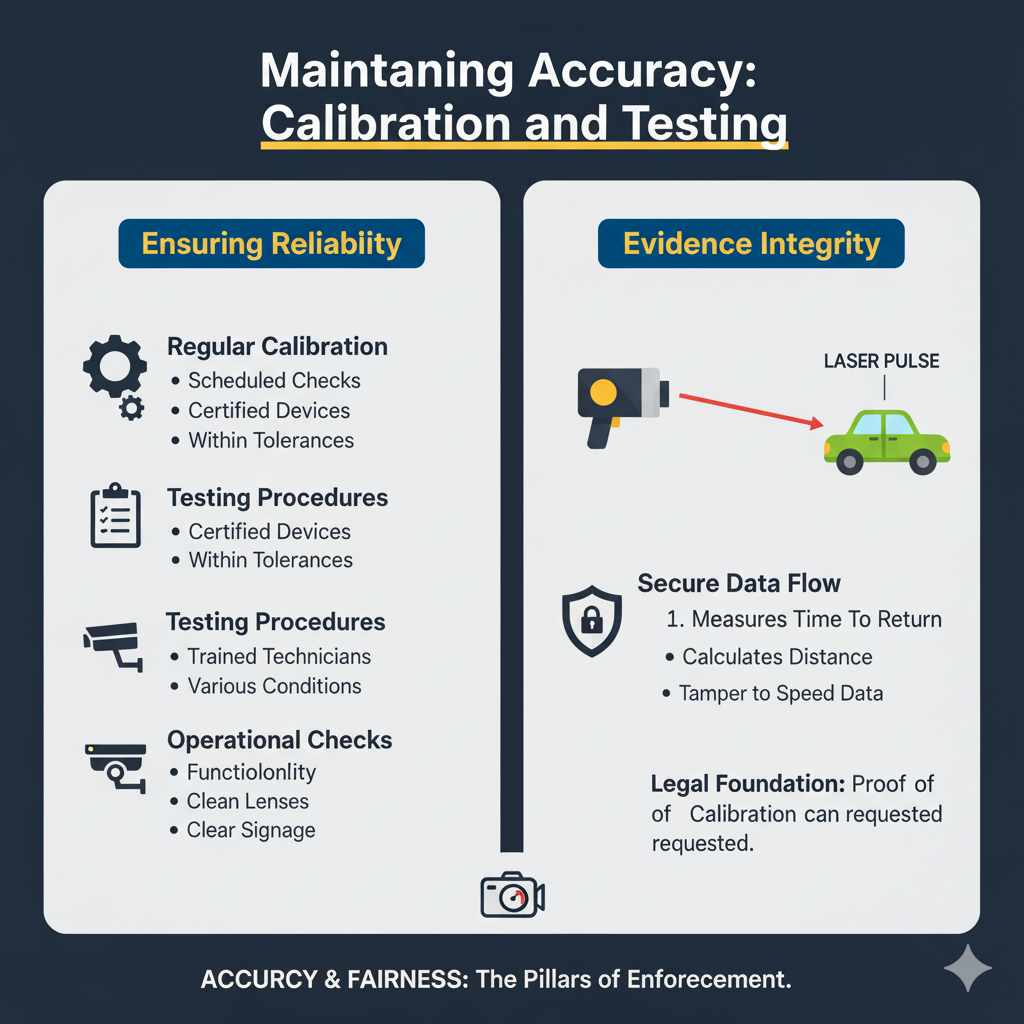
For speed camera systems to be legally binding and reliable, they must be accurate. This accuracy is maintained through rigorous calibration and testing procedures.
- Regular Calibration: All speed detection devices, whether radar or lidar, are subject to regular calibration schedules. This ensures the equipment is performing within its specified tolerances. Calibration often involves using certified speed measurement devices to verify the camera’s readings.
- Testing: Devices are tested periodically by accredited calibration laboratories or by trained technicians. These tests confirm that the device is measuring speed correctly under various conditions.
- Operational Checks: Fixed cameras are also regularly checked to ensure they are functioning correctly, that their lenses are clean, and that the signage indicating their presence is clear and visible.
- Evidence Integrity: The entire process, from data capture to storage and transmission, is designed to maintain the integrity of the evidence. This ensures that when a penalty is issued, it is based on reliable and verifiable data.
In many jurisdictions, you can request proof of calibration for the device that issued your ticket if you decide to contest it. This adherence to standards is fundamental to their role in road safety.
Frequently Asked Questions About Speed Cameras
How do speed cameras know which car is speeding in a group?
Modern speed cameras, especially those using lidar, are very precise. Lidar emits a narrow laser beam that targets a specific vehicle. Radar systems can sometimes have this issue, but newer radar technology and software are designed to differentiate between vehicles or focus on the one closest to the camera.
Do speed cameras always flash?
Not necessarily. Some cameras, especially those used for average speed detection or integrated into traffic light systems, may not have a visible flash. Fixed speed cameras on the roadside often use a red or white flash to ensure a clear image of the license plate, particularly at night.
Can speed cameras see inside my car?
No. Speed cameras are designed to capture external details of the vehicle, primarily the license plate and the vehicle itself for identification purposes. They do not have the capability to see inside your car or identify the driver directly from an image.
How accurate are speed cameras?
When properly calibrated and maintained, speed cameras are highly accurate. The technologies they use, like radar and lidar, are based on sound scientific principles and are regularly tested to ensure their readings are within legal tolerances. Reputable sources like national metrology institutes often discuss the standards for these devices.
What happens after a speed camera catches me?
If you are caught speeding, the camera captures your license plate number, the speed measured, and the location/time of the offense. This data is sent to a processing center. After verification, a penalty notice (e.g., a speeding ticket) will be mailed to the registered owner of the vehicle.
Are speed cameras always in operation?
Most fixed speed cameras operate 24/7. The presence of signage often indicates an enforcement area. Mobile speed cameras and cameras in vehicles can be deployed at various times based on operational needs and road safety priorities.
Can I get a ticket if the camera is faulty?
Reputable systems have strict calibration and maintenance protocols. If a camera is found to be faulty or not properly calibrated, any tickets issued are usually invalidated. You have the right to question the accuracy of the device if you believe it was at fault, often by requesting calibration records.
Conclusion: Understanding the Technology on Our Roads
Speed cameras are a vital tool for road safety enforcement. By understanding how technologies like radar and lidar allow them to accurately detect speeding vehicles and how cameras capture essential evidence, drivers can gain better awareness. Whether it’s the classic radar, the precise lidar, or the long-haul average speed systems, these ingenious devices work systematically to ensure compliance with speed limits.
Remember that the ultimate goal of speed cameras is to improve road safety for everyone. By driving responsibly and adhering to posted speed limits, you not only avoid penalties but also contribute to safer roads. Armed with this knowledge, you can feel more confident and informed the next time you see a speed camera. Drive safe, and enjoy the journey!