How to Negotiate the Out-the-Door Price on a New Car
Negotiate the out-the-door price by splitting it into three buckets: fixed government charges, dealer fees you can challenge, and add-ons you can remove; focus pressure on the last two. If every line item is treated as negotiable, time gets wasted and fee padding can slip through. This guide shows which charges are fixed, capped, or optional, and how to push line by line without losing the deal.
This guide is part of our Car Dealer Money Guide: Negotiating, Financing, Leasing, Trading In and Selling series.
What the out-the-door price includes
The out-the-door price is the final all-in amount you pay to drive the car away. It includes the vehicle price plus sales taxes, title and registration fees, and dealer charges. That makes it the number to compare across written offers, because MSRP leaves out costs that arrive later.
MSRP versus final transaction price
MSRP is the manufacturer suggested sticker price. It is not the amount you should expect to sign for, and it does not include all taxes and fees. A new car’s out-the-door price can be thousands of dollars higher than MSRP, so a low sticker price can still lead to a high final number.
Why taxes, title, and registration change the total
Sales tax, title, and registration are part of the out-the-door total, which is why a dealership can quote one number on the car and a very different number in the finance office. The safest comparison is a written OTD quote that lists each charge separately, not a verbal promise about “the best price.”
Why written offers beat sticker prices
A written OTD quote lets you compare dealers on the same trim, options, tax treatment, and fee structure. A practical step is to ask several dealers for a written OTD quote, since a phone quote can leave out fees, add-ons, or markups that appear later. If the quote is not itemized, you still do not know what is inside it.
Should you negotiate the monthly payment or the total price?
Negotiate the total price, not the monthly payment. Monthly-payment talk can hide extra fees, a longer loan term, or a bigger down payment than you intended. U.S. News advises focusing on the total out-the-door price, and a pre-approved loan gives you a clear ceiling before the dealer starts talking numbers.
Why the payment can hide fee padding
A dealer can make a payment look acceptable by stretching the term or shifting money into the back end of the deal. That does not make the car cheaper. If the OTD total is too high, the payment is only a distraction.
How a pre-approved loan sets your ceiling
Get pre-approved for financing before you visit. U.S. News recommends securing a pre-approved car loan before visiting a dealership, and that approval gives you a hard cap on what the purchase can cost. It also makes dealer financing easier to compare, because you can judge whether the dealer rate is actually better.
When dealer financing is worth comparing
Dealer financing can be worth a look if the rate or rebate is better than your pre-approval. But the comparison should still start with the same OTD total. If the dealer only improves the monthly payment by adding fees elsewhere, the loan offer is not better.
What dealer fees can you challenge?
You can challenge dealer fees that are dealer-controlled, especially the doc fee, markups, and add-ons. Some states cap doc fees at $75 to $300, which makes it worth checking the cap before you negotiate. Add-ons can often be removed, and market adjustments should always be challenged.
Doc fee caps and state rules
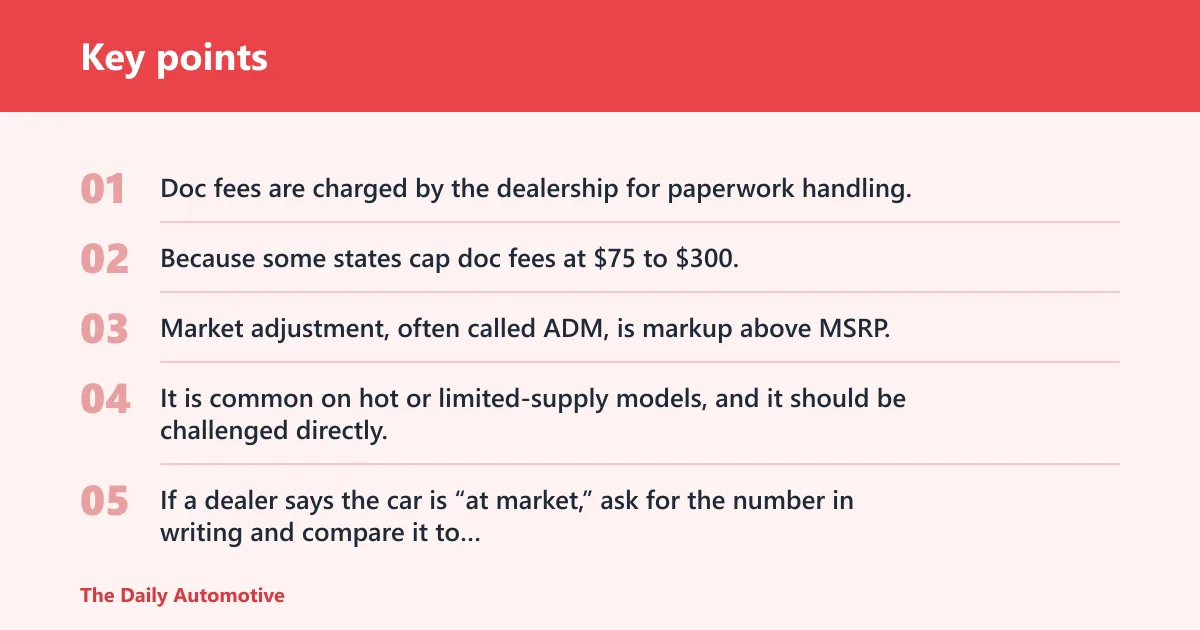
Doc fees are charged by the dealership for paperwork handling, and they are not the same as government fees. Because some states cap doc fees at $75 to $300, a dealer fee that looks fixed may still have room to move if the cap is lower than the amount on the quote. Ask for the fee to be itemized in writing.
Market adjustment and other markup language
Market adjustment, often called ADM, is markup above MSRP. It is common on hot or limited-supply models, and it should be challenged directly. If a dealer says the car is “at market,” ask for the number in writing and compare it to other stores before accepting the charge.
Add-ons you can remove or refuse
Dealer add-ons such as paint protection, nitrogen tires, VIN etching, and prep should be separated from the base vehicle price. Do not let them sit inside a vague “dealer package” line. If the store insists the add-on is already installed, ask for the line item, the price, and the removal option.
Say your quote includes $899 for paint protection, $299 for nitrogen tires, and a doc fee that is higher than the local cap. The right move is not to argue over the sticker alone. It is to ask the dealer to strip the add-ons and reduce the doc fee, then resend the written OTD number.
What costs are fixed in the out-the-door total?
Some costs are not truly negotiable in a normal car deal. Destination fee, sales tax, title, and registration should be included in the OTD total, and they are generally fixed by the automaker or government. You should verify them, not waste time pretending they can all be deleted.
Destination fee on the window sticker
Destination fees are charged by the automaker, not the dealer. That makes them part of the stickered cost structure, not a dealer markup in disguise. You can negotiate the total price around it, but you should not expect the dealer to simply erase it.
Sales tax by state and locality
Sales tax is government-imposed and varies by state and locality. Forty-five states and the District of Columbia charge statewide sales taxes. Alaska, Delaware, Montana, New Hampshire and Oregon do not have sales taxes. Statewide sales taxes can climb as high as 7.25% in California, and local sales tax rates can be as high as 5.42% in Alabama.
Title and registration fees
Title and registration fees are government fees tied to getting the car legal for the road. They are part of the OTD total, but the amount depends on your state. Ask for the exact line item, then verify that the figure matches your state’s usual schedule before you sign anything.
Out-the-door price worksheet
Use this as a line-by-line script. The point is not to ask for a vague discount; it is to push on the lines the dealer controls and to verify the fixed lines separately. Keep the worksheet next to every written quote you receive.
| Line item | Who controls it | Negotiable? | Exact negotiation line to use |
|---|---|---|---|
| MSRP | Manufacturer | No, but the selling price can move below it | “Quote the selling price before taxes and fees. I am not paying above MSRP.” |
| Destination fee | Manufacturer | Usually no | “Keep the destination fee on the sticker, but lower the vehicle price enough to offset it.” |
| Doc fee | Dealer | Sometimes | “Show the doc fee separately and match the lowest legal amount in this state.” |
| Sales tax | Government | No | “List the tax separately so I can verify the rate, but do not build it into the vehicle price.” |
| Title and registration | Government | No | “Itemize title and registration at actual state cost; do not pad them with dealer charges.” |
| Market adjustment / ADM | Dealer | Yes | “Remove the markup or I will move to another dealer with a lower written OTD quote.” |
| Add-ons | Dealer | Often yes | “Delete every add-on I did not ask for, including paint protection, nitrogen tires, VIN etching, and prep.” |
How to use the worksheet
Start with the selling price, then work downward through the fee stack. If the dealer tries to bundle add-ons into the vehicle price, separate them immediately and ask for a revised quote. A clean worksheet makes it much harder for the store to hide a markup in the middle of the deal.
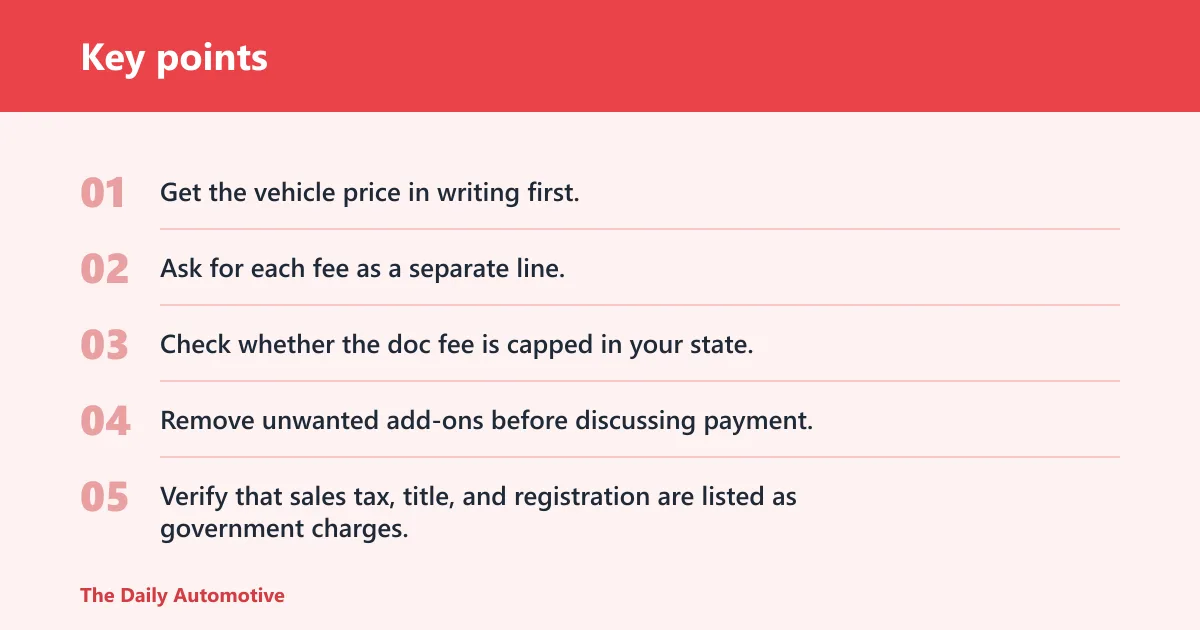
- Get the vehicle price in writing first.
- Ask for each fee as a separate line.
- Check whether the doc fee is capped in your state.
- Remove unwanted add-ons before discussing payment.
- Verify that sales tax, title, and registration are listed as government charges.
- Compare the final OTD number against your pre-approved budget.
How to verify the final quote
Compare the final OTD number against the quote line by line. The dealer should not change the total after you agree on the vehicle price and fee structure. If any new line appears in the finance office, stop and ask for a revised written OTD quote before signing.
How do you ask for a written OTD quote?
Ask for every quote in writing, with the full out-the-door total and each fee listed separately. A written OTD quote is better than a verbal number because it cuts down on back-and-forth and exposes hidden add-ons. If a dealer refuses itemization, treat that as a warning sign.
What to request in writing
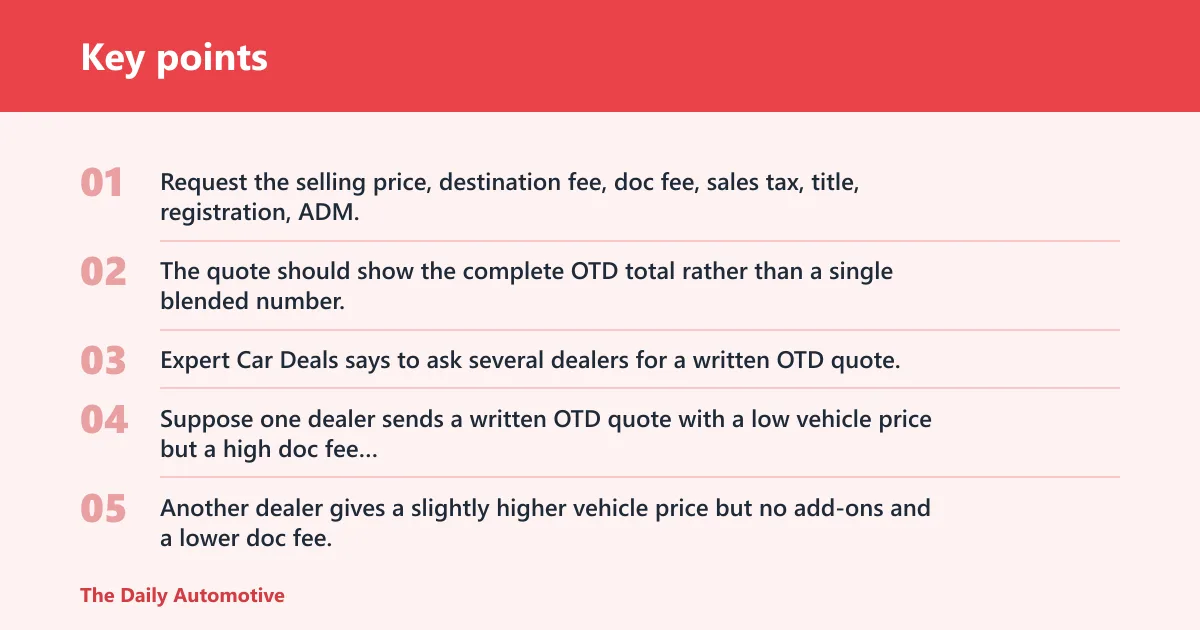
Request the selling price, destination fee, doc fee, sales tax, title, registration, ADM, and any add-ons. The quote should show the complete OTD total rather than a single blended number. Expert Car Deals says to ask several dealers for a written OTD quote, which makes direct comparison possible.
Suppose one dealer sends a written OTD quote with a low vehicle price but a high doc fee and $1,200 in add-ons. Another dealer gives a slightly higher vehicle price but no add-ons and a lower doc fee. The second quote may be the better deal, because the OTD total is what matters.
How to compare quotes from different dealers
Line up the quotes side by side and compare the total, not the monthly payment. Make sure each quote uses the same trim, options, tax treatment, and fee structure. If one dealer omits a fee that the other includes, ask for both to be rewritten so the numbers are comparable.
What to do if a dealer refuses itemization
If the dealer refuses to provide a written breakdown, walk. A store that will not itemize the OTD total leaves room for surprise charges in the finance office. You do not need to argue; you need a clear quote from a dealer willing to put the number on paper.
New car versus used car OTD negotiation
New-car and used-car OTD negotiation do not work the same way. On a new car, the biggest pressure points are MSRP, ADM, dealer add-ons, and the doc fee. On a used car, the price is more market-driven, so the condition of the vehicle and the dealer’s reconditioning charges matter more.
Why used-car fees are handled differently
Used cars often have more room in the asking price, but fewer manufacturer-based items to challenge. There is no destination fee in the same sense as a new car, and the dealer may present a reconditioning charge or lot fee instead. Ask for the same written OTD breakdown, then decide whether the added charges are justified.
What still applies in both cases
The same discipline still works: separate the purchase price from taxes, title, registration, and finance terms. Treat trade-in as a separate transaction, as U.S. News and Expert Car Deals both recommend. That keeps the dealer from mixing one negotiation into another and muddying the final total.
When the strategy changes
On a used car, the cleanest pressure often comes from comparing similar vehicles at different stores and using a pre-approved loan as your ceiling. On a new car, the pressure is more about refusing ADM and add-ons that were not part of your original target number. In both cases, the final written OTD quote is the real test.
Frequently asked questions
How to negotiate the out the door price on a new car
Start with a written OTD quote, then separate fixed charges from dealer-controlled items. Push on the doc fee, ADM, and add-ons first, and keep taxes, title, and registration out of the argument. Use a pre-approved loan as your ceiling and compare offers from more than one dealer.
How to negotiate the out the door price on a car
Ask for the full out-the-door total in writing and make sure every line item is listed separately. Then challenge the dealer fees and remove unwanted add-ons before you discuss financing. If the store will not itemize the quote, do not accept a verbal number.
How to negotiate the out the door price on a used car
On a used car, focus on the total price, then check whether the dealer has added reconditioning charges or other fees that are not essential. Compare similar listings, verify the condition-based value, and keep taxes, title, and registration separate from the vehicle price. The same OTD logic applies, but the fee stack often looks different.
Should I get pre-approved before negotiating with a dealer?
Yes. A pre-approved auto loan sets your budget ceiling before you start negotiating and gives you a clean way to compare dealer financing. U.S. The same source recommends securing a pre-approved car loan before visiting a dealership, and that advice helps keep the discussion centered on the OTD total.
Which dealer fees can I negotiate on a new car?
The most common challenge points are the doc fee, market adjustment, and add-ons. Some states cap doc fees at $75 to $300, so check your local rule before you agree to the number. Destination fee, sales tax, title, and registration are generally fixed or government-set, so they should be verified rather than bargained away.
Products related to this article
Sponsored / affiliate links. As an Amazon Associate I earn from qualifying purchases. I may earn additional commission from eligible campaigns.